

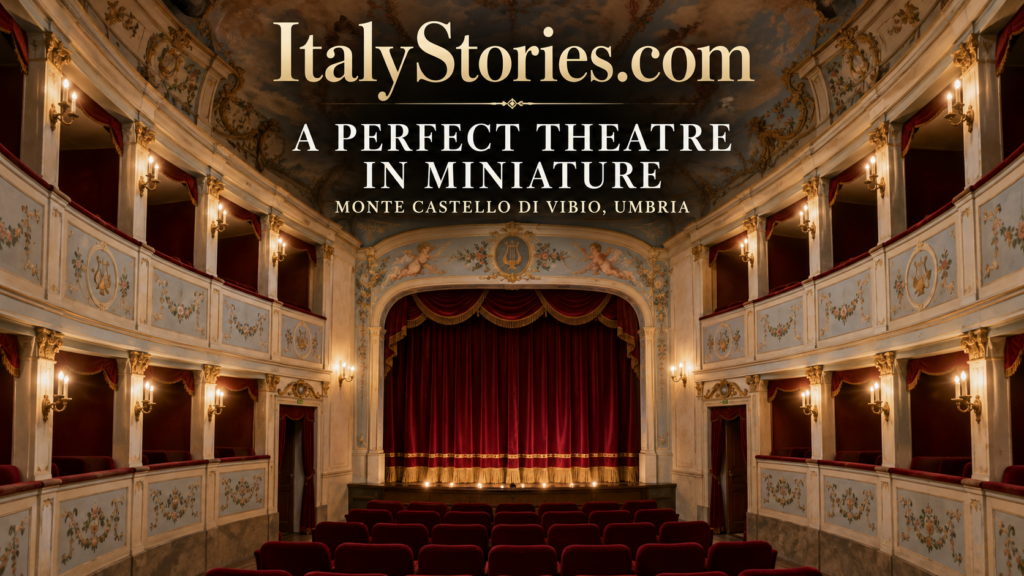
Hidden among the green hills of Umbria, in the tiny medieval village of Monte Castello di Vibio, there is a theatre so small that entering it feels almost like stepping inside an exquisitely crafted music box. It has a stage, a proscenium, a frescoed ceiling, red velvet seats and two elegant tiers of private boxes. It possesses everything one expects to find in a grand Italian opera house, except for the grand dimensions. The Teatro della Concordia has only 99 seats, yet nothing about it feels incomplete. It is a real theatre, still active more than two centuries after its inauguration, built not for a king, a pope or the aristocracy of a great capital, but for a small community overlooking the Tiber Valley.
Monte Castello di Vibio lies not far from Todi, surrounded by olive groves, woodland and the soft, rolling landscape that makes Umbria appear almost untouched by time. Its stone houses, narrow streets and quiet squares give little warning that behind one modest façade stands one of the most charming theatres in Europe. There are smaller performance spaces in the world, but the Teatro della Concordia is celebrated for something more particular: it reproduces, in perfect miniature, the essential structure of a traditional Italian-style theatre. Its intimate bell-shaped auditorium, stalls, boxes, stage, dressing rooms and foyer make it a complete theatre rather than simply a small hall equipped for performances.
Its story began during one of the most turbulent periods in European history. The French Revolution had overturned old certainties, Napoleon’s armies were changing the political map of the continent, and ideas such as liberty, equality and fraternity were spreading far beyond France. Even a secluded Umbrian village could feel the arrival of a new age. At the beginning of the nineteenth century, nine prominent families from Monte Castello di Vibio decided to create a place where the community could gather for entertainment, conversation and culture. The building was inaugurated in 1808 and given the name “Concordia”, a word that expressed the hope of harmony and agreement among people.
The choice of name was important. This was not simply a room where actors would perform and spectators would applaud. The theatre was imagined as a civic meeting place, a small temple of culture belonging to a community that wished to participate in the intellectual life of its time. Its size was determined by the village around it. Monte Castello di Vibio did not need a theatre with thousands of seats, enormous staircases or endless corridors. It needed a theatre built to human proportions, large enough to bring people together but small enough for every spectator to feel involved in what happened on stage.
A phrase associated with the theatre expresses this philosophy perfectly: civilisation cannot be measured in square metres or cubic capacity. It is difficult to imagine a more suitable motto. The Teatro della Concordia demonstrates that cultural ambition does not depend on the size of a city. A village may have only a few streets and a small population, yet still decide that music, performance and beauty are necessities rather than luxuries.
The auditorium contains 99 seats: 37 in the stalls and 62 distributed among 22 small boxes arranged on two levels. The entire space is so intimate that there is almost no distance between performer and audience. In a large opera house, the stage can seem like a distant illuminated world. Here, every expression can be seen, every movement noticed and every note heard with unusual immediacy. An actor cannot hide behind scale or spectacle, and the audience cannot disappear anonymously into the darkness. Performance becomes an encounter between people who are physically and emotionally close to one another.
The architecture follows the traditional Italian theatrical model, with its curved, bell-shaped plan and boxes embracing the auditorium. It is sometimes described as Goldonian in spirit, recalling the elegant theatrical culture associated with Carlo Goldoni and the eighteenth-century Italian stage. Wood plays an essential role in its construction, giving the room both warmth and excellent acoustic qualities. The deep red of the seats and curtain contrasts with pale decorated surfaces, delicate gilding and the frescoes that seem to open the ceiling towards an imaginary sky.
Those paintings were added in 1892 by Luigi Agretti, an extraordinarily young artist who was only about fourteen years old at the time. While staying in Monte Castello di Vibio, the teenager covered parts of the theatre with elegant ornamental compositions and figures, displaying a talent remarkable for his age. His father, Cesare Agretti, had already contributed decorations, stage scenery and the theatre curtain. Together, father and son helped give the Concordia the graceful appearance that visitors admire today. Luigi’s work adds another unexpected detail to the story: some of the theatre’s most recognisable decoration was created not by an established master at the end of a long career, but by a gifted boy at its beginning.
During the nineteenth and early twentieth centuries, the theatre became part of village life. Performances, music, meetings and social occasions took place within its walls. The local families did not need to travel to Perugia, Rome or Florence to experience the magic of a curtain rising. They had created their own theatre, proportioned to their community and maintained through local pride. In 1823, the owners established an academy responsible for managing its activities, confirming that the building had become more than a fashionable private project. It was now a cultural institution.
In 1914, rows of small armchairs were installed in the stalls. There were initially 36; today there are 37. It is a wonderfully modest number, especially when compared with the capacity of famous opera houses. At the Concordia, selling every seat does not require filling a city block. An entire audience could almost fit into a modern railway carriage. Yet when the lights are lowered and the red curtain opens, the emotional effect can be as powerful as it would be in a theatre twenty times larger.
The twentieth century, however, was not kind to the building. After years of decline, the theatre was declared unsafe and closed in 1951. Its silence lasted for decades. During the 1960s, part of the roof collapsed, and there was a genuine risk that the little theatre might disappear completely. This is where the story becomes not only one of architecture, but also of devotion. The residents of Monte Castello di Vibio refused to abandon it. They contributed money towards the first conservation efforts, proving that the Concordia still belonged emotionally to the village even when performances could no longer take place inside it.
In 1981 the municipality acquired the theatre, beginning the long process that would eventually bring it back to life. Restoration required patience, specialised work and respect for the original wooden structure supporting the boxes. It would have been easy to transform the building into a lifeless replica: attractive to look at, perhaps, but no longer capable of fulfilling its purpose. Instead, the theatre was restored as a functioning cultural space. It reopened in 1993, and an organisation dedicated to its protection and promotion began managing visits, performances and events.
This revival is an essential part of the Concordia’s appeal. It is not a miniature theatre preserved beneath glass, nor a decorative curiosity that exists only for tourists. Actors still cross its stage, musicians still perform beneath its frescoes and audiences still take their places in the stalls and boxes. The building continues to perform the task for which it was created in 1808. That continuity gives it a quality that even larger and more famous monuments sometimes lack: it feels alive.
The survival of the theatre also says something profound about Italy’s smaller towns. The country’s cultural identity was not built only in Rome, Florence, Venice and Naples. It was also shaped in hundreds of provincial communities where local citizens founded academies, commissioned paintings, built theatres, organised concerts and defended their heritage. These places rarely appear on the traditional tourist route, but they reveal how deeply culture once penetrated everyday Italian life. A theatre was not considered too ambitious for a small Umbrian village. On the contrary, it was viewed as evidence that the village was civilised, curious and connected to the wider world.
There is also something irresistibly playful about the Concordia. The proportions invite comparisons with a doll’s house, a jewel box or a theatre created for characters in a fairy tale. But the closer one looks, the more serious the achievement becomes. Everything is functional. The boxes are real boxes, the stage is a real stage and the dressing rooms have welcomed real performers. The smallness is not a gimmick added later to attract visitors. It is the natural result of adapting an important architectural tradition to the needs of a very small community.
Imagine attending a performance here on a winter evening. Outside, the stone streets of Monte Castello di Vibio are quiet and the Umbrian hills have disappeared into darkness. Inside, warm light falls across the frescoes, the boxes begin to fill and the audience settles into fewer than one hundred seats. Conversations can be heard across the room. Performers wait just beyond the curtain, only a few metres away. When the lights dim, there is no enormous distance separating stage and spectator. Everyone becomes part of the same moment.
That intimacy is perhaps the theatre’s greatest luxury. Modern entertainment often tries to impress through size, volume and technology. The Teatro della Concordia offers the opposite experience. It asks the audience to come closer, listen carefully and notice every detail. Nothing is hidden by distance. The space creates concentration, warmth and a sense of participation that a much larger venue may struggle to reproduce.
The theatre’s beauty extends beyond its architecture. It represents the stubborn determination of a community that built it, enjoyed it, almost lost it and finally saved it. Its history belongs to the nine families who first imagined it, to the young Luigi Agretti painting its decorations, to generations of local spectators and to the residents who contributed to its restoration when demolition or abandonment might have been easier.
Today, visitors who pass through its doors often arrive expecting a charming curiosity. They leave having discovered something more meaningful: proof that greatness and size are not the same thing. The Teatro della Concordia may be measured in only a few rooms, 22 boxes and 99 seats, but its story contains more than two centuries of ambition, beauty, decline and rebirth.
In the green heart of Italy, a tiny red curtain still rises. And behind it survives the enormous cultural dream of a very small village.
Follow ItalyStories.com to discover Italy’s hidden theatres, secret libraries, forgotten palaces and extraordinary places that most travellers never see.