

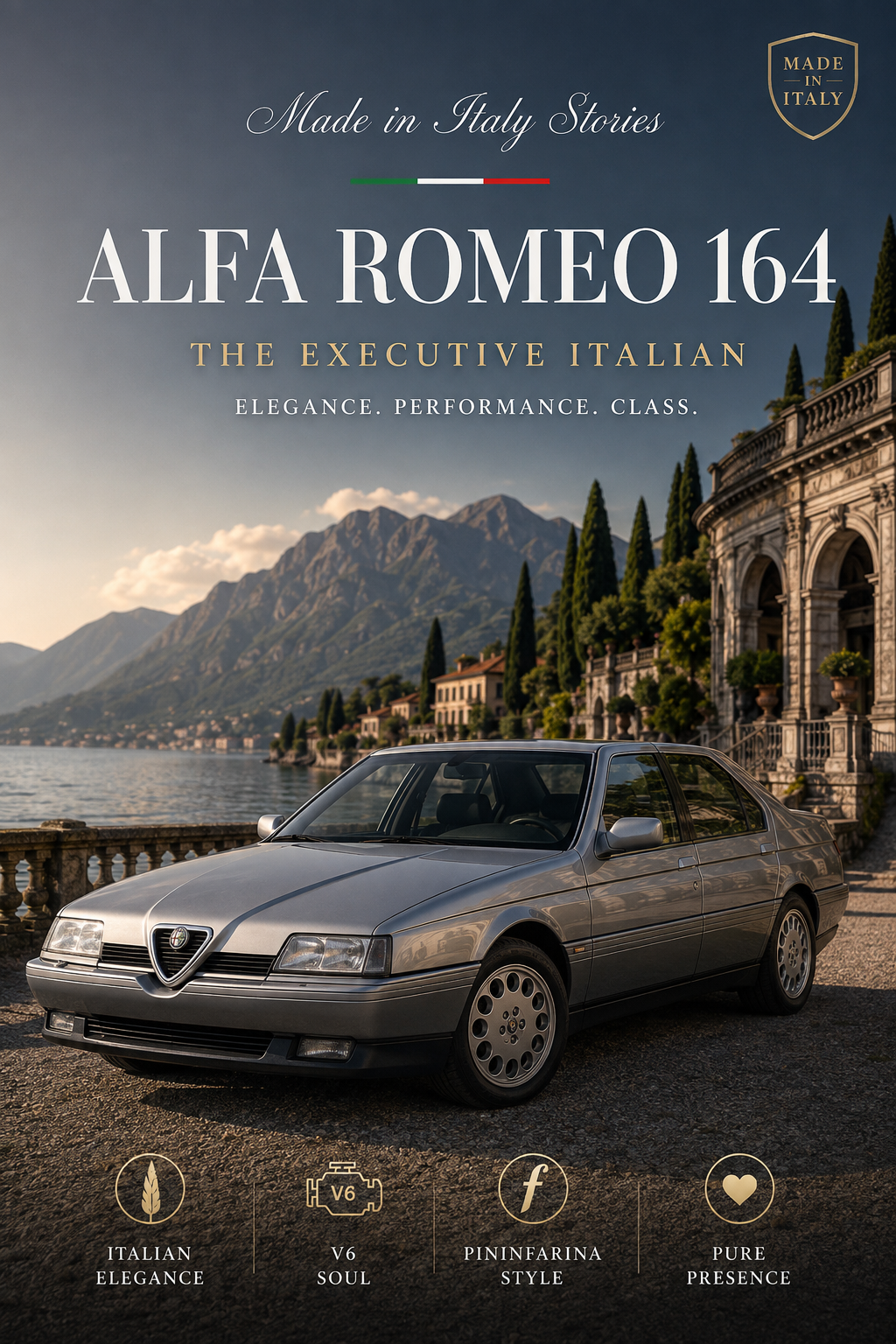
The Pininfarina Flagship That Carried Alfa into a New Era
The Alfa Romeo 164 is a car of transition, and transition is rarely simple. It was developed while Alfa Romeo was still controlled by the Italian state, launched after the company had been acquired by Fiat, built on a collaborative platform shared in concept with other European executive cars, and styled so distinctively that it looked related to none of them. It also moved Alfa’s large sedan formula from rear-wheel drive to front-wheel drive. Purists had reasons to be suspicious. Then they saw it. Pininfarina had created one of the cleanest executive shapes of the late 1980s, and the Busso V6 gave the new flagship a heart nobody could accuse of anonymity.
The project belonged to the Type Four collaboration involving Fiat, Lancia, Saab and eventually Alfa Romeo. The shared architecture underpinned the Fiat Croma, Lancia Thema and Saab 9000, allowing manufacturers to divide some development costs in an increasingly expensive industry. Alfa Romeo used the common concept but required a body and dynamic character of its own. The result was far more visually independent than a simple badge-engineering exercise. Different dimensions, panels, suspension details and styling ensured that the 164 stood apart.
Pininfarina, with Enrico Fumia playing the key design role, gave the 164 a low wedge-shaped nose, a strongly defined shoulder line and a distinctive rear light treatment stretching across the tail. The traditional Alfa shield grille was prominent and integrated into the entire front composition rather than applied as decoration. Aerodynamics mattered, but so did presence. The car looked long, low and expensive. It was modern without severing visual ties to Alfa’s past.
The 164 made its public debut at the Frankfurt Motor Show in 1987. This was a remarkable moment in European automotive design: manufacturers were moving rapidly toward cleaner aerodynamics, electronic controls and sophisticated multi-valve engines, while executive buyers expected both performance and comfort. Alfa needed a flagship capable of facing BMW, Mercedes, Audi and increasingly ambitious Japanese rivals. The 164’s answer was not to imitate them. It offered Italian style, distinctive engines and a cabin that treated buttons almost as interior decoration.
Engine choice was central to the car’s personality. The 2.0 Twin Spark four-cylinder combined efficiency with Alfa’s twin-ignition tradition. Turbocharged and diesel versions broadened the range for different markets. But the star was the 3.0-liter Busso V6. Installed transversely, the polished intake runners became one of the most beautiful engine bays of the era. The V6 was smooth, powerful and sonorous, giving the front-wheel-drive executive sedan a character far more exotic than its architecture suggested.
Performance versions strengthened the image. The Quadrifoglio Verde offered more power and sporting suspension, while the later 164 Q4 combined a 24-valve V6 with a sophisticated permanent all-wheel-drive system developed with Steyr-Puch and a six-speed gearbox. The Q4 demonstrated how far the platform could be pushed. What began as a shared front-drive executive architecture became, in Alfa form, a technically ambitious high-performance flagship.
The front-wheel-drive layout remained controversial among traditionalists. Earlier large Alfas such as the Alfa 6 and 90 had driven the rear wheels, and the company had decades of rear-drive history. Yet the 164 handled with more precision than critics expected. Its wide track, carefully tuned suspension and relatively low mass allowed the car to feel agile for its size. With the V6, the front tires had plenty of work to do, but the car remained recognizably an Alfa in steering response and engine enthusiasm.
Inside, the 164 was gloriously of its era. The dashboard featured a broad central console filled with individual switches and warning indicators, a layout that looked almost like a piece of laboratory equipment. Digital climate controls and electronic features gave the flagship a high-tech atmosphere. Ergonomic fashion has since moved toward giant touchscreens with almost no physical buttons. Anyone who misses switches should sit in a 164 and enjoy abundance.
The car also had important international significance. It was one of the last Alfa Romeo models officially sold in the United States before the brand withdrew from that market in the mid-1990s. For American enthusiasts, the 164 V6 often became the final memory of a new Alfa available from a local dealer. When the brand eventually returned to the United States many years later, the 164 remained a reference point for a generation of owners.
Production continued through the 1990s with significant updates, including the Super facelift, revised interiors, improved safety and 24-valve V6 engines. The design proved remarkably durable. Even late cars retained the essential line created in the early 1980s, which is one reason clean 164s still look elegant today. A good design can survive new bumpers. A bad design usually cannot survive the first brochure photograph.
More than a quarter of a million 164s were produced over its long career. That made it a successful flagship and an important commercial bridge during the reorganization of Alfa Romeo under Fiat ownership. It was also the last Alfa developed substantially before the acquisition, giving it a unique position between two corporate eras. The engineering was collaborative, the style independent, the engine deeply traditional and the future uncertain. Somehow all of those tensions produced a coherent car.
Today the 164 is emerging as an undervalued modern classic. The best V6 cars offer a magnificent engine, strong period design and enough comfort for real travel. Parts and electronics can require commitment, and neglected examples can become expensive projects, but a sorted 164 has enormous charm. It represents the moment Alfa Romeo entered the modern executive age without completely surrendering its eccentricity.
The 164’s importance is not that it preserved everything from the old Alfa Romeo. It did not. Its importance is that it found a way to carry enough of the brand’s identity into a new industrial reality. The drivetrain changed, the ownership changed and the market changed. The shield grille, the V6 and the desire to make a sedan beautiful survived.
Would you choose the elegant 2.0 Twin Spark or the unforgettable 3.0 V6? Follow Made in Italy Stories for more stories about Italy’s great automobiles, and tell us whether the 164 deserves to be remembered as one of Pininfarina’s finest executive designs.