

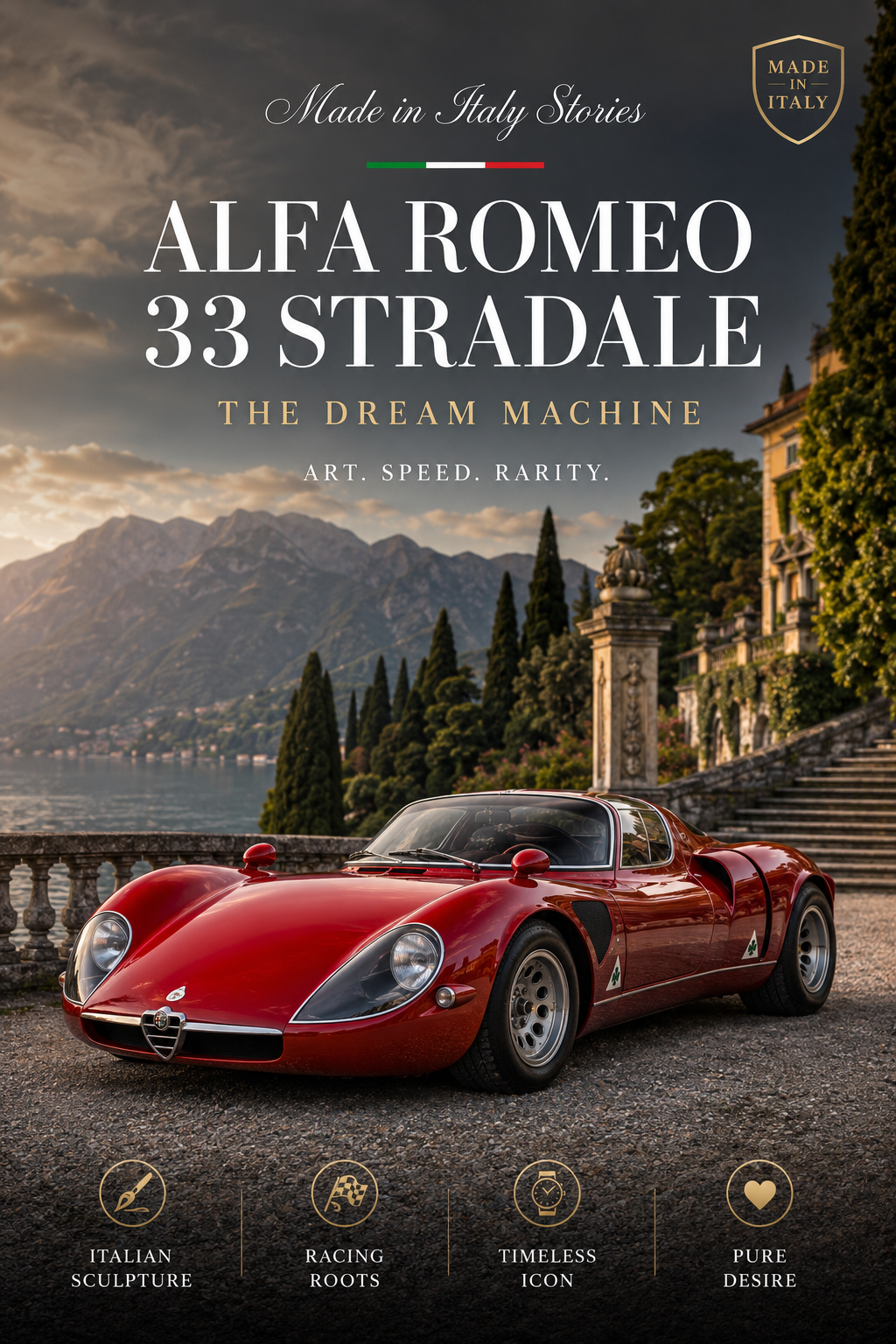
The Racing Prototype That Became Rolling Sculpture
There are beautiful cars, and then there is the Alfa Romeo 33 Stradale. Even among Italian exotics of the 1960s, a period not exactly short of dramatic machinery, the 33 Stradale appears almost unreal. It is tiny, low, sensuous and purposeful, with doors that rise into the roof and a cabin wrapped around two people as though the body had been stretched directly over the mechanical parts. It is often described as one of the most beautiful cars ever made. That phrase has become so common that it risks sounding lazy, yet stand beside one and the exaggeration disappears. The car seems to have been shaped by speed itself.
The origin was competition. During the 1960s Alfa Romeo wanted to return seriously to international sports-prototype racing. Autodelta, the competition department led by Carlo Chiti, developed the Tipo 33, a lightweight mid-engine racing machine built around a tubular structure and a compact two-liter V8. The project would evolve into a long and successful family of competition cars. The Stradale was the audacious idea of translating that racing architecture into a road-going automobile.
The task of designing the body went to Franco Scaglione, one of the most original figures in Italian automotive styling. Scaglione had already created the Giulietta Sprint and the extraordinary Bertone BAT aerodynamic studies. With the 33 Stradale he produced something more mature and more extreme. The nose was low and rounded, the front wings rose gently over the wheels, and the windscreen curved into the side glass. The roof was barely high enough to qualify as one. The doors hinged upward and included sections of the roof, an arrangement that would later be described as butterfly doors. In 1967 it looked like machinery from another decade.
The engineering was equally exotic. The road car was based on a modified Tipo 33 chassis, lengthened slightly to make the cabin usable. Behind the occupants sat a two-liter V8 with double overhead camshafts and fuel injection, capable of revving to extraordinary speeds. Road output is generally quoted around 230 horsepower, impressive in isolation but astonishing when combined with a curb weight of roughly 700 kilograms. A six-speed gearbox sent power to the rear wheels. The 33 Stradale did not need a huge engine. It needed a racing engine and almost no mass.
Production was extremely limited. Eighteen chassis are commonly associated with the Stradale project, although not all became identical completed Stradales; several chassis were used by Italian design houses for famous concept cars. This is why surviving numbers are discussed carefully by historians. What is certain is that the car was extraordinarily rare even when new. It was also extraordinarily expensive, costing more in Italy than many larger and more powerful supercars. Alfa Romeo was effectively offering a road-legal prototype racer with coachbuilt bodywork. There was no reason for it to be cheap.
The construction involved Autodelta for the mechanical package and Carrozzeria Marazzi for the bodies. Because the cars were hand-built in tiny numbers, individual examples differ in details. Headlamp arrangements, vents, wipers and trim can vary, giving each survivor an almost bespoke identity. This is important when looking at restored cars today: the 33 Stradale was not produced with the industrial uniformity of a modern limited edition. It belongs to the last great age when a small run of exotic cars could still carry the slight irregularities of human hands.
Performance was sensational for 1967. The car could reach around 260 km/h depending on gearing and specification, and acceleration was comparable to the fastest road machines of its time. Yet the numbers tell only part of the story. The V8 was a competition-derived engine with a hard, urgent voice. The steering was unassisted, the car tiny, the visibility unusual and the whole experience closer to operating a racing machine than a luxury grand tourer. It was not designed to isolate the driver from the road. It was designed to eliminate the distance between them.
The 33 Stradale also became a foundation for some of the most important Italian concept cars of the era. Chassis related to the project were clothed by Bertone, Pininfarina and Italdesign in experimental bodies such as the Carabo, Iguana and other radical studies. This makes the 33 not only a legendary road car but a platform for the future of automotive design. The wedge-shaped supercar language of the 1970s was explored on mechanical bones born from Alfa Romeo racing.
Its influence continued long after production ended. The 8C Competizione openly echoed its proportions and emotional character. The 4C borrowed the idea of a compact, lightweight Alfa sports car. In 2023 Alfa Romeo revived the 33 Stradale name for a new limited-production supercar, explicitly acknowledging the original as one of the central objects in the company’s history. Very few cars are important enough that a manufacturer waits more than half a century before daring to reuse the name.
The original 33 Stradale occupies a peculiar place in Alfa mythology because it sits at the intersection of road and race, art and engineering, corporate ambition and artisanal production. Ferrari and Lamborghini built more famous supercars during the same era, but the Alfa feels different. It was not created by a company whose primary business was exotic road cars. It was created by a major manufacturer temporarily allowing its competition department and designers to behave with almost no restraint.
For collectors, the 33 Stradale is now essentially unobtainable. Surviving examples are among the most valuable and historically significant Alfa Romeos in existence. But rarity is not the main reason people remain fascinated. Photographs of the car continue to circulate because the shape has not aged. It does not look retro; it looks independent of fashion. That is a much rarer achievement.
Perhaps the best way to understand the 33 Stradale is to imagine the conversation that created it. Someone asked whether Alfa Romeo could make a road car from a racing prototype. Someone else decided it should be one of the most beautiful objects ever placed on four wheels. Engineers, racers, designers and craftsmen then answered both questions at once. The result was unnecessary in every practical sense and essential in every emotional one.
If you could see only one historic Alfa Romeo in person, would you choose the 33 Stradale? Follow Made in Italy Stories for more stories about the machines that turned Italian engineering into art, and tell us what you think is the most beautiful Alfa ever made.