

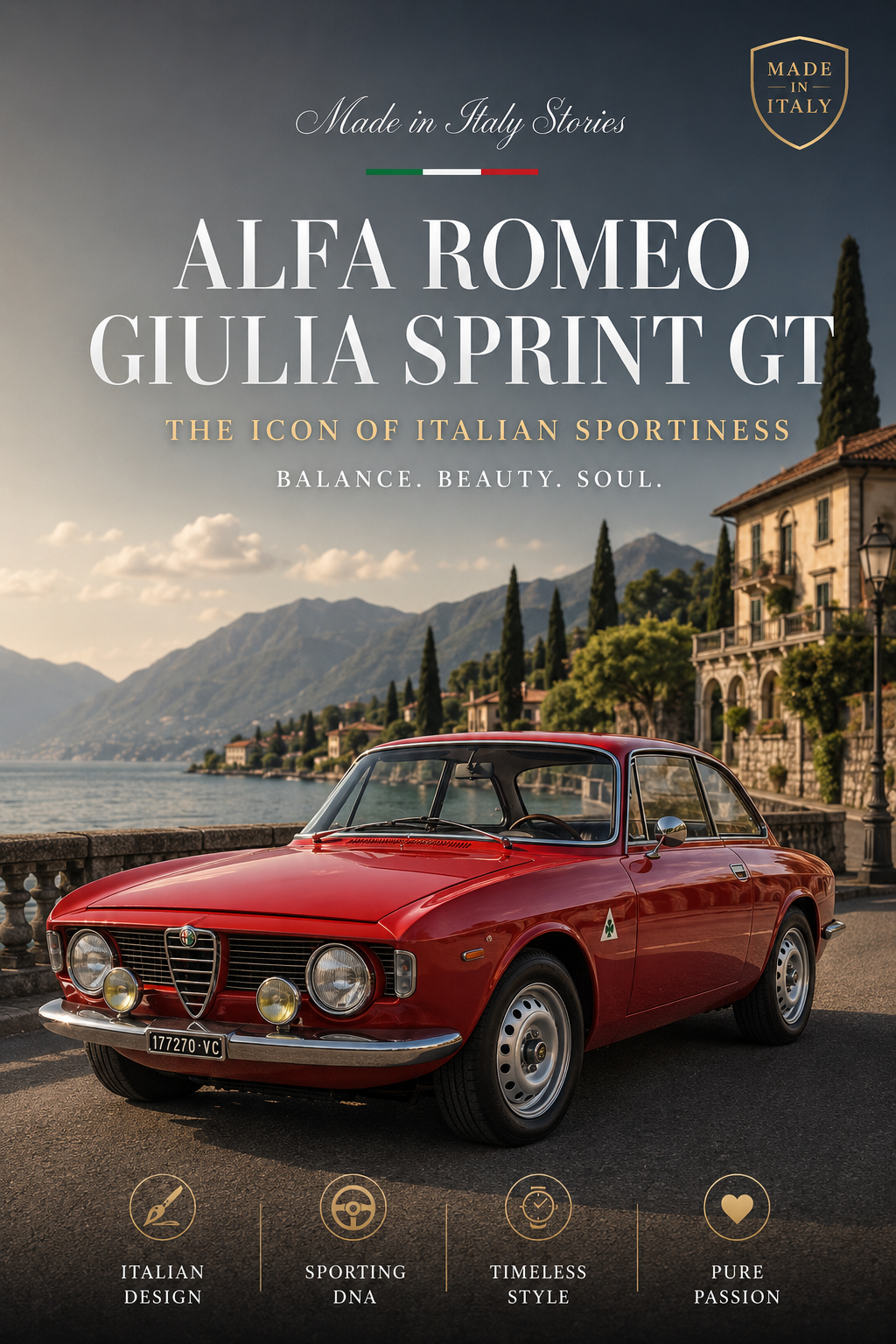
The Bertone Coupe That Defined Italian Sporting Elegance
Some cars become classics because they are rare. The Alfa Romeo Giulia Sprint GT became a classic because it was right. The proportions were right, the mechanical recipe was right, the timing was right, and the idea behind it was right: take the excellent engineering of the Giulia sedan, shorten the wheelbase, clothe it in a beautifully restrained Bertone body, and create a four-seat coupe that could commute during the week and behave like a competition car when the road became interesting. It sounds obvious only because Alfa Romeo did it so convincingly.
The Sprint GT appeared in 1963 as the true successor to the Giulietta and Giulia Sprint coupes of the 1950s. Alfa Romeo had just opened its new Arese factory, and the new coupe was among the first products to emerge from that modern industrial expansion. The press saw it in September 1963, only days before its public debut at the Frankfurt Motor Show. The response was immediate. Here was a modern Alfa that looked leaner and more geometric than the soft-bodied Giulietta Sprint, but had lost none of the elegance.
The styling was created at Bertone by a very young Giorgetto Giugiaro. His design used taut surfaces, a broad glasshouse and an elegant roof curve that preserved genuine rear seating. The car was compact but never cramped in appearance. Most memorable was the small step between the leading edge of the bonnet and the top of the grille. This ‘scalino’ became a beloved identifying feature. It resulted from a late design change rather than a deliberate decorative flourish, which is a useful reminder that some of automotive history’s most cherished details began as practical compromises.
Under the body was the shortened platform of the Giulia sedan, with the wheelbase reduced to improve agility. The engine was Alfa Romeo’s 1.6-liter twin-cam four-cylinder, fed by twin carburetors and producing a little over 100 horsepower in early form. Four-wheel disc brakes were an advanced feature for a road coupe in its class, and the rear-wheel-drive chassis delivered the balance enthusiasts expected. The numbers may appear modest today, but the Sprint GT was light and aerodynamically efficient enough to offer serious performance in the early 1960s.
More important than outright speed was the way the car combined abilities. Many sports cars of the period were noisy, fragile, cramped or inconvenient. The Giulia Sprint GT could carry four people, luggage and a respectable amount of comfort while remaining a driver’s machine. This combination became one of Alfa Romeo’s signature talents. The company did not ask customers to choose between being adults and enjoying themselves. The Sprint GT suggested that responsibility could wait until after the next corner.
The basic design soon produced a remarkable family. The GT Veloce increased performance and refinement. The 1300 GT Junior opened the look and handling of the coupe to customers in tax-sensitive markets. The 1750 and 2000 GTV versions developed the idea into faster, more mature grand tourers. Then there was the GTA, the competition-focused lightweight developed with Autodelta. Aluminum body panels, reduced weight and tuned engines turned the elegant Bertone coupe into a touring-car weapon. The GTA’s competition success permanently attached the quadrifoglio and racing mythology to the shape.
This sporting career was not a side story. Alfa Romeo’s brand had always been built partly on competition, and the 105-series coupes were ideal ambassadors. They raced in touring-car championships, hill climbs, endurance events and national competitions around the world. Private drivers loved them because they were robust enough to use and responsive enough to reward skill. Factory-supported cars won major championships. The road cars benefited from the same image, creating a cycle in which racing improved reputation and reputation sold more cars.
The design aged exceptionally well. Over more than a decade of production, the basic Giugiaro body survived mechanical updates, trim changes and increasingly powerful engines. The famous step front disappeared on later cars, quad headlamps appeared, interiors evolved and bumpers changed, yet the fundamental proportions remained intact. Very few automotive shapes can tolerate so much evolution without losing coherence. The Giulia GT could.
Its cultural life expanded beyond racing. The coupe became a familiar sight in Italian cinema, police dramas and city streets, often representing a particular kind of young professional confidence. It was expensive enough to be desirable but common enough to become part of lived Italian memory. Many families remember an uncle, doctor, architect or local businessman who owned one. That is a different kind of immortality from museum rarity. It is the immortality of presence.
Modern enthusiasts sometimes romanticize old Alfa Romeos and forget the practical realities: rust, carburetor tuning, electrical eccentricities and the need for maintenance were part of the relationship. Yet the Sprint GT rewards care. Its steering, gearbox, twin-cam engine and chassis form a mechanical conversation that modern cars often filter away. It is not fast by twenty-first-century standards, but it can feel vividly alive at speeds that do not require a courtroom explanation.
The car also represents a peak moment in the relationship between Alfa Romeo and the great Italian design houses. Alfa supplied a strong mechanical platform; Bertone and Giugiaro gave it a shape that became inseparable from the brand. This collaboration produced something neither styling nor engineering could have achieved alone. The car is beautiful because it works, and it works because its beauty was built around sound proportions.
Collectors now divide the family into countless desirable versions: early scalino cars, GT Veloce, Juniors, 1750s, 2000s, GTAs. Arguments over the perfect specification can last longer than some marriages. But that debate is proof of the model’s depth. There is no single correct Giulia coupe because the fundamental architecture was strong enough to support many personalities.
The Giulia Sprint GT’s greatest legacy is perhaps that it established a template still admired today: compact size, elegant body, real rear seats, light weight, strong engine, rear-wheel drive and steering designed for people who enjoy driving. Every modern sports coupe is judged, consciously or not, against cars that proved this formula could work. Alfa Romeo proved it particularly beautifully.
Which version of the classic Giulia coupe would you choose: the original Sprint GT, a GT Veloce, a Junior, or the legendary GTA? Follow Made in Italy Stories and tell us which one belongs in your imaginary Italian garage.