

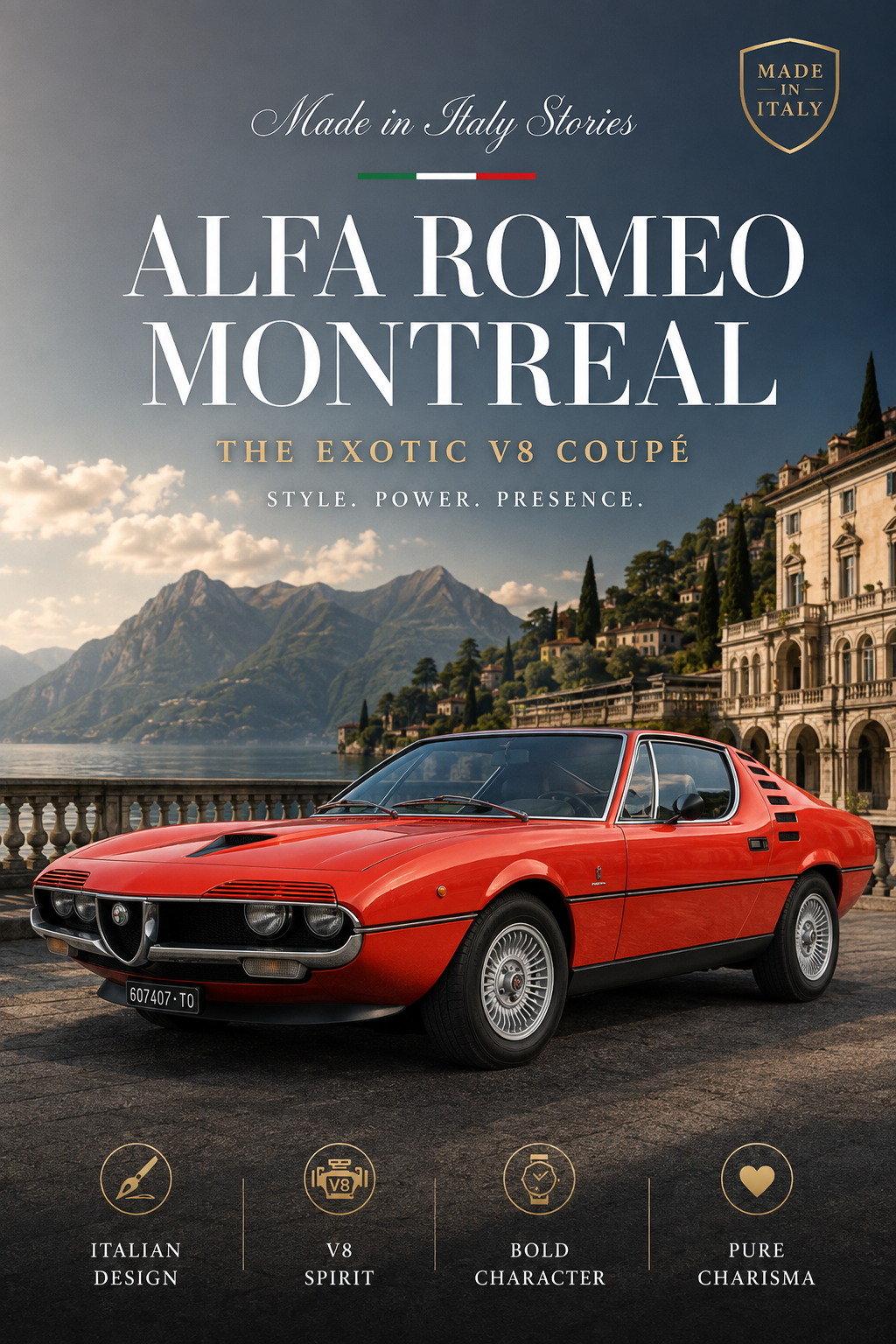
The Expo Dream That Became a V8 Grand Tourer
The Alfa Romeo Montreal began with an almost impossible brief. For Expo 67 in Montreal, the organizers asked Alfa Romeo to provide a car representing the highest aspiration of modern man in motoring. No pressure, then. Alfa had only months to respond, and building an entirely new vehicle from scratch was unrealistic. The company used Giulia Sprint GT mechanical foundations and turned to Bertone for the styling. There, a young Marcello Gandini created two pearl-white prototypes that were displayed in Canada as symbols of technological optimism. They had no official model name at first. The public solved that problem by calling them the Montreal.
The 1967 prototypes were elegant, low and futuristic without being outrageous. Their most famous feature was the partially covered headlamps, hidden behind slatted eyelids that seemed to blink as the lights were used. Six vents decorated each rear pillar, the glass tailgate lay at a dramatic angle and the body combined smooth surfaces with geometric details. The prototypes used a four-cylinder Giulia engine, but the public response was so strong that Alfa Romeo decided the show car deserved a production future. At that point the project became far more ambitious.
The road-going Montreal was shown at the 1970 Geneva Motor Show. Gandini preserved the essential shape but adapted it for a much more serious mechanical package. Under the raised bonnet sat a 2.6-liter V8 derived from the racing engine family associated with the Tipo 33 and 33 Stradale. Detuned for road use and fitted with SPICA mechanical fuel injection, it produced around 200 horsepower. A five-speed ZF gearbox sent the power to the rear wheels. The result was no longer a glamorous Giulia-based concept. It was an exotic grand tourer with genuine supercar ancestry.
This combination made the Montreal one of the strangest and most fascinating Alfa Romeos ever built. The chassis itself retained conventional front-engine, rear-drive architecture related to Alfa’s established production cars rather than adopting the mid-engine layout of the 33 Stradale. The sophisticated V8 therefore sat in a car that was more grand tourer than pure sports prototype. It was fast, comfortable enough for distance and visually unlike anything else in the range. The Montreal did not fit neatly into a category, which may be one reason it remains so interesting.
The engine was the star. Compact, all-alloy and equipped with double overhead camshafts per bank, it brought competition engineering into a usable road environment. The SPICA injection system gave strong performance when correctly adjusted, though later owners would learn that ‘correctly adjusted’ was a phrase requiring respect, knowledge and sometimes a specialist with the patience of a monk. The V8’s character was smooth and eager, and the central twin exhaust outlets completed the car’s theatrical presence.
Production did not begin at full pace immediately after the 1970 debut. Orders opened later, and the Montreal reached customers at a price that placed it among genuinely expensive machinery. Alfa was selling a sophisticated exotic at a time when the European market was about to change dramatically. Then came the oil crisis of the 1970s. Large-engined sports cars suddenly seemed less socially comfortable and more expensive to run. The Montreal had been born from the optimism of the 1960s and reached maturity in a decade becoming increasingly suspicious of extravagance.
Between 1970 and 1977 fewer than four thousand examples were produced, with Alfa Romeo Heritage citing 3,925 cars. That relatively small number ensured rarity but also reflected the car’s difficult market position. It was more exotic than a normal Alfa, less focused than a mid-engine supercar and expensive to maintain. Yet these same qualities are precisely what make it desirable now. Nobody buys a Montreal today because it is the rational solution to personal transportation.
The design has aged magnificently. The slatted headlamp covers remain instantly recognizable, as do the sculpted flanks and the vents behind the doors. Color plays a major role in the car’s identity. Period shades such as orange, green, metallic gold and unusual browns suit the Montreal because subtlety was never the entire point. The car came from an era when Italian manufacturers were willing to sell adults automobiles in colors that could be identified from another province.
Inside, the Montreal mixed grand-touring comfort with distinctly 1970s instrumentation. The cabin felt special but not impossibly cramped, and luggage could be carried. This practical streak is often forgotten because the exterior looks so dramatic. Gandini had designed an exotic coupe that could actually be used, at least by owners prepared to maintain its mechanical complexity. It was not a racing car with number plates. It was a fast road car carrying the heart of a racing lineage.
The Montreal never achieved the universal fame of the Lamborghini Miura or Ferrari Daytona, but that may have helped preserve its outsider charm. For many years it was undervalued relative to its rarity and engineering. Enthusiasts now understand what it represents: a production Alfa Romeo with a V8 descended from one of the company’s most exotic engines, styled by the man who would shape some of the most important supercars of the era, and born from a World’s Fair concept that should never logically have reached production.
Its cultural appearances have added to the mythology. The car has surfaced in films and period photography, often looking less like a prop than an object that accidentally wandered in from a design exhibition. More importantly, it represents a moment when Alfa Romeo still felt comfortable producing a machine simply because it was exciting. The commercial case may have been uncertain. The emotional case was overwhelming.
Today the Montreal deserves to be understood on its own terms. It is not the fastest classic supercar, nor the simplest to own, nor the rarest Italian exotic. What it offers is a uniquely Alfa blend of advanced engine, distinctive design, grand-touring usefulness and historical improbability. It began as a symbolic answer to a philosophical question at Expo 67 and ended as one of the most charismatic road cars ever to wear the cross and serpent badge.
Would you choose a Montreal over a more obvious Italian exotic from the 1970s? Follow Made in Italy Stories for more stories about Italy’s automotive imagination, and tell us which Montreal color you would order if the calendar still said 1972.