

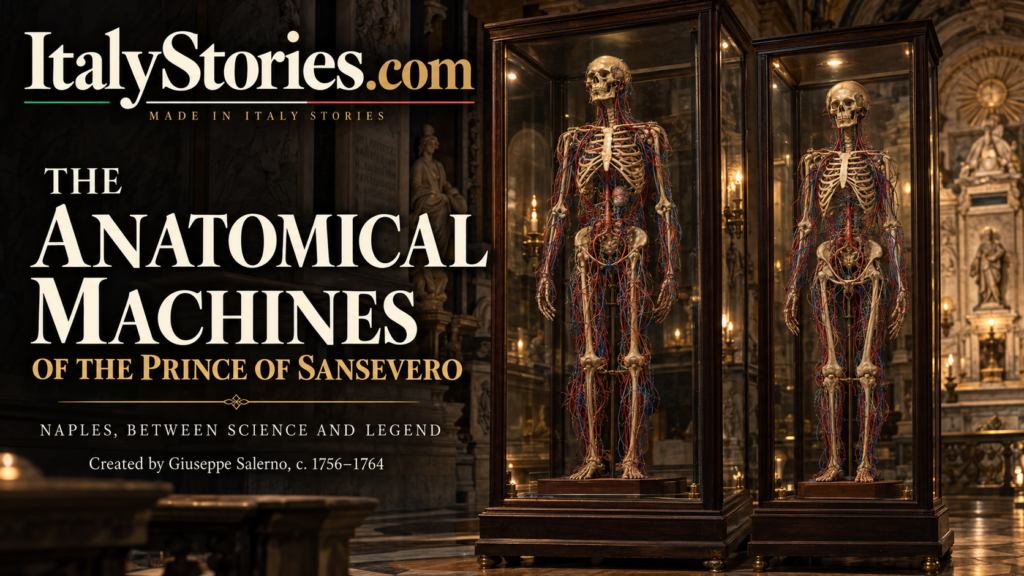
In the historic heart of Naples, where narrow streets preserve centuries of voices, beliefs and contradictions, there is a place in which beauty and unease exist side by side. The Sansevero Chapel is famous throughout the world for the Veiled Christ, the extraordinary marble sculpture whose transparent-looking shroud seems almost impossible to have been carved from stone. Yet beneath the chapel, inside a small underground chamber, two far more disturbing figures continue to challenge visitors. They are known as the Anatomical Machines: the skeletons of a man and a woman surrounded by an astonishingly detailed reconstruction of the human circulatory system.
At first sight, they appear to be the result of a medical procedure far ahead of its time. Arteries and veins seem to spread across the skeletons with almost obsessive precision, branching into increasingly delicate vessels around the skull, limbs and internal areas of the body. Red and blue colours distinguish parts of the network, creating an image that is scientific, theatrical and deeply unsettling. The figures stand inside glass cases, silently displaying the hidden architecture that once carried blood through a living body.
For generations, their extraordinary appearance encouraged one of the darkest legends in the history of Naples. According to the most frightening version of the story, Raimondo di Sangro, seventh Prince of Sansevero, ordered a man and a pregnant woman to be killed and injected with a mysterious substance while they were still alive. The fluid, it was said, transformed their blood vessels into metal and preserved their entire circulatory systems forever.
It is a powerful tale, perfectly suited to a city where history and legend often become inseparable. It is also almost certainly untrue.
The real story of the Anatomical Machines is less horrifying, but in many ways even more remarkable. They were created during the eighteenth century by Giuseppe Salerno, a physician and anatomist from Palermo, under the patronage of Raimondo di Sangro. Their complex vascular networks were not produced by turning the veins of living victims into metal. Modern studies indicate that they were carefully reconstructed using materials including iron wire, beeswax and coloured substances, applied around genuine human skeletons.
The precision of the work remains astonishing. Even without secret injections or alchemical murder, creating such an elaborate representation of the circulatory system in the eighteenth century required anatomical knowledge, manual skill and extraordinary patience. The mystery does not disappear when the legend is removed; it simply changes shape. The question is no longer how two bodies were transformed into machines, but how an anatomist working more than two and a half centuries ago managed to reproduce the human vascular system in such extraordinary detail.
To understand why these figures exist, one must first understand Raimondo di Sangro, one of the most unusual personalities of the Italian eighteenth century. Born in 1710 into one of the most important aristocratic families of the Kingdom of Naples, he inherited the title of Prince of Sansevero and grew up in an intellectual world shaped by religion, philosophy, scientific curiosity and the first great challenges to traditional knowledge.
Raimondo was not satisfied with the ceremonial life expected of a nobleman. He was an inventor, writer, military thinker, printer, experimenter and patron of the arts. He studied chemistry, mechanics, anatomy, typography and the properties of materials. Contemporary accounts attributed an almost endless list of inventions and experiments to him: waterproof fabrics, coloured fireworks, hydraulic devices, improved weapons, mechanical systems and unusual methods of printing.
Some of these achievements were genuine, others were exaggerated, and still others became inseparable from the mythology that grew around him. Raimondo encouraged amazement and seems to have understood the power of mystery. In eighteenth-century Naples, scientific experiments could easily appear magical to anyone unfamiliar with their principles. Chemistry resembled alchemy, mechanical devices seemed animated by invisible forces, and anatomical research entered areas that many people regarded with fear.
The Prince lived during a period when the boundaries between scientific investigation, artistic performance and private spectacle were far less rigid than they are today. European aristocrats collected natural curiosities, unusual animals, minerals, preserved bodies, scientific instruments and mechanical automata. A private collection could function simultaneously as a laboratory, a museum, a theatre and a demonstration of its owner’s education and power.
Raimondo’s greatest surviving creation is the Sansevero Chapel itself. Originally connected with the di Sangro family, the chapel was transformed during the eighteenth century into an elaborate monument to dynastic memory and the Prince’s intellectual vision. Its sculptures are not simply decorative. Virtues appear in human form, marble seems to imitate fabric and fishing nets, and religious symbolism mixes with philosophical and possibly initiatory meanings.
At the centre lies the Veiled Christ, sculpted in 1753 by Giuseppe Sanmartino. The dead body of Christ rests beneath a marble shroud so delicate that generations of visitors have struggled to believe it was carved from the same block of stone. The folds of the veil reveal rather than conceal the anatomy beneath them: the face, chest, wounds and veins remain visible through the apparently transparent surface.
This masterpiece generated its own legend. Some claimed that Raimondo di Sangro had taught the sculptor a secret process capable of transforming real fabric into marble. The story is false—the veil is an extraordinary example of sculptural skill—but it reveals how quickly anything connected with the Prince became surrounded by rumours of alchemy and forbidden knowledge.
The Anatomical Machines produced an even stronger reaction because, unlike the Veiled Christ, they contain actual human remains. Their story can be traced to Giuseppe Salerno, whose role was very different from that of Giuseppe Sanmartino. Salerno was a physician and anatomical modeller, not the sculptor of the famous marble Christ.
Evidence indicates that the male Anatomical Machine already existed when Raimondo di Sangro encountered it. In 1756, Salerno publicly exhibited a male anatomical model in Naples. The Prince purchased it and subsequently employed the Sicilian doctor, granting him a substantial annual pension. He then commissioned a second model, the female figure, which was probably completed during the following years.
This chronology changes the usual story. Raimondo did not personally manufacture the Anatomical Machines, and there is no evidence that he created their vascular systems with his own hands. His importance lay in recognising Salerno’s ability, financing his work and placing the models within a broader intellectual project. The machines belonged to the Prince’s world of experiments, inventions and carefully constructed astonishment.
The two figures were originally displayed in a room inside the Palazzo Sansevero known as the Apartment of the Phoenix. The name was probably not accidental. The phoenix, the mythical bird reborn from its own ashes, had long been associated with resurrection, transformation and immortality. Placing anatomical models within a room carrying that symbolism connected the study of the human body with the Prince’s fascination for death, renewal and the possibility of overcoming natural limits.
An eighteenth-century guide described the models in impressive detail, noting vessels extending through the head and even towards the tongue. The female figure was mounted on a rotating base so that viewers could examine it from every direction. This suggests that the Anatomical Machines were conceived at least partly as instruments of study and demonstration. They offered observers a three-dimensional view of structures that were normally hidden beneath skin and muscle.
The female model once included an even more disturbing element. At her feet lay the small body of a foetus, accompanied by a placenta and umbilical cord. The presence of this figure encouraged the belief that the woman had been pregnant when she died and added enormous emotional force to the display. The foetus remained visible until comparatively recent times but was eventually stolen and has never been recovered.
What visitors see today is therefore incomplete. Nevertheless, the remaining figures are sufficient to create an unforgettable impression. The male skeleton stands upright with the vascular network spread across the bones. The female is displayed with the same intricate system of arteries and veins, while details around the head, chest and limbs demonstrate the ambition of Salerno’s reconstruction.
The skeletons themselves are genuine. The network surrounding them, however, was manufactured. Analyses of the materials have identified wire, silk fibres, beeswax and pigments. These substances were shaped and assembled to imitate blood vessels. Some portions may also include organic components, but the idea that the entire circulatory system was preserved through a miraculous injection is not supported by the available evidence.
The distinction is important because the dark legend has often overshadowed the real achievement. Reconstructing such a complicated system by hand was not a crude trick. It required an impressive understanding of anatomy at a time when medical knowledge depended heavily on dissections, drawings and preserved specimens. Salerno had to translate structures observed inside the body into a durable three-dimensional model.
Not every vessel corresponds perfectly to modern anatomical knowledge. The models were products of their era, created before many later advances in physiology and microscopic research. Yet their overall complexity remains remarkable. The smallest branches form a dense web that would have demanded countless hours of precise work. In certain areas the network is so detailed that researchers have considered whether earlier injection experiments might have helped Salerno study the distribution of vessels before constructing them.
Injection techniques were not unknown to eighteenth-century anatomy. Researchers experimented with waxes, coloured liquids and other substances to make blood vessels visible during dissection. Such procedures could have provided information used in the creation of the Sansevero models. This possibility is very different from the legend of living victims being forcibly “metallised,” but it shows that the machines were connected to genuine scientific experimentation.
The legend survived because Raimondo di Sangro was an ideal figure around whom to build it. He belonged to the world of aristocratic secrecy, conducted experiments inside his palace and developed techniques that ordinary citizens did not understand. He was also associated with Freemasonry, which strengthened rumours about hidden rituals and forbidden knowledge. In a deeply religious society, the idea of a nobleman investigating the body, matter and transformation could easily provoke suspicion.
After his death in 1771, stories about him became increasingly dramatic. He was described as an alchemist who could create blood, imitate precious stones, produce light from bones or restore life to dead creatures. The palace became a place of imagined laboratories and underground crimes. The Anatomical Machines appeared to offer physical proof that the darkest rumours might be true.
The Italian philosopher and historian Benedetto Croce later recorded the popular belief that the Prince had killed two servants in order to preserve their bodies. By that time, the story had become part of Neapolitan folklore. It was repeated because it captured something essential about Raimondo’s public image: the brilliant nobleman whose intelligence had supposedly crossed the boundary between genius and cruelty.
There is, however, no reliable evidence that the two skeletons belonged to the Prince’s servants, that the individuals were killed for the experiment or that any substance was injected while they were alive. The tale should be understood as a legend, not as historical fact.
Removing the murder story does not make the Anatomical Machines less fascinating. On the contrary, it allows us to appreciate the real people behind them. Giuseppe Salerno emerges from Raimondo’s shadow as a highly skilled anatomical modeller. His work belongs to the history of medicine and scientific education, when three-dimensional models offered students and scholars a way to examine the internal organisation of the body.
Raimondo di Sangro, meanwhile, appears not as a supernatural villain but as something more interesting: an eighteenth-century intellectual who understood that knowledge could be communicated through wonder. He did not separate science from spectacle. He wanted observers to learn, but he also wanted them to be astonished. The rotating female model, the Phoenix Room and the overwhelming complexity of the vessels were all part of an experience carefully designed to remain in the memory.
This relationship between knowledge and amazement connects the Anatomical Machines with the rest of the Sansevero Chapel. The Veiled Christ demonstrates what marble can appear to become. Francesco Queirolo’s Disillusion presents a man freeing himself from an intricate stone net, carved with such precision that the material seems to lose its weight. Antonio Corradini’s Modesty covers the female body with another apparently transparent marble veil.
Throughout the chapel, solid stone imitates soft fabric, rope and human flesh. The spectator repeatedly sees something that appears physically impossible. The Anatomical Machines continue the same idea in a different material. Rather than making marble resemble the human body, they make wire and wax resemble the hidden machinery of life.
The chapel is therefore not a random collection of masterpieces and curiosities. It is an environment built around transformation. Matter becomes something it should not be. Marble turns into cloth. A net emerges from stone. Skeletons appear to retain their vessels. Death is displayed with such technical skill that it seems temporarily defeated.
The Anatomical Machines also reflect a moment when art and science were not regarded as entirely separate worlds. Anatomical drawings could be both medical documents and works of art. Wax models required scientific accuracy but also demanded the hands of gifted craftsmen. Sculptors studied dissected bodies to understand muscles and movement, while physicians relied on visual representation to preserve and communicate their discoveries.
Naples was an ideal setting for this encounter. During the eighteenth century, the city was one of Europe’s great capitals: populous, intellectually active and filled with artisans, physicians, musicians, philosophers and collectors. Its streets brought together aristocratic splendour, religious devotion, poverty, scholarship and popular superstition. The Sansevero Chapel condensed these contradictions into a single extraordinary place.
Visitors today usually arrive because they have heard about the Veiled Christ. After admiring the sculpture, they descend towards the underground chamber and encounter something entirely different. The atmosphere changes. The luminous beauty of marble gives way to glass cases, exposed skeletons and the intricate map of the vessels.
The reaction is often a mixture of fascination and discomfort. These are not abstract representations. Genuine human bones remain at the centre of the display, reminding us that scientific history was built through the study of real bodies. The identity of the man and woman is unknown, and the circumstances in which their skeletons were obtained remain uncertain. Their anonymity gives the models an additional sense of mystery.
Modern visitors must also confront an ethical question. Can human remains be viewed purely as artworks or scientific objects? The answer is not simple. The Anatomical Machines belong to a different historical understanding of death, education and exhibition. They must be approached with respect, neither reduced to horror attractions nor stripped of the disturbing power they inevitably possess.
Their continued survival allows us to study more than anatomy. They reveal the ambitions of an aristocratic patron, the skill of a Sicilian physician, the medical knowledge of the eighteenth century and the power of storytelling. They also show how legends grow. A complex object is created, its technique is not understood, and the gaps in knowledge are filled with fear.
The story of the living servants transformed into metal persists because it is easier to remember than the patient construction of veins with wax and wire. Yet the truth has its own drama. A physician painstakingly recreating the vascular system during the 1750s is not less extraordinary than an alchemist performing an impossible experiment. It is simply extraordinary in a human way.
Science does not destroy the mystery of the Anatomical Machines. It reveals a different mystery: the intelligence, observation and manual ability required to make them. Their creators did not possess modern imaging equipment, plastic polymers or computer-generated anatomical models. They worked with dissections, drawings, simple instruments and materials shaped by hand.
More than 250 years later, the man and woman remain inside the underground chamber. Their blood no longer moves, their names have disappeared and the foetus once placed at the woman’s feet is lost. Yet the reconstructed vessels continue to trace the paths through which life once travelled.
Above them, the Veiled Christ rests beneath his impossible marble shroud. Around him, statues struggle against nets, veils and symbolic burdens. Below, two skeletons expose the architecture hidden beneath every human face. Together, these works form one of Italy’s most powerful meditations on the body, death, knowledge and transformation.
The Anatomical Machines are not evidence of a murder committed by a mad prince. They are the product of a more complicated and more fascinating world, one in which art, medicine, craftsmanship and theatrical wonder could become part of the same project. Raimondo di Sangro understood that people remember what astonishes them. Giuseppe Salerno gave that idea a physical form.
Perhaps that is the true secret of the Sansevero Chapel. Its mysteries are not doors hiding a single final answer. They are invitations to look more closely, question familiar stories and discover the real ingenuity concealed beneath the legend.
Follow ItalyStories.com to discover more mysterious places, remarkable people, forgotten traditions and extraordinary stories from every corner of Italy.