

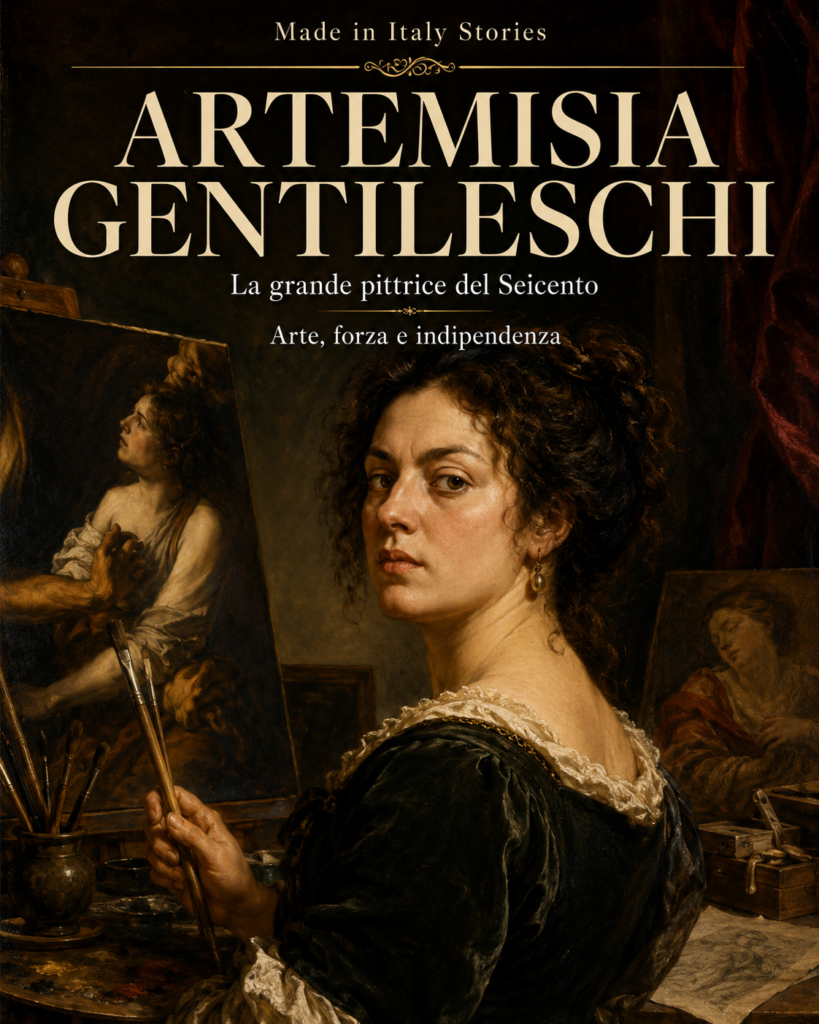
The Great Painter of the Seventeenth Century: Art, Strength and Independence
Artemisia Gentileschi spent centuries being discussed as an exception before the world finally began to see her as what she had always been: a major painter. Her life contained trauma, public humiliation, ambition, motherhood, debt, travel, court patronage and professional triumph. Because the documents of the rape she suffered and the trial that followed survive in extraordinary detail, modern audiences have often approached her paintings through biography first. The temptation is understandable, but it can become another form of injustice. Artemisia was not great because suffering made her interesting. She was great because she could paint.
She was born in Rome on 8 July 1593, the only daughter of the painter Orazio Gentileschi and Prudenzia di Ottaviano Montoni. Her mother died when Artemisia was still young, and she grew up inside her father’s workshop alongside her brothers. Painting in the seventeenth century was not primarily a romantic act of private inspiration. It was a profession built on workshop discipline: grinding pigments, preparing surfaces, copying models, studying anatomy, learning composition and understanding how to satisfy patrons. Artemisia absorbed that world from childhood.
Orazio was influenced by Caravaggio, whose dramatic use of light and uncompromising naturalism transformed Roman painting. Artemisia learned within that Caravaggesque environment, but she was not merely an extension of her father. Her earliest signed and dated work, Susanna and the Elders of 1610, was painted when she was about seventeen. It already reveals something distinctive: the biblical Susanna is not presented as a decorative nude comfortably available to the viewer. Her body twists away from the two men harassing her, and the discomfort is palpable. Long before Artemisia’s later fame, the painting announced a young artist capable of psychological clarity.
In 1611 Artemisia was raped by Agostino Tassi, a painter who worked with her father and had access to the household. The following year Orazio brought legal action, and the resulting trial became one of the most famous judicial records in art history. Artemisia was questioned repeatedly and subjected to the use of sibille, cords tightened around the fingers, as part of the court’s attempt to test the truth of her testimony. Tassi was found guilty and sentenced to banishment from Rome, though the punishment was not effectively enforced. For Artemisia, the trial meant that violence against her became public knowledge in a society that often attached shame to the woman rather than to the aggressor.
For centuries, that episode was either ignored or used to sensationalize her. Modern scholarship has rightly restored its seriousness, but it has also warned against turning every female figure she painted into a coded self-portrait of revenge. Artemisia’s art is richer than that. Her women are frequently active, intelligent and physically present, but they belong to biblical, historical and mythological traditions that she treated with exceptional dramatic force. Judith, Jael, Lucretia, Cleopatra, Mary Magdalene and other figures become not symbols of a single event in the painter’s life, but participants in complex moral and emotional situations.
Soon after the trial Artemisia married the Florentine painter Pierantonio Stiattesi and moved to Florence. That change of city transformed her professional possibilities. Florence under the Medici was one of Europe’s great artistic centers, and Artemisia succeeded in building an independent reputation there. She worked for important patrons, developed connections within court culture and, in 1616, became the first woman admitted to the Accademia delle Arti del Disegno. The significance of that achievement is difficult to exaggerate. Membership gave her professional status in an institution designed by and for male artists. She had entered through the front door.
Her Florentine years were artistically productive and socially important. She knew members of the intellectual world and maintained a friendship and correspondence with Galileo Galilei. Her literacy and cultural confidence developed, and she negotiated commissions in her own name. This mattered because a woman artist in early seventeenth-century Italy faced practical restrictions men rarely had to consider: access to life drawing, legal autonomy, workshop management, travel and the constant suspicion that talent must somehow belong to a father, husband or lover. Artemisia repeatedly demonstrated that she could operate independently.
The painting most closely associated with her is Judith Beheading Holofernes. Artemisia painted the subject more than once, and the version in the Uffizi, dating from around 1620, remains one of the most shocking images of Baroque art. Judith and her maidservant do not perform violence delicately. They work. Their sleeves are rolled, their arms are engaged, and the physical effort of the act is impossible to ignore. Blood crosses the canvas in a way that even Caravaggio might have considered enthusiastic. Yet the painting’s power does not come from gore alone. It comes from composition, concentration and the extraordinary conviction with which Artemisia gives the women agency.
It is tempting to interpret Judith as Artemisia’s direct revenge upon Tassi. Popular culture often does. Historians are more cautious. The subject was widespread, especially in Florence, and patrons understood it through biblical, political and moral traditions. Artemisia’s personal experience may have informed her sensitivity to female danger and resistance, but art is not a police report in oil paint. The greatness of the work lies precisely in its ability to exceed biography.
Financial difficulties and complicated domestic circumstances eventually contributed to Artemisia’s return to Rome around 1620. By then she was no longer a promising daughter of Orazio Gentileschi. She was a recognized painter with her own professional identity. She worked in Rome, spent time in Venice and continued seeking patrons in competitive artistic environments. Unlike many women who painted within convents or family workshops, Artemisia moved across cities and courts with the mobility of a professional artist.
Around 1630 she settled in Naples, one of the largest and most vibrant cities in Europe. Naples became the base for much of the rest of her career. There she ran a successful workshop and received major religious commissions. This part of her output is sometimes overshadowed by the famous heroines, but it demonstrates the breadth of her ability. She painted large altarpieces, saints and complex multi-figure compositions, proving she could operate on the same scale as leading male painters of the period.
Her career also reached the English court. In 1638 or 1639 Artemisia traveled to London, where her father Orazio was working for King Charles I. She may have assisted him with major decorative projects, including work associated with the Queen’s House at Greenwich. Orazio died in 1639. Artemisia returned to Naples by the following year and resumed her workshop there. A recently discovered document shows her alive in Naples in August 1654, which means the exact date of her death remains uncertain. Older references often give 1652 or 1653; current scholarship is more careful.
Her paintings reveal a sophisticated understanding of fabric, flesh, gesture and light. She could paint luxurious silk with almost tactile richness, then turn the same surface into a psychological instrument. In works such as Mary Magdalene, conversion is not an abstract theological idea. It is visible as hesitation, conflict and decision. Her Lucretias are not simply decorative tragedies. They think. Her self-portraits and allegorical figures complicate the boundaries between artist, subject and public image.
One of her most remarkable works is the Self-Portrait as the Allegory of Painting, now in the British Royal Collection. The image takes advantage of a visual convention that was almost unavailable to male artists. In Cesare Ripa’s influential iconography, Painting was personified as a woman. Artemisia, being a woman and a painter, could embody the allegory literally. She depicts herself in action, leaning into the work, hair loose, chain at her neck, body engaged in the act of creation. It is difficult to imagine a more elegant statement of professional identity.
Artemisia’s personal life remained complicated. She and Stiattesi had several children, and documents reveal debts, moves, negotiations and relationships that make her life feel startlingly modern in its mixture of career pressure and domestic difficulty. Letters connected to Francesco Maria Maringhi show an emotional world far removed from the simplistic image of a permanently wounded victim. Artemisia loved, argued, borrowed money, pursued opportunities and built networks. She lived fully.
Her reputation did not disappear immediately after death, but it faded significantly as artistic taste changed and as art history narrowed its canon. For generations, women artists were treated as curiosities rather than central participants. Artemisia was sometimes misattributed, reduced to her father, or remembered more for scandal than for painting. Twentieth-century scholars and feminist historians played a major role in recovering her work, and major exhibitions have since established her as one of the leading painters of the Baroque.
The modern rediscovery brought its own risks. Artemisia became an icon of female resistance, which helped bring attention to her but sometimes encouraged readings that made every canvas autobiographical. The best current understanding allows both truths to coexist: her experience as a woman in a male-dominated society mattered profoundly, and her art cannot be reduced to that experience. She was not important only because she overcame barriers. She was important because, after overcoming them, she produced paintings of exceptional power.
For Italy, Artemisia Gentileschi represents something larger than a recovered female biography. She changes the map of the seventeenth century. Once she is placed where she belongs, the Baroque becomes more complicated, more human and more accurate. Rome, Florence, Naples and London were not worlds inhabited only by male geniuses while women watched from balconies. Women worked, negotiated, painted and sometimes became masters.
Her story also teaches us to be suspicious of historical silence. When a name seems absent from the traditional narrative, absence does not necessarily mean insignificance. Sometimes it means the narrative was built with doors closed. Artemisia forced one of those doors open in 1616 when she entered the Florentine academy. Centuries later, art history has finally followed her inside.
If Artemisia Gentileschi’s life and paintings fascinate you, follow Made in Italy Stories and tell us in the comments which work speaks to you most. Is it Judith, Susanna, Mary Magdalene, one of her self-portraits – or simply the extraordinary fact that she built an international career in a century that was never designed to make that easy for a woman?