

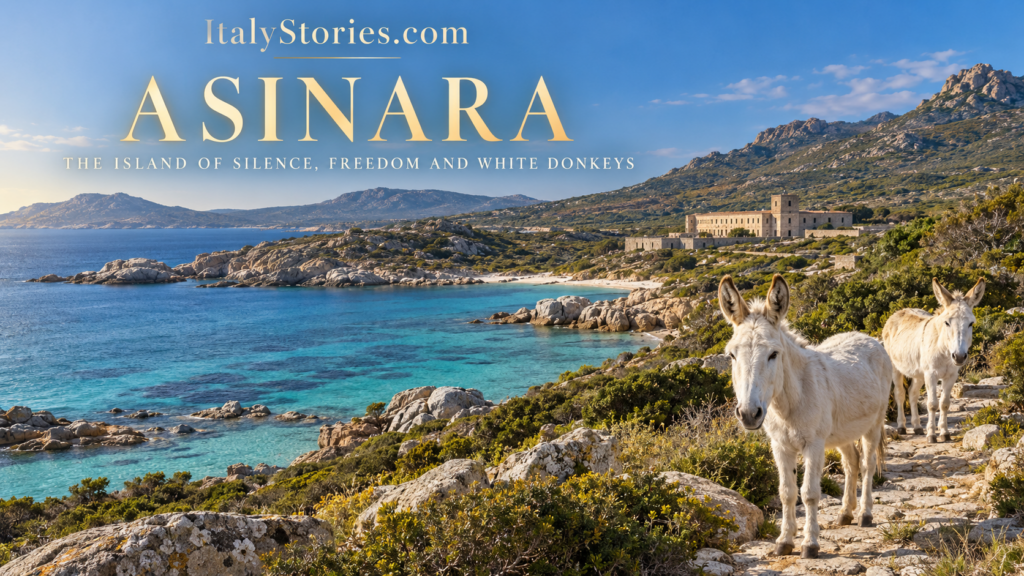
At the far north-western edge of Sardinia, beyond the narrow peninsula of Stintino, there is an island where beauty and uneasiness have learned to live side by side. The sea surrounding it has the impossible colours normally associated with tropical postcards: transparent turquoise over pale sand, intense blue above deeper water, flashes of emerald around granite rocks. Yet behind those beaches stand abandoned cells, watchtowers, hospital buildings and silent houses that remember more than a century of isolation. This is Asinara Island, one of the most extraordinary places in Italy: a former quarantine station and prison colony transformed into a national park, where white donkeys wander among Mediterranean shrubs and the wind passes through buildings once considered impossible to escape.
An island at the edge of Sardinia
Asinara lies just off Sardinia’s north-western coast and belongs administratively to the municipality of Porto Torres. It stretches for roughly fifty square kilometres, with an elongated and irregular shape that creates two very different coastlines. The western side faces the open sea and is dramatic, exposed and frequently battered by the mistral. Here cliffs, rocky slopes and dark blue water create a landscape of almost uncompromising severity. The eastern coast, protected by the Gulf of Asinara, is gentler and more welcoming, with small coves, pale beaches and exceptionally clear water.
The highest point, Punta della Scomunica, rises a little above 400 metres. This is not a high mountain, but on such a narrow island it is enough to dominate the surrounding sea and offer a remarkable view over the coast of Sardinia. Between the sea and the hills, the land is covered by low Mediterranean vegetation shaped by wind, salt and centuries of grazing. Juniper, mastic, cistus, lavender and tree spurge grow among granite outcrops, releasing their scents beneath the sun.
Asinara is often imagined as a single untouched wilderness, but the landscape tells a more complicated story. Humans have lived here, cultivated the land, raised animals, guarded prisoners and built villages, hospitals, roads and military structures. Nature has now reclaimed much of that space, but it has not erased the past. Instead, vegetation and ruins have become part of the same scenery.
Even the island’s name contains a mystery. It is tempting to believe that “Asinara” simply derives from the Italian word asino, meaning donkey, especially because the island is famous for its white animals. The real origin, however, is uncertain and may be much older. Some interpretations connect it to the Latin Sinuaria, possibly referring to the island’s deeply indented coastline. The donkeys became its symbol later, but they did not necessarily give the island its name.
The people who were forced to leave
Before Asinara became synonymous with prisons and isolation, Sardinian families lived there in small communities, particularly around Cala d’Oliva. They survived through fishing, farming and livestock breeding, building a life adapted to distance, wind and limited resources. That existence changed dramatically in 1885, when the Italian state decided to establish an agricultural penal colony and a maritime quarantine station on the island.
The resident population was removed. Many displaced families settled on the nearby coast and contributed to the development of Stintino, today one of Sardinia’s best-known seaside towns. This is one of the most important human chapters in the history of Asinara: the creation of the penal colony was not simply an administrative decision made on empty land. It transformed a living community and separated people from their homes, fields and traditions.
The new quarantine station was established at Cala Reale, where ships, crews and passengers suspected of carrying infectious diseases could be isolated. In an era when epidemics travelled along maritime trade routes, islands were considered ideal locations for lazarets. The sea acted as a natural barrier, protecting the mainland while confining those considered a potential danger.
During the First World War, Asinara became a vast detention and health complex for thousands of Austro-Hungarian prisoners of war. Many arrived exhausted, malnourished and ill after brutal journeys. Disease spread rapidly, and a significant number died on the island. The ossuary and the surviving structures preserve the memory of this tragic period, adding another layer to a landscape already marked by separation and suffering.
Italy’s prison island
For much of the twentieth century, the name Asinara inspired fear rather than dreams of turquoise water. Its penal colony was divided into several branches distributed across the island, each designed for different kinds of prisoners and agricultural work. Fornelli, in the south, became one of the most notorious sections. Cala d’Oliva, farther north, served as the administrative centre, with officers’ homes, prison facilities and the small village that still stands today.
The sea made escape extremely difficult, while the island’s geography allowed prisoners to be separated from one another and from the outside world. In the 1970s and 1980s, during Italy’s years of terrorism, organised crime and political violence, parts of Asinara were converted into a maximum-security prison. Members of terrorist organisations, kidnappers and Mafia figures were held behind its walls.
The prison’s history is also connected with two of the most important figures in modern Italian justice. In 1985, judges Giovanni Falcone and Paolo Borsellino were brought to the island with their families for protection while preparing the enormous Palermo Maxi Trial against Cosa Nostra. They worked in the guesthouse at Cala d’Oliva, surrounded by guards and separated from ordinary life. The location offered security, but it also revealed the extraordinary danger faced by the magistrates.
Walking through the former prison areas today produces a strange sensation. The landscape is bright, open and beautiful, yet the buildings were designed to restrict every movement. Doors, bars, courtyards and watchtowers remain as evidence of a world governed by control. In Fornelli, the atmosphere can still feel severe even when sunlight floods the abandoned spaces. Asinara does not allow its visitors to enjoy beauty without also confronting memory.
The prison finally closed in 1997, the same year in which the national park was established. After more than a century of compulsory isolation, the island entered a new phase. Its separation from the mainland, once used for quarantine and punishment, had unintentionally protected it from hotels, roads, holiday villages and large-scale construction. A place associated with confinement became a sanctuary for nature.
The white donkeys of Asinara
The most beloved inhabitants of the island are its small white donkeys. With their pale coats, pink skin and light-coloured eyes, they appear almost unreal against the dark green vegetation and blue sea. They are not merely a picturesque tourist attraction but a distinctive population associated with Asinara’s environmental and cultural identity.
Their appearance is linked to a genetic form of albinism. The lack of normal pigmentation makes them particularly sensitive to strong sunlight, especially around their eyes and skin. During the hottest hours, they may seek shade near shrubs or inside abandoned buildings. They live freely on the island and often appear beside the road, seemingly indifferent to visitors.
Scientific studies have helped explain their unusual colouring, but their distant origin remains surrounded by competing stories. Some traditions suggest that their ancestors were brought from elsewhere in the Mediterranean; others connect them with the domestic donkeys once raised by the island’s inhabitants. What is certain is that they survived decades of profound human change and have become the living emblem of Asinara.
They share the island with grey Sardinian donkeys, horses, goats, wild boar and mouflons. The wetlands and rocky coasts also provide habitat for numerous bird species, while the protected sea supports a rich Mediterranean ecosystem. Dolphins may be seen offshore, and sea turtles are treated at the island’s recovery centre before being returned to the water.
Asinara’s wildlife should not be mistaken for a collection of tame animals. This is a protected environment, not an open-air petting zoo. Feeding animals can alter their behaviour and damage their health. The most respectful encounters happen at a distance: a donkey crossing a track, a mouflon disappearing between rocks or a bird lifting from a lagoon.
Cala Reale, Cala d’Oliva and Fornelli
Most journeys through the island follow the road connecting its principal historical settlements. Cala Reale is one of the main arrival points and immediately introduces the double identity of Asinara. The bay is peaceful and elegant, but the buildings recall the former quarantine station and the administrative life of the island. Nearby are environmental and scientific facilities, including activities connected with wildlife conservation.
Farther north, Cala d’Oliva resembles a tiny abandoned village suspended in time. White houses line quiet streets above the harbour, while the former prison administration buildings recall the years when guards, officials and their families lived here. The village church, the old structures and the house associated with Falcone and Borsellino make this one of the island’s most emotionally powerful places.
To the south, Fornelli preserves the imposing former maximum-security prison. Its austere architecture stands in striking contrast with the luminous coastal landscape around it. The building does not need dramatic decoration to communicate its purpose. Its corridors and enclosed spaces are powerful because they are real.
Nature offers its own landmarks. Cala Sabina is admired for its transparent water and pale shoreline, while other coves appear between granite rocks along the eastern coast. Swimming and access are regulated to protect sensitive environments, so visitors should always respect the park’s current rules. On Asinara, the absence of uncontrolled development is precisely what makes the coastline so exceptional.
How to experience Asinara
The island is generally reached by authorised boat services and excursions departing from Porto Torres or the Stintino area. Once ashore, it can be explored in several ways, including guided vehicles, bicycles, walking routes and organised off-road tours. Services and access conditions can vary according to the season, weather and conservation requirements, so planning ahead is essential.
A rushed visit risks reducing Asinara to a sequence of photographs. Its meaning emerges more slowly. It is found in the distance between one building and another, in the silence around the former cells, in the sudden appearance of a white donkey and in the way the colour of the sea changes as the road turns. This is not simply one of the many beautiful coastal places of Sardinia. It is a landscape in which Italian history, human suffering and environmental recovery remain visible at the same time.
Visitors should bring water, sun protection and suitable footwear, especially during the warmer months. Shade can be limited, and the Sardinian sun is intense. Spring is particularly beautiful, when the Mediterranean vegetation flowers and temperatures are generally more comfortable. Early autumn can also offer warm sea, softer light and a quieter atmosphere.
Respect matters here more than convenience. The island’s rules protect nesting birds, terrestrial animals, marine habitats and historical buildings. Waste must never be left behind, wildlife should not be approached or fed, and access restrictions should be treated as part of the experience rather than an obstacle to it.
From confinement to freedom
Few places in Italy have undergone a transformation as symbolic as Asinara. For generations it was defined by forced distance: residents expelled from their homes, sick travellers held in quarantine, prisoners of war confined far from their countries, inmates separated from society and magistrates hidden for their own protection. The island’s beauty was always present, but for many of the people who came here, the sea was not an invitation. It was a wall.
Today that same isolation has become a form of freedom. The abandoned roads are crossed by animals rather than prison convoys. Plants grow beside walls that once represented authority. Visitors arrive not to be detained but to understand, walk, observe and eventually leave with a different idea of what an island can be.
Asinara is neither only a paradise nor only a former prison. Its power comes from refusing such a simple definition. It is one of those rare Italian places where nature does not conceal history and history does not destroy beauty. The white donkeys, standing quietly beneath the Mediterranean sun, have become the perfect symbol of that transformation: vulnerable yet resilient, unusual yet entirely at home.
Follow ItalyStories.com to discover more remarkable places, characters, traditions and hidden stories from across Italy.