

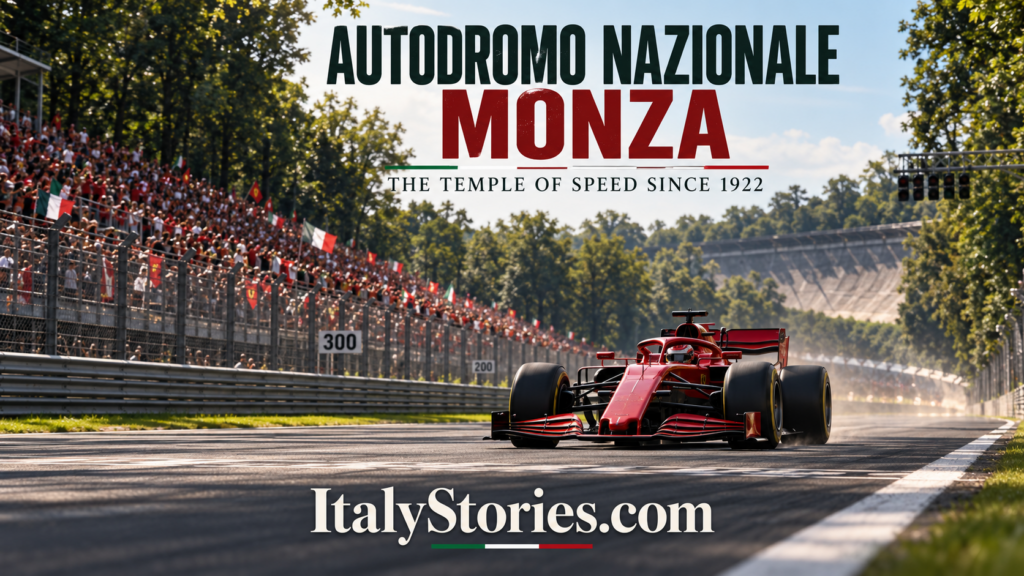
Autodromo Nazionale Monza is not simply a place where motor races are held. It is one of the great theatres of speed, a circuit where the history of the automobile can be read in layers of asphalt, concrete, trees and memory. Since 1922, racing cars have thundered through the Royal Park of Monza with their engines working at full power for longer than almost anywhere else. The circuit has celebrated engineering courage, national pride and unforgettable victories, but it has also witnessed tragedies that forced motorsport to reconsider the price of speed. Monza has changed repeatedly, yet its fundamental character has survived. The long straights, violent braking zones, fast curves and passionate Italian crowd still make it a circuit unlike any other. It is known throughout the world as the Temple of Speed, and the name is not a marketing invention. At Monza, speed has always been the central idea.
A Racetrack Built in 110 Days
The decision to build the circuit was taken in January 1922 by the Automobile Club of Milan, which wanted to celebrate its twenty-fifth anniversary and provide the rapidly developing Italian motor industry with a permanent testing and competition facility.
Italy already possessed ambitious manufacturers, talented engineers and courageous drivers. Fiat, Alfa Romeo, Lancia, Isotta Fraschini and other companies were using competition to prove the quality of their machines. What the country lacked was a dedicated circuit capable of hosting major international races and supporting serious technical development.
The first Italian Grand Prix had been held in 1921 on a semi-permanent road circuit near Montichiari. The event demonstrated that Italy could organize a great international race, but it also revealed the limitations of using ordinary roads. A permanent autodrome would offer better facilities, controlled conditions and different types of track on which manufacturers could test speed, endurance, brakes, suspension, tyres and engines.
The project was entrusted to architect Alfredo Rosselli. The original proposal was for a circuit approximately fourteen kilometres long, but concerns about the environmental and monumental value of the Royal Park led to a reduction in scale. Even in 1922, building a racetrack inside one of Europe’s largest enclosed parks created controversy.
Vincenzo Lancia and Felice Nazzaro laid the first stone at the end of February. Construction began in earnest on May 15 and proceeded at an extraordinary pace. Approximately 3,500 workers, hundreds of carts, dozens of trucks and a temporary narrow-gauge railway were used to move materials through the park.
The entire facility was completed in only 110 days.
On July 28, Pietro Bordino and Felice Nazzaro became the first drivers to cover the complete circuit, using a Fiat 570. The official inauguration took place on September 3, 1922, during heavy rain. One week later, on September 10, Monza hosted the second Italian Grand Prix. Pietro Bordino won in a six-cylinder Fiat 804.
Italy had built the third permanent purpose-designed motor-racing circuit in the world, after Brooklands in Britain and Indianapolis in the United States.
Two Tracks in One
The original Monza was an extraordinary engineering project. It combined a 5.5-kilometre road course with a 4.5-kilometre high-speed oval, creating a complete lap of approximately ten kilometres.
The road circuit contained straights and curves designed to test the complete behaviour of a car. The oval was dedicated to pure velocity. Its two banked corners were connected by straights more than a kilometre long, allowing cars to remain at full throttle for extended periods.
The two sections crossed one another at different levels near the Serraglio, with one track passing beneath the other. Drivers could use the road circuit, the oval or a combination of both.
This layout expressed the engineering philosophy of the era. Racing circuits were not yet designed principally around spectator entertainment or television images. They were laboratories. Manufacturers needed to discover whether engines could survive sustained high revolutions, whether tyres could tolerate enormous centrifugal forces and whether chassis components could withstand repeated impacts and vibrations.
The theoretical maximum speed of the first banking was around 180 or 190 kilometres per hour, an extraordinary figure in the early 1920s. The cars had narrow tyres, mechanical brakes, exposed wheels and almost no protection for the driver. Suspension systems were basic, and the surfaces were far rougher than those of a modern circuit.
Speed was increasing much faster than safety.
The First Golden Years
Monza immediately became the home of Italian motor racing. Crowds travelled to the Royal Park to see machines they had previously encountered only in newspapers. Grand Prix cars were loud, dangerous and visibly mechanical. Drivers sat high in open cockpits, wrestling with large steering wheels while oil, smoke and stones filled the air.
Italian victories became demonstrations of national engineering strength. Fiat dominated the circuit’s first important events, while Alfa Romeo, Maserati and Bugatti later became central characters in Monza’s story.
The circuit also hosted motorcycle racing. Two-wheel competition was an essential part of the autodrome from its earliest years, allowing manufacturers such as Moto Guzzi and Gilera to test and promote their machines.
Monza became a meeting place for drivers, mechanics, engineers, industrialists and spectators. The technical knowledge developed there travelled back to factories and eventually reached road vehicles. Engine reliability, braking systems, tyres, road surfaces and safety equipment all benefited from the extreme conditions of competition.
Yet the circuit’s enormous speed and limited protection produced an inevitable danger. Spectators stood close to the track, barriers were primitive and crowd control belonged to another age.
The consequences soon became terrible.
The 1928 Disaster
During the 1928 Italian Grand Prix, Emilio Materassi lost control of his Talbot while attempting to overtake a Bugatti on the main straight. The car crossed a ditch and entered an area crowded with spectators.
Materassi and twenty-seven spectators were killed. Many others were injured. It remains one of the worst accidents in the history of Italian motorsport.
The tragedy exposed the enormous gap between the speed of racing cars and the safety of the facilities surrounding them. Monza had been built as a modern circuit, but “modern” in 1922 no longer meant adequate only six years later.
Alternative layouts were introduced, and organizers experimented with using different sections of the circuit. Racing continued because motorsport’s response to tragedy during that era was rarely to stop. Instead, officials modified the course, changed procedures and hoped the next solution would be sufficient.
In 1933, the circuit suffered another appalling day. Giuseppe Campari, Baconin Borzacchini and Stanisław Czaykowski were killed during the Monza Grand Prix after accidents connected with an oil-contaminated section of the track. The event became known as Monza’s Black Sunday.
Chicanes and alternative configurations followed. The circuit was repeatedly adapted in an attempt to reduce speeds without destroying the qualities that made it important.
This conflict between speed and survival would define much of Monza’s history.
War and Abandonment
The Second World War brought racing to an end. The autodrome was used for purposes that had little to do with motorsport. Buildings stored administrative archives and displaced materials. Military vehicles occupied parts of the site, while the track surface deteriorated.
In April 1945, Allied armoured vehicles took part in a parade along the main straight, damaging the already neglected surface. Areas of the circuit were subsequently used to store military machinery and war material.
A facility that had once symbolized technological confidence now looked exhausted.
The Automobile Club of Milan decided to restore Monza in 1948. The work was carried out with something approaching the urgency of the original construction. Within approximately two months, the circuit returned to operation.
On October 17, 1948, the reborn autodrome hosted a Grand Prix won by Jean-Pierre Wimille in an Alfa Romeo 158. The sound of racing engines once again filled the Royal Park.
Two years later, the new Formula One World Championship began. Monza became the natural home of the Italian Grand Prix and, with the sole exception of 1980, has hosted the championship race every season since 1950.
The New Banking of 1955
By the early 1950s, racing cars had become dramatically faster. The original oval had been altered and partly removed before the war, but Monza’s directors still believed in the idea of a complete circuit combining road racing with extreme-speed testing.
In 1955, a new high-speed oval was constructed. Its two enormous concrete banked curves were among the most spectacular structures ever built for motor racing. The inclination increased progressively toward the top, reaching approximately 80 percent. In practical terms, the banking looked almost like a wall.
The new oval measured 4.25 kilometres and could be combined with the 5.75-kilometre road circuit to recreate a ten-kilometre course. The concrete banking was calculated for theoretical speeds of about 285 kilometres per hour.
Driving there required extraordinary courage. The surface was made from sections of concrete rather than perfectly smooth modern asphalt. At high speed, suspension components compressed and rebounded violently as the cars crossed each joint. Drivers experienced continuous vibration and heavy vertical loads, while tyres were subjected to enormous stress.
The view from the cockpit must have been extraordinary. A driver entered the banking low, accelerated upward and felt the car pressed into the concrete by centrifugal force. The horizon tilted, the steering loaded up and the outer edge of the track seemed to disappear into the sky.
The combined circuit was used for the Italian Grand Prix in 1955, 1956, 1960 and 1961. It produced races of almost unimaginable speed.
The Race of Two Worlds
In 1957 and 1958, Monza organized one of the most unusual experiments in motorsport history: the 500 Miles of Monza, also known as the Race of Two Worlds.
The event was intended to bring American Indianapolis-style racing and European competition together on the high-speed oval. American roadsters, designed to run anti-clockwise at Indianapolis, were adapted to race in the opposite direction at Monza. European manufacturers attempted to respond with specially prepared machines.
In 1958, Ferrari entered powerful cars, while Maserati produced the extraordinary Eldorado special driven by Stirling Moss. Sponsored by an ice-cream company, the white Maserati was one of the earliest major examples of a European racing car carrying the complete identity of a commercial sponsor.
The American machines proved better suited to the unique demands of continuous high-speed oval racing. Jim Rathmann won the 1958 event at an average speed exceeding 260 kilometres per hour.
The experiment lasted only two editions, but it demonstrated Monza’s international ambition. For a brief moment, the circuit attempted to unite two very different motorsport cultures: European Grand Prix racing and the American world of Indianapolis.
Alberto Ascari and the Vialone
The name of Alberto Ascari belongs permanently to Monza. Son of racing driver Antonio Ascari, he became Italy’s first Formula One World Champion and won consecutive titles for Ferrari in 1952 and 1953.
On May 26, 1955, only a few days after surviving his spectacular accident in the harbour at Monaco, Ascari visited Monza. He was not officially scheduled to test, but he decided to try a Ferrari sports car belonging to his friend and teammate Eugenio Castellotti.
Wearing ordinary clothes and borrowing a helmet, Ascari completed several laps. At the fast Vialone curve, the car unexpectedly left the track and overturned. Ascari was killed.
The cause was never established with certainty. The corner was later replaced by a fast sequence that carries his name: Variante Ascari.
At Monza, corner names are more than navigational labels. They preserve memories of people, landscapes and events. Lesmo refers to the nearby town. Roggia recalls a small water channel. Parabolica described the progressive radius of the final curve. Ascari remembers a champion whose life ended in the park.
In 2021, the Parabolica was officially dedicated to Michele Alboreto, another admired Italian driver. It is now known as Curva Alboreto, although generations of enthusiasts still instinctively call it Parabolica.
The Tragedy of 1961
The 1961 Italian Grand Prix was expected to decide the World Championship between Ferrari drivers Wolfgang von Trips and Phil Hill. The ten-kilometre combined road-and-oval circuit was being used, creating tremendous average speeds.
On the opening lap, approaching the Parabolica, von Trips’ Ferrari made contact with Jim Clark’s Lotus. The Ferrari was launched into the air and entered the spectator area.
Von Trips and fifteen spectators were killed.
Phil Hill won the race and became World Champion, but celebration was impossible. The disaster effectively ended the use of the banked oval for Formula One Grand Prix racing.
The old banking remained part of Monza’s physical landscape. Sports prototypes later used sections of the high-speed circuit, but Formula One moved permanently to the road course.
Today, the concrete curves survive among the trees like the ruins of an industrial civilization. Their cracked surfaces and extreme inclination communicate the ambitions and dangers of another era more powerfully than any museum display.
They are monuments to a period when engineers continually asked how fast a car could go, often before anyone had properly asked what would happen when it went wrong.
The Last Great Slipstream Battle
Without the banking, Monza remained exceptionally fast. During the 1960s and early 1970s, Formula One cars raced along its straights with few interruptions. Aerodynamic slipstreaming became the central tactical weapon.
A car following closely behind another encountered reduced air resistance and could gain speed before pulling out to overtake. At Monza, groups of cars exchanged positions repeatedly, with drivers sometimes avoiding the lead until the final lap because the first car was forced to push through undisturbed air.
The 1971 Italian Grand Prix became the ultimate expression of this racing. Peter Gethin won for BRM after a five-car battle, crossing the line only one hundredth of a second ahead of Ronnie Peterson. François Cevert, Mike Hailwood and Howden Ganley followed immediately behind. The first five cars were separated by little more than six-tenths of a second.
It remains one of Formula One’s closest finishes.
The race was spectacular, but the average speeds had reached a level that could no longer be accepted without substantial changes. Monza’s era of uninterrupted slipstream battles was ending.
The Arrival of the Chicanes
In 1972, chicanes were introduced to reduce the speed at the entrance to Curva Grande and the Vialone section. These first solutions were relatively improvised and created new problems, including congestion and collisions.
More permanent modifications were made in 1976. The Variante del Rettifilo slowed cars dramatically at the end of the main straight, while the Variante della Roggia interrupted the high-speed section before the Lesmo curves. The Ascari section was also developed into the fast left-right-left sequence known today.
The philosophy of the circuit changed. Instead of remaining at full throttle for most of the lap, drivers now faced enormous differences between maximum and minimum speed. A modern Formula One car may approach the first chicane at around 340 kilometres per hour and then brake to approximately 80.
This creates a different type of test. Monza still rewards engine power and aerodynamic efficiency, but it also demands exceptional braking stability, traction and control over kerbs.
The speed has not disappeared. It has become concentrated.
A Lap of Modern Monza
The present circuit measures 5.793 kilometres and is driven clockwise. It contains eleven corners—seven right-hand and four left-hand—and a start-finish straight almost 1.2 kilometres long.
A flying lap begins at the exit of Curva Alboreto. The car accelerates through the gears and crosses the finish line with the engine delivering maximum power. The rear wing is smaller than at most circuits because teams attempt to reduce aerodynamic drag.
The first braking zone arrives at the Variante del Rettifilo. It is one of the most violent decelerations of the Formula One season. The driver brakes extremely late, fights the tendency of the rear wheels to lose stability and attacks a tight right-left sequence where contact is common on the opening lap.
Good acceleration is essential on the exit because Curva Grande follows. This long right-hand bend is taken at very high speed. The steering input appears modest, but the car is loaded heavily and must remain stable as it accelerates toward the Roggia chicane.
At Roggia, the driver brakes hard again and changes direction quickly over the kerbs. The two Lesmo corners follow. The first is tighter; the second is faster and especially important because it leads onto a long acceleration zone beneath the trees.
The car passes through the Serraglio section, near the point where the old high-speed track crosses the modern circuit. The driver then approaches Variante Ascari, one of Monza’s finest sequences. The car turns left, immediately changes direction to the right and then opens into a long left-hand exit.
A small mistake at the beginning compromises the entire section. The driver must use the kerbs aggressively without destabilizing the car.
Another straight leads to Curva Alboreto, the final long right-hand corner. The entry demands confidence because the car arrives at high speed with relatively little aerodynamic downforce. The driver aims for a late apex, allows the car to move toward the outside and begins accelerating as early as possible.
The entire lap depends upon the exit. Any lost speed is carried all the way down the main straight.
Engineering for the Temple of Speed
Monza requires a technical configuration used almost nowhere else. Teams fit low-downforce aerodynamic packages, with reduced rear-wing angles and smaller aerodynamic elements intended to minimize drag.
The compromise is severe. Less downforce increases straight-line speed but reduces grip under braking and through corners. The car can feel nervous, particularly at the Lesmos and Ascari, where drivers need stability while changing direction.
Ride height and suspension settings must also accommodate the kerbs. A car that is too stiff may bounce or become airborne when the driver attacks a chicane. A car that is too soft can respond slowly and lose aerodynamic control.
Brakes experience enormous energy loads. They have periods in which to cool along the straights, but individual braking events are exceptionally demanding. At the first chicane, the braking system must remove a vast amount of kinetic energy within seconds.
Engine power remains crucial, but efficiency matters just as much. A powerful engine combined with excessive drag may still be slow. The gearbox ratios, energy-recovery system, cooling openings and wing settings must operate as a complete package.
Slipstreaming continues to influence qualifying and racing. A well-positioned car can gain valuable speed from the aerodynamic wake of the machine ahead. Teams carefully organize gaps during qualifying, but the search for a tow sometimes produces groups of drivers slowing dramatically before the final corner, each unwilling to lead onto the straight.
Monza encourages bravery, but it also rewards calculation.
Ferrari and the Tifosi
No relationship defines Monza more strongly than the bond between Ferrari and the Italian crowd. For the tifosi, the Italian Grand Prix is not an ordinary sporting event. It is a yearly ceremony.
Red flags appear throughout the park. Ferrari shirts fill the grandstands. Applause follows the cars even during practice, while a victory transforms the main straight into a sea of people.
Ferrari has enjoyed some of its most emotional moments at Monza. Alberto Ascari, Phil Hill, John Surtees, Clay Regazzoni, Jody Scheckter, Michael Schumacher, Rubens Barrichello, Fernando Alonso and Charles Leclerc are among the drivers who have won there for the Scuderia.
The 1988 race occupies a special place in Ferrari history. Enzo Ferrari had died only weeks earlier. McLaren had dominated the season and would win every other Grand Prix, but at Monza Ayrton Senna collided with Jean-Louis Schlesser while lapping him. Gerhard Berger and Michele Alboreto finished first and second for Ferrari.
It seemed almost impossible, a final gift offered to the founder in front of the Italian crowd.
In 2000, Michael Schumacher’s victory brought him level with Ayrton Senna’s total of forty-one Formula One wins. During the press conference, Schumacher became visibly emotional when asked what the achievement meant to him. The driver usually associated with discipline and control could not continue speaking.
In 2019, Charles Leclerc resisted intense pressure to give Ferrari its first Monza victory since 2010. The crowd invaded the straight beneath the podium, creating one of the defining images of modern Formula One.
At Monza, a Ferrari victory is never only a result. It becomes part of national memory.
Victories Nobody Expected
Monza also has a talent for producing improbable winners.
In 2008, Sebastian Vettel won a rain-affected race for Toro Rosso. He became, at the time, the youngest driver to win a Formula One Grand Prix, while the Italian team achieved its first victory before its senior partner Red Bull Racing had won a race.
In 2020, Pierre Gasly claimed an emotional victory for the same Faenza-based team, by then renamed AlphaTauri. An interrupted race, penalties and strategy created an opportunity, but Gasly still had to withstand the pressure and bring the car home.
These surprises occur partly because Monza’s unusual technical demands can rearrange the normal competitive order. Low downforce, powerful slipstreams, heavy braking and strategic opportunities sometimes allow a smaller team to challenge cars that dominate elsewhere.
The Temple of Speed respects power, but it occasionally rewards the unexpected.
More Than Formula One
Although the Italian Grand Prix is its most famous event, Monza has hosted almost every important form of circuit racing. Sports cars competed in the 1,000 Kilometres of Monza, where machines from Ferrari, Porsche, Ford, Alfa Romeo and other manufacturers wrote important chapters of endurance-racing history.
Touring cars, prototypes, junior single-seaters and motorcycles have all raced within the park. The circuit has also served as a test facility for tyres, engines, fuels, road surfaces and safety systems.
Monza’s contribution extends beyond competition. Technologies associated with road infrastructure and vehicle development have been tested there because a permanent circuit offers controlled conditions impossible to reproduce safely on public roads.
The autodrome has therefore functioned simultaneously as stadium, laboratory and historical archive.
A Racetrack Inside a Royal Park
Monza’s location is one of its greatest strengths and most persistent complications. The circuit lies inside the vast Royal Park, surrounded by mature trees and historic landscape.
Television cameras show cars disappearing into green corridors rather than racing through a landscape dominated entirely by grandstands and concrete. Light changes beneath the branches, leaves fall onto the circuit and the old banking emerges unexpectedly from the woodland.
At the same time, every major modification raises questions about environmental protection. Trees, historic structures, spectator access, safety zones and modern racing requirements must coexist within a sensitive site.
This tension existed even before construction began in 1922, when the original works were briefly stopped because of concern for the landscape. More than a century later, the same fundamental question remains: how can one of the world’s fastest circuits continue evolving without losing the park that gives it its identity?
Monza survives by changing carefully.
Why Monza Still Matters
Many modern circuits are safer, more efficient and easier to operate. Their paddocks are spacious, their access roads are rational and their run-off areas have been designed with contemporary vehicles in mind. Yet few possess Monza’s emotional weight.
At Monza, the old banking still rises among the trees. The names Ascari and Alboreto are written into the circuit. The main straight remembers Bordino’s Fiat, Fangio’s Mercedes, Clark’s Lotus, Regazzoni’s Ferrari and the countless machines that followed them.
The track is not difficult because it contains a large number of corners. It is difficult because every fraction of drag, every movement under braking and every hesitation on the throttle carries a heavy penalty. Speed makes small errors enormous.
For spectators, the experience begins before the cars appear. Engines can be heard approaching through the forest. The sound grows, passes with physical force and disappears again among the trees. For a moment, the entire park seems to vibrate.
That sensation connects the modern spectator with generations who stood in the same place watching very different machines.
Monza has known glory and grief, progress and destruction, reckless courage and serious reflection. It has repeatedly been forced to change by the consequences of its own speed. Yet it has never become ordinary.
More than a century after Pietro Bordino and Felice Nazzaro first drove around the completed circuit, the fundamental promise remains unchanged. Monza offers drivers, engineers and spectators an encounter with speed in its purest form.
That is why it is not merely an autodrome. It is the Temple of Speed.
Follow ItalyStories.com for more stories about Italy’s legendary cars, circuits, engineers and motor-racing heroes.