

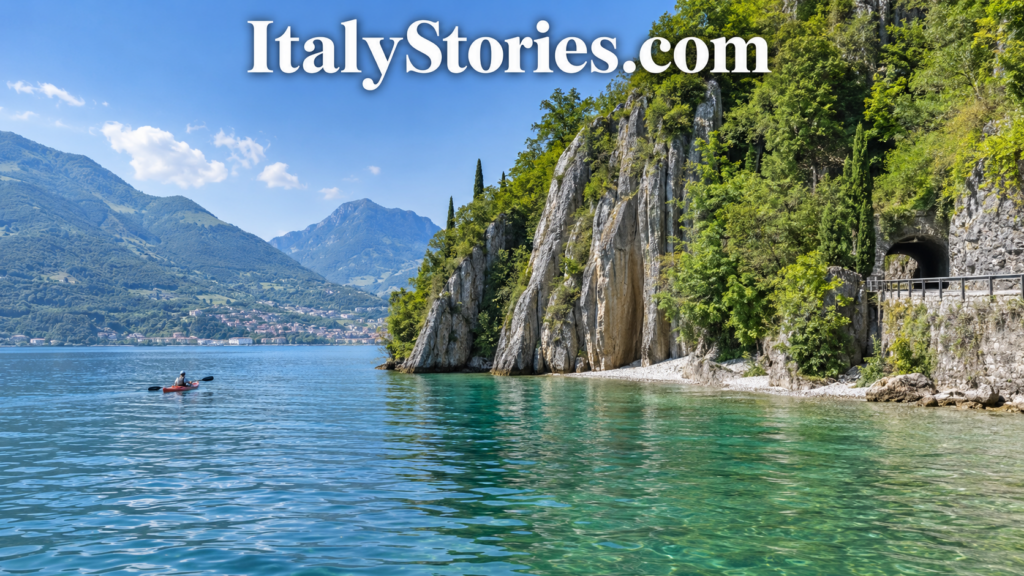
There is a place on Lake Iseo where the mountains do not simply rise behind the water. They plunge directly into it. Great slabs of pale limestone stand almost vertically along the shore, trees grow from narrow cracks in the rock and the lake changes from deep blue to transparent green as it enters a small, sheltered bay. This is Baia del Bogn, one of the most unusual landscapes in Lombardy.
The bay is located near Riva di Solto, a historic village on the Bergamo side of Lake Iseo, approximately forty kilometres from Bergamo. It is often promoted as “the Thailand of Lombardy,” a comparison inspired by its clear water, dense vegetation and dramatic limestone formations.
The nickname is effective, but photographs shared online sometimes exaggerate the resemblance. Baia del Bogn does not contain the enormous isolated karst towers found in places such as Khao Sok National Park in Thailand. Its real landscape is different and distinctly Italian: a narrow lake inlet bordered by steep, tilted layers of rock, a small pebble shoreline and a road carved into the cliff.
What makes the Bogn special is not only the beauty of the water but also its geology. The limestone was formed from marine sediments deposited when this part of Europe lay beneath an ancient sea. Much later, enormous tectonic forces lifted and folded the rock, rotating its layers until they stood almost vertically.
These tilted slabs now descend directly into Lake Iseo, creating a natural corridor of stone and water. Seen from a boat or kayak, the formations are particularly impressive because their full height and unusual angle become visible.
The bay can also be reached on foot from Riva di Solto. A pleasant lakeside walk leaves the village and follows the shore towards the Bogn, passing close to the water and through a short tunnel cut into the rock. The walk to the bay is relatively short and mostly accessible, although the amount of available space along the shore is limited.
This is not a vast tropical beach with endless sand. The shoreline consists mainly of pebbles, stones and narrow areas between the water and the cliff. During summer weekends, the small bay can become crowded quickly, making early morning or a weekday visit a more peaceful choice.
The colour of the water changes continuously. When sunlight reaches the pale lakebed, the shallow sections take on bright green and turquoise tones. A few metres away, where the lake becomes deeper, the colour returns to dark blue. Wind, clouds and the time of day can transform the view within minutes.
Kayaking is one of the best ways to experience the Bogn. From the water, visitors can approach the rock walls without being confined to the narrow shoreline and can observe the folds, cracks and vegetation of the limestone from below. Organised tours are available from different points around the lake, while experienced paddlers may reach the area independently when conditions are suitable.
The lake should never be underestimated. Its surface may appear calm, but wind and weather conditions can change, boat traffic may create waves and the water can be cold beyond the shallow edge. Anyone using a kayak or paddleboard should wear appropriate safety equipment and remain aware of other vessels.
Swimming is popular during the warmer months, but there are no tropical temperatures guaranteed by the scenery. Lake water can remain cool, the rocky bottom may be slippery and the depth can increase suddenly. Water shoes are useful, especially along the pebble shore.
The vertical cliffs have also attracted people who attempt to dive from the rocks or the old road. This is extremely dangerous. The depth of the water can vary, submerged rocks may not be visible and access points that appear safe from a distance may be unstable. The bay is best enjoyed without turning a beautiful afternoon into an unnecessary rescue operation.
Baia del Bogn is closely connected with Riva di Solto, a village that deserves more than a quick stop for the photograph. Its historic centre contains narrow medieval streets, stone houses, small courtyards and views across the northern part of Lake Iseo. The waterfront offers a gentler landscape than the dramatic cliffs nearby, with fishing boats, cafés and quiet places facing the lake.
From Riva di Solto, visitors can continue towards other destinations around Lake Iseo. Lovere, at the northern end, is known for its elegant lakeside architecture and art collections. Further south lies Monte Isola, the enormous inhabited island rising from the centre of the lake.
The Bogn, however, remains one of the lake’s most intimate landscapes. It is not monumental in size and does not require an entire day to explore. Its attraction lies in the suddenness with which it appears. One moment the road follows a familiar Italian lakeshore; the next, rock and vegetation close around a small basin of green water.
Social media has made the bay increasingly famous, often presenting it as a secret paradise known only to a fortunate few. It is certainly beautiful, but it is no longer entirely secret. Visitors should arrive with realistic expectations, particularly during the busiest weeks of summer.
The famous comparison with Thailand should be understood as an invitation rather than a literal description. Baia del Bogn is not an Asian jungle transplanted to northern Italy. It is a Lombard geological landscape shaped by an ancient sea, the movement of the earth and thousands of years of erosion.
Its beauty does not need exaggerated photographs. The real cliffs may be less enormous than those sometimes shown online, but their vertical layers tell a much more interesting story. They are evidence of a world that existed long before Lake Iseo, before the Alps took their present form and before any village appeared along these shores.
Baia del Bogn is worth visiting precisely for what it is: a small, surprising meeting point between stone, forest and water. It may remind travellers of distant tropical scenery for a moment, but its true identity belongs entirely to Lake Iseo.
#BaiaDelBogn #LakeIseo #RivaDiSolto #VisitLombardy #HiddenItaly #ItalianLakes #LombardyTravel #KayakingItaly #NatureInItaly #ItalyStories