

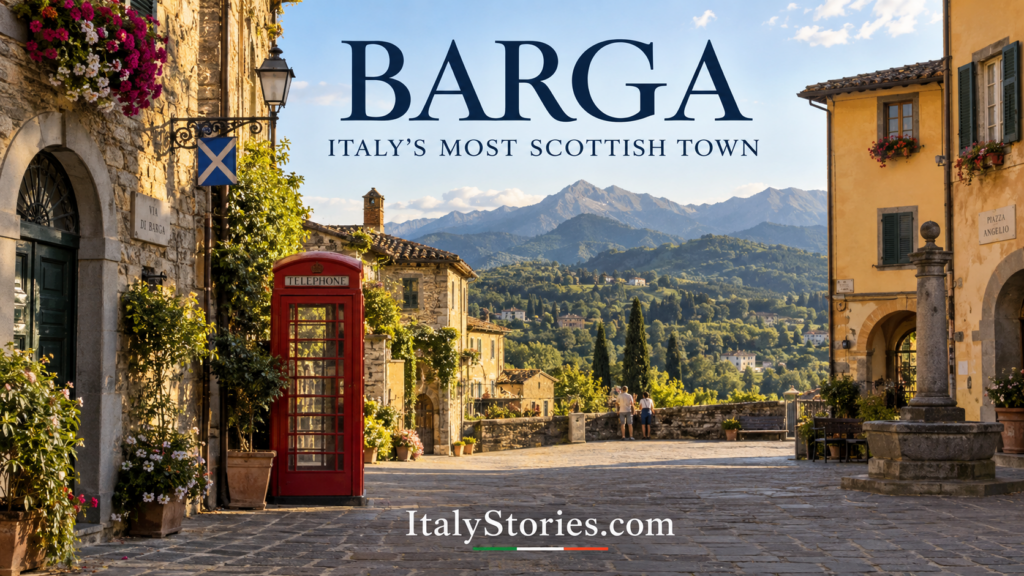
In the green mountains of northern Tuscany, there is a medieval town where stone alleys, Renaissance palaces and panoramic terraces coexist with Scottish flags, bagpipe music and the unmistakable aroma of fish and chips. This is Barga Tuscany, a place shaped not only by Italian history but also by generations of migration between Italy and Scotland.
Barga is often described as “the most Scottish town in Italy.” The nickname may sound like a clever tourism slogan, but its origins are deeply human. During the late nineteenth and early twentieth centuries, many local families left this part of Tuscany in search of work and opportunity. A significant number settled in Scotland, where they opened cafés, ice-cream shops and restaurants or found employment in the growing industrial towns.
Some remained abroad, while others eventually returned to Barga. Their journeys created a lasting connection between two landscapes that appear very different: the hills of Tuscany and the cities, coastlines and Highlands of Scotland.
A Medieval Town in Northern Tuscany
Barga stands in the province of Lucca, in the mountainous area associated with the Garfagnana and the Mid Serchio Valley. Its position offers extensive views across wooded hills, cultivated valleys and the dramatic peaks of the Apuan Alps.
The oldest part of the town rises above the modern neighbourhoods. Visitors enter through historic gateways and discover narrow streets paved with stone, small squares, vaulted passages and buildings in warm shades of ochre and terracotta. Laundry hangs from upper windows, flowers brighten the doorways and sudden openings between the houses reveal the surrounding mountains.
Barga’s historic centre is compact enough to explore on foot, but it rewards an unhurried visit. The pleasure lies in following streets without a strict itinerary, stopping at a café and observing how the town’s medieval layout continues to shape everyday life.
Piazza Angelio is one of its most atmospheric spaces. Surrounded by elegant buildings and intimate restaurants, it feels less like a monumental square and more like an open-air living room. Nearby, the Teatro dei Differenti recalls Barga’s long appreciation of performance, music and community culture.
The Cathedral Above the Town
At the highest point of the historic centre stands the Cathedral of San Cristoforo, commonly known as the Duomo of Barga. Its restrained stone exterior has an almost fortress-like appearance, reflecting different phases of construction and centuries of local history.
The climb to the cathedral is one of the essential experiences in Barga. From the open space surrounding the church, the view stretches across the Serchio Valley towards layers of mountains and distant villages. In changing weather, the landscape can appear bright and distinctly Tuscan or misty and unexpectedly northern.
That shifting atmosphere may help explain why the Scottish connection feels so natural here. Barga is unmistakably Italian, yet its mountain scenery, cool evenings and deep green surroundings occasionally evoke a more distant northern country.
The cathedral is dedicated to Saint Christopher, the town’s patron saint. Its position above Barga gives it both religious and symbolic importance: it is a landmark, a viewpoint and a quiet reminder of the community’s long history.
Why Barga Became Italy’s Most Scottish Town
The relationship between Barga and Scotland began with economic necessity. Life in rural and mountainous Tuscany was difficult during the nineteenth century, and employment opportunities were limited. Like millions of other Italians, residents of Barga and the surrounding countryside looked abroad.
Scotland became one of their most important destinations. Italian migrants often entered businesses connected with food and hospitality, gradually establishing cafés, ice-cream parlours and fish-and-chip shops. These enterprises became familiar features of Scottish towns and cities, while the families behind them maintained close relationships with their places of origin.
Money earned abroad helped support relatives and improve homes in Tuscany. Return journeys brought new habits, stories and sometimes a different language. Children and grandchildren grew up with identities connected to both countries.
This was not a simple movement from one homeland to another. It became a continuous exchange. Scottish-born descendants visited Barga, returning emigrants brought Scotland home with them, and family networks survived across generations.
The connection remains visible today. Scottish surnames and accents can sometimes be heard during the summer, when families return to visit relatives or rediscover their origins. The Saltire appears outside buildings and during local celebrations. For many residents, Scotland is not an exotic theme but part of their family biography.
Red Telephone Boxes and Fish and Chips
One of Barga’s most photographed Scottish details is a traditional red British telephone box in the town centre. Surrounded by Tuscan stone buildings, it creates a striking contrast and has become a cheerful symbol of the relationship between the two cultures. The telephone box has also been used as a small community book exchange.
Food provides another important connection. Barga’s Fish and Chips Festival, known locally as the Sagra del Pesce e Patate, celebrates a dish closely associated with the working lives of Italian families in Scotland.
The festival is more than an opportunity to eat fried fish and potatoes. It recalls the cafés and restaurants through which many emigrants built new lives. It also brings together residents, returning families and visitors in the informal atmosphere of an Italian summer festival.
Scottish-themed events, music and cultural gatherings continue to reinforce the relationship. Bagpipes may sound through medieval streets, tartan appears beside Italian colours and conversations move naturally between English and Italian.
Yet Barga never feels like a reproduction of Scotland. Its Scottish character has not been added as decoration. It grew from departure, work, family memory and return.
Music, Poetry and Creative Life
Barga’s identity is not limited to its Scottish heritage. The town has developed a lively cultural reputation that seems surprisingly ambitious for a relatively small mountain community.
Opera Barga, founded in 1967, has brought singers, musicians and audiences to the town for decades. Performances in historic surroundings create an intimate relationship between music and place. BargaJazz, established in the 1980s, adds another dimension through concerts, competitions and performances by Italian and international musicians.
The surrounding area is also connected with Giovanni Pascoli, one of Italy’s most influential poets. Pascoli made his home at nearby Castelvecchio, now called Castelvecchio Pascoli, where the landscape became an important presence in his writing. His former house is preserved as a museum.
Artists and writers have long been attracted to Barga’s combination of architecture, landscape and relative isolation. The town provides beauty without the overwhelming crowds found in many better-known Tuscan destinations.
What to Eat in Barga
Beyond fish and chips, the local cuisine belongs firmly to the mountains of northern Tuscany. Traditional dishes make use of chestnuts, mushrooms, local cheeses, cured meats, polenta and rustic soups.
Chestnut flour was historically an essential ingredient in communities where wheat could be difficult or expensive to obtain. It appears in sweet and savoury recipes, preserving the memory of a landscape in which chestnut trees were once a fundamental source of food.
Autumn brings porcini mushrooms and richer flavours, while summer encourages outdoor dining in the town’s squares. Eating in Barga reflects the same dual identity found elsewhere in the town: Tuscan traditions remain central, but an occasional Scottish accent is never far away.
When to Visit Barga Tuscany
Spring and early autumn are excellent seasons for walking through the historic centre and exploring the surrounding countryside. Temperatures are generally comfortable, the landscape is green and the streets are quieter than during the busiest summer weeks.
Summer offers a more animated atmosphere, with cultural festivals, outdoor dining and returning families. Visitors interested in a particular event should always check the official programme and dates before travelling.
Barga can be visited on a day trip from Lucca, but staying overnight reveals a more intimate town. After daytime visitors leave, the stone streets grow quiet, lights appear in the windows and the surrounding mountains fade into the evening.
Comfortable shoes are advisable because the historic centre includes slopes, steps and uneven paving. A car is useful for exploring nearby villages and mountain landscapes, although it should be left outside the oldest pedestrian streets.
A Town with Two Homelands
What makes Barga memorable is not simply the unusual sight of a British telephone box in Tuscany. Its real story is about the way migration changes both the place people leave and the place they eventually call home.
The residents who travelled to Scotland carried their language, recipes and ambitions with them. Those who returned brought back new experiences and relationships. Their descendants inherited a sense of belonging that could include two countries at the same time.
Barga therefore offers something more meaningful than an unexpected cultural curiosity. It shows how identity can travel without disappearing and how a small town can remain connected to a much wider world.
Here, a Scottish flag beside a Tuscan doorway does not feel contradictory. It represents generations of families who learned that home does not always have to be only one place.
Follow ItalyStories.com to discover more Italian villages, traditions and remarkable local stories hidden beyond the country’s most famous destinations.