

THE ITALIAN GARDEN WHERE MONSTERS ARE CARVED INTO STONE
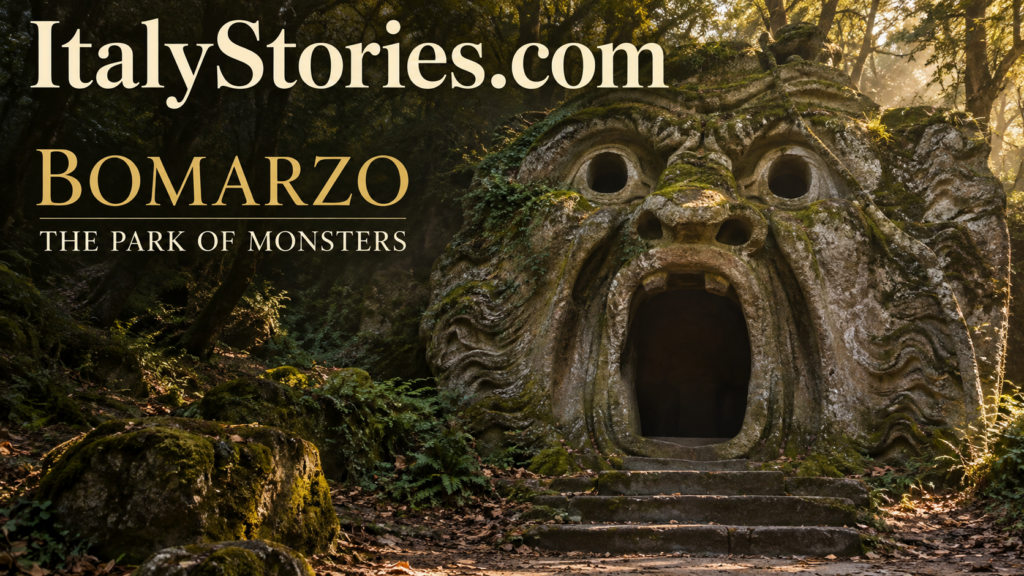
In the wooded hills of northern Lazio, less than one hundred kilometres from Rome, there is a garden that seems to have been created from a dream, or perhaps from the moment immediately before a nightmare. Enormous stone faces emerge from the vegetation, dragons fight wild animals, an elephant carries a tower on its back and a house leans at an impossible angle. At the centre of this strange world, a gigantic mouth opens in the rock and invites visitors to step inside.
This is Bomarzo, a small medieval town in the province of Viterbo, famous throughout the world for the Sacro Bosco, the Sacred Wood, more commonly known as the Park of Monsters.
The name may suggest a modern amusement park, but Bomarzo is something far more mysterious. Created during the 16th century, it is one of the most unusual gardens of the Italian Renaissance. There are no perfectly symmetrical flower beds, elegant fountains arranged along straight avenues or reassuring statues of ideal beauty. The paths descend unpredictably through the forest, the sculptures appear without warning and nothing seems to obey an obvious order.
The park was not designed to offer visitors harmony. It was created to surprise, confuse and perhaps disturb them. Almost five centuries after its construction, nobody has been able to explain its meaning completely.
THE VILLAGE ABOVE THE MONSTERS
Bomarzo stands on a rocky spur formed by the ancient volcanic activity of the Cimini Mountains. The surrounding landscape is part of Tuscia, a territory of deep ravines, forests, vineyards and settlements built from dark volcanic stone. Long before the Renaissance, the area was inhabited by Etruscans and Romans, who carved tombs, roads, steps and sacred places directly into the rock.
The medieval village rises compactly above the valley. Its houses, arches and narrow streets appear to grow from the same stone beneath them. At the highest point stands Palazzo Orsini, the great residence of the noble family that controlled Bomarzo for centuries. The building developed from an earlier defensive structure and was gradually transformed into a Renaissance palace.
Nearby, the Cathedral of Santa Maria Assunta preserves the religious history of the town and the memory of Saint Anselm, the patron saint of Bomarzo. Every year, local traditions celebrate him with the Palio di Sant’Anselmo and with the characteristic Biscotto di Sant’Anselmo, a ring-shaped bread flavoured with anise. According to tradition, the saint ordered a special bread to be prepared for poor travellers and pilgrims passing through the area.
Yet the peaceful streets of the village offer little warning of what waits in the forest below.
VICINO ORSINI AND HIS IMPOSSIBLE GARDEN
The Sacred Wood was commissioned by Pier Francesco Orsini, better known as Vicino Orsini, a nobleman, military commander and patron of the arts born in 1523. He belonged to one of the most powerful aristocratic families in Italy and inherited the lordship of Bomarzo during a period marked by war, political intrigue and competition among the great families of Renaissance Italy.
Vicino was not merely a provincial lord with a taste for unusual decoration. He was educated, intellectually curious and familiar with classical literature, mythology and the artistic experiments of his age. He fought as a soldier, experienced captivity and witnessed the violence of war. He was also deeply attached to his wife, Giulia Farnese, who came from another influential Italian family.
This Giulia Farnese should not be confused with the more famous woman of the same name who had been associated with Pope Alexander VI several decades earlier. Vicino’s wife was a different member of the Farnese family, and her relationship with the lord of Bomarzo became central to later interpretations of the garden.
Work on the Sacred Wood began around the middle of the 16th century and continued for decades. The overall design has traditionally been associated with Pirro Ligorio, the Renaissance architect and antiquarian also connected with the gardens of Villa d’Este at Tivoli. Some scholars, however, have questioned how much of Bomarzo can be attributed directly to him. The sculptures are frequently linked to Simone Moschino and his workshop, while other artists and craftsmen may also have contributed.
The uncertainty seems appropriate. A garden built as an enigma has even managed to preserve uncertainty about the people who designed it.
THE OPPOSITE OF A RENAISSANCE GARDEN
A traditional Renaissance garden demonstrated humanity’s ability to impose reason and geometry upon nature. Trees were aligned, hedges were cut into precise forms and statues were positioned according to an intellectual programme. Perspective guided the visitor’s eye towards villas, fountains and distant landscapes.
Bomarzo overturns those rules.
Its monuments were carved largely from enormous blocks of peperino, the local volcanic rock already scattered across the valley. Instead of removing the boulders or forcing them into a regular arrangement, the creators transformed them where they stood. Nature was not placed under complete control. It became part of the artwork.
The result is a garden with no single, universally accepted route or interpretation. Mythological creatures stand beside architectural jokes. Literary references mix with personal memories. Inscriptions address the visitor directly but often create more questions than answers.
Was the Sacred Wood a memorial to Giulia Farnese after her death? Was it an autobiographical journey through Vicino Orsini’s grief and experiences? Was it an intellectual game based on classical literature? Did it contain religious, philosophical or alchemical meanings? Or was it simply designed to astonish guests and reject the seriousness of more conventional gardens?
The answer may include all these possibilities. Vicino himself called it his “boschetto”, his little wood, but the monuments inside it suggest a private universe built from loss, humour, mythology and deliberate confusion.
THE SPHINXES AND THE BEGINNING OF THE JOURNEY
Visitors are welcomed by two stone sphinxes, creatures traditionally associated with riddles and hidden knowledge. Their presence immediately establishes the nature of the journey. A sphinx does not provide answers; it asks questions and punishes those who respond carelessly.
Inscriptions warn visitors that what they are about to see may exceed the traditional wonders of the world. This boast contains the characteristic spirit of Bomarzo. The garden is playful, theatrical and not especially modest.
From this point, the paths lead among trees and sudden encounters with enormous sculptures. Some monuments are clearly inspired by classical mythology, while others resist precise identification. Figures may be called Proteus, Glaucus, Neptune or Pluto depending on the interpretation. Their ambiguity is part of their power. They seem ancient, but they belong to no single story.
HERCULES, THE DRAGON AND THE ELEPHANT
One of the most violent scenes in the park shows two giants locked in combat. The larger figure tears the other apart with astonishing force. The scene is commonly identified as Hercules fighting Cacus, although other interpretations have been proposed. It is not an elegant classical duel. It is a brutal vision of physical power, frozen at its most terrible moment.
Nearby, a dragon is attacked by a lion, a dog and another wild animal. The figures appear to twist together inside the vegetation, creating a scene that changes according to the visitor’s position. The stone seems almost too animated to remain still.
Another famous sculpture represents an elephant carrying a fortified tower. Its trunk wraps around the body of a fallen soldier. The image has been connected with the war elephants of Hannibal, who crossed the Alps during his campaign against Rome. It may also have reminded Vicino Orsini of military life and the deaths he had witnessed.
The sculpture is both magnificent and unsettling. The elephant appears disciplined and powerful, while the human figure beneath it has lost all control over his fate. In Bomarzo, civilisation and violence often occupy the same monument.
THE TURTLE AND THE WHALE
One of the strangest compositions features an enormous turtle carrying a winged female figure on its shell. The turtle looks towards the open mouth of a gigantic creature usually described as a whale. The two animals appear to be engaged in a silent encounter whose meaning has never been established conclusively.
The turtle has often been interpreted as a symbol of stability, patience or the earth, while the winged figure may represent Fame or Victory. The whale could evoke the sea, danger or the biblical story of Jonah. Yet every explanation leaves something unresolved.
This is one of the pleasures of Bomarzo. The visitor is free to construct a personal story, only to discover that the next sculpture contradicts it.
PEGASUS, NEPTUNE AND THE SLEEPING WOMAN
Not every figure in the park is frightening. Pegasus rises from a stone fountain, bringing the poetry of classical mythology into the shadowed forest. In ancient tradition, the winged horse was associated with inspiration and the sacred spring of the Muses.
A monumental male figure commonly identified as Neptune reclines near the water. Elsewhere, an enormous sleeping woman rests with her head turned gently to one side. Her scale transforms a peaceful human pose into something almost supernatural. She might be a nymph, a goddess or simply another dream made from stone.
These quieter figures prevent the Sacred Wood from becoming a simple collection of monsters. Beauty and fear continually exchange places. A terrifying creature may become humorous when approached, while a graceful figure may appear strangely disturbing because of its enormous size.
THE LEANING HOUSE
Among the most ingenious structures in the park is the Casa Pendente, the Leaning House. It was constructed deliberately on an incline, with walls, floors and architectural lines that challenge the visitor’s balance.
Entering it produces an immediate physical confusion. The eyes attempt to establish which surfaces are vertical, but the body receives contradictory information. Visitors may feel as if the room is moving, even though it is completely still.
The building turns architecture into a practical joke, but it also expresses one of Bomarzo’s central ideas: the senses cannot always be trusted. What appears stable may be distorted, and what looks impossible may have been carefully designed.
THE MOUTH OF ORCUS
The most famous monument in Bomarzo is the enormous face known as the Mouth of Orcus, the Mouth of Hell or simply the Ogre. Its eyes stare from the rock, its nostrils flare and its mouth opens into a dark chamber. Above it is the celebrated inscription “OGNI PENSIERO VOLA”, meaning “Every thought flies.”
Stone steps lead directly between the giant lips. Entering the mouth feels like accepting an invitation that common sense would normally refuse. Inside, visitors discover a chamber containing a stone table and benches. The monstrous exterior hides a place apparently designed for conversation or dining.
The room also produces unusual acoustic effects. Voices spoken inside can be distorted and heard in unexpected ways, adding another layer of theatrical surprise. Renaissance guests may have eaten, joked and listened to strange echoes while sitting inside the mouth of a monster.
The inscription is wonderfully ambiguous. Inside this stone head, does every troubling thought fly away? Does reason disappear? Or do ideas become free only after passing through the mouth of fear?
Bomarzo offers no definitive answer.
THE TEMPLE AND THE MEMORY OF GIULIA
At a higher point in the garden stands a small classical temple, more restrained and harmonious than the monsters below. It has often been connected with the memory of Giulia Farnese and may have been dedicated to her after her death.
The contrast is striking. After grotesque faces, battles, dragons and impossible buildings, the visitor reaches an architecture of order and calm. The temple can be understood as the emotional conclusion of the garden: after confusion and suffering comes remembrance.
Yet even here, uncertainty survives. The temple’s precise meaning, date and designer have been debated. Like the rest of the Sacred Wood, it can be read as a personal monument, a philosophical symbol or part of a larger programme whose key has been lost.
ABANDONMENT AND REDISCOVERY
After the death of Vicino Orsini, the garden gradually lost its original importance. Ownership changed, vegetation grew around the sculptures and the meaning of the paths became increasingly obscure. Moss, roots and weather transformed the monuments, making the boundary between art and nature even less distinct.
For a long period, the Sacred Wood was neglected. Its isolation, however, helped create the atmosphere visitors experience today. The monsters no longer looked like new Renaissance sculptures. They appeared to have emerged from the earth.
Interest returned during the 20th century, when artists, writers and intellectuals recognised how modern the garden seemed. Salvador Dalí visited Bomarzo in 1948 and was photographed and filmed among its monuments. The combination of dreamlike figures, distorted architecture and unexplained symbols naturally fascinated the great Surrealist.
Dalí did not discover the park in a literal sense, but his celebrated visit helped draw international attention to it. Bomarzo seemed to anticipate Surrealism by almost four centuries. It presented a world in which dreams became solid, scale lost its normal meaning and ordinary logic was replaced by association and surprise.
The park was later restored and reopened by the Bettini family, who rescued the sculptures from abandonment while preserving much of their woodland atmosphere.
BOMARZO IN LITERATURE AND MUSIC
The mystery of Vicino Orsini also inspired the Argentine writer Manuel Mujica Láinez, whose novel Bomarzo was published in 1962. The author created an imaginative and psychologically intense version of the prince’s life, turning the historical figure into a narrator haunted by deformity, desire, jealousy and death.
The novel later became the basis of the opera Bomarzo by Argentine composer Alberto Ginastera, with a libretto written by Mujica Láinez himself. Premiered in Washington in 1967, the opera generated enormous controversy. Its planned performance in Buenos Aires was prohibited by Argentina’s military government, which objected to its disturbing and sexually charged content.
Once again, Bomarzo had managed to unsettle authority centuries after its monsters were carved.
THE ETRUSCAN PYRAMID
The mysteries of Bomarzo extend beyond the official boundaries of the Sacred Wood. In the surrounding forest stands an enormous volcanic boulder known as the Etruscan Pyramid of Bomarzo. Steps, platforms and ritual-looking surfaces were carved directly into the rock.
Its exact date and purpose remain uncertain. It is commonly associated with the Etruscan or pre-Roman occupation of the territory, although the structure may have been modified during later periods. Seen among the trees, it resembles an altar from a vanished civilisation.
The pyramid demonstrates that Vicino Orsini did not create his strange garden in an ordinary landscape. The woods around Bomarzo were already filled with ancient roads, tombs, carved stones and sacred sites. The Renaissance monuments continued a much older relationship between human imagination and volcanic rock.
A GARDEN THAT REFUSES TO EXPLAIN ITSELF
The Sacred Wood of Bomarzo has survived because it cannot be reduced to a single meaning. If it were only a memorial to a beloved wife, the violent sculptures would remain difficult to explain. If it were merely an intellectual game, its atmosphere of grief would be difficult to ignore. If it were simply designed to entertain, why are its inscriptions so mysterious?
Perhaps Vicino Orsini never intended visitors to solve it. The garden may have been created as an experience rather than a message: a place where certainty disappears and the imagination becomes active.
Walking through Bomarzo means entering a Renaissance mind that did not seek perfect order. The monsters are frightening, comic, melancholy and magnificent at the same time. Trees have grown around them, rain has darkened their faces and moss has softened the details, but their power remains.
Bomarzo is not a horror attraction and not an ordinary garden. It is a landscape made from memory, mythology, humour and stone. Its sculptures do not simply wait to be photographed. They watch the visitor, challenge interpretation and seem to change whenever the path turns.
At the end, one leaves the forest with more questions than answers. That is not a failure to understand Bomarzo. It is exactly what Bomarzo was created to do.
Follow ItalyStories.com to discover the mysterious gardens, forgotten monuments and extraordinary stories hidden across Italy.