

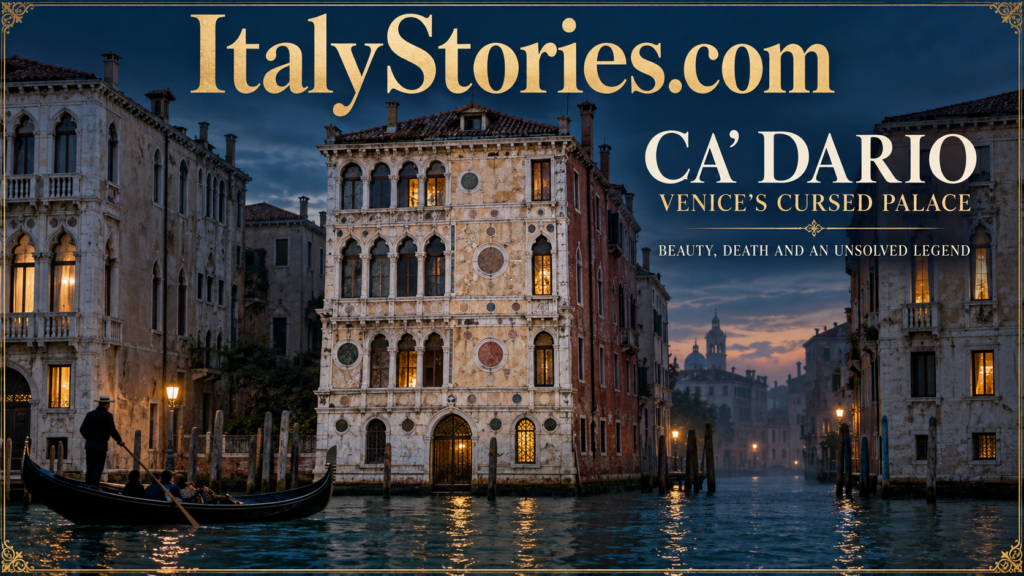
On the Grand Canal, among the magnificent palaces of Venice, there is a building that gondoliers often point out in a lowered voice. Its façade is narrow, slightly tilted and covered with circles of coloured marble. It is beautiful enough to have fascinated Claude Monet, John Ruskin and Gabriele D’Annunzio, yet it has acquired a name that no estate agent would ever choose: the house that kills.
This is Ca’ Dario, one of the most mysterious palaces in Venice. According to the legend, those who own it are condemned to financial ruin, violent death or both. Murder, suicide, accidents and bankruptcy have all been connected to its rooms. But how much of the story is true, and how much was created by Venice’s extraordinary ability to transform coincidence into legend?
The palace stands in the Dorsoduro district, between Palazzo Barbaro Wolkoff and the narrow Rio delle Torreselle, not far from the Basilica of Santa Maria della Salute. Its principal façade faces the Grand Canal, where its unusual asymmetry immediately distinguishes it from the grander and more orderly residences surrounding it.
Its story began with Giovanni Dario, a merchant, diplomat and secretary of the Venetian Senate. In 1479 he negotiated a peace agreement between the Republic of Venice and the Ottoman sultan Mehmed II, ending a long and costly conflict. His diplomatic success earned him considerable prestige in a city whose survival depended upon trade with the East.
Construction and remodelling of the palace took place during the final decades of the fifteenth century. The design is traditionally connected with Pietro Lombardo or a member of his workshop, although the precise attribution remains debated. Its architecture stands at the meeting point between Venetian Gothic and the early Renaissance.
The façade is decorated with Istrian stone and discs of porphyry, serpentine and other coloured marbles. Multi-light windows, delicate arches and geometric inlays create an appearance that is both elegant and strangely irregular. The building occupies a narrow plot, which may explain its unbalanced composition. Structural settlement has also caused it to lean slightly, adding to the impression that the palace is quietly sliding toward the canal.
At the base of the façade is a Latin inscription: “VRBIS GENIO IOANNES DARIVS,” meaning approximately “Giovanni Dario, to the genius of the city.” Centuries later, believers in the curse rearranged its letters to produce the sinister phrase “SVB RVINA INSIDIOSA GENERO,” generally interpreted as “I bring forth beneath an insidious ruin.”
It is a wonderful piece of ominous wordplay, but there is no evidence that Giovanni Dario intended any hidden warning. The threatening anagram appears to have been discovered retrospectively, after the palace had already acquired its dark reputation.
Following Giovanni Dario’s death in 1494, the building passed to his daughter Marietta, who had married Vincenzo Barbaro, a member of the family that owned the neighbouring palace. Popular versions of the curse claim that Vincenzo was financially ruined and murdered, that Marietta threw herself into the Grand Canal and that their son Giacomo was later killed on the island of Crete.
These deaths form the supposed beginning of the curse, but reliable contemporary documentation supporting the dramatic version is difficult to find. Giovanni Dario himself, whom one might expect to have been the curse’s first victim, lived to an advanced age and apparently died naturally. For centuries, numerous people occupied the palace without experiencing any unusual tragedy.
During the nineteenth century, Ca’ Dario passed through the hands of several foreign owners. One was Arbit Abdoll, an Armenian merchant involved in the precious-stone trade, who reportedly suffered financial difficulties and sold the property. In 1838 it was acquired by Rawdon Brown, a British historian fascinated by Venice. Brown later sold the palace, partly because of the enormous cost of restoring and maintaining it.
Financial trouble among the owners of a Venetian palace was not particularly mysterious. Buildings exposed constantly to salt water, humidity and structural movement could consume fortunes. Yet every sale made it easier to claim that Ca’ Dario was capable of ruining anyone who possessed it.
At the end of the nineteenth century, the palace was restored by the French aristocrat Isabelle Gontran de la Baume-Pluvinel and her companion Augustine Bulteau. Their residence became a meeting place for writers and artists. The French poet Henri de Régnier stayed there until illness interrupted his Venetian visits; the legend later counted even this ordinary misfortune as another attack by the palace.
Ca’ Dario fascinated some of Europe’s greatest observers of Venice. John Ruskin studied and painted its architecture. Gabriele D’Annunzio compared its leaning, jewel-covered appearance to that of an ageing courtesan burdened by her ornaments. The description captured the unsettling contradiction at the centre of the palace: beauty and decay occupying the same surface.
In 1908 Claude Monet painted Ca’ Dario during his only visit to Venice. As he had done with Rouen Cathedral and the Houses of Parliament in London, Monet returned to the same subject under changing conditions of light. His paintings transformed the supposedly cursed façade into colour, reflection and atmosphere.
The modern reputation of Ca’ Dario truly began to take shape after the Second World War. An American named Charles Briggs acquired the palace but later left Italy amid scandal and hostile rumours surrounding his private life. The subsequent suicide of his companion was eventually added to the growing catalogue of tragedies, despite having occurred elsewhere.
In 1964 the celebrated Italian tenor Mario Del Monaco considered purchasing Ca’ Dario. Before the transaction could be completed, he was seriously injured in a road accident. Del Monaco survived and abandoned the purchase, but storytellers decided that the palace had somehow struck a man who did not even own it.
The event that gave the legend real power occurred in 1970. Count Filippo Giordano delle Lanze, then the owner of Ca’ Dario, was murdered inside the building. He was killed by Raul Blasich, a young Croatian sailor with whom he had a relationship. Blasich fled to London, where he was himself murdered several years later.
This was no vague story inherited from the Renaissance. It was a real and recent crime committed within the palace walls. From that moment, Ca’ Dario was no longer merely an unusual old building with stories attached to it. It became the scene of a modern murder.
The next famous owner was Christopher “Kit” Lambert, the influential manager who helped guide the British rock group The Who to international success. Lambert purchased the palace during the early 1970s, attracted by its beauty and romantic atmosphere.
His years connected with Ca’ Dario coincided with worsening drug addiction, professional conflict and serious financial problems. Friends later claimed that, although he publicly dismissed the curse, he sometimes preferred to sleep elsewhere because he felt uncomfortable in the building. Lambert sold the property in 1978 and died in London in 1981 after a fall.
The palace then passed to Venetian businessman Fabrizio Ferrari, who lived there with his sister Nicoletta. Ferrari experienced financial difficulties, while Nicoletta died in a road accident. Once again, personal misfortune was absorbed into the legend, making the chain appear increasingly impossible to dismiss.
The most famous name linked with Ca’ Dario was probably Raul Gardini, one of Italy’s most powerful financiers during the 1980s. Gardini became deeply involved in the Enimont affair, one of the major corruption scandals uncovered during the Tangentopoli investigations. In July 1993, he took his own life in Milan.
Gardini did not die in Ca’ Dario, but the coincidence was irresistible. A wealthy and powerful owner had risen spectacularly, become entangled in financial and political disaster and died by suicide. The Venetian palace was blamed once more.
As the legend grew, its rules became increasingly flexible. It no longer affected only owners or residents. People who considered buying it, briefly visited it or were loosely associated with it could be included. Musician John Entwistle of The Who was later linked to the curse after his death in Las Vegas, supposedly because he had recently stayed in or rented the palace. Such distant connections reveal how legends expand: once a conclusion has been accepted, almost any event can be made to support it.
Other explanations are even more imaginative. One story claims that Ca’ Dario was built over a Templar burial ground. Another suggests that the palace is affected by mysterious energy from a neighbouring building. Neither theory is supported by historical evidence.
The simpler explanation is that Ca’ Dario has existed for more than five centuries and has passed through the hands of wealthy, complicated and sometimes controversial people. Over such a long period, deaths, illnesses, accidents and financial problems are inevitable. Venice contains many historic buildings associated with crimes and tragedies, yet few have received the same attention.
Local historians have observed that the curse became widely popular only during the second half of the twentieth century, particularly after the 1970 murder and Gardini’s suicide in 1993. Earlier stories were collected, altered and arranged into what appeared to be an unbroken chain of doom.
But a legend does not need to be literally true to influence reality. The reputation of Ca’ Dario has reportedly discouraged potential buyers, complicated sales and ensured that every new owner is examined for signs of approaching disaster. In that sense, the curse exists because people behave as though it exists.
Today, the restored palace remains an extraordinary private residence with Gothic arches, frescoed rooms, Murano chandeliers, a garden, a water entrance and one of the most recognisable façades on the Grand Canal. In 2026 it was offered for sale for a figure reported to be around twenty million euros.
Perhaps a new owner will finally break the supposed curse. Or perhaps the next ordinary misfortune will be added to the list, repeated by gondoliers and transformed into another chapter of the story.
As evening falls over the Grand Canal, Ca’ Dario reflects in the darkening water. Its marble circles resemble watchful eyes, its illuminated windows appear suspended above the canal and its leaning façade seems to carry the weight of every story told about it.
Is it truly cursed? There is no evidence that it is. But in Venice, a legend repeated for long enough can become almost as solid as stone.