

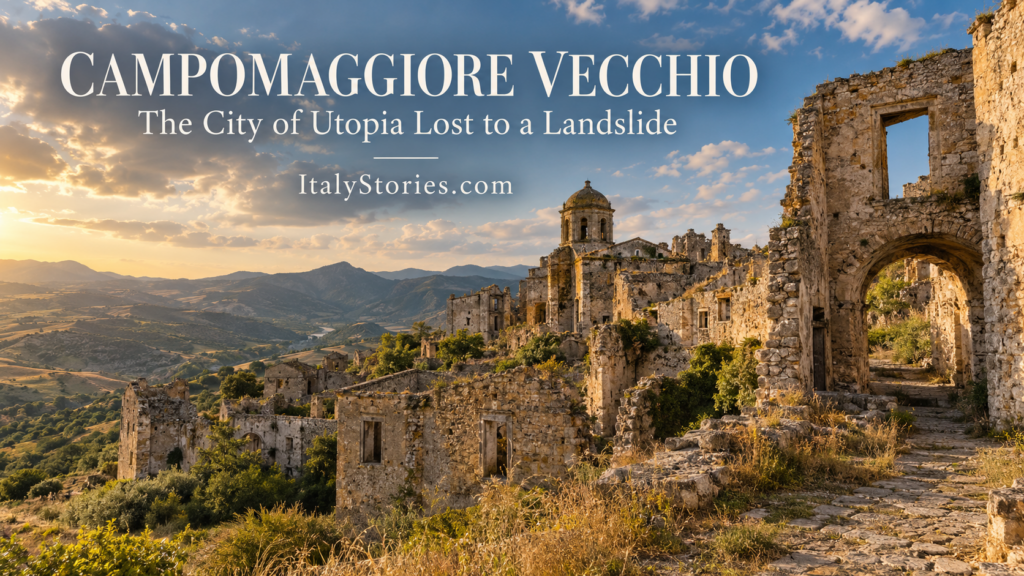
Campomaggiore Vecchio is not simply another abandoned village in southern Italy. Its roofless houses, broken arches and empty windows are the remains of a remarkable social experiment: an attempt to create an orderly, productive and surprisingly modern community in the mountains of Basilicata. For more than a century, families cultivated the surrounding land, built homes along carefully planned streets and shared the promise of a better life. Then, in 1885, the earth moved beneath them and the dream came to an abrupt end.
Today, the ruins stand in a silent landscape between Potenza and the dramatic peaks of the Lucanian Dolomites. Grass grows inside rooms where generations once ate, slept and argued. Trees rise behind walls that no longer support a roof. From a distance, Campomaggiore Vecchio may look like a village slowly consumed by time, but its abandonment was not gradual. Behind these stones lies the story of an ambitious noble family, a planned settlement, a growing community and a disaster that forced an entire population to begin again somewhere else.
A Nearly Empty Feudal Estate
The history of Campomaggiore changed in 1673, when the Rendina family acquired the feudal estate. At the time, the area was sparsely populated and difficult to develop. Basilicata was a hard land in which distances, mountains and poor roads could isolate communities for long periods. Yet the Rendina family saw agricultural potential in the territory and understood that land alone was of little value without people willing to cultivate it.
The most important phase began during the eighteenth century, particularly with Count Teodoro Rendina. Instead of waiting for the settlement to grow without direction, the family encouraged new inhabitants to move to Campomaggiore. Families were offered the possibility of obtaining a house and land to cultivate. The plan was simple but powerful: people would receive an opportunity to build a future, while their work would transform an almost deserted estate into a functioning agricultural community.
In 1741, a group of families formally committed themselves to the project. Some settlers came from other parts of southern Italy and brought useful agricultural knowledge with them, including experience in the cultivation of olive trees. The population began to grow, fields were worked and the surrounding countryside gradually became productive.
This was not a charitable experiment in the modern sense, and Campomaggiore remained part of the economic and social system of its period. Nevertheless, the relationship between landowner, village and inhabitants was unusually organised. The success of the community depended on giving families a concrete reason to remain: a home, land and the prospect that their work might improve their lives.
A Village Designed Before It Was Built
What made Campomaggiore particularly unusual was its urban plan. Many ancient Italian villages developed slowly, following the contours of a hill and creating narrow, irregular streets over the course of centuries. Campomaggiore was different. Its growth followed a deliberate design, traditionally associated with architect Giovanni Patturelli.
The streets were laid out according to a rational grid, creating regular blocks and an ordered arrangement of houses. The main public and religious buildings occupied prominent positions, while agricultural activities and spaces for animals were organised to make daily life more efficient. This geometric structure gave the village an appearance that was very different from the labyrinthine medieval settlements found elsewhere in southern Italy.
Campomaggiore later became known as the “City of Utopia.” The name should not be interpreted as evidence of a perfect society or a place without poverty and conflict. Life remained physically demanding, agriculture depended on uncertain weather and the social divisions of the period did not disappear. The village was utopian because it embodied an idea: that a community could be planned rationally and that its inhabitants could prosper through a combination of land, work and organisation.
It is sometimes claimed that Campomaggiore was directly inspired by the nineteenth-century thinkers Charles Fourier and Robert Owen. The chronology, however, makes that interpretation misleading. The Rendina project and the settlement’s principal development began before their most influential ideas became known. Campomaggiore is more accurately understood as a local expression of eighteenth-century reforming ambitions, shaped by the practical needs of the territory rather than copied from a later philosophical model.
The Dream Begins to Work
The experiment produced visible results. From a tiny settlement, Campomaggiore grew into a community of more than a thousand inhabitants. Olive cultivation became important, agriculture expanded and the village acquired the buildings and services needed for a stable civic life. Houses, a church, a palace, workshops, fountains and public spaces turned the original plan into a real town.
This growth is essential to understanding the tragedy that followed. Campomaggiore Vecchio was not a failed settlement already approaching extinction. It was a living town whose inhabitants had invested generations of labour in their homes and land. Its streets were filled with children, farmers, craftsmen and animals. Religious celebrations marked the calendar, while family stories became tied to particular houses, fields and corners of the village.
The Rendina family’s original vision had become part of the identity of Campomaggiore. The settlement demonstrated that even an isolated area could attract people and grow when land and opportunity were offered together. What began as a plan on paper had developed into a functioning community with its own routines, traditions and memories.
But the ordered streets concealed a danger that no social plan could control. The village had been built on unstable ground.
The Earth Gives Its Warning
The hills of Basilicata are beautiful, but their geological structure can be fragile. Landslides have repeatedly altered villages, roads and cultivated land across the region. Campomaggiore was not protected from this danger, and during the nineteenth century signs of instability became increasingly difficult to ignore.
Cracks reportedly appeared in buildings and sections of the ground began to move. The inhabitants understood that something was happening beneath their homes, although predicting the scale and timing of a landslide was almost impossible with the knowledge and instruments available at the time.
Local tradition adds a more dramatic element. According to a story passed down through generations, animals sensed the danger before people fully understood it. Mules are said to have refused to continue across unstable ground, while warnings connected with the Madonna del Carmelo entered the village’s collective memory. Such accounts belong partly to legend, but they reveal how communities explain catastrophe: natural signs, religious faith and human recollection become inseparable.
What is certain is that in February 1885 a major landslide struck Campomaggiore Vecchio. Buildings collapsed or were left severely damaged, the ground opened and the town could no longer be considered safe. The inhabitants were forced to leave the streets and houses that had represented the success of more than a century of work.
The City of Utopia had been defeated not by political conflict or economic failure, but by the land on which it stood.
Leaving an Entire Life Behind
The most painful aspect of the disaster was not simply the destruction of buildings. A house can be measured in stone, timber and square metres, but a home contains things that cannot be calculated: the marks left on a doorway, the memory of a wedding, the kitchen where a family gathered, the view from a window opened every morning.
The people of Campomaggiore had to abandon all of this. Objects could be carried away, but walls, streets and fields could not. The organised village created by their ancestors became a dangerous landscape of fractured buildings and unstable earth.
A new Campomaggiore was eventually constructed several kilometres away on safer ground. Significantly, the new settlement preserved something of the rational spirit of the old one, including an orderly street plan. The inhabitants therefore did not simply erase their past. They carried the identity of the original town into a new location, rebuilding the community even though the physical heart of the old village had been lost.
Campomaggiore Vecchio remained behind. With no families to repair roofs, clear vegetation or maintain the streets, weather and time continued the work begun by the landslide. Roofs disappeared, interiors opened to the sky and nature entered the abandoned houses.
Walking Through the City of Utopia Today
Visiting Campomaggiore Vecchio is a strange experience because the village is neither completely dead nor truly alive. Its buildings have lost their original purpose, yet their arrangement still tells the story of the people who designed and inhabited them. The grid of the streets can still be understood, and the surviving walls reveal the scale of what once existed.
Unlike a conventional archaeological site, Campomaggiore does not belong to a remote civilisation. Its abandonment occurred recently enough for the ruins to feel familiar. These were recognisable homes, public buildings and village spaces. The distance between the visitors of today and the inhabitants of 1885 is measured in only a few generations.
The surrounding landscape adds to the atmosphere. The Lucanian hills stretch beyond the ruins, beautiful and indifferent. In spring and summer, plants and grasses soften the broken stone. At sunset, the remaining walls cast long shadows and the empty windows frame portions of sky. It is easy to understand why Campomaggiore has become one of Basilicata’s most evocative hidden places.
The old village has also found a new cultural purpose. Artistic projects, performances and events have occasionally brought people back among the ruins, allowing contemporary creativity to enter a place shaped by memory. This does not restore the vanished town, but it prevents silence from becoming complete oblivion.
More Than an Italian Ghost Town
Italy contains many abandoned villages, some emptied by earthquakes, others by landslides, poverty, migration or the gradual disappearance of work. Campomaggiore Vecchio is different because its ruins preserve both the birth and the destruction of a dream.
The village began with a decision to create opportunity in an almost empty territory. It grew through planning, agricultural knowledge and the labour of families who believed they could build a future there. Its rational streets represented confidence in human organisation. Its destruction revealed the limits of that confidence when confronted by nature.
Calling Campomaggiore the City of Utopia does not mean that life there was perfect. Its true importance lies in the attempt. Long before modern discussions about planned communities, rural development and the revival of Italy’s interior regions, Campomaggiore tried to connect land, housing and work in a single social project.
That question remains surprisingly current. Across Italy, many inland towns are once again searching for ways to attract inhabitants, protect their traditions and create sustainable local economies. Campomaggiore Vecchio therefore belongs not only to the past. Its rise and fall speak directly to the future of small Italian communities.
Among its empty windows and roofless rooms, the old village still preserves the outline of a possibility. The landslide destroyed the streets, but it did not completely erase the idea on which they had been built.
Campomaggiore Vecchio reminds us that even a lost city can continue to tell its story. Follow ItalyStories.com to discover more forgotten places, remarkable people and extraordinary chapters from Italy’s past.