

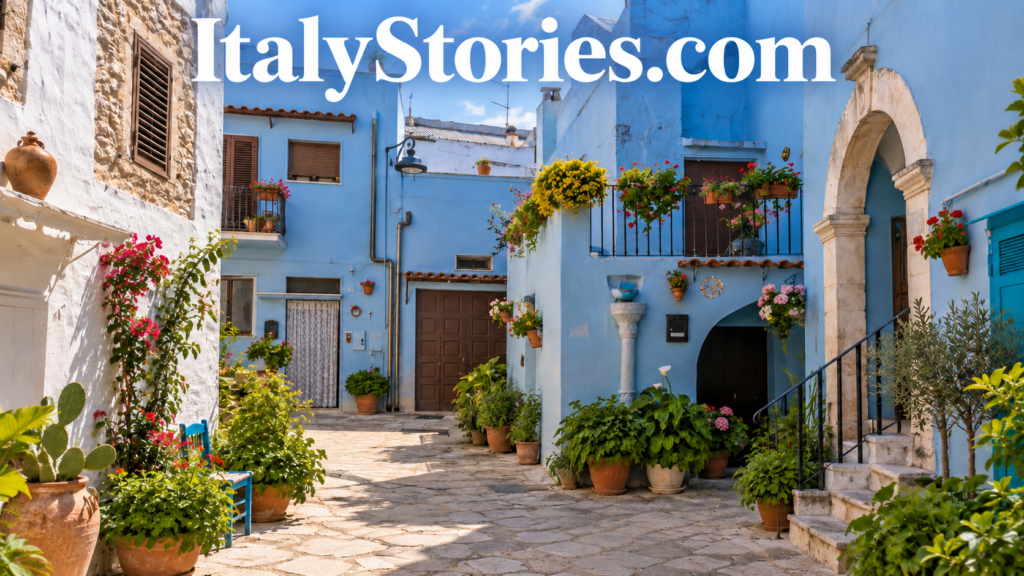
Puglia is famous for whitewashed villages, ancient olive trees, conical trulli and towns that seem to have been carved directly from pale limestone. Yet only a short distance from Bari, there is a place that breaks almost every rule. Its old houses are not simply white, its narrow alleys are not crowded with souvenir shops, and its name rarely appears on the classic tourist itineraries. Casamassima is known as Puglia’s Blue Village, a small and surprising historic town where walls, doors, courtyards and stairways are painted in countless shades of sky blue, turquoise and faded indigo.
Casamassima lies about twenty kilometres south of Bari, at the foot of the Murge hills. The modern town is larger and busier than the photographs might suggest, but its historic heart preserves a completely different atmosphere. Passing through the Clock Gate, the main entrance to the old quarter, feels like stepping into a secluded world. The streets become narrower, the buildings lean closer together and fragments of blue begin to appear on walls softened by time. Some façades are bright and freshly painted, while others reveal faded layers of colour beneath worn plaster, giving the village a beauty that feels genuine rather than carefully manufactured for visitors.
The most fascinating part of Casamassima is the Scesciola district. Its name is traditionally associated with an Arabic word suggesting a labyrinth, an appropriate description for a neighbourhood made of twisting lanes, tiny courtyards and houses built almost one against another. These were once modest homes belonging largely to farmers and labourers. Many had a room at street level, another room above it and an external stone staircase known locally as a “vignale.” Wooden boards were sometimes placed outside the windows to dry figs and other produce beneath the strong Puglian sun. Today, geraniums, climbing plants, ceramic plates and terracotta pots brighten the old walls, creating the intimate scenes for which Casamassima has become increasingly admired.
But why is the village blue? According to the best-known local tradition, the story began during the seventeenth century, when a devastating plague reached Bari and threatened the surrounding countryside. Michele Vaaz, the feudal lord of Casamassima, is said to have prayed to the Madonna of Constantinople, asking that the town be spared. He then ordered the houses to be covered with lime mixed with blue pigment, recalling the colour of the Virgin Mary’s mantle. Lime was widely used for sanitation, while the blue transformed the town into a visible symbol of protection and devotion. Casamassima reportedly escaped the worst of the epidemic, and the colour remained as a sign of gratitude.
It is a beautiful story, although history is rarely as tidy as legend. Studies of the surviving paint layers suggest that some of the blue pigments visible today may have appeared during later periods. The plague tradition should therefore be understood as part of Casamassima’s cultural memory rather than as a completely documented explanation. What is certain is that blue became the defining colour of the old town. During the twentieth century, the Milanese painter Vittorio Viviani was so impressed by its unusual appearance that he described Casamassima as “the Blue Village,” a name that has remained attached to it ever since.
The comparison with Chefchaouen in Morocco is almost inevitable, and Casamassima is sometimes called “the Italian Chefchaouen.” The resemblance is understandable, but the Puglian village has its own character. Its blue is interrupted by warm limestone, brown wooden doors, iron balconies and the brilliant colours of flowers. Nothing appears perfectly uniform. Every wall has a slightly different tone, every doorway carries the marks of age, and every small courtyard reveals the personality of the people who live there. This imperfection is precisely what makes the old quarter so appealing.
Among the most photographed corners are Via Paliodoro and Chiasso Bongustai, where blue façades, external staircases and flower-filled balconies create some of the village’s finest views. The Clock Gate, enlarged during the nineteenth century and topped by its small tower, provides a natural starting point. Nearby stand the Church of Purgatory and the old town’s principal square. Deeper inside the historic centre are the Mother Church of Santa Croce, the former Monastery of Santa Chiara and the building commonly called the Castle, although it is more accurately described as an aristocratic palace connected to the feudal families who once governed Casamassima.
Casamassima is not a destination filled with grand attractions requiring an entire day. Its pleasure comes from wandering slowly, looking through archways, noticing old stone steps and discovering how the light changes the colour of the walls. In the morning, the façades can appear almost white beneath the intense sun. Later in the day they become deeper and softer, shifting from pale blue to turquoise and occasionally to violet. It is a place to explore without rushing, allowing the narrow streets to decide the route.
Its relative obscurity is part of its charm. While Alberobello, Polignano a Mare and the famous white towns attract large numbers of visitors, Casamassima often remains outside the busiest routes. This means that the old quarter still feels like a lived-in neighbourhood rather than an open-air museum. Laundry may hang above the street, doors remain open, plants occupy every available corner and residents continue their daily routines behind the blue walls.
Casamassima is a worthwhile stop for anyone travelling through central Puglia, particularly for those looking for something different from the region’s most familiar images. It does not need monumental splendour or dramatic scenery to be memorable. A few narrow streets, some weathered houses and an unexpected colour are enough. In a region famous for villages dressed in white, Casamassima quietly chose blue—and created one of Puglia’s most unusual hidden treasures.