

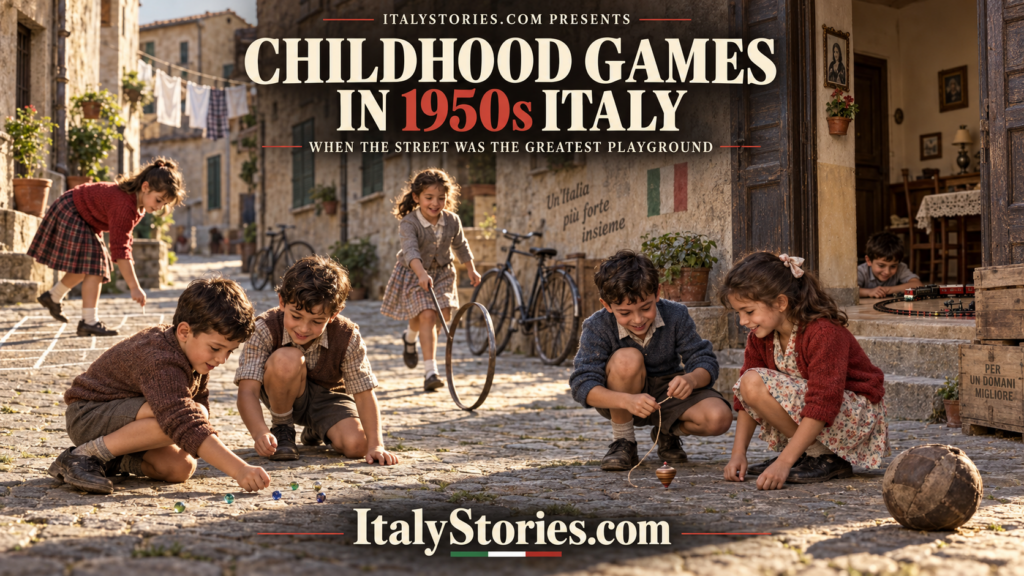
Childhood games in 1950s Italy belonged to a world in transition. The war had ended only a few years earlier, many families still lived with very little, and the economic miracle that would transform the country had not yet reached every home. Italy was modernising, but it was doing so unevenly. In the great northern cities, factories were attracting thousands of workers from the countryside and the South; in provincial towns, life continued at a slower pace; in rural villages, children still grew up among fields, animals and seasonal work. Toys existed, of course, and some were beautifully made, but for a large part of the population childhood entertainment did not come from crowded bedrooms full of objects. It came from the street, the courtyard, the parish square, the schoolyard and an extraordinary ability to transform almost anything into a game.
A piece of chalk could create a world on the pavement. A bottle cap could become a racing car, a broomstick could become a horse, and two stones could mark the goalposts of a football pitch. Children did not need an official playing field, carefully written instructions or an adult to organise every afternoon. They invented rules, negotiated disputes, formed teams and continued playing until a mother’s voice came from a window announcing that dinner was ready. The games were simple, but the afternoons rarely were.
An Italy Relearning How to Live
The children of the 1950s were the first Italian generation to grow up entirely after Fascism and the Second World War. Their parents had experienced bombing, displacement, military service, food shortages and political upheaval. Many houses had been damaged, family savings had disappeared and entire communities were rebuilding themselves materially and emotionally.
The decade is often remembered through elegant photographs of Vespas, cinemas, new household appliances and fashionable young people strolling through Rome, but daily life for many families remained difficult. Homes could be small and overcrowded. Several children might share one bedroom, while heating was limited and bathrooms were not always inside the house. Clothes were passed from an older brother or sister to a younger one, then repaired until there was very little original fabric left to recognise. Shoes were expected to last, schoolbooks were treated carefully, and breaking a toy was not a minor inconvenience when replacing it could be impossible.
This scarcity did not prevent children from playing. It shaped the way they played. A toy was rarely discarded simply because one piece was missing. It was repaired, modified or used for something entirely different. Adults fixed wheels, straightened metal parts and carved replacement components from wood. Older children taught games to younger ones, and the same spinning top, doll or ball might pass through several members of a family.
There was also no single Italian childhood. The experience of a child in Milan or Turin could be very different from that of one growing up in a Sicilian village, a Tuscan farmhouse or a fishing community on the Adriatic coast. Dialects changed from one town to the next, and the names and rules of games changed with them. Yet certain experiences were shared across the country: the street as a meeting place, the importance of imagination and the almost complete absence of the organised entertainment that surrounds children today.
The Street as a Playground
The street was not simply the route between home and school. It was a social space in which children learned to recognise neighbours, understand local hierarchies and make their own place within the group. Traffic was growing, especially in the cities, but there were still far fewer cars than today. A courtyard, alley or small square could therefore become a football field, a racecourse or the stage for an imaginary adventure.
Adults were present without necessarily supervising every movement. A shopkeeper, a grandmother sitting near a doorway or a woman hanging laundry from a balcony might notice what the children were doing. This informal community surveillance gave them considerable freedom while ensuring that somebody usually knew where they were. It was far from perfect, and accidents certainly happened, but the boundary between the private home and the public street was more porous than it is today.
Children formed groups that included different ages. The older ones controlled the rules, settled arguments and sometimes exploited their authority shamelessly. The younger ones watched, waited and learned. Being selected for a team was a small triumph; being ordered to retrieve a ball from beneath a parked vehicle was one of the less glorious duties of childhood.
Arguments were part of every game. A marble had crossed the line. A player had moved before the signal. A goal should not count because the ball had passed above the imaginary crossbar. These disputes could become loud and dramatic, but they were also lessons in negotiation. There was no adult referee to consult. The children had to solve the problem themselves or watch the entire game collapse.
Marbles, Chalk and Dusty Knees
Marbles were among the most accessible and beloved playthings. Glass marbles were treasured for their colours, but clay, stone or improvised substitutes could also be used. Children created tracks in the earth, dug small holes or drew circles on the ground. Depending on the local rules, the objective might be to strike an opponent’s marble, complete a course with the fewest shots or win the pieces lying inside a marked area.
A particularly beautiful marble could become a form of currency. It might be exchanged, displayed or risked in a match. Winning was therefore more than symbolic: a skilled player could return home with a pocket full of trophies, while an unlucky one had to explain why the collection had suddenly disappeared. Parents did not always admire this early introduction to high-stakes competition.
Hopscotch, known in Italy by several regional names but commonly called campana, required almost nothing. A pattern of numbered squares was drawn with chalk or scratched into the ground. A small stone was thrown into one section, and the player had to move through the course on one foot without touching the lines. The rules were simple enough for small children but demanding enough to produce serious rivalries.
The game required balance, precision and concentration, yet it also left room for endless variations. Every neighbourhood seemed to have its preferred design and its own interpretation of what counted as a mistake. Rain could erase the court in minutes, but another one would appear as soon as the pavement dried.
The spinning top, or trottola, was another familiar object. Traditionally made from wood and fitted with a metal point, it was launched by winding a cord around the body and pulling it sharply. Success depended on speed, angle and practice. A well-thrown top could spin with an almost hypnotic stability, while an inexperienced attempt might send it jumping unpredictably toward someone’s ankle.
Children competed to see whose top would spin longest or tried to strike another top inside a circle. Some decorated the wood with coloured rings that seemed to blend as it turned. The toy was mechanically simple, but mastering it brought the satisfaction that modern games often replace with instructions, buttons and automatic movement.
Hoops, Lippa and Games of Skill
Rolling a hoop along the street was a familiar sight. The hoop might be manufactured, but it could also be taken from an old barrel or created from a piece of metal. The child guided it with a stick or bent wire, running beside it and trying to keep it upright. Races demanded coordination and speed, especially on uneven cobblestones where a moment’s distraction could send the hoop into a doorway.
Another widespread traditional game was lippa, played with a long stick and a shorter wooden piece sharpened at both ends. A player struck one end of the small piece to make it jump into the air, then hit it again to send it as far as possible. Regional versions used different rules and names, but the essential idea was ancient and remarkably persistent.
Lippa demanded skill, timing and a generous amount of open space. It could also be dangerous. A badly directed piece of wood had little respect for windows, passers-by or younger brothers. The game belonged to an age in which children were allowed to experiment with objects that would cause considerable alarm today.
Bottle caps offered a safer form of competition. Children collected metal caps, sometimes decorating them with paper portraits of cyclists or footballers. The caps became racing competitors on tracks drawn in dust, sand or chalk. Players flicked them forward with a finger, trying to negotiate bends without leaving the course.
During the years when Fausto Coppi and Gino Bartali divided Italian sporting loyalties, even a humble bottle-cap race could become a miniature Giro d’Italia. The route might include mountain stages represented by small piles of earth, narrow passages between stones and dangerous curves around drain covers. The commentary was supplied by the children themselves, at a volume capable of making a tiny race sound like a national event.
Football Without a Football Field
No account of Italian childhood could ignore football. In the 1950s, as today, the sport was much more than a game, but young players did not require proper pitches, matching shirts or expensive boots. Any open space could be used, and almost any vaguely round object could become a ball.
A real leather football was precious and could become heavy when wet. Many children played with rubber balls or improvised versions made from cloth, paper and string. Goalposts were represented by stones, schoolbags, jackets or two marks on a wall. The absence of a crossbar created endless disputes, particularly when a powerful shot sailed well above the goalkeeper’s head.
Teams were selected through improvised systems, and the strongest players were usually chosen first. The youngest child was often placed in goal, partly because nobody else wanted the position and partly because the older children believed he would cause less damage there. Matches ended not after ninety minutes but when darkness arrived, a window was broken, the ball disappeared over a wall or its owner was ordered home.
The great champions of the period inspired imitation. Children argued about clubs and players, recreated famous goals and dreamed of stadiums they had never visited. Radio commentaries allowed imagination to supply the images, making football sound heroic even inside a modest kitchen.
Hide-and-Seek, Blind Man’s Buff and Imaginary Adventures
Hide-and-seek, nascondino, transformed familiar surroundings into a landscape of secret passages and forbidden territory. Doorways, staircases, carts, trees and low walls offered hiding places, although the best locations were quickly claimed by older children. The player who was “it” counted against a wall while everyone scattered, then tried to find the others before they could race back and touch the base.
Blind man’s buff, mosca cieca, required only a cloth to cover the eyes. The blindfolded player attempted to catch and identify the others while they moved around, laughed and occasionally offered misleading sounds. It was simple, chaotic and usually played in a space containing at least one object capable of being knocked over.
Games such as guardie e ladri turned children into police officers and thieves, while cowboys and Indians reflected the enormous popularity of American Westerns in cinemas and comic books. From a modern perspective, some of those imaginary worlds appear simplistic or culturally insensitive, but they reveal how strongly popular cinema shaped children’s fantasies.
Comic books were widely exchanged and read until the pages became soft and covers disappeared. A child who had seen a Western film or read an adventurous story could bring the entire plot into the courtyard the following afternoon. Wooden swords, cardboard shields and broom-handle rifles completed the transformation. No batteries were required; only someone willing to accept the less desirable role of the villain.
“One, two, three, star”—uno, due, tre, stella—tested a different kind of control. One child faced a wall and recited the phrase while the others moved forward. When the leader turned around, everyone had to remain perfectly still. Anyone caught moving returned to the starting point. The tension came from trying to freeze immediately, often in a ridiculous position, while resisting the temptation to laugh.
Dolls, Domestic Games and the Expectations Placed on Girls
Girls participated in many street games, including campana, skipping rope, hide-and-seek and races, but 1950s society also channelled them toward activities intended to prepare them for domestic life. Dolls, miniature kitchens, sewing sets and toy household objects reflected the expectation that women would become mothers and homemakers.
Not every family could afford an elaborate doll. Some were made from cloth, wool, corn husks or other available materials. A damaged doll might receive a handmade dress, a repaired arm or a new hairstyle created by an older sister. The care invested in these objects gave them a value that had little to do with their price.
Pretend households reproduced the adult world in miniature. Children organised imaginary meals, weddings, schools and shops. A row of stones became food, leaves became plates and pieces of paper became money. These games allowed children to imitate the authority they observed around them, sometimes with an accuracy that adults might have found uncomfortable.
The division between boys’ and girls’ toys was strong, but everyday play was less rigid than advertising and social convention suggested. Sisters joined football games; brothers were recruited into imaginary families; groups changed according to who lived nearby and who had been allowed outside. Children have always been more inventive than the categories designed for them.
Skipping rope and elastic games combined rhythm, memory and physical coordination. Rhymes differed across regions and were transmitted orally, often changing from one generation to the next. The words did not always make logical sense, but that was part of their charm. A rhyme could survive for decades even when nobody remembered what it originally meant.
The Dream of the Electric Train
For children who received one, the electric train was among the most magical toys of the period. It combined movement, electricity, engineering and imagination. A circle of track laid on the floor could become an entire national railway, with stations, tunnels, signals and carefully planned timetables. The child operating it was simultaneously driver, stationmaster and director of a transport empire occupying most of the living room.
Italian manufacturers helped turn model railways into objects of technical fascination. Rivarossi, founded in 1945, became famous for detailed locomotives and rolling stock. Its products reflected the optimism of a country rebuilding its railway system and industrial capacity. Electric trains were admired by children, but often just as enthusiastically by their fathers, who might insist that the model was educational while gradually taking complete control of it.
These sets were not available to every household. They were relatively expensive, especially when additional track, carriages and scenery were added. For many children, an electric train was something seen in a shop window, in a catalogue or in the home of a wealthier friend. Possessing one could make a child temporarily very popular, particularly during winter afternoons.
The train therefore represents one side of 1950s childhood: the beginning of a new consumer society. It stood between traditional improvised play and the increasingly sophisticated toys that would fill Italian homes during the economic boom.
Construction sets appealed to the same mechanical curiosity. Metal components, screws, wheels and perforated strips could be assembled into cranes, bridges or vehicles. They demanded patience and sometimes adult assistance, but they encouraged children to understand how objects were built. A finished model was rarely the end of the game. It could be dismantled and transformed into something new.
Tin Toys, Toy Soldiers and Small Machines
Italian shops also sold tin cars, motorcycles, aeroplanes, wind-up animals and toy soldiers. Some were brightly lithographed, while others were simpler and more affordable. A key wound a spring mechanism that made the toy move, often noisily and not always in the direction expected.
Pedal cars, scooters and miniature vehicles were particularly desirable. They imitated the adult world at a time when cars, motorcycles and Vespas were becoming symbols of freedom and progress. A child driving a pedal car through a courtyard could imagine taking part in the Mille Miglia, even if the vehicle’s maximum speed depended entirely on small legs and a forgiving surface.
Toy soldiers were arranged into elaborate battles across floors and garden paths. The memory of real war was still painfully close, yet military toys remained common. For children, the figures could belong as much to cinema and adventure stories as to recent history. Adults, however, may have watched those games with emotions their children could not yet understand.
Small toy shops became windows onto the future. A child could spend a long time studying objects that were unlikely to be purchased. Christmas, Epiphany, a birthday or a First Communion might provide the rare opportunity for an important gift. Anticipation was part of the experience, and the dreamed-of toy often occupied the imagination long before it entered the home.
Games Around the Family Table
Not all play took place outside. Winter evenings brought families together around tables for cards, checkers, dominoes, the Game of the Goose and tombola. These activities included adults, children and grandparents, creating a bridge between generations.
Card games varied by region, as did the decks themselves. Neapolitan, Piacentine, Sicilian and other regional cards carried their own imagery and traditions. Children learned by watching before being permitted to participate. Rules were explained with great seriousness, and accusations of cheating could disturb the domestic peace as effectively as any street-football dispute.
Tombola was especially associated with Christmas gatherings. Numbers were drawn from a bag, players covered matching spaces on their cards, and relatives competed for small prizes. In Naples, the traditional association between numbers and meanings added another layer of humour and superstition.
Board games offered a more structured form of entertainment. The Italian edition of Monopoly, adapted as Monopoli, had existed before the war and became increasingly familiar during the postwar period. The game’s property deals and paper money introduced children to a fantasy of wealth at a time when many real families were counting every lira.
Radio, Cinema and the Arrival of Television
At the beginning of the decade, radio remained the central electronic medium in many Italian homes. Children listened to songs, dramatic stories, variety programmes and sporting events. The voices emerged from the radio, but the images belonged entirely to the listener. A sound effect could create a storm, a train or a distant battlefield more convincingly than any improvised toy.
Cinema offered another escape. Children attended afternoon screenings, parish cinemas and local theatres where adventure films, comedies and Westerns created new heroes. The stories did not remain inside the cinema. They continued in the streets, where children repeated dialogue, reconstructed scenes and argued over who would play the leading role.
Regular Italian television broadcasting began on 3 January 1954, but television sets were initially expensive and rare. Watching television could therefore become a collective occasion. Families gathered in cafés, parish halls or the homes of neighbours fortunate enough to own a set. Chairs were arranged, children sat on the floor, and a small black-and-white screen commanded the attention of an entire room.
Television did not immediately end street play. During most of the 1950s, it was still a scheduled event rather than a constant presence. But it began to change children’s imagination and their desires. Carosello, launched in 1957, combined entertainment with advertising and introduced memorable characters while presenting consumer goods as part of modern family life.
Children now wanted not only what they saw in shop windows but also what appeared on the screen. The relationship between play and commerce was beginning to change. The toy did not need to be discovered in a local shop; it could enter the home first as an image and a promise.
The End of the Decade and the Beginning of a New Childhood
By the late 1950s, Italy was moving rapidly into its economic miracle. Industrial production increased, internal migration transformed cities, wages rose for many workers and household consumption expanded. More families bought refrigerators, washing machines, scooters and eventually cars and televisions. Children’s products became a growing market.
Toys were increasingly advertised, branded and produced in large numbers. Plastic allowed manufacturers to create colourful objects more cheaply than before. Bedrooms gradually filled with manufactured entertainment, while growing traffic made streets less available for spontaneous play.
The change was neither immediate nor universal. Traditional games continued for decades, especially in smaller towns and working-class districts. Yet the direction was clear. Childhood was becoming more private, more supervised and more closely connected to consumer culture.
Something was gained: safer toys, broader educational opportunities and access to forms of entertainment that earlier generations could scarcely imagine. Something was also lost: the daily freedom to invent a game from nothing, the mixing of age groups and the familiarity created when every doorway and courtyard belonged to a shared community.
Not a Perfect Childhood, but an Unforgettable One
Nostalgia can soften the difficult parts of the past. Childhood in 1950s Italy was not universally carefree. Poverty limited opportunities, gender expectations restricted girls, disability was poorly accommodated and some children worked when they should have been studying or playing. Discipline at home and school could be severe. Streets were free spaces, but they were not automatically safe.
It would therefore be misleading to claim that everything was better. What deserves to be remembered is not hardship itself but the creativity with which children responded to limited resources. They knew how to construct entertainment, share objects and turn ordinary surroundings into imaginary landscapes.
A courtyard could become a stadium. A bottle cap could win the Giro d’Italia. A chalk line could mark the border of a kingdom. A circle of electric railway track could connect an entire miniature nation. The value of a game did not depend on how much it cost but on how completely children believed in it.
Those boys and girls grew up while Italy itself was growing up. They witnessed the arrival of television, the spread of motor vehicles, the expansion of industry and the transformation of family life. Their games preserve the memory of the country just before abundance became an expectation and entertainment became a product available at the touch of a button.
Perhaps that is why these simple objects still carry such emotional power. A glass marble, a wooden spinning top or a metal train can bring back the sound of voices in a courtyard, the smell of dinner drifting through an open window and the last golden light of an afternoon that seemed capable of lasting forever.
Follow ItalyStories.com to discover more stories about Italian traditions, everyday life and the memories that helped shape modern Italy.