

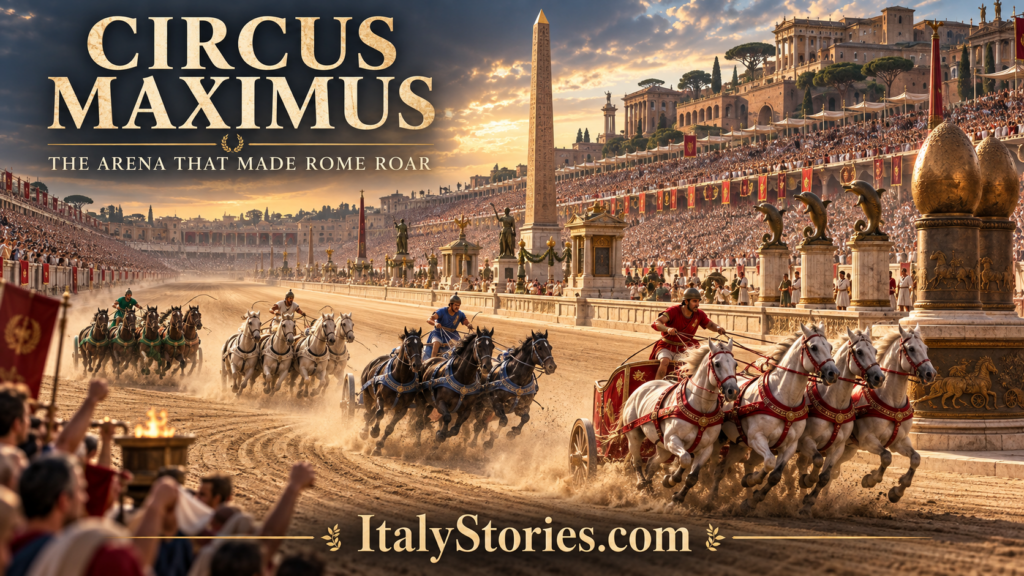
The Circus Maximus was not simply the largest stadium in ancient Rome. It was the place where an entire civilization gathered to celebrate, gamble, worship, argue and lose itself in the speed of horses. Between the Palatine and Aventine hills, hundreds of thousands of spectators could watch chariots hurtle around the track while emperors, senators, merchants, soldiers, slaves and ordinary citizens shouted for the same colours.
Today the arena appears almost empty. Its enormous outline survives as a long green valley, bordered by roads, trees and scattered ruins. Visitors walking across it may struggle to imagine the noise that once filled the air. Yet for more than a thousand years, this was one of the most powerful stages of Roman life.
The Colosseum has become the universal symbol of Roman entertainment, but the Circus Maximus was older, larger and capable of attracting an audience several times greater. Chariot racing was not a secondary amusement. It was Rome’s most popular mass sport, supported by professional teams, wealthy patrons, obsessive fans and enormous financial interests.
A day at the Circus combined the atmosphere of a modern championship final, a political rally, a religious festival and a dangerous motor race. The spectacle could last from morning until evening, and the crowd’s roar was said to be heard across the city.
A Racetrack Shaped by the Landscape
The Circus Maximus occupied the Valley of Murcia, a natural depression between the Palatine Hill and the Aventine Hill. Long before stone grandstands surrounded it, the valley offered an obvious place for public gatherings and horse races. Its elongated form created a natural track, while the hillsides provided elevated positions from which spectators could watch.
In Rome’s earliest centuries, the area was probably still partly agricultural and vulnerable to flooding. A stream crossed the valley, and drainage remained an important challenge as the site developed. The first spectators may simply have stood along the slopes or sat on temporary wooden platforms.
The Romans did not impose the arena upon an empty landscape in a single construction campaign. They gradually transformed a natural valley into the greatest entertainment complex of the ancient world. Each generation added gates, seats, shrines, shops, monuments and new architectural structures.
The final result was approximately 600 metres long and around 140 metres wide. Capacity remains uncertain. Ancient writers sometimes offered figures exceeding 250,000 spectators, while modern estimates are generally more cautious. Even allowing for exaggeration, the Circus could probably accommodate at least 150,000 people at its peak—far more than the Colosseum.
Its true scale can still be understood by walking from one end to the other. What appears manageable from the Palatine becomes immense at ground level. The surviving field is not simply where the arena stood; it preserves the original space of the track itself.
Romulus, the Sabine Women and Rome’s Founding Violence
The oldest story associated with the Circus Maximus reaches back to Romulus and the legendary foundation of Rome.
According to Roman tradition, the first community created by Romulus had many male inhabitants but too few women to guarantee its future. Neighbouring peoples refused to allow their daughters to marry the Romans. Romulus therefore organized a festival in honour of the god Consus and invited the surrounding communities to attend.
During the celebration, at a prearranged signal, Roman men seized the young Sabine women among the spectators. The episode, remembered as the Rape or Abduction of the Sabine Women, became one of the central legends of early Rome.
The story is not reliable history in the modern sense. It was a foundation myth through which the Romans attempted to explain the merging of different peoples and the violence surrounding the birth of their city. Nevertheless, Roman writers placed the event within the valley later occupied by the Circus Maximus.
This legendary connection gave the site a significance that extended beyond sport. The Circus stood in a landscape associated with Rome’s origins, religious festivals and the dangerous relationship between spectacle and political power.
Tradition also credited the Etruscan king Tarquinius Priscus with organizing early public games in the valley. The precise details cannot be confirmed, but the Circus undoubtedly developed from rituals and competitions held during the monarchy and early Republic.
Before it became an architectural machine for mass entertainment, it was sacred ground.
From Wooden Benches to an Imperial Stadium
The earliest installations were temporary. Wooden seats and viewing platforms could be erected for a festival and removed or rebuilt afterwards. Permanent starting gates, known as carceres, are recorded by the late fourth century BC.
As Rome expanded, the Circus grew with it. Successful wars brought wealth, enslaved labour and exotic animals into the city. Public games became increasingly elaborate, and politicians discovered that sponsoring spectacular entertainment could win popular support.
Julius Caesar carried out a major enlargement during the first century BC. The seating was extended and the track developed into the monumental shape recognized in later imperial times. The Circus became an enclosed stadium rather than a valley loosely adapted for racing.
Augustus understood its political value perfectly. He added an Egyptian obelisk to the central barrier and created an imperial viewing area connected symbolically with the palace on the Palatine. The emperor could appear before the Roman people without descending into the crowd, visible as both ruler and patron of the games.
Fires repeatedly damaged the Circus because large parts of the seating and the surrounding commercial areas were constructed from wood. Successive emperors rebuilt it using more durable materials. Trajan’s reconstruction in the early second century AD helped give the stadium the monumental form associated with its greatest period.
Stone and concrete supported multiple levels of seating. Exterior arcades contained entrances, stairways, workshops, food stalls and shops. Vast circulation routes allowed spectators to reach their places and leave after the events.
The Circus was not just a track with benches around it. It was one of antiquity’s greatest machines for controlling crowds.
The Procession Before the Race
A day at the Circus began with ceremony. Before the horses ran, a procession known as the pompa circensis entered the arena.
Magistrates, musicians, dancers, priests, athletes and charioteers advanced before the spectators. Images of the gods were carried on ceremonial vehicles or displayed upon sacred platforms. The procession connected the games with Roman religion and reminded the audience that public entertainment formed part of the relationship between the city and its gods.
The races were not originally secular sporting events in the modern sense. They were presented during religious festivals, and the success of the games could be understood as a sign of divine favour.
The procession also gave the crowd an opportunity to inspect the competitors. Famous charioteers received cheers, while unpopular drivers or rival factions heard insults. Horses were admired for their appearance, pedigree and past victories.
By the time the chariots approached the starting gates, anticipation had been carefully intensified. The race was only a few minutes long, but the ceremony surrounding it could transform those minutes into the emotional centre of an entire day.
The Starting Gates
At one end of the Circus stood the carceres, a line of starting boxes arranged in a slight curve. The design helped compensate for the different distances between each gate and the first turn.
The chariots waited behind closed doors while attendants controlled the horses. A team of four horses—a quadriga—was powerful, nervous and difficult to hold still. The driver had to prevent the animals from wasting energy or becoming tangled before the race even began.
The presiding magistrate gave the signal by dropping a white cloth called the mappa. The gates opened together, and the chariots surged onto the track.
That first acceleration could immediately create chaos. Drivers fought to obtain the best position near the central barrier, where the route around the stadium was shortest. Too far outside, and a chariot travelled a greater distance. Too close to the turning posts, and a minor miscalculation could destroy horses, vehicle and driver.
Victory depended on speed, but also on position, patience and tactical aggression.
Seven Laps Around the Spina
The track was divided by a long central barrier conventionally called the spina, meaning “spine.” It was not merely a low wall. At various times it carried temples, shrines, statues, columns, fountains and imperial monuments.
The chariots raced around this central structure for seven laps. Spectators needed to know how many remained, so large counters were used. One set took the form of eggs, probably connected symbolically with Castor and Pollux, the divine twins associated with horses. Another used bronze dolphins, creatures linked to Neptune.
After each circuit, an egg or dolphin was moved or turned. These lap counters combined practical function with religious meaning and theatrical display.
The most dangerous points were the metae, the groups of conical turning posts at either end of the central barrier. A driver attempted to pass as close as possible without striking them. A tight line saved distance, but the wheels and axles of neighbouring chariots could collide.
The first turn was especially violent because the competitors arrived together. Horses leaned into the curve, wheels bounced across the sand and drivers attempted to block or overtake one another. A chariot forced wide might lose the race; one driven too tightly might not complete it.
Roman spectators did not come only to see speed. They came to witness courage, strategy and the constant possibility of disaster.
The Auriga and His Dangerous Profession
The charioteer, or auriga, stood inside a lightweight vehicle designed for speed rather than protection. Unlike the heavier ceremonial chariots seen in triumphal processions, a racing chariot offered little defence in a collision.
Drivers often wrapped the reins around their waists so that they could control the horses with the movement of their entire bodies while keeping a hand available for the whip. The technique provided strength and sensitivity, but it also created a terrible danger. If the chariot overturned, the driver could remain tied to the horses and be dragged along the track.
For this reason, the auriga carried a curved knife. In a crash, he had only moments to cut the reins before the horses pulled him beneath hooves and wheels.
Drivers wore protective leather straps, a helmet and faction-coloured clothing, but no equipment could make the sport safe. A major collision was called a naufragium, literally a shipwreck. The term perfectly describes the sudden destruction of a chariot and the scattering of its parts across the track.
Not all drivers were enslaved, but many began their careers as slaves or freedmen. Racing offered one of the few paths by which a man of low social status could achieve extraordinary fame and wealth. A successful auriga could purchase freedom, receive gifts from admirers and become known throughout the empire.
The profession was despised by some members of the elite and adored by the public. Roman society might consider the driver socially inferior while treating him like a modern sporting superstar.
The Reds, Whites, Blues and Greens
Chariot racing was organized around professional factions. The four great teams were distinguished by colour: Red, White, Blue and Green.
These were not informal groups of drivers wearing different tunics. They were large organizations with managers, trainers, veterinarians, horse buyers, grooms, craftsmen, financial backers and networks of supporters. They owned or contracted horses and drivers, maintained racing equipment and negotiated appearances.
Fans inherited loyalties, argued over results and placed bets. Graffiti, inscriptions and curse tablets reveal how seriously the factions were taken. Supporters did not merely hope their colour would win; some called upon supernatural forces to stop rival horses or drivers.
The Blues and Greens eventually became especially powerful, although Reds and Whites continued to compete. Certain emperors publicly supported a faction, giving sporting loyalty an unavoidable political dimension.
Domitian briefly introduced two additional teams, Gold and Purple, but they did not survive long after his reign. The traditional four colours were too deeply rooted in popular culture.
The faction system spread across the Roman world. Similar teams competed in major cities from Italy to North Africa and the eastern Mediterranean. A successful driver could change colours, just as a modern professional athlete might move between clubs.
To the crowd, however, loyalty was supposed to be eternal.
Gaius Appuleius Diocles, the Millionaire Charioteer
The most extraordinary surviving racing record belongs to Gaius Appuleius Diocles, born in Lusitania, a Roman province covering much of modern Portugal and western Spain.
Diocles began racing as a young man and competed for several factions during a career lasting twenty-four years. An inscription records that he entered 4,257 races and won 1,462 of them. His lifetime prize money amounted to 35,863,120 sesterces.
Converting an ancient fortune into modern currency produces misleading results because the two economies were fundamentally different. Nevertheless, the total was enormous. Diocles earned enough to live among the wealthiest athletes known from the ancient world.
His survival was almost as impressive as his victories. Many aurigae died young or suffered career-ending injuries. Diocles retired in his early forties after thousands of races.
His inscription lists statistics with an enthusiasm recognizable to any modern sports fan: starts, victories, prize categories and achievements. The Romans did not simply enjoy the race and forget it. They remembered records, compared champions and debated greatness.
Diocles was not an anonymous performer sacrificed for imperial amusement. He was a professional who understood tactics, managed his career and became rich through extraordinary consistency.
The Horses Were Stars Too
The drivers did not receive all the attention. Individual horses became famous, and their names, origins and victories were recorded in inscriptions and mosaics.
Racing teams required careful coordination. The strongest or most experienced horse did not necessarily occupy the same position as the others. The animals placed on the outside or near the turning barrier had different responsibilities, and the driver needed to know their temperaments intimately.
Breeding, feeding and training were major investments. Horses arrived from regions renowned for speed and endurance, including North Africa, Spain and other provinces of the empire.
Fans could recognize successful animals just as they recognized famous charioteers. A champion horse might be celebrated after retirement, while rumours of injury could affect betting and faction morale.
The race was therefore not the achievement of a single man. It was the visible climax of an organization that began in stables, training grounds and breeding farms far from the Circus.
Betting, Food and the Business of Spectacle
A crowd of more than a hundred thousand people created enormous commercial activity. Food sellers, taverns, bookmakers, prostitutes, souvenir vendors and thieves all found opportunities around the Circus.
Spectators could spend an entire day inside. Programmes sometimes included ten, twelve or even more races, with ceremonies and other entertainments between them. Emperors occasionally increased the number dramatically to impress the crowd.
Betting was widespread. People compared drivers, horses and factions, then risked money on the result. An unexpected crash could destroy fortunes as quickly as it destroyed chariots.
The exterior arcades housed shops and workshops, making the Circus part of Rome’s daily economy even when no race was taking place. Its neighbourhood remained crowded with workers, visitors and merchants.
This commercial world may have contributed to one of Rome’s greatest disasters. According to the historian Tacitus, the Great Fire of AD 64 began among shops containing flammable goods near the Circus. Driven by wind and fed by the dense urban fabric, the flames spread across the city.
The building dedicated to speed became the starting point of a fire that moved with terrifying speed through Rome.
The Emperor and the Crowd
The Circus allowed ordinary Romans to see their ruler and, more importantly, allowed the ruler to hear them.
From the imperial viewing area, the emperor presided over the games as provider and protector of public pleasure. A generous ruler offered more races, better competitors and larger prizes. A miserly or unpopular ruler risked being mocked by a crowd too large to control easily.
Spectators shouted requests, complaints and political messages. The collective voice of the Circus could become a form of public pressure rarely possible elsewhere in Roman life.
The games helped create the political formula later summarized by the poet Juvenal as panem et circenses—bread and circuses. The phrase did not mean that entertainment was trivial. It meant that food distribution and public spectacle had become essential elements in the relationship between rulers and the urban population.
An emperor who understood the Circus understood Rome. He could appear close to the people while remaining physically protected, share their enthusiasm and present himself as the source of abundance.
But the crowd was not always obedient. Faction loyalty, food shortages or political anger could transform cheers into demands.
More Than Chariot Racing
Chariot racing dominated the Circus Maximus, but the enormous arena hosted many other events. Religious ceremonies, public processions, athletic competitions, staged hunts and displays involving exotic animals could all take place there.
Triumphal celebrations and imperial spectacles used the Circus because no other location could accommodate such vast numbers. Temporary scenery might transform the track, while trees and structures could be installed for elaborate animal hunts.
The venue changed according to the event, but its connection with religion remained strong. Shrines and sacred sites existed around the central barrier and valley. The games were offered to gods even when political ambition and popular entertainment had become equally important.
The Circus was therefore simultaneously a racetrack, temple landscape, marketplace and political theatre.
The Two Egyptian Obelisks
Among the most impressive monuments on the central barrier were Egyptian obelisks.
Augustus brought an ancient obelisk from Heliopolis and erected it in the Circus in 10 BC. Its presence proclaimed Rome’s conquest of Egypt and the emperor’s command over distant civilizations. An object created for an Egyptian sun god became part of Rome’s greatest arena.
Centuries later, in AD 357, Emperor Constantius II added an even larger obelisk originally associated with the temple complex at Karnak. Transporting such a monument across the Mediterranean and through Rome was itself an extraordinary engineering achievement.
Neither obelisk remains in the Circus. Pope Sixtus V had the Augustan monument re-erected in Piazza del Popolo during the sixteenth century. The larger obelisk now stands in Piazza San Giovanni in Laterano.
Modern visitors may pass them without realizing they once towered above racing chariots. Rome did not lose the monuments; it rearranged them.
The Last Race
Chariot racing survived the political collapse of the Western Roman Empire. Emperors disappeared from Rome, populations declined and ancient buildings were stripped of valuable materials, yet the attraction of the races endured.
The last recorded chariot race at the Circus Maximus took place in AD 549, when Rome was controlled by the Ostrogothic king Totila. By then the city had suffered sieges, warfare and dramatic demographic decline.
After more than a millennium of spectacles, the engines of the Circus fell silent.
Without imperial financing and regular maintenance, the complex deteriorated. Flooding, earthquakes and the removal of stone damaged the structures. The valley gradually became agricultural land. Medieval buildings appeared, including the surviving Torre della Moletta associated with the Frangipani family.
In later centuries, workshops, mills and industrial installations occupied parts of the site. Soil accumulated above the ancient levels, burying much of what remained.
The greatest stadium of antiquity did not vanish in a single catastrophe. It disappeared through abandonment, reuse and the practical needs of a changing city.
Rome’s Monument Made of Empty Space
Compared with the Colosseum, the Circus Maximus can initially seem disappointing. Most of its seating has gone, the central monuments have disappeared and the track is covered with grass.
Yet the absence is precisely what makes the site extraordinary. The shape of the valley remains visible. The Palatine still rises beside it, and the long curve at the southern end preserves the logic of the ancient arena.
It is sometimes described as a monument whose principal surviving material is space. The architecture has largely disappeared, but the immense volume once contained by that architecture can still be experienced.
Modern concerts, public celebrations and mass gatherings occasionally fill the valley again. The events are different, but the ancient purpose of the landscape returns whenever thousands of people assemble between the hills.
The Circus continues to perform its oldest function: bringing Rome together.
Where Rome Held Its Breath
The Circus Maximus reveals a side of Roman civilization that marble temples and imperial portraits cannot show on their own. Rome was disciplined and chaotic, religious and commercial, hierarchical and capable of becoming emotionally united by a race.
The emperor watched from the Palatine. Senators occupied privileged seats. Workers, freedmen, foreigners and slaves filled the stands. For a few minutes, their attention followed the same horses around the same dangerous turn.
A charioteer could begin life enslaved and finish it wealthy. A horse could become famous across an empire. A coloured tunic could divide a city, and the fall of a white cloth could make more than a hundred thousand people rise together.
Today there is no roar, only traffic, footsteps and wind across the grass. But the silence does not erase what happened there. It makes imagination necessary.
To understand the Circus Maximus, one must stand in the empty valley and rebuild it mentally: the obelisk catching the sun, the dolphins marking another lap, the horses covered in foam, the driver leaning against the reins and the crowd realizing that the final turn has begun.
For that instant, Rome held its breath.
Then the arena roared.
Follow ItalyStories.com to discover more extraordinary monuments, hidden histories and unforgettable stories from ancient and modern Italy.