

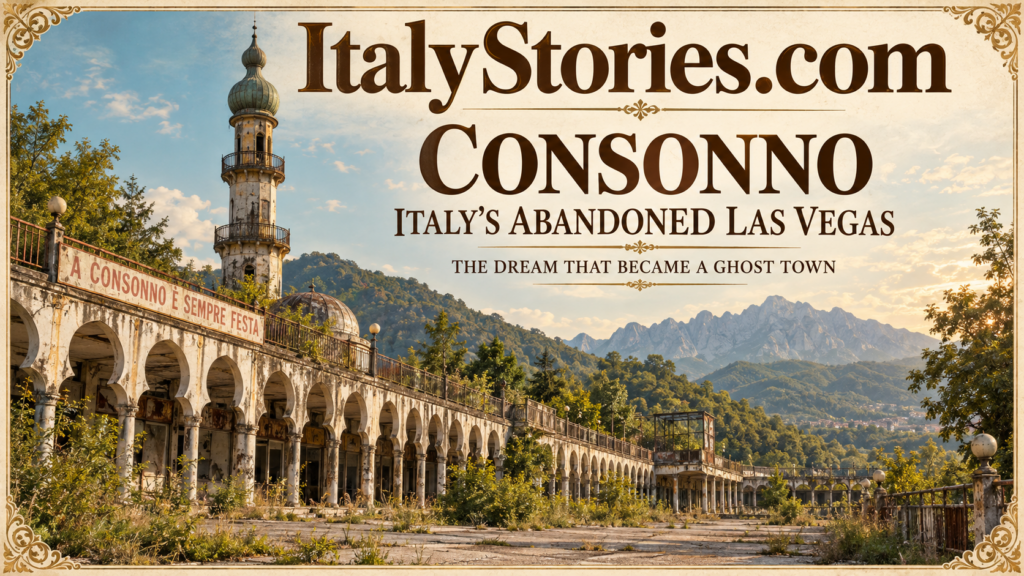
High above the Lombard town of Olginate, surrounded by the green hills of Brianza and facing the sharp profile of Mount Resegone, stands one of Italy’s strangest ghost towns. A weathered minaret rises over a long Moorish-style gallery. Empty windows stare across cracked terraces, weeds push through the concrete and faded decorations recall a place where music, dancing and crowds once filled the air.
The most famous slogan still associated with the town sounds almost cruel today:
“At Consonno, the party never ends.”
But the party ended decades ago.
Consonno was once a small agricultural village. During the economic boom of the 1960s, an eccentric businessman bought almost the entire settlement, demolished most of its old houses and attempted to replace it with an Italian version of Las Vegas. He imagined hotels, restaurants, dance halls, exotic buildings, shops, sports facilities and a constant stream of visitors from Milan.
For a few extraordinary years, the dream appeared to work. Then the crowds disappeared, the mountain moved and the road was swallowed by a landslide. What remained was an abandoned fantasy city, trapped between a forgotten farming village and a future that never arrived.
The Village Before the Dream
Consonno stands approximately 630 metres above sea level in the municipality of Olginate, in the province of Lecco. Before its transformation, it was a quiet rural settlement connected to the surrounding towns by steep paths and an inadequate mountain road.
Its inhabitants lived mainly from agriculture, livestock and the resources offered by the surrounding woods. They cultivated fields and terraces, gathered chestnuts and maintained a way of life that had changed slowly over generations. The village contained stone houses, barns, narrow lanes and the small Church of San Maurizio, whose origins reach back to the Middle Ages.
Consonno was never a wealthy place. By the middle of the twentieth century, traditional mountain agriculture was becoming increasingly difficult to sustain. Younger residents were moving towards Lecco, Milan and the industrial towns of Lombardy in search of reliable work.
The village was already losing population when Mario Bagno arrived.
Bagno was a successful construction entrepreneur who had made his fortune building roads, airports and large infrastructure projects during Italy’s post-war economic expansion. He was often called Count Mario Bagno and described himself in grandiose terms, although the title by which he became famous was less important than his personality.
He thought on a monumental scale. Where other people saw an ageing agricultural village, Bagno saw the perfect location for an enormous entertainment resort serving the increasingly wealthy population of northern Italy.
It was close enough to Milan for a day trip, high enough to enjoy clean air and panoramic views, and isolated enough to become an entirely new world.
A Man Buys a Village
Before acquiring Consonno, Bagno financed the construction of a better road connecting the settlement with Olginate. The municipal council approved the project in 1961, and the privately built road was later transferred to the municipality.
In 1962, Bagno’s company purchased the land and buildings belonging to the families that controlled most of the village. Some residents welcomed the operation. They had been told that tourism could bring employment, customers and a new market for local agricultural products. An agritourism development might have saved the declining community.
But Bagno was not interested in preserving the traditional village.
Bulldozers arrived soon after the purchase. Between 1962 and 1966, most of old Consonno was demolished. Houses, barns and rural buildings disappeared. Residents who remained were moved into replacement accommodation around the edge of the development.
Only a few structures escaped destruction, most importantly the Church of San Maurizio, the adjoining rectory and the small cemetery. These were among the final witnesses to the village that had existed before Bagno’s arrival.
The transformation was extremely aggressive. Explosives were reportedly used to reduce part of a hill and improve the view towards Mount Resegone. The landscape itself had to be modified to fit the entrepreneur’s vision.
A community shaped over centuries was dismantled in only a few years.
The City of Toys
Bagno called his creation the Città dei Balocchi, the “City of Toys.” The name suggested a place of endless pleasure where adults could temporarily forget work, responsibilities and ordinary life.
The project reflected the optimism of Italy’s economic miracle. During the 1950s and 1960s, millions of Italians left the countryside, found industrial employment and gained access to cars, televisions, household appliances and paid holidays. Leisure was becoming an industry, and Bagno intended to profit from it.
But Consonno was not designed with a single architectural identity. It became an eccentric collection of styles borrowed from different parts of the world.
The most famous building was a long commercial gallery decorated with Moorish arches and dominated by a minaret-like tower. It was not a mosque and had no religious function. Its purpose was purely decorative, an exotic landmark intended to impress visitors arriving from the plains below.
Elsewhere, Bagno added a medieval-looking entrance, oriental decorations, a Chinese-style pagoda and other structures inspired by an imaginary journey around the world. The result had little connection with the landscape or history of Brianza.
That was exactly the point. Visitors were not supposed to feel that they were still in an old Lombard farming village.
Consonno offered restaurants, bars, shops, a dance hall, an entertainment pavilion and the Hotel Plaza. A small panoramic train carried families around the complex. Music and dancing attracted weekend visitors, while singers, entertainers and television personalities occasionally appeared during public events.
Period photographs show terraces filled with people. Families arrived by car, young couples danced and children explored buildings that seemed to belong to distant countries. For a generation accustomed to modest holidays, Consonno must have appeared wonderfully extravagant.
Signs placed along the road announced:
“Consonno is the smallest but most beautiful town in the world.”
“At Consonno the sky is bluer.”
And, most famously:
“At Consonno the party never ends.”
Projects Without Limits
Bagno’s imagination went far beyond what was actually completed. He proposed sports grounds, tennis courts, football pitches, a golf course, a zoo, an amusement park and facilities for shooting and skating. Some accounts also mention plans for a racing circuit, a casino and additional luxury hotels.
It is important to distinguish the finished attractions from the enormous list of announced projects. Consonno never became the complete entertainment capital Bagno imagined. Much of it remained unfinished, under construction or permanently awaiting expansion.
His planning method appears to have been highly personal and constantly changing. According to local recollections, he could decide to construct something one day and alter or demolish it soon afterwards because a new idea had captured his imagination.
There was no coherent master plan capable of guiding the resort’s development over many years. Consonno grew as a succession of theatrical impulses.
For a time, the energy of the idea helped conceal its weaknesses. Crowds came because the place was new, unusual and fashionable. But novelty rarely lasts forever.
By the early 1970s, visitor numbers were beginning to decline.
The Mountain Strikes Back
The usual version of Consonno’s story says that a single landslide suddenly destroyed the resort. The truth is more gradual.
The landscape was geologically vulnerable, and the intensive construction work had altered parts of the mountain. Heavy rain caused instability, and a first serious landslide affected the access road during the second half of the 1960s. Bagno repaired the damage and continued developing the resort.
Consonno survived, but warning signs had appeared.
The greater problem was that the public was slowly losing interest. New entertainment options were opening elsewhere, Italians were travelling farther and the improvised architecture of Consonno was beginning to look less miraculous and more dated.
Then, in 1976, another major landslide struck the road connecting the resort with Olginate. Access became extremely difficult, cutting Consonno off from the flow of cars on which its entire economy depended.
The buildings had not all collapsed, and the landslide did not physically erase the town. But an entertainment resort without an accessible road could not survive. The disaster accelerated a decline that had already begun.
The slogan promised an endless party. Nature simply closed the entrance.
A Dream That Refused to Disappear
Mario Bagno did not immediately surrender. He continued searching for ways to revive Consonno. New roads, different attractions and alternative uses were discussed, but the atmosphere of the 1960s could not be recreated.
During the 1980s, part of the former Hotel Plaza was adapted as a retirement home. Elderly residents temporarily brought human life back to the abandoned resort, creating the strange sight of a nursing facility surrounded by empty entertainment buildings and decaying exotic decorations.
Bagno died in 1995 at the age of ninety-four. With his death, Consonno lost the person whose personality had driven the entire project.
The retirement home remained active for several more years but eventually closed in 2007. After that, abandonment became almost complete.
Without maintenance or security, the buildings deteriorated. Water entered through broken roofs, windows disappeared and vegetation invaded terraces and interiors. Vandals covered walls with graffiti and removed anything that could be carried away.
In the summer of 2007, an unauthorised rave attracted more than a thousand people. During the event, several surviving structures were further damaged and covered with graffiti. The episode confirmed Consonno’s transformation from forgotten resort into a destination for urban explorers, vandals and people attracted by abandoned places.
The Ghost Town of Brianza
Consonno is often described as a ghost town, but this expression requires some qualification. It is not a completely forgotten settlement lying beyond the reach of modern life. The Church of San Maurizio still stands, volunteers protect what remains and occasional religious and community events continue to take place.
The Association of Friends of Consonno has worked to preserve the memory of the old village and the story of the entertainment resort. On certain occasions, Mass is celebrated in the church, the statue of San Maurizio is carried in procession and visitors return to the empty square.
For a few hours, music, voices and footsteps can once again be heard beneath the minaret.
These events do not restore Bagno’s City of Toys, but they prevent Consonno from disappearing completely. They also remind visitors that the site contains two different histories: the rural village destroyed in the 1960s and the pleasure resort abandoned after the 1970s.
Both were lost.
What Consonno Really Represents
It is easy to portray Mario Bagno as a mad visionary who attempted to build Las Vegas on a mountain. There is certainly something theatrical and obsessive in his story. Yet Consonno also reflects a much larger moment in Italian history.
Post-war Italy believed strongly in construction, automobiles, tourism and technological progress. Old villages were often considered obstacles to development rather than places worthy of protection. The countryside was expected to modernise or disappear.
Bagno took this belief to an extreme. He did not restore Consonno or adapt it carefully for tourism. He erased most of the existing village and replaced it with his personal vision of the future.
The result was not created gradually by a community. It depended almost entirely on one man, one road and the continuing curiosity of the public. When the road failed and the public moved on, the entire system collapsed.
The old agricultural village might have declined slowly, but Bagno’s new Consonno had no way to become old. It had been designed only to remain fashionable.
Between Memory and Ruin
Today the abandoned gallery and its minaret stand against the green landscape of Lombardy. Their appearance is surreal because they belong neither to the region nor to the present. They resemble the remains of a film set for a production that ended before anyone removed the scenery.
The mountain has begun reclaiming the site. Trees grow close to walls, roots disturb the pavement and weeds cover spaces where visitors once danced. The colours have faded, but the strange architecture remains recognisable.
Old postcards show crowds, polished terraces and buildings freshly painted in bright colours. Modern photographs show silence, decay and vegetation. Placed beside each other, the images seem to record not several decades but two entirely different worlds.
Consonno attracts people because it contains the ruins of optimism. Medieval castles become ruins slowly, over centuries. Consonno became a ruin within the lifetime of people who remembered its opening day.
That makes its abandonment feel particularly disturbing.
The Party That Ended
Mario Bagno wanted to build a place where entertainment never stopped. For a short period, his impossible idea became real. Cars climbed the mountain, music played beneath the Moorish arches and families boarded the little train to tour an invented world.
But Consonno had been created by demolishing the very community that might have given it a lasting identity. When the attractions lost their novelty, there was little ordinary life left to sustain the settlement.
The landslide did not destroy the dream by itself. It revealed how fragile the dream had always been.
Today the famous slogan survives on walls, postcards and photographs:
“At Consonno, the party never ends.”
The dance hall is silent. The shops are empty. The hotel rooms have been abandoned and the panoramic train has disappeared.
Yet in an unexpected way, the slogan was not entirely wrong. People continue climbing the mountain to see the strange city, tell its story and imagine the crowds that once gathered there.
The party ended long ago, but Consonno has never completely left the stage.