

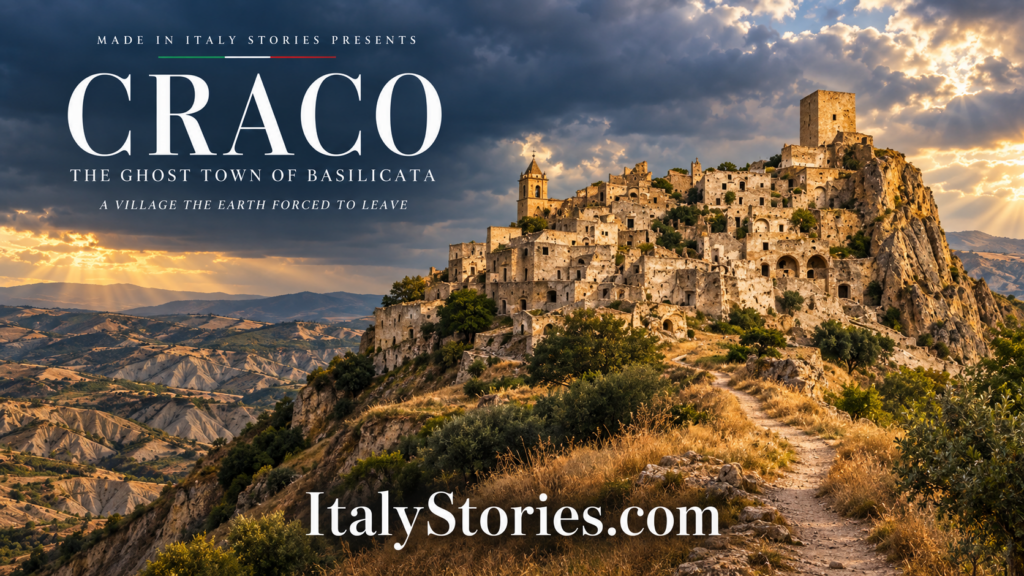
Craco ghost town rises from the clay hills of Basilicata like the surviving fragment of a vanished civilisation. Its houses cling to a narrow ridge, their empty windows looking across the valley of the Cavone River, while a square medieval tower dominates the ruins from the highest point. From a distance, the village appears almost intact. One expects smoke to rise from a chimney, a church bell to announce the hour or a resident to emerge from one of the stone doorways. Yet the streets are silent, many roofs have collapsed and the community that built Craco no longer lives within its ancient walls.
The expression “ghost town” is irresistible, but it tells only part of the story. Craco was not suddenly erased by one catastrophic night, nor did its people simply disappear. Its abandonment was a long and painful process shaped by unstable geology, landslides, inadequate infrastructure, poverty, emigration, floods and earthquakes. Families were moved from homes occupied for generations and transferred to a new settlement in the valley. The old village remained above them, close enough to be seen but increasingly impossible to inhabit.
Today Craco is one of the most recognisable abandoned places in Italy. Photographers are drawn to its dramatic skyline, travellers arrive to experience its silence and filmmakers use its ruins to represent biblical cities, forgotten worlds and landscapes outside ordinary time. Beneath that cinematic beauty, however, lies the story of a real community and of a southern Italian territory that has spent centuries negotiating its relationship with the earth.
A Village Built for Defence
Craco stands in the province of Matera, about forty kilometres from the city famous for its Sassi. The landscape surrounding it is one of the most distinctive in southern Italy. Dry ridges descend toward broad valleys, cultivated fields alternate with exposed clay and deep channels have been carved into the hills by centuries of erosion. These formations are known as calanchi, the Italian name for badlands created when water cuts rapidly into soft, fragile soil.
In such a landscape, Craco’s position was both intelligent and dangerous. Building on a steep hill offered protection, visibility and control over the surrounding territory. Approaching armies, bandits and travellers could be seen from a distance. The summit provided a natural fortress, while the compact arrangement of houses helped defend the population.
The same hill that protected Craco would eventually become its greatest threat. The clay beneath the village absorbed water, shifted and eroded. The slopes were never completely stable, and the construction of roads, houses, pipes and drainage systems placed additional pressure on already vulnerable ground.
For centuries, however, the advantages of the position outweighed the risks. Craco developed as a fortified agricultural centre overlooking routes that connected the Ionian coast with the interior of Lucania, the historical name still widely used for Basilicata. Grain, livestock, olive oil and other products from the countryside supported a community organised around the rhythms of the land.
The village was constructed vertically. Narrow streets followed the shape of the ridge, stone houses leaned against one another and stairways connected different levels. At the summit stood the defensive tower, while churches, palaces, workshops and modest homes descended along the slope. This was not architecture planned on paper; it was a settlement that grew through centuries of adaptation.
From Ancient Traces to a Medieval Stronghold
The territory around Craco was inhabited long before the medieval village appeared. Archaeological discoveries, including ancient burials, indicate settlement in the area during the first millennium BC. Greek influence later moved inland from the coastal colonies of Magna Graecia, particularly from the area around Metaponto.
Craco’s documented medieval history is generally connected with the name Graculum, recorded during the eleventh century. The Latin term has often been interpreted as meaning a small cultivated field. The name evokes the agricultural identity that would define the village for generations.
During the Norman period, feudal control strengthened and the defensive settlement expanded. The great square tower became the most visible expression of authority. Rising above the surrounding houses, it served as a lookout, military structure and symbol of whoever controlled the territory.
Craco subsequently passed through the hands of different feudal families and followed the complicated political history of southern Italy. Normans, Swabians, Angevins, Aragonese and the rulers of the Kingdom of Naples all left their mark on Basilicata. Political power might change in distant courts, but daily life in the village remained closely tied to harvests, rainfall, family alliances and the authority of landowners and the Church.
Religious buildings became central points of social life. Churches were places of worship but also of collective identity, public ceremony and memory. Baptisms, weddings, funerals and processions connected individual lives with the history of the community. The veneration of San Vincenzo Martire, Craco’s patron saint, would eventually travel far beyond Basilicata with the emigrants who carried their traditions to the United States.
By the sixteenth century, Craco had grown into an important local centre with several thousand inhabitants. Noble residences stood beside farmers’ houses and religious institutions. Streets that now appear empty once contained workshops, ovens, animals, children and carts carrying agricultural products.
The present silence can make it difficult to imagine this density of life. Craco was never designed as a monument. It was a functioning town, continually repaired and changed by the people who lived there.
Life in the Old Village
Before abandonment, daily life in Craco followed patterns shared by many rural communities of Basilicata. Families depended on agriculture and livestock, often cultivating land that was difficult to work and exposed to drought. Wheat and other cereals occupied much of the surrounding countryside, while olive trees, vines, vegetables and legumes contributed to the local economy.
Bread possessed an importance that went far beyond food. It represented work, survival, hospitality and domestic skill. Families prepared dough at home and used communal or local ovens, marking loaves so that each household could recognise its own. Traditional dishes relied on ingredients that could be produced, preserved or gathered locally: handmade pasta, pulses, wild herbs, vegetables, pork products and the intensely flavoured peppers for which Basilicata later became famous.
Water had to be managed carefully. Homes were adapted to collect and store supplies, while wells, fountains and channels served the community. The difficult relationship with water was one of Craco’s great contradictions. Too little rain threatened crops; too much water entering the clay soil threatened the hill itself.
Houses often contained spaces for both people and animals. Rooms were reused across generations, and buildings expanded according to family needs. Wealthier residents occupied more elaborate palaces, while agricultural labourers lived in far simpler conditions. Social divisions were visible in the quality of architecture, ownership of land and access to education.
Life was hard, but it was not culturally empty. Religious feasts, marriages, seasonal work, music and oral storytelling created a strong sense of belonging. News travelled through streets and squares; church bells regulated time; neighbours depended on one another during harvests, illnesses and family emergencies.
Craco formed part of a wider Lucanian civilisation that writers and filmmakers would later describe as remote from the modern Italian state. Carlo Levi’s famous account of exile in Basilicata, Christ Stopped at Eboli, helped introduce international readers to a southern world marked by poverty, dignity, superstition and political neglect. Craco was not the village of Levi’s confinement—that was Aliano—but it belonged to a related physical and human landscape.
Emigration Before the Landslide
The departure from Craco began long before the ground opened beneath its houses. Between the end of the nineteenth century and the first decades of the twentieth, large numbers of residents left for North America and other destinations. They were part of the enormous Italian migration that carried people from Basilicata, Calabria, Sicily, Campania and other regions across the Atlantic.
Poor agricultural conditions, limited employment and unequal access to land made departure appear necessary. Emigration was rarely a simple rejection of the village. Many people intended to work abroad temporarily, send money home and eventually return. Some did. Others established permanent lives in New York, New Jersey and elsewhere while preserving a powerful emotional connection with Craco.
Letters, photographs, religious images, recipes and family names crossed the ocean. Money sent home helped relatives survive or improve their houses. Marriages and inheritances continued to connect families separated by thousands of kilometres.
The Crachesi abroad recreated elements of village life in their new communities. Devotion to San Vincenzo travelled with them, as did traditional foods, dialect expressions and stories about the old town. Even today, descendants of emigrants work to preserve Craco’s history and maintain relationships between Basilicata and the Italian-American community.
This earlier migration is essential to understanding what happened later. When the geological crisis arrived, Craco had already been weakened by decades of population loss. The village was not an isolated medieval world untouched by modernity; it was part of a global network of departures, remittances and memories.
The Craco Ghost Town Was Not Created in a Single Day
The popular version of the story says that a landslide struck Craco in 1963 and everyone immediately abandoned the town. The reality was slower, more complicated and more painful.
The geological instability of the hill had been known for a long time. Historical records refer to earlier landslides, while cracks and movement repeatedly affected parts of the settlement. Craco was built on layers of clay, sand and other materials that responded differently to water. When the ground became saturated, sections of the slope could begin to move.
During the twentieth century, new construction and infrastructure altered the fragile balance. Roads, water networks, sewers and building work were intended to modernise the village, but poorly understood drainage may have contributed to the instability. Water leaking or collecting within vulnerable layers could increase the pressure inside the slope.
In 1963, a major landslide marked the beginning of the decisive evacuation. Houses cracked, streets shifted and buildings became unsafe. Residents watched walls separate and doorways distort. The danger was not an abstract prediction. Families could hear the structures around them moving.
The authorities began transferring inhabitants to Craco Peschiera, a new settlement constructed lower in the valley. For those forced to leave, the move involved much more than receiving another house. The old village contained their work, relationships, religious traditions and family memories. Its architecture had developed around a compact community in which neighbours met constantly. The new settlement offered greater safety but could not immediately reproduce the social geography of Craco Vecchia.
Some residents resisted leaving. Others returned to retrieve possessions, care for animals or remain close to their fields. Evacuation continued over an extended period as the condition of the old centre worsened.
An important distinction must therefore be made: Craco did not cease to exist as a municipality or community. Its historic centre was abandoned, while its people continued their lives in Craco Peschiera, nearby towns and communities abroad. Calling Craco a ghost town should never erase the Crachesi themselves.
Flood, Earthquake and the Final Departure
The landslide of 1963 did not close the story. In 1972, severe flooding further destabilised the area and reduced hopes that the old centre might be safely repopulated. Water again demonstrated its double role in the landscape: necessary for life, yet potentially destructive when channelled through unstable clay.
Then, in November 1980, the powerful Irpinia earthquake struck southern Italy. Its epicentre lay elsewhere, but the shock was felt across Basilicata and affected buildings already weakened by movement and abandonment. Structures that might once have been repaired became even more dangerous.
Further instability continued in subsequent years. The gradual nature of the evacuation explains why different accounts provide different dates for Craco’s abandonment. The landslide of 1963 began the decisive exodus; flooding and later earthquakes reinforced it; continuing slope movement completed the separation between the population and the historic centre.
This long decline is more revealing than the legend of one sudden catastrophe. Craco was lost through the accumulation of natural vulnerability, human intervention and limited economic resources. The village did not lack people who cared about it. It lacked a realistic way to guarantee that the ground beneath their homes would remain in place.
The abandoned houses began to deteriorate. Roofs failed, rain entered rooms and vegetation grew through floors. Furniture and personal objects were removed, lost or buried under debris. Churches and palaces that had survived for centuries were left exposed to weather and structural movement.
Yet the central skyline remained astonishingly complete. The tower, bell towers and mass of stone houses continued to rise above the valley, giving Craco the appearance of a city interrupted rather than destroyed.
Architecture Written into the Hill
Seen from a distance, Craco resembles a natural extension of the ridge. The colour of its masonry echoes the dry earth, while the buildings appear to have emerged from the rock rather than been placed upon it. This visual unity is one of the reasons the village has become so famous.
At the highest point stands the Norman tower, the most recognisable structure in the old town. Its severe square form contrasts with the irregular houses below. It once controlled the landscape; today it acts as a silent marker visible from kilometres away.
The historic centre also contains the remains of churches, chapels and noble palaces. The Palazzo Grossi, Palazzo Carbone and other buildings recall the families who once exercised influence in the town. Decorative portals and surviving architectural details reveal that Craco was not merely a settlement of poor rural houses. It contained several levels of wealth and ambition.
Narrow streets pass beneath arches and between buildings adapted to the slope. Some houses have several entrances at different heights because the terrain changes so rapidly. Cellars, storerooms and agricultural spaces were integrated into the urban fabric.
The instability that emptied Craco also preserves an unusual historical cross-section. With little modern redevelopment inside the abandoned centre, layers of architecture remain visible beside one another. Medieval defensive forms, later palaces, religious buildings and twentieth-century houses occupy the same ridge.
This does not mean that the village is frozen perfectly in time. Craco continues to change. Walls collapse, plaster disappears and erosion reshapes the slopes. Abandonment is not preservation; it is another form of transformation.
Craco and the Cinema
Filmmakers recognised immediately what makes Craco visually extraordinary. The village can appear medieval, biblical, post-apocalyptic or completely imaginary without requiring the construction of an artificial set. Its empty streets contain no shop signs, traffic lights, television antennas or crowds to interrupt the illusion of another era.
Alberto Lattuada used Craco in La lupa, released in 1953, before the great evacuation had transformed the village into an abandoned landscape. The film therefore preserves images of Craco while it was still inhabited, making it especially valuable as a visual record.
Francesco Rosi later filmed scenes connected with Christ Stopped at Eboli in the landscapes of Basilicata. The film, based on Carlo Levi’s book, brought the region’s villages, calanchi and rural history to an international audience.
Craco subsequently appeared in productions ranging from historical drama to major international cinema. Its ruins were used in King David, The Nativity Story and Mel Gibson’s The Passion of the Christ. The village’s austere architecture and dry landscape allowed it to stand in for the ancient Mediterranean world.
It also entered the modern universe of James Bond through Quantum of Solace. Although the film used several Italian locations, including nearby Matera and other dramatic landscapes, Craco became part of the cinematic geography through which Basilicata presented itself to the world.
Italian productions have used the village in different ways. Basilicata Coast to Coast, directed by Rocco Papaleo, celebrated the region with affection and humour, helping audiences discover a territory too often represented only through poverty or isolation.
Cinema gave Craco a second existence. The village that could no longer function safely as a residential centre became a setting capable of representing many different places and centuries. Cameras returned movement to the streets, actors passed through abandoned rooms and artificial stories brought attention to a very real historical tragedy.
Beauty, Danger and Responsible Tourism
Craco’s fame has encouraged visitors to seek access to the old centre, but the ruins cannot be treated as an ordinary open village. The soil remains unstable and many buildings are structurally dangerous. Falling stones, weak floors and sudden collapses are genuine risks.
For this reason, access is controlled and visits are generally organised along authorised routes with appropriate safety equipment and guidance. Restrictions may change according to structural conditions and conservation work. Anyone planning a visit should consult the official local information rather than relying on photographs or older travel accounts.
The controlled route offers more than protection. A knowledgeable guide can restore names and functions to buildings that might otherwise appear as anonymous ruins. Streets become places where families lived; a damaged church becomes the centre of former celebrations; an empty square becomes the setting of markets and public meetings.
Responsible tourism should also resist the temptation to describe Craco only through ghosts, curses or supernatural legends. Its atmosphere is undeniably haunting, but its abandonment has a geological, social and political history. The village deserves curiosity rather than sensationalism.
Visitors should remember that abandoned buildings are not unowned theatre sets. They belong to a community, contain cultural heritage and may include places of religious or personal significance. Removing an object, entering a prohibited structure or damaging a wall means taking something from a story already placed at risk.
A Heritage Still in Danger
In 2010, the historic centre of Craco was included in the World Monuments Watch, drawing international attention to its architectural importance and continuing vulnerability. Recognition did not magically stabilise the hill, but it helped frame Craco as cultural heritage rather than a picturesque ruin destined to disappear.
Preserving the village presents exceptional difficulties. Restoring individual buildings is not enough if the ground supporting them continues to move. Engineers, geologists, architects and conservation specialists must understand the entire slope, water circulation and interaction between structures.
There is also a philosophical question: what does it mean to preserve an abandoned town? Rebuilding Craco as if nothing had happened might erase the evidence of its geological and human history. Allowing it to collapse completely would destroy centuries of architecture and memory. Turning it into a polished tourist attraction could remove the emotional power that makes it unique.
The most intelligent approach lies somewhere between reconstruction and surrender. Dangerous areas must be monitored, significant structures stabilised and historical documentation preserved. At the same time, Craco should continue to reveal the scars of abandonment.
Those scars are not imperfections. They are the story.
The Community That Survived Its Town
Craco Vecchia is empty, but Craco is not dead. The people who left the historic centre rebuilt their lives in Craco Peschiera, elsewhere in Italy and abroad. Families preserved photographs of houses that could no longer be entered. Former residents continued to identify themselves through streets, neighbourhoods and family properties in the old village.
This distinction changes the emotional meaning of Craco. A true ghost town suggests that everyone has vanished and no one remains to remember. Craco is instead a displaced town: its buildings stayed on the hill while its community moved away.
Associations created by descendants of emigrants have worked to collect documents, photographs, family histories and traditions. The bond between Craco and the United States remains particularly strong. Celebrations dedicated to San Vincenzo demonstrate how a local devotion from Basilicata could survive in the streets and churches of New York.
Food provides another form of continuity. Recipes carried abroad connect descendants with the agricultural world of their ancestors. Homemade pasta, bread, preserves and festive dishes become edible archives, repeated within families even when the original house in Craco has lost its roof.
The village survives through language as well. Dialect words, surnames, nicknames and family stories preserve a geography that physical access can no longer guarantee. For descendants who visit Basilicata, seeing the old town can feel less like tourism than an encounter with a missing part of their identity.
Why Craco Continues to Fascinate Us
Italy contains countless medieval villages, dramatic hill towns and archaeological ruins. Craco is different because its past feels so close. The houses were not abandoned in antiquity. People alive today remember living there, attending church, walking to school and looking from their windows across the calanchi.
The village stands at the intersection of several Italian stories: the fragility of rural communities, the history of southern emigration, the unequal development of the country, the beauty of Basilicata, the power of cinema and the challenge of preserving places that nature continues to threaten.
Its silence invites imagination, but the real story is stronger than any invented legend. Craco was built because the hill offered protection. It prospered because generations learned to live with a difficult landscape. It was abandoned when that relationship became impossible to sustain.
The empty streets do not represent failure alone. They also reveal endurance. Buildings remained standing; displaced residents created a new community; emigrants maintained traditions across the Atlantic; filmmakers transformed the ruins into images seen around the world.
At sunset, when the stone turns gold and shadows fill the abandoned houses, Craco appears suspended between presence and absence. The village is no longer alive in the ordinary sense, but neither has it disappeared. It continues to change, to deteriorate, to inspire and to be remembered.
Craco is not simply the town that died. It is the town that lost its streets but kept its people, the village abandoned by necessity yet preserved through memory. Above the clay valleys of Basilicata, it remains a warning about the power of the earth and a monument to the communities that refuse to forget where they came from.
Follow ItalyStories.com to discover more remarkable villages, hidden landscapes, historic cities, local traditions and unforgettable stories from Basilicata and every corner of Italy.