

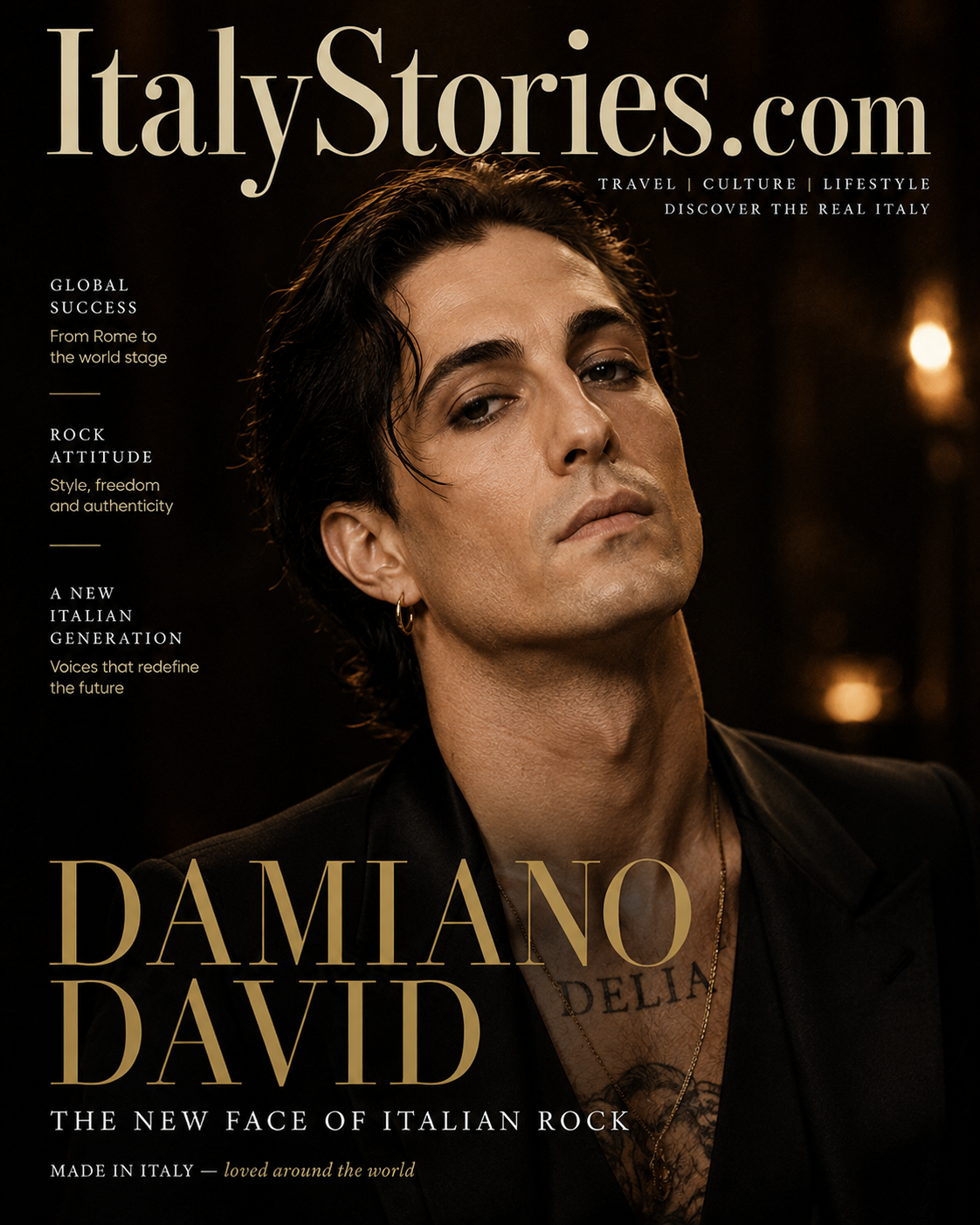
The Night the World Learned His Name
On May 22, 2021, the Ahoy arena in Rotterdam was already vibrating when four young Italians walked onto the Eurovision stage. Their song was called “Zitti e buoni,” and the title carried the defiance of a command they had no intention of obeying. The guitarist attacked the opening riff, the rhythm section hit like a door kicked open, and at the center stood Damiano David: shirtless under leather, eyeliner sharp, body coiled, voice rough enough to sound dangerous and controlled enough to fill the room.
Three minutes later, Europe had witnessed something unusual. Italy had sent rock music to a contest better known for pop spectacle, and the gamble worked. Måneskin won Eurovision with 524 points, giving Italy its first victory since Toto Cutugno in 1990. The moment made international news, but for Damiano it was not the beginning. It was the instant when years of rehearsals, street performances, talent-show scrutiny, Italian touring and stubborn self-invention suddenly became visible to the rest of the world.
What followed was one of the fastest international rises by an Italian rock act in modern music. Songs recorded years earlier began exploding on streaming platforms. “Beggin’,” the band’s 2017 cover of the Four Seasons song, reached the upper levels of charts in the United States and Britain. “I Wanna Be Your Slave” became a major UK hit. Måneskin sold out arenas, played Madison Square Garden, opened for the Rolling Stones, earned a Grammy nomination for Best New Artist, and turned their Rome-born combination of glam, hard rock, pop instinct and theatrical freedom into a global brand.
At the center of the storm was Damiano David, whose public image seemed almost too perfectly designed for rock mythology: charismatic, tattooed, provocative, elegant, gender-fluid in styling, capable of swagger and humor, with the kind of face a camera remembers. Yet the deeper story is more interesting than the image. His career is also about apprenticeship, pressure, collaboration, self-doubt, artistic separation and the difficult question every frontman eventually faces: who am I when the band is not around me?
That question became central when Damiano stepped into a solo career in 2024 and 2025. Instead of reproducing the loudest elements of Måneskin, he moved toward pop, orchestration, theatrical balladry and personal confession. The solo album Funny Little Fears revealed a different emotional register and, in doing so, made his role in the band easier to understand. The fearless rock frontman had never been the whole person. It was one mask among several, and Damiano’s most interesting artistic move was choosing to take it off without pretending it had been false.
Rome Before the Spotlight
Damiano David was born in Rome on January 8, 1999. He grew up in the Portuense area of the capital, in a city that trains young people in contradiction: ancient beauty beside traffic, monumental history beside ordinary neighborhood life, elegance beside irreverence. Rome can make performance feel natural because theatricality is built into daily speech, gesture and attitude. Damiano’s later stage persona would be international in reference, but its confidence and humor remained recognizably Roman.
Music did not arrive in his life as a solemn destiny announced from childhood. In interviews, Damiano has described becoming fascinated around adolescence by the sheer power of singers standing before enormous crowds. The attraction was not only to music as sound but to performance as a state of being. To stand in front of people and hold their attention seemed both frightening and irresistible.
At school he sang in a choir, and a teacher who later remembered him described a young performer already capable of drawing focus even before his voice had become the instrument millions would recognize. He attended the Liceo Linguistico Eugenio Montale in Rome, but the growing demands of music eventually took precedence over a conventional academic route. What matters is not the romantic cliché of “dropping everything for art,” but the degree of certainty required at such a young age. There was no guarantee that a teenage band from Rome would become a profession.
Damiano was also serious about sport, particularly basketball, before music took over. That athletic background is worth mentioning because his later stage movement has always been unusually physical. He does not simply sing into a microphone. He prowls, jumps, drops to the floor, stretches phrases with his body and treats the stage almost like a court on which momentum must constantly be controlled.
The crucial transformation came not from childhood prodigy status but from decision. Damiano chose performance, then trained himself through repetition. His career would later appear explosive, but its foundations were built in rooms and streets where attention had to be earned one stranger at a time.
Four Teenagers, One Band and a Danish Word
The band that became Måneskin took shape in Rome around the musical friendship of bassist Victoria De Angelis and guitarist Thomas Raggi. Damiano joined as singer, and drummer Ethan Torchio completed the lineup after the group searched for a percussionist. They were teenagers with different tastes and temperaments, which would eventually become one of their greatest strengths.
The name arrived almost accidentally. Preparing for a competition, the group needed something to put on the form. Victoria, whose family background is partly Danish, was asked to throw out Danish words until one sounded right. “Måneskin,” meaning “moonlight,” won the vote. It had no deep conceptual relation to their music at first. Like many good band names, it became meaningful only because of what the musicians later poured into it.
The chemistry among the four members was not based on sameness. Victoria brought strong rhythmic instinct, visual daring and a fierce sense of band identity. Thomas developed into a guitarist with a taste for classic rock vocabulary without slavish imitation. Ethan supplied a dramatic, muscular drumming style. Damiano, meanwhile, was the voice and theatrical focal point, but his role was never simply to stand in front of three accompanists. The band’s later success depended on the tension among four personalities.
That distinction matters because Damiano’s individual charisma eventually became so visible that casual audiences sometimes perceived Måneskin as “the singer and the others.” In reality, the group’s identity was collective from the beginning. Even “Zitti e buoni,” the song that transformed them internationally, was credited as a composition by all four members. The stage image of Damiano only worked because the band behind him generated enough force to justify it.
Their early years were therefore a laboratory. They were learning not only how to play together but how to create a coherent identity from four separate influences: rock, pop, funk, hip-hop, soul, glam and contemporary fashion. Rather than resolving those contradictions, they learned to make them part of the appeal.
Via del Corso: Learning to Stop Strangers
Before television made them famous, Måneskin played in the streets of Rome. Busking on Via del Corso and in other public spaces became one of the most important stages of their education. Street performance is unforgiving. Nobody has bought a ticket. Nobody owes the musician silence. The crowd can walk away at any second.
For Damiano, this was an ideal school in stage presence. A singer on the street must learn quickly how to project, how to create an event where there was none, and how to convert indifference into attention. Later, when Måneskin performed before tens of thousands of people, the scale was different but the principle was similar: make the audience feel that something urgent is happening now.
The band has often credited busking with developing that instinct. They played school parties, small venues and wherever they could find space. Rome did not offer them an obvious rock-club ladder to climb, so they created their own training ground. This practical limitation became an advantage. They learned to perform before they were famous enough to be protected by fame.
Their visual identity also began to sharpen. Makeup, unusual clothes and a willingness to play with masculine and feminine codes drew attention. Some people stared because they liked the band; others stared because they found them strange. Either reaction was useful. The young musicians understood that indifference was more dangerous than division.
Damiano’s stage style in particular became increasingly physical and self-aware. He discovered that his voice alone was not the whole instrument. Gesture, clothing, silence, posture and facial expression could all extend the song. By the time television arrived, he already knew how to make three minutes feel like a confrontation.
X Factor 2017: Fame Without Victory
In 2017, Måneskin entered the eleventh season of the Italian X Factor. For a rock band suspicious of easy categorization, a television talent show could have been dangerous. Such programs can reward personality but also flatten it, turning musicians into weekly products. Måneskin survived because they treated the format less as a destination than as an amplifier.
Mentored by Manuel Agnelli, they became one of the season’s sensations. Damiano’s voice and stage presence were obvious television assets, but the band’s appeal was broader: four young people who looked as if they had arrived from a different nightlife than the rest of prime-time television. They used covers strategically, rearranging familiar songs in ways that showcased groove, attitude and collective personality.
They finished second behind Lorenzo Licitra. In commercial terms, losing the final hardly mattered. Their original track “Chosen” had already become a calling card, and their audience was growing faster than the show could contain. In fact, finishing second became part of the mythology: the group had gained exposure without being permanently branded as the winner of a talent competition.
The Chosen EP followed, including their version of “Beggin’.” At the time, the cover was successful but not yet the global phenomenon it would become four years later. That delayed explosion is one of the strangest episodes in their career. A recording made during their early rise would eventually re-emerge through streaming and social media after Eurovision and become, for many international listeners, the first Måneskin song they ever heard.
X Factor did not manufacture the band. It accelerated them. The difference is important. They arrived with an identity and left with a platform.
Il ballo della vita: The First World They Built
In 2018 Måneskin released their first full studio album, Il ballo della vita. The record established that they intended to be more than a collection of television performances. It also introduced a recurring figure named Marlena, a symbolic muse representing freedom, inspiration and creative energy.
The album moved across Italian and English, rock and pop, tenderness and swagger. “Morirò da re” and “Torna a casa” became major Italian successes, and Damiano demonstrated a capacity that would remain central to his career: he could shift from aggressive rhythmic phrasing to emotionally exposed melody without losing recognizability.
“Torna a casa” in particular revealed a side of the singer that international audiences would only discover later. Behind the leather and provocation was a performer comfortable with dramatic balladry. His voice could carry vulnerability as effectively as defiance. This contrast would become increasingly important when he moved into solo work years later.
Il ballo della vita also helped build a huge domestic fan base and sent the group on extensive touring. Fame was no longer theoretical. The band was living on the road, experiencing the accelerated adulthood that comes with young success: constant travel, interviews, expectations, performance and the sudden loss of ordinary time.
For Damiano, the frontman role hardened into public identity. The confident figure audiences saw onstage was real, but it was also becoming a professional responsibility. Night after night, the band had to deliver intensity. The persona that originally created freedom could also become a kind of uniform.
Teatro d’ira and a Harder Sound
By the time Måneskin made Teatro d’ira: Vol. I, released in 2021, their sound had become leaner and more confrontational. The album title—“Theater of Wrath”—suggested an artistic reset toward live energy, guitar attack and less polished immediacy. The group wanted the record to feel like four musicians playing together rather than a studio construction hidden under layers of production.
Songs such as “I Wanna Be Your Slave,” “Coraline” and “Zitti e buoni” showed the breadth of Damiano’s role. “I Wanna Be Your Slave” turned sexual contradiction and identity into a chantable rock statement. “Coraline” was darker and more narrative, allowing his voice to move through grief and tenderness. “Zitti e buoni” was pure assertion: a demand to be judged on one’s own terms.
The album was short, concentrated and strategically timed. Italy already knew the band, but the rest of the world did not. Within months, that would change completely.
Damiano’s writing during this period also shows how much of his later solo identity was already present inside the band. His melodies often had strong pop architecture even when surrounded by distorted guitars. In interviews during his solo era, he would later describe himself as the “pop guy” inside Måneskin. Hearing Teatro d’ira with that knowledge makes the band’s balance easier to understand: the rock frame was collective, while Damiano frequently pulled the vocal line toward immediacy and hook.
Sanremo 2021: Rock at the Ariston
When Måneskin entered the 2021 Sanremo Music Festival with “Zitti e buoni,” they were taking a real risk. Sanremo is Italy’s most famous musical institution, but historically it has often rewarded melody, tradition and television elegance more readily than abrasive rock. The band arrived with a song that did not ask for permission.
The final on March 6 ended with Måneskin in first place. Rai described the result as a historic moment for rock at the festival. Damiano’s visible shock after the announcement—repeating that it seemed impossible—was striking because it briefly shattered the controlled frontman persona. The victory mattered nationally, but it also carried a practical consequence: it gave the group the right to represent Italy at Eurovision.
Sanremo transformed “Zitti e buoni” from a band statement into a national one. The title itself had emerged as a response to the expectation that young artists should behave, stay quiet and fit a mold. On the Ariston stage, the phrase became almost comically inappropriate: the loudest, least obedient act in the competition had won.
For Damiano, the festival also confirmed that his theatricality could work inside Italy’s most traditional television ritual. He did not have to soften the band to enter the institution. Instead, the institution made room for them.
Rotterdam 2021: The Door to the World Opens
Eurovision turned a successful Italian band into an international phenomenon. Måneskin’s performance of “Zitti e buoni” in Rotterdam was designed for maximum directness: live-band energy, aggressive camera work, physical confidence and a frontman who seemed entirely comfortable with the scale of the event.
They won with 524 points. Italy had not won Eurovision since 1990, and the result immediately transformed the band’s commercial horizon. But the victory alone does not explain what happened next. Eurovision winners often enjoy a powerful moment and then recede. Måneskin had something more useful waiting behind the trophy: a catalog, a striking visual identity, an energetic live reputation and old recordings perfectly suited to the streaming era.
In the hours after the final, a brief controversy arose around a television image that some viewers misinterpreted as drug use. Damiano denied the claim, and a subsequent drug test was negative. The episode is worth mentioning only because of what it revealed about the speed of global scrutiny. Overnight, the band was no longer being watched as an Italian act. Every gesture could become international news.
Damiano handled the transition with a mixture of humor and defiance. The incident could have overwhelmed the victory; instead, it disappeared as the music began moving faster than the gossip. The real story of Eurovision was not scandal. It was the moment an Italian rock band acquired a global audience almost instantaneously.
“Beggin’” Comes Back From the Past
The strangest hit of Måneskin’s breakthrough was not the Eurovision winner. It was “Beggin’,” a cover the band had recorded in 2017. After Eurovision, the track surged on TikTok and streaming services, introducing the group to listeners who had never watched Sanremo or Eurovision and did not know the chronology.
The numbers were extraordinary. “Beggin’” reached number one on Spotify’s global chart, climbed to number 6 on the UK singles chart and eventually peaked at number 13 on the Billboard Hot 100 in the United States. For an Italian rock band singing in English, this was a remarkable crossover.
The recording also displayed Damiano’s strengths in concentrated form. His raspy phrasing transformed the familiar composition, giving it a streetwise urgency that distinguished it from previous versions. The performance was not technically polished in the traditional sense; its roughness was the appeal. He sounded hungry.
At the same time, “I Wanna Be Your Slave” reached number 5 in the UK. Suddenly, Måneskin had multiple songs competing internationally, and one of the most unusual facts of the entire rise was that their Italian-language Eurovision song remained part of the global conversation too. The band was not succeeding because it had erased its origin. It succeeded while carrying Rome, Italian lyrics, European glamour and old-fashioned rock instrumentation into a global pop system.
From European Winners to Global Rock Stars
The next two years were a blur of festivals, television appearances, awards shows and arena concerts. Måneskin performed in the United States, across Europe and around the world. They appeared with Iggy Pop on a version of “I Wanna Be Your Slave,” opened for the Rolling Stones in Las Vegas, and became one of the most visible rock bands of their generation.
Their 2023 album Rush! broadened the sound. Working increasingly in English and with international songwriters and producers, the band moved toward a hybrid of glam rock, pop-rock and contemporary arena production. “Supermodel,” “The Loneliest,” “Mammamia,” “Gossip” featuring Tom Morello, and later “Honey (Are U Coming?)” showed different sides of the group’s appeal.
The shift generated debate among fans who preferred the rawer Italian period, but it also reflected the reality of their new scale. Måneskin was no longer only an Italian band exporting itself. It had become an international act making records within the global pop-rock industry.
Their 2023 Grammy nomination for Best New Artist confirmed the symbolic significance of that transformation. They did not win, but the nomination placed a band from Rome inside one of the music industry’s most visible international categories.
Live performance remained their strongest argument. Selling out Madison Square Garden and major arenas gave concrete weight to claims that rock could still speak to young audiences. Damiano’s stage presence was essential. Years after Via del Corso, he was still practicing the same skill: forcing strangers to look.
The Voice: Roughness, Pop Instinct and Theatrical Control
Damiano David’s voice is distinctive because it contains tensions that should not always coexist comfortably. It can be raspy and abrasive, yet it often follows extremely clean pop melodies. It can sound arrogant in one phrase and wounded in the next. He can bark a line, croon another, and then open into a sustained chorus with surprising warmth.
He is not a classic rock screamer in the tradition of vocal athletics for their own sake. Nor is he a conventional pop tenor aiming for immaculate smoothness. His strongest performances use texture as drama. The rasp signals urgency; the cleaner upper register provides release. He understands when to sound unpolished.
Another important quality is diction. In English, his Italian accent became part of the appeal rather than an obstacle. The international market did not require him to erase it entirely. In Italian, meanwhile, his phrasing is often more rhythmically conversational and emotionally direct.
His voice also reveals the pop songwriter inside the rock star. Many Måneskin choruses rely on highly memorable toplines, and Damiano’s solo work made that tendency explicit. Funny Little Fears is full of melodies that would still function without guitars, makeup or rock production. The band showed what he could do inside friction; the solo record showed what happened when the melody itself moved to the foreground.
Fashion, Gender and the Politics of Looking
Måneskin’s visual style became almost as discussed as its music, and Damiano was central to that conversation. High heels, sheer fabrics, skirts, corsets, makeup, leather, formal tailoring, exposed skin and jewelry all appeared in a wardrobe that treated gender codes as material rather than law.
It would be simplistic to describe this merely as provocation. Glam rock has played with gender presentation for decades, from David Bowie and Marc Bolan onward. What made Måneskin’s version contemporary was the relative lack of apology. The clothes were not presented as a joke or a costume that needed explanation. They were simply part of the band’s aesthetic vocabulary.
For Damiano, fashion became another performance language. He could look aristocratic one night, decadent the next, severe in a suit, almost androgynous in lace, or stripped down to the physical minimalism of tattoos and skin. The common element was control. He rarely looked as though clothes were wearing him.
This visual freedom had cultural significance in Italy, where traditional ideas of masculinity remain powerful. A frontman could be sexually charismatic while refusing conventional masculine uniform. The band’s success helped normalize a broader range of presentation for young audiences without turning identity into a lecture.
Yet image also created pressure. The more recognizable the “Damiano character” became, the easier it was for the public to mistake the stage persona for the complete person. His solo project would later emerge partly from the need to escape that simplification.
When Success Stops Feeling Like Freedom
Global success is often narrated as uncomplicated reward. Damiano’s later reflections make the story less comfortable and more useful. The pace after Eurovision was relentless: travel, concerts, promotion, attention and the expectation that the band should continue escalating. He has described living out of suitcases for years and gradually realizing that the achievements he had once treated as goals were not automatically producing happiness.
This does not mean he rejected the band or regretted success. It means that success changed the problem. As a teenager, the challenge was to become visible. By his mid-twenties, the challenge was to remain psychologically recognizable to himself while millions of people watched an amplified version of him.
The frontman persona had become both asset and cage. The fearless, provocative rock star was real, but it represented only one part of his personality. Media narratives naturally prefer simple characters, and Damiano had provided an exceptionally photogenic one. The risk was that the character would become more important than the person creating it.
By 2024, the members of Måneskin began allowing one another more space for individual work. Rather than announcing a breakup, they described solo exploration as a way to grow and eventually return with new ideas. For Damiano, the separation created the first real opportunity in years to ask what kind of music he would make without negotiating with three bandmates.
The answer surprised listeners who expected a smaller version of Måneskin.
“Silverlines”: The First Step Out Alone
Damiano’s first major solo statement was “Silverlines,” released in 2024 and produced by Labrinth. The choice immediately signaled a change in direction. Instead of guitar-driven rock, the song unfolded through spacious production, orchestral color and a vocal performance that emphasized control and vulnerability.
The collaboration with Labrinth was significant because it placed Damiano in a world of cinematic pop rather than rock revivalism. “Silverlines” was not designed to prove that he could out-rock his own band. It was designed to reveal another set of instincts.
The accompanying visual presentation reinforced the sense of transition. The singer who had spent years running across stages now appeared in a more composed, almost narrative frame. The song was about finding a line of light after emotional confusion, and in interviews Damiano described it as the end point of an internal journey even though it became the public beginning of the solo era.
This inversion—ending emotionally where the solo career began professionally—is central to understanding the project. He did not go solo because he had suddenly discovered ambition. He had already experienced ambition at its most extreme. He went solo because he wanted to recover curiosity and self-knowledge.
“Born With a Broken Heart” and the Pop Singer Revealed
The next single, “Born With a Broken Heart,” made the new direction impossible to miss. Bright, polished and immediately melodic, it revealed a Damiano who sounded far closer to contemporary pop than to hard rock. The contrast was deliberate.
For years, Måneskin fans had heard pop intelligence inside his vocal lines, but the solo production removed the camouflage. The chorus was built for direct recognition, and the theatrical presentation embraced classic pop-star performance. Instead of hiding from accessibility, Damiano leaned into it.
This was artistically risky. Rock audiences can be suspicious when a singer moves toward pop, especially if the band’s credibility has been built partly on resistance to commercial expectations. But Damiano’s argument was straightforward: pop had always been part of him. The solo project did not betray the band; it isolated one of the ingredients that had always existed inside it.
“Born With a Broken Heart” also established the emotional terrain of the album that followed. The songs would focus less on collective rebellion and more on fear, love, insecurity, loneliness, self-image and the difficult process of building a life that feels stable after years of motion.
Funny Little Fears: A Different Kind of Courage
Damiano David released his debut solo album Funny Little Fears on May 16, 2025 through Sony Music Italy and Arista. The title was almost a manifesto. The frontman famous for fearlessness was making an album about fear.
Across fourteen tracks, the record moved through bright pop, balladry, theatrical arrangements, acoustic intimacy and cinematic production. Songs such as “Voices,” “Next Summer,” “Zombie Lady,” “The Bruise,” “Angel,” “Tango,” “Born With a Broken Heart,” “The First Time,” “Perfect Life,” “Silverlines” and “Solitude (No One Understands Me)” presented different versions of the same artist.
The album was intentionally personal. In interviews, Damiano described songwriting as a way to identify feelings he could not clearly understand while living through them. Making the record became a form of self-observation. The songs were not presented as a heroic victory over fear but as evidence that fear can be useful information.
That distinction gave the project credibility. A less interesting solo record might have been designed to prove independence through louder ego. Funny Little Fears did the opposite. Its ambition was emotional specificity.
The record also confirmed his taste for theatricality. Even when the guitars receded, drama remained. Damiano likes songs with shape: tension, entrance, climax, release. The rock frontman had not disappeared; he had changed scenery.
Commercially, the album achieved gold certification in Italy, and its physical editions reached the top levels of the FIMI physical chart. More important artistically, it established that Damiano could attract an audience outside the band framework without simply reproducing the band’s sound.
Collaborations and a Wider Musical Circle
The solo era also expanded Damiano’s collaborative world. “The Bruise” included Suki Waterhouse, whose airy vocal tone created a deliberate contrast with his heavier presence. “Tangerine” brought in d4vd. The later expanded edition Funny Little Fears (Dreams), released physically in November 2025, added five new tracks and collaborations that pointed in several directions at once.
“Talk to Me” paired Damiano with Tyla and Nile Rodgers, connecting contemporary pop and African-influenced rhythmic music with one of the most important guitarists and producers in modern dance and pop history. “Cinnamon” featured Albert Hammond Jr. of the Strokes, reconnecting Damiano to a sharper guitar lineage without simply returning to Måneskin.
The expanded version also included “Naked,” “Mysterious Girl” and “Over,” as well as other alternate and collaborative material. The title shift from fears to dreams was almost too neat symbolically, but it reflected the arc of the project: what had begun as self-examination had become an increasingly confident solo identity.
These collaborations also demonstrate something important about Damiano’s taste. He does not appear interested in defending a single genre border. Rock, pop, R&B-adjacent production, orchestral balladry and classic funk guitar can all coexist within his solo world if the emotional effect feels right.
This openness may ultimately be one of the most important lessons he brings back to Måneskin whenever the band reconvenes.
The 2025 World Tour: Proving the Project Could Live on Stage
A solo album can exist as a studio experiment. A tour forces it to become a new public identity. Damiano’s 2025 world tour was therefore essential. He was not standing beside Victoria, Thomas and Ethan, the three musicians with whom he had learned almost every major stage lesson of his adult life. He had to build chemistry with a new live band and create a concert language around songs that often depended on vulnerability rather than aggression.
The tour traveled through Europe, North America, South America, Asia and Australia. The scale confirmed that the audience following Damiano was not limited to curiosity about a famous frontman’s side project. There was a viable solo career.
Yet he has been careful to distinguish solo success from the end of Måneskin. In interviews, he repeatedly rejected the idea that touring alone meant the band had split. Instead, he described the solo work as a full artistic project that naturally required live performance.
This distinction matters because popular culture often assumes competition where artists experience expansion. Damiano’s solo tour did not need to defeat Måneskin. It needed to teach him something he could not learn inside the band.
By the end of 2025, that purpose seemed clear. He had proven he could hold a stage without reproducing the choreography, sound or interpersonal electricity of Måneskin. The performer remained recognizable, but the emotional temperature had changed.
Måneskin After the Explosion: Pause, Not Erasure
As of the middle of the 2020s, the members of Måneskin have pursued individual projects, but they have repeatedly spoken about the band as a continuing relationship rather than a finished chapter. Damiano has said that when the group returns, it should happen only after everyone is rested and genuinely excited by the idea, not because an industry calendar demands it.
That attitude is significant. The band’s extraordinary rise created a pace that was difficult to sustain indefinitely. Taking space may be less dramatic than a breakup, but it can be artistically healthier. Victoria has pursued DJ work, Thomas Raggi has developed solo material and collaborations, and Damiano built an entire album and tour. Each member is accumulating experiences outside the original chemistry.
The obvious question is what happens when those experiences re-enter the same room. Damiano has suggested that future Måneskin work should feel instinctive again, not like a job. If that happens, the solo era may prove not to have been a detour but a necessary reset.
What is certain is that Damiano’s individual identity is now broader than it was at the peak of the band’s first global explosion. He can still be the leather-clad frontman, but he no longer depends on that image to explain himself.
Why Damiano David Matters in the Story of Modern Italy
Damiano David’s significance extends beyond sales, streams and celebrity. He belongs to a generation of Italian artists who no longer treat international success as something requiring cultural disguise. His accent, Roman identity and band history were not obstacles to global visibility. They became part of the story.
Måneskin’s success also altered the global stereotype of contemporary Italian music. For decades, international audiences often associated Italy with opera, melodic pop, cinematic scores, Sanremo balladry or dance music. Måneskin added another image: young, sexually fluid, fashion-conscious, guitar-driven and openly European rock.
Damiano became the most recognizable face of that shift. He embodied a version of Italian masculinity less defensive about beauty, makeup, vulnerability and theatricality. He could project power without insisting on conventional masculine codes. For many younger fans, that mattered as much as the songs.
His solo work added another layer. It showed that the rebellious image had not exhausted the person. A modern artist can move from rock swagger to orchestral pop without needing to apologize for complexity.
Perhaps most importantly, Damiano’s career illustrates a new kind of Italian cultural confidence. Earlier generations often approached the international market with the question: how can an Italian artist fit in? His generation is more likely to ask: why should fitting in be the goal at all?
That shift is bigger than one singer. It is part of a broader transformation in how Italian creativity travels.
The Performer Behind the Persona
After years of extraordinary visibility, the most interesting thing about Damiano David is that the persona has become less important than the choices behind it. The tattoos, the eyeliner, the leather, the jewelry and the provocative stage poses remain visually powerful, but they no longer explain the career on their own.
The deeper pattern is a willingness to enter uncomfortable situations. Busking required learning how to stop strangers. X Factor required surviving a television machine without losing identity. Sanremo required bringing rock into a traditional institution. Eurovision required performing under continental scrutiny. Global fame required surviving a scale of attention no rehearsal room could prepare anyone for. The solo album required stepping away from the three musicians who had shared every major success.
At each stage, Damiano’s instinct has been to use discomfort as fuel. That is not the same as fearlessness. In fact, the solo project suggests the opposite: fear is constantly present. The difference is that he tends to move toward it.
This may be why the solo title Funny Little Fears feels so revealing. The central Damiano myth used to be that he was not afraid. The more mature version is better: he is afraid, notices it, and performs anyway.
Conclusion: A New Face, Still Becoming
Damiano David is still unusually young for an artist whose career already contains several distinct eras. He has been a teenage street performer, a television breakout, an Italian chart star, a Sanremo winner, a Eurovision champion, the frontman of a globally successful rock band, a Grammy nominee and a solo artist with a world tour and a gold-certified debut album.
That list is impressive, but it is not the reason his story matters. The real interest lies in the transformations between those stages. He has repeatedly outgrown the identity that made him successful without pretending the earlier version was false.
Måneskin revealed his appetite for performance, conflict, glamour and collective energy. Solo work revealed his pop instinct, theatrical sensitivity and willingness to write directly about fear, love and self-doubt. The two careers do not cancel each other. They illuminate one another.
The boy who once imagined the power of a singer facing a huge crowd eventually stood before some of the largest crowds in the world. Then, having reached the image he once wanted, he discovered that the next challenge was more private: learning what remained when the noise stopped.
That is where Damiano David’s story becomes more than a modern rock fairy tale. It becomes a story about identity after success, about the difference between being seen and being known, and about an artist still deciding what freedom sounds like.
For Italy, he represents a generation no longer willing to choose between national identity and global ambition. For rock, he represents proof that theatricality and youth culture can still create new audiences. For pop, he represents a voice comfortable crossing borders. And for his own future, the most important fact may be that nothing yet feels finished.
The new face of Italian rock is still changing.
A Final Thank You from ItalyStories.com
Thank you for spending time with this story. ItalyStories.com was created to explore the people, voices, places and ideas that carry Italy far beyond its borders. If Damiano David’s journey has made you curious about another chapter of modern Italian music and culture, we would be delighted to welcome you to the next story.