

WHERE CLAY BECOMES ITALIAN ART
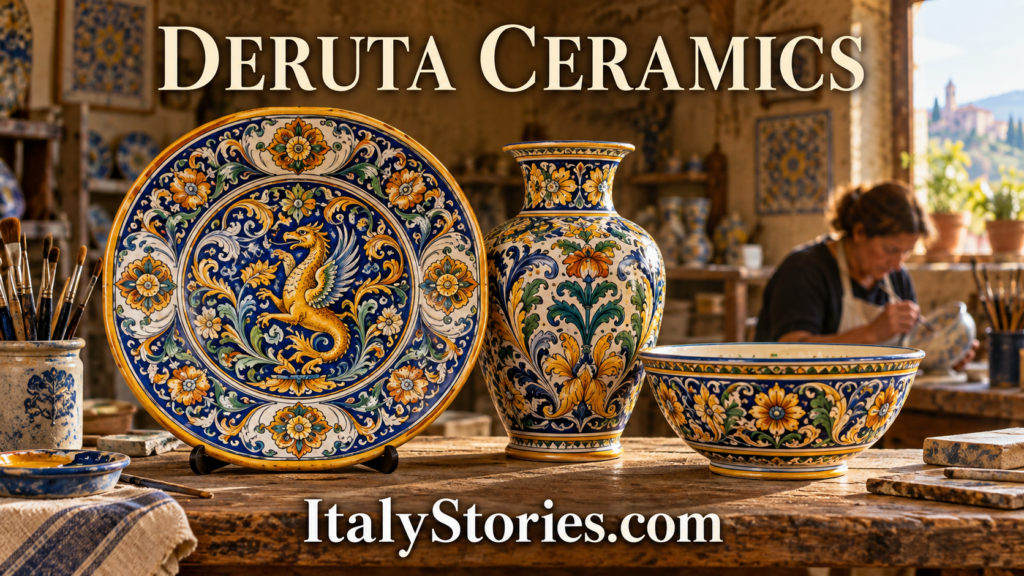
In the green heart of Umbria, a few miles south of Perugia, there is a small hill town whose name has travelled much farther than its streets. Deruta may appear quiet and modest from a distance, surrounded by olive trees, vineyards and the gentle Umbrian countryside, but for centuries it has been one of the most important centres of artistic ceramics in the world. Here, clay is not simply shaped into plates, bowls and vases. It is transformed into colour, tradition and identity.
To walk through Deruta is to enter a town where ceramics seem to be everywhere. Painted signs decorate workshops and buildings, colourful plates fill shop windows, and ornamental tiles brighten walls, fountains and public spaces. Even before entering an artisan’s studio, visitors understand that pottery is not merely a local product. It is the language through which Deruta has told its story for generations.
The ceramic tradition of the town has medieval origins. Its position near the Tiber River, along important commercial routes connecting central Italy with Rome, helped local workshops obtain raw materials and sell their products beyond Umbria. Early Deruta pottery was generally practical and relatively simple, created for kitchens, pharmacies, convents and ordinary households. Artisans produced jugs, bowls, storage containers and the cylindrical vessels known as albarelli, traditionally used by apothecaries to preserve herbs, powders and medicinal preparations.
Between the fifteenth and sixteenth centuries, however, Deruta entered its golden age. The Renaissance brought wealth, artistic experimentation and a growing demand for beautiful objects. Wealthy families, religious institutions and noble courts no longer wanted pottery that was merely useful. They wanted pieces capable of displaying taste, education and social prestige.
Deruta’s potters answered with magnificent maiolica: earthenware covered with an opaque white glaze and painted with brilliant mineral colours. Against the luminous surface, cobalt blue, copper green, golden yellow, orange and deep manganese tones acquired an intensity that ordinary clay could never achieve. Everyday objects became miniature works of art.
The process remains far more complicated than the finished pieces might suggest. First, the clay must be prepared and shaped, often on a potter’s wheel. The object is then carefully dried and fired for the first time, producing a porous form known as biscuit or bisque. It is dipped into a pale glaze that provides the smooth background on which the decorator will paint.
This is one of the most delicate stages because the unfired glaze absorbs colour immediately. Unlike painting on canvas, there is little room for correction. A line placed incorrectly cannot simply be erased. The artist must work with concentration and confidence, following the curve of the object while anticipating how the pigments will change inside the kiln.
After the decoration is complete, the piece returns to the kiln. Fire fuses the glaze and colours to the surface, producing the brilliant finish associated with Italian maiolica. Opening the kiln is still a moment of suspense. Heat can reward weeks of work, but it can also reveal cracks, distortions or unexpected changes in colour. The kiln always has the final word.
Some of Deruta’s most spectacular Renaissance pieces were made using lustre decoration, a sophisticated technique that created shimmering metallic reflections. Compounds containing copper or silver were applied to an already glazed and fired surface, after which the object underwent another firing in a special low-oxygen atmosphere. When successful, the ceramic emerged with iridescent shades of gold, ruby red or copper.
The result seemed almost magical. Plates reflected the light like precious metal, although they were made from humble earth. This contrast between simple material and luxurious appearance became one of the great achievements of Renaissance ceramic art.
Deruta workshops created objects for almost every aspect of life. There were large presentation dishes, pharmacy jars, wine jugs, devotional plaques, tableware, wedding gifts and ceremonial pieces. Some were decorated with religious subjects or coats of arms. Others depicted mythological scenes, battles, allegories and episodes inspired by classical history.
Particularly fascinating were the so-called “beautiful woman” plates. These featured idealised female portraits accompanied by ribbons bearing a name or a complimentary phrase. They were often connected with courtship, engagement or marriage and offered an elegant Renaissance solution to a problem that still exists today: finding a romantic gift that looks expensive and says the right thing.
Over time, Deruta developed an unmistakable decorative vocabulary. One of its most recognisable patterns is the Raffaellesco, inspired by the fantastic creatures, foliage and ornamental figures found in Renaissance grotesque decoration. Its central character is often a colourful winged dragon, surrounded by elegant scrolls and flowers.
Despite the name, the pattern was not personally designed by Raphael. It reflects the decorative world associated with Renaissance art and with the grotesques that became fashionable after ancient Roman wall paintings were rediscovered. The dragon is often interpreted as a benevolent guardian, although on Deruta pottery its main responsibility today may be protecting a very good plate of pasta.
Another celebrated style is Ricco Deruta, a richly detailed design filled with curling leaves, flowers and rhythmic blue-and-gold decoration. The Peacock Feather pattern uses repeated eye-shaped forms inspired by the bird’s magnificent plumage, while other traditional designs feature geometric borders, lemons, grapes, sunflowers, olive branches and scenes from the Umbrian landscape.
These patterns are not frozen relics. Each workshop interprets them in its own way. Two plates may follow the same traditional design but still reveal small differences in colour, line and composition. Those variations are not defects. They are evidence of the human hand.
For centuries, ceramic production involved entire families and specialised groups of workers. One person prepared the clay, another shaped it, another managed the kiln and a skilled painter completed the decoration. Knowledge passed from master to apprentice and from one generation to the next, sometimes remaining within the same family for centuries.
The history of Deruta ceramics was not always a continuous success. Changes in taste, competition from industrial production and periods of economic difficulty caused the industry to decline after its Renaissance splendour. During the nineteenth and early twentieth centuries, however, interest in historic Italian craftsmanship returned. Artists and entrepreneurs studied surviving Renaissance pieces, revived traditional patterns and adapted them for international buyers.
Today, Deruta ceramics are exported around the world and are particularly admired in the United States. Their colours have become part of an international image of Italian life: generous tables, sunlit kitchens, family meals and the pleasure of surrounding oneself with beautiful handmade objects.
Yet the most authentic pieces are not anonymous souvenirs produced by machines. In a genuine artisan workshop, every stage still demands time. The clay must dry slowly. The painter must follow the design by hand. The kiln cannot be hurried. Small irregularities in a brushstroke or border give each object its personality and ensure that no two pieces are perfectly identical.
Visitors to Deruta can often see artisans at work inside the town’s workshops. Watching a painter decorate a plate is a lesson in patience. The brush moves steadily across the pale surface, creating leaves, flowers and geometric borders with an ease that hides years of experience. What appears spontaneous is actually the result of discipline, repetition and an extraordinary control of colour.
The town’s Regional Museum of Ceramics preserves this long history inside the former convent of San Francesco. Its collections document the development of local production from medieval pottery to Renaissance masterpieces and modern creations. The museum allows visitors to understand how Deruta changed over the centuries while maintaining its deep connection with clay and fire.
Another moving expression of this tradition can be found at the nearby Sanctuary of the Madonna dei Bagni. Its walls preserve hundreds of ceramic ex-votos left by believers to express gratitude for protection or healing. These small painted plaques depict illnesses, accidents, difficult births and moments of danger. They are works of popular faith, but also vivid fragments of everyday life.
The people represented in them were not princes or famous commanders. They were farmers, mothers, travellers and children. Their painted stories remind us that ceramics in Deruta were never limited to palaces and elegant tables. They also carried prayers, fears, memories and hope.
This combination of beauty and humanity explains why Deruta ceramics remain so appealing. A hand-painted bowl is useful, but it is also connected to centuries of artistic knowledge. A plate may decorate a wall in New York, London or Sydney, yet its colours still speak of Umbria: blue skies, green hills, golden sunlight and the warm tones of old stone.
In a world increasingly filled with identical objects, Deruta continues to celebrate the opposite idea. Its ceramics require slowness, attention and skilled hands. They preserve the small imperfections that make an object unique and remind us that real craftsmanship cannot be reduced to a button pressed in a factory.
Deruta’s greatest treasure is therefore not a single pattern, pigment or historic vase. It is the uninterrupted conversation between past and present. Renaissance dragons still appear on contemporary tableware, ancient techniques survive in family workshops, and young decorators continue to learn the gestures of those who worked before them.
Clay, water, colour and fire: the ingredients appear simple. In Deruta, however, they have created an artistic tradition recognised throughout the world. Every plate carries a little of the town with it, every brushstroke preserves a memory, and every finished piece proves that even the most ordinary material can become something extraordinary when placed in the right hands.
Follow ItalyStories.com to discover the artisans, traditions, landscapes and hidden stories that make Italy unlike anywhere else in the world.