

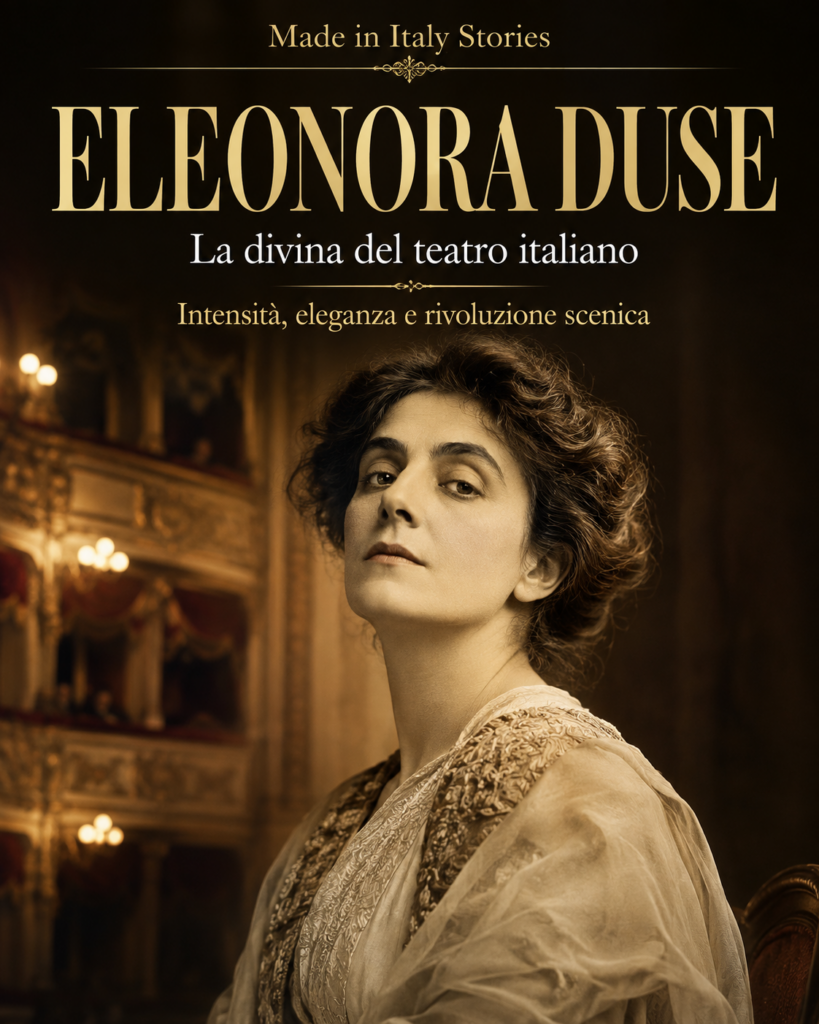
The Divine of Italian Theatre: Intensity, Elegance and a Revolution on Stage
There are performers who become famous, and then there are performers who change the vocabulary used to describe acting itself. Eleonora Duse belongs to the second category. At the end of the nineteenth century, when the great star actor often dominated the stage through grand gestures, carefully projected poses and magnificent vocal display, Duse moved in another direction. She made hesitation meaningful. She allowed silence to work. She seemed to let emotion appear rather than announce it. Audiences across Europe and the Americas felt they were not watching a woman perform feeling but witnessing feeling happen. That illusion of truth made her one of the most influential actresses in the history of modern theatre.
She was born in Vigevano on 3 October 1858 into a family of actors. Her parents, Alessandro Duse and Angelica Cappelletto, belonged to the precarious world of traveling companies. Theatre was not a glamorous choice Eleonora made after a protected childhood; it was the environment into which she was born. She appeared on stage as a very young child, reportedly playing Cosette in an adaptation of Victor Hugo’s Les Miserables at around four years old. Her childhood was spent moving from town to town, among modest theatres, unstable finances and the demanding rhythms of performance.
The romantic myth of the child born for the stage can hide how difficult that life was. Duse’s early years involved insecurity, work and little conventional education. She learned through experience, observation and the accumulated craft of theatrical families. For a long time there was no obvious sign that she would become extraordinary. She developed gradually, through roles, failures, mentors and the discipline of repetition. The great Duse was not a miracle that appeared fully formed. She built herself.
A decisive period came in the late 1870s and early 1880s. While performing in Naples, she attracted the attention of established actors and joined stronger companies. Giacinta Pezzana became an important influence, and within Cesare Rossi’s company Duse advanced rapidly. Her performances in works by Alexandre Dumas fils and other contemporary dramatists brought major recognition. By the early 1880s, audiences in Turin, Rome and elsewhere were speaking of her as a new force.
What made her acting different is difficult to reconstruct because theatre disappears the moment it happens. We have photographs, reviews, letters and memories, but not a recording of her greatest stage performances. Witnesses repeatedly described an art that rejected obvious theatricality. Her face could seem to change color with emotion. Small physical details replaced conventional gestures. She was willing to appear tired, ill, awkward or emotionally exposed if the role required it. She did not preserve a glamorous mask between herself and the character. In a period obsessed with star image, that was revolutionary.
Her name is often paired with Sarah Bernhardt, the other enormous international actress of the era. The comparison became almost irresistible for critics. Bernhardt represented brilliance, vocal command, spectacle and a consciously sculpted theatrical presence. Duse represented inwardness, nervous intensity and apparent spontaneity. The contrast was sometimes exaggerated, and both women were far more complex than the rivalry suggests, but it helped audiences understand that two very different forms of greatness could exist on the same world stage.
Duse’s private life and professional life were inseparable in the way they often were for nineteenth-century performers. In 1881 she married the actor Tebaldo Checchi, and in January 1882 their daughter Enrichetta was born. The marriage deteriorated and the couple separated. Duse’s relationship with her daughter remained deeply important, and she was determined that Enrichetta should not be forced into the theatrical life that had shaped her own childhood. The stage had given Duse everything and taken a great deal from her. She knew both sides.
By the mid-1880s Duse was not merely a leading actress but a capocomica, effectively responsible for the artistic and financial life of her own company. This role required far more than acting. She had to choose repertory, negotiate contracts, manage tours, deal with actors, secure theatres and carry financial risk. The image of the ethereal artistic genius is therefore incomplete. Duse was also an entrepreneur in one of the most unstable businesses imaginable.
Her international career expanded dramatically. She toured across Europe, Russia, Egypt, South America and the United States, performing in Italian before audiences who often understood only part of the language. The fact that she could move spectators without linguistic fluency became part of her legend. Gesture, rhythm, expression and emotional structure carried meaning where words could not. Theatre, in her hands, became strangely translatable.
Arrigo Boito, the composer and writer, became one of the major intellectual and emotional relationships of her life. Their long, largely private bond deepened Duse’s literary education and introduced her more fully to writers and philosophical questions beyond the commercial repertoire of the day. Through this period she increasingly searched for drama that could match the psychological complexity she wanted to bring to the stage. Henrik Ibsen became especially important to her, and she would become a celebrated interpreter of works such as A Doll’s House, Rosmersholm and The Lady from the Sea.
Then came Gabriele D’Annunzio. Their relationship, beginning in the 1890s, became one of the most famous unions of art, love, ambition and emotional damage in Italian cultural history. Duse believed D’Annunzio might create a new poetic theatre worthy of her aspirations, and she invested money, energy and reputation in his plays. She performed works including La Gioconda and Francesca da Rimini. The relationship was passionate and public, and it became even more complicated when D’Annunzio used elements of their life in his novel Il fuoco. Duse suffered, accepted, resisted and continued. As usual, art and private life refused to remain in separate rooms.
Her fascination with Ibsen and the newer European drama was part of a wider theatrical transformation. Duse wanted roles in which women were not simply decorative centers of melodrama but psychologically complex beings. Her acting style anticipated developments that would later become central to modern performance: reduced gesture, internal motivation, emotional continuity and suspicion of empty display. She did not invent modern acting alone – no historical transformation belongs to one person – but she became one of its most powerful early symbols.
Illness, exhaustion and disappointment accumulated. In 1909 Duse withdrew from the stage. For a woman whose identity had been entangled with performance since childhood, retirement was both relief and uncertainty. She did not disappear from culture. She remained connected to writers, artists and younger intellectuals, read widely and reflected on theatre, spirituality and art. Figures including Rainer Maria Rilke and other major cultural voices regarded her with enormous admiration.
In 1916 she made her only film, Cenere, based on the novel by Grazia Deledda. The encounter is historically irresistible: one of Italy’s greatest actresses interpreting one of its greatest women writers. Duse was curious about cinema as an independent art but dissatisfied with the result. She understood that film required a different grammar from theatre, and she resisted the simple idea that a camera should merely preserve stage acting. Even when the experiment disappointed her, the instinct was forward-looking.
After more than a decade away from the theatre, Duse returned to the stage in 1921. She was in her sixties, physically fragile and already a legend to younger audiences who had never seen her. The return could easily have become a sentimental disaster. Instead, it was a triumph. She performed Ibsen, D’Annunzio and other works in Italy and abroad, proving that her art had not become a museum piece. If anything, age intensified the stripped-down quality of her presence.
In 1923 Time magazine placed Duse on its cover. She was the first woman ever to appear on the cover of the young American magazine, a remarkable indication of her international stature. The fact is often forgotten today because theatre fame can fade more quickly than film fame. There are no surviving close-up performances to circulate endlessly online. Yet in her own lifetime, Duse was not a specialized cultural figure. She was a world celebrity.
Her final American tour was demanding. In April 1924, after performing while already unwell, she developed pneumonia in Pittsburgh and died there on 21 April. Her body was returned to Italy, and she was buried in Asolo, the Veneto town she had loved and chosen as a place of retreat. The international reaction confirmed what her audiences had known for decades: an era of theatre had ended.
Duse’s influence is difficult to measure precisely because it entered the bloodstream of acting. Later performers and directors inherited a world in which psychological truth, silence and natural gesture were increasingly valued. What had once seemed daring became part of the modern expectation that an actor should ‘be’ rather than merely display. Of course every performance is constructed. Duse’s genius lay in making construction disappear.
Her story also complicates simple narratives of female emancipation. She achieved immense professional authority, ran companies and traveled internationally, yet her life was marked by the pressures placed on women, mothers and public figures. She sought artistic independence while becoming emotionally entangled with powerful men. She earned money and lost it on ambitious projects. She was adored by audiences and frequently exhausted by the machinery required to remain adored. Freedom was real, but it was never inexpensive.
For Italy, Eleonora Duse remains not simply ‘La Divina’ but one of the artists who helped move theatre toward the twentieth century. She made the body quieter and the emotion louder. She showed that a pause could carry more force than a declaration, that beauty on stage did not require vanity and that an actress could be both the center of a performance and its most invisible mechanism. That is a sophisticated revolution, and we are still living inside it.
If you have heard of Eleonora Duse but never knew the full scale of her international fame, follow Made in Italy Stories and tell us in the comments what surprised you most. Her revolutionary acting, her relationship with D’Annunzio, her only film with a story by Grazia Deledda, or the fact that she became the first woman ever featured on the cover of Time?