

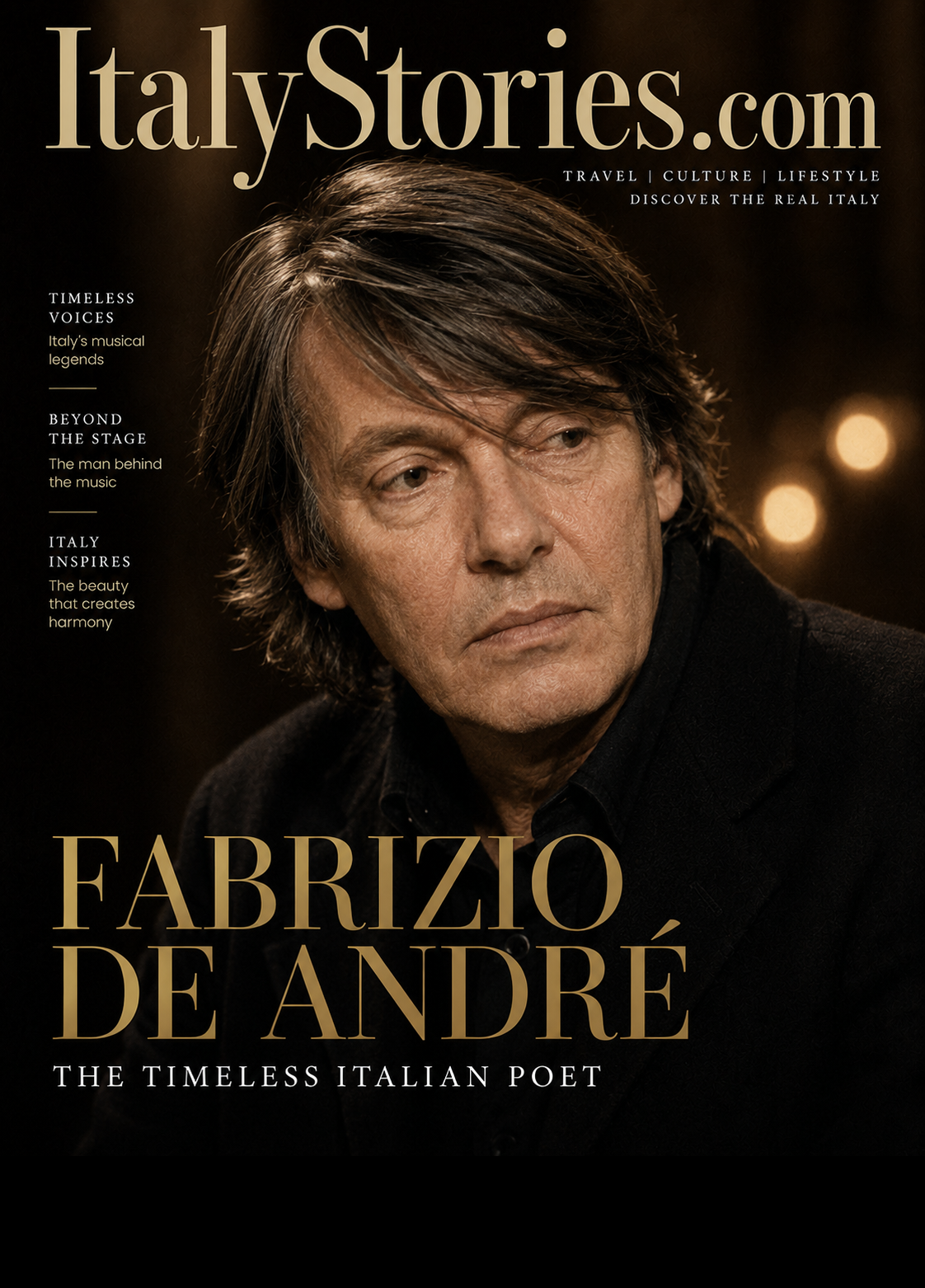
The Day Genoa Understood What It Had Lost
In January 1999, Genoa did not say goodbye to Fabrizio De André as it might have said goodbye to an ordinary celebrity. The city seemed to recognize that one of its own voices had become something larger than a recording artist. His songs had entered schools, political discussions, family record collections, student bedrooms and the vocabulary of people who had never agreed on much else. The prostitutes, soldiers, prisoners, rebels, mothers, outsiders and defeated people who populated his lyrics had become part of Italy’s cultural memory.
That reaction was fitting because De André had spent almost forty years refusing the role of conventional star. He distrusted spectacle, resisted easy moral judgments, sang from the side of people normally excluded from respectable narratives and preferred the dignity of a well-written song to the machinery of celebrity. Even his public appearances were comparatively rare for much of his career. He seemed less interested in being seen than in forcing listeners to look somewhere else: toward a poor neighborhood, a battlefield, a prison cell, an impossible love, a minority community or a person condemned by society before being understood.
This is why calling him simply a singer-songwriter is accurate but incomplete. De André used popular song as a form of literature, social inquiry and moral argument. He borrowed from medieval poetry, French chanson, the Bible, apocryphal gospels, Edgar Lee Masters, Bob Dylan, Leonard Cohen, Georges Brassens, anarchist thought, Mediterranean folk traditions and the language of the streets. Yet the final result never sounded like a classroom exercise. It sounded unmistakably his.
His story began in Genoa, but not in the Genoa of postcards. It began between bourgeois security and wartime displacement, between family expectations and rebellious friendships, between classical education and the rough human theater of the old port. Long before the world called him Faber, Fabrizio De André was learning to distrust the official version of things.
Pegli, War and the Memory of the Countryside
Fabrizio Cristiano De André was born in Pegli, a district of Genoa, on February 18, 1940. His parents, Giuseppe De André and Luigia Amerio, came from Piedmontese families. His father was educated, ambitious and professionally successful; his mother came from a family connected with vineyards and wine production. Fabrizio therefore did not grow up in poverty, a fact he never tried to hide. His later solidarity with the excluded did not come from pretending to share their material origins. It came from a conscious ethical and intellectual choice.
Only a few months after his birth, Italy entered the Second World War. As bombing and political danger reshaped daily life, much of the De André family moved to the countryside near Asti, to Revignano, where Giuseppe had acquired a farm. Those years left deep impressions on Fabrizio. The rural environment, animals, farmers and the rhythms of non-urban life remained in his memory long after the family returned to Genoa. Decades later, images from that childhood would re-emerge indirectly in his writing, most famously in the emotional landscape surrounding “Ho visto Nina volare.”
The war also gave his childhood a political background before he was old enough to understand politics in theoretical terms. His father, who had remained in Genoa for part of the conflict, was endangered after helping protect Jewish students at his school. The lesson was not delivered as ideology. It existed inside family history: institutions can become unjust, authority can become criminal, and individual responsibility may require disobedience.
When the family returned to Genoa after the war, Fabrizio entered a city marked by reconstruction, class difference and intense political debate. He began music lessons, first studying violin and later moving toward guitar. The change of instrument mattered. The violin belonged more naturally to formal musical education; the guitar could be carried into a room, a street, a gathering of friends. It suited the kind of songwriter he would become.
Genoa After the War: School, Rebellion and the Old Port
De André’s school years were not a story of disciplined academic brilliance. He was intelligent, widely curious and capable of serious study, but resistant to imposed authority. He moved through different schools and eventually completed classical studies in Genoa. Later he enrolled at university, first considering literature and then law, but never completed a degree.
The more decisive education was taking place elsewhere.
Genoa’s old quarters offered a social world far removed from the respectable bourgeois environment in which he had been raised. In the caruggi, the narrow streets of the historic center, he encountered sailors, prostitutes, drifters, workers, petty criminals and people whom conventional society preferred to describe through labels. De André’s songs would later repeatedly reverse the direction of judgment: respectable people might prove cruel or hypocritical, while the condemned could possess tenderness, dignity and moral clarity.
This was not romantic tourism among the poor. He developed friendships and habits that brought him close to marginal environments, sometimes destructively. Alcohol, nightlife, gambling and a taste for provocative company became part of the young De André legend. Yet beneath the bohemian behavior there was serious reading. He devoured literature and political thought, especially authors suspicious of power and conventional morality.
The result was a worldview that would stay with him. He did not believe that legality and justice were automatically the same thing. He did not believe that the majority was automatically right. And he did not believe that the people at the bottom of a social hierarchy were necessarily there because they deserved to be.
Those ideas would eventually become songs.
Paolo Villaggio, ‘Faber’ and a Generation of Genoese Songwriters
Among the most important friendships of De André’s youth was Paolo Villaggio, who would later become one of Italy’s most famous comic actors and writers. Villaggio gave him the nickname “Faber,” linked to De André’s fondness for Faber-Castell pencils and helped by the natural echo of his first name. The nickname survived so completely that decades later many Italians still use Faber as if it were another official name.
The friendship was creatively important as well as personal. De André and Villaggio shared a taste for irreverence and linguistic play, and they collaborated on songs including “Carlo Martello ritorna dalla battaglia di Poitiers,” a comic medieval ballad that already displayed De André’s instinct for using history to puncture respectability.
Genoa in those years produced an extraordinary cluster of songwriters and performers: Luigi Tenco, Gino Paoli, Bruno Lauzi, Umberto Bindi and others. The so-called Genoese School helped transform Italian popular song by making it more personal, literate, introspective and modern. De André belonged to that environment while remaining stylistically separate from it.
His most decisive foreign influence was French chanson, especially Georges Brassens. From Brassens he learned that a song could be elegant and obscene, tender and anticlerical, funny and politically dangerous at the same time. He later translated and adapted several Brassens songs into Italian, not as mechanical copies but as acts of cultural translation.
He also listened closely to Leonard Cohen and Bob Dylan, whose work demonstrated different possibilities for combining poetry, storytelling and song. Yet De André’s eventual voice was never a simple Italian version of any of them. He absorbed models, then redirected them toward Genoa, Italian history and his own moral obsessions.
The First Singles: Murdered Girls, Soldiers and Uncomfortable Stories
De André’s recording career began with 45 rpm singles in the early 1960s. The earliest releases did not make him famous, but they already contained the themes that would define him.
“La ballata del Michè” told of a prisoner and death. “La guerra di Piero” turned the battlefield away from patriotic rhetoric and toward the vulnerability of a single soldier. “La canzone di Marinella” transformed the death of a young woman, inspired by a news story, into a tragic ballad of almost fairy-tale delicacy.
The method was already clear: De André was interested in people whom official history reduced to statistics or moral categories. He gave them names, motives, gestures and private destinies.
“La canzone di Marinella” became crucial when Mina, already one of the greatest voices in Italy, recorded it in the late 1960s. Her interpretation brought the song and its author to a much wider public. De André later acknowledged that the royalties and visibility helped convince him that songwriting could become a real profession rather than an uncertain side activity.
The breakthrough is especially revealing because it did not come from De André changing his language to chase the market. Another major artist recognized the power of what he was already doing.
From that moment, the question was no longer whether Fabrizio De André could write important songs. It was how far he could push the form.
‘Via del Campo’ and ‘Bocca di rosa’: Genoa Becomes a Moral Landscape
By 1967, De André had written two songs that would become inseparable from his name: “Via del Campo” and “Bocca di rosa.”
Both songs are rooted in the world of marginal sexuality, but neither treats its characters as objects of pity. In “Via del Campo,” the old Genoese street becomes a place where beauty and degradation coexist, where the social categories used to divide respectable people from the excluded begin to lose authority. In “Bocca di rosa,” a sexually independent woman enters a small community and exposes its jealousy, moralism and hypocrisy.
The song became controversial enough to face censorship and lyrical alteration, which only confirmed the accuracy of its target. De André was interested in the mechanisms by which a community protects its self-image by punishing the person who reveals its contradictions.
This pattern would recur across his career. He rarely argued through slogans. Instead, he built situations. He introduced a character, allowed society to judge that person, and then quietly rearranged the listener’s sympathies.
The technique made his songs durable because the moral question remained open. One could listen decades later and still ask: who is actually guilty here?
For De André, the outcast was often not a symbol of failure but a test of civilization.
From Song Collections to Concept Albums
At the end of the 1960s De André moved decisively toward the album as a larger artistic form. Volume 1 and Volume 3 gathered songs that established his early canon, but Tutti morimmo a stento in 1968 showed a broader ambition. The album was conceived around death, social exclusion and the fragility of human life, drawing partly on the atmosphere of François Villon and other literary traditions.
This approach distinguished De André from many commercial singers of the period. The individual song still mattered, but he increasingly treated the album as a book with chapters. Themes could echo across tracks. Characters could belong to the same ethical universe. Musical choices could support an argument rather than simply decorate a hit single.
That ambition would reach remarkable heights in the early 1970s, when he produced a sequence of concept albums that permanently changed the intellectual expectations surrounding Italian popular music.
De André did not stop being accessible. He simply refused the assumption that accessibility required simplification.
‘La buona novella’: The Gospels Seen from Below
La buona novella, released in 1970, took material from the apocryphal gospels and retold the story of Mary, Joseph and Jesus through a profoundly human lens.
The choice was provocative. Italy was still a heavily Catholic society, and religion was often treated either with reverence or with anticlerical hostility. De André did something subtler. He separated the figure of Jesus from institutional power and read the Gospel tradition from the perspective of poverty, motherhood, suffering and disobedience.
The album arrived in the political climate following 1968, when many younger listeners expected artists to address revolution more directly. De André’s decision to make a record about Christian origins could therefore seem evasive. In fact, he saw the story of Jesus as radically political: a narrative centered on the weak and a challenge to authority.
“Il testamento di Tito” became one of the album’s key songs. Rather than reciting religious rules abstractly, the criminal crucified beside Christ examines commandments against the messy reality of human behavior. The effect is not a rejection of morality but a rejection of moral simplification.
La buona novella demonstrated De André’s gift for entering a canonical story and shifting the camera. The people at the edge become central; the officially central figures become human.
It was a method he would use repeatedly.
Spoon River in Italian: ‘Non al denaro non all’amore né al cielo’
In 1971 De André turned to Edgar Lee Masters’ Spoon River Anthology for Non al denaro non all’amore né al cielo.
The original American book consists of epitaph-like monologues spoken by the dead inhabitants of a small town. De André did not simply set existing poems to music. He selected characters, transformed them, collaborated with composer and arranger Nicola Piovani, and created a new Italian musical work inspired by Masters’ moral architecture.
The album allowed him to explore envy, ambition, failure, science, judgment and love through people speaking after death, when social masks no longer matter. Fernanda Pivano, who had translated Spoon River into Italian and was a major mediator of American literature in Italy, recognized the seriousness of the project.
The record contains some of De André’s most carefully constructed character songs. A judge deformed by resentment, a doctor defeated by his own ideals, an eccentric player capable of seeing the world differently: each becomes an argument about how society shapes individual destiny.
This was one of De André’s greatest strengths. He could make philosophical questions visible through a person.
Instead of asking “What is envy?” he showed what envy does to a life.
‘Storia di un impiegato’: Revolution, Failure and Collective Responsibility
Storia di un impiegato, released in 1973, was De André’s most explicitly political concept album.
Written with Giuseppe Bentivoglio and with important musical contributions and arrangements by Nicola Piovani, the record follows an ordinary employee who hears a song connected to the French May of 1968 and becomes obsessed with rebellion. His first response is individualistic and violent. He wants to destroy power without understanding the collective structures that make change possible.
The narrative moves through fantasy, bombing, arrest, prison and eventual recognition that private revolt is not enough.
The album divided listeners. Some on the political left considered it confused or insufficiently aligned with their positions; others valued its refusal to romanticize revolutionary violence. De André himself was suspicious of ideological discipline, even when he sympathized deeply with anti-authoritarian movements.
That tension is central to understanding him. He was an anarchist in ethical orientation, but he was rarely interested in repeating party language. His distrust of power included distrust of movements that could become new forms of power.
Storia di un impiegato is therefore less a manifesto than an argument with the desire for revolution itself.
The album asks what happens when anger is morally justified but politically immature.
The Man Who Was Afraid of the Stage
For a major recording artist, De André was remarkably reluctant to perform live during the first long phase of his career.
Part of the reason was temperament. He disliked the exhibitionistic side of performance and was famously uncomfortable with audiences. Records allowed him to control language, arrangement and atmosphere without submitting himself to the unpredictable theater of the stage.
That changed in 1975, when he finally began performing concerts more regularly. His first major public live appearance at La Bussola in Versilia became a historical turning point. The singer who had spent years avoiding the stage discovered that live performance could become something other than self-display.
The concerts also altered the audience’s relationship with him. The voice that had existed privately in homes and headphones now belonged to a physical person standing under lights.
De André never turned into a flamboyant showman. That was precisely the point. His authority on stage came from concentration, from the songs, and from the unusual feeling that the audience was listening to someone who would rather be accurate than spectacular.
‘Amico fragile’ and the Violence of Polite Society
The mid-1970s produced one of De André’s most revealing songs, “Amico fragile.”
The song emerged from his growing irritation with bourgeois rituals and the demand that an artist perform on command for people who wanted entertainment without necessarily wanting to hear what the artist was saying. It is one of his most personal pieces, filled with fractured images, anger and vulnerability.
By this stage, the social outsider in De André’s work was no longer only someone he observed in the city. The singer himself had begun to understand a form of outsider status: famous, financially secure, invited everywhere, but suspicious of the social world that celebrated him.
The contradiction would follow him. De André came from privilege, became successful and lived comfortably, yet devoted his work to criticizing the moral assumptions of his own class.
Rather than resolve that contradiction, he wrote from inside it.
Francesco De Gregori, Massimo Bubola and the Art of Collaboration
De André’s public image can make him seem like a solitary author, but many of his finest periods were built through collaboration.
Volume 8, released in 1975, was created with Francesco De Gregori. The meeting joined two major writers from different generations and produced songs in which their styles interacted rather than disappeared. De André’s work became more contemporary in language and musical texture, while De Gregori entered the orbit of an already canonical figure.
Later, Massimo Bubola became a crucial collaborator on Rimini in 1978 and on the self-titled 1981 album often called L’Indiano. Bubola helped De André move toward a broader folk-rock vocabulary and toward narrative themes connected with the American West, Sardinia and the violence of conquest.
These partnerships reveal a useful truth about De André: he was intellectually confident enough to share authorship.
He did not protect originality by isolation. He protected it by choosing strong collaborators and allowing the work to change.
The PFM Tour: Old Songs Become Rock Without Losing Their Meaning
At the end of the 1970s, De André made one of the boldest choices of his career by touring with Premiata Forneria Marconi, Italy’s great progressive rock band.
The collaboration could easily have failed. De André’s songs were associated with acoustic arrangements, clear words and literary concentration; PFM came from a world of electric virtuosity, progressive structures and powerful stage sound.
Instead, the band reimagined the songs with extraordinary intelligence. Familiar pieces gained electric guitars, expanded rhythm sections and new dramatic architecture while the lyrics remained central.
The tour, spanning late 1978 and 1979, produced celebrated live recordings and permanently changed the way many of the songs were heard. It also demonstrated something important about De André’s writing: strong songs survive rearrangement.
A melody and lyric that depend entirely on one production style may belong to an era. De André’s songs belonged to something more durable.
Sardinia, Dori Ghezzi and the Kidnapping
By the late 1970s, Sardinia had become central to De André’s private life. He and singer Dori Ghezzi, his partner and later wife, spent increasing time on the island and established a home at L’Agnata, near Tempio Pausania.
The attraction was understandable. De André had always been drawn to rural communities, marginal cultures and places resistant to homogenization. Sardinia offered landscape, distance and a social history unlike mainland urban Italy.
On the evening of August 27, 1979, De André and Ghezzi were kidnapped by members of the Sardinian bandit world and held for roughly four months. They were released in December after payment of a ransom.
The experience could easily have produced only hatred. De André’s response was more complicated. He condemned the violence, but also tried to understand the social environment that produced the kidnappers. He famously distinguished between those who physically held them and the higher-level organizers he believed were truly responsible.
This capacity to search for context even after becoming a victim himself was consistent with his entire artistic ethic. Understanding, for De André, did not mean excusing. It meant refusing to stop thinking when judgment became emotionally easy.
The kidnapping left deep marks on his life and art, and the Sardinian landscape would remain intertwined with his later work.
‘L’Indiano’: Sardinians, Native Americans and the Violence of the Center
The 1981 album Fabrizio De André, commonly known as L’Indiano because of its cover image, drew a parallel between Sardinian communities and Native American peoples.
The comparison was not historical equivalence. It was an artistic attempt to connect cultures that De André saw as living under pressure from more powerful centers: communities with strong traditions, territorial identities and experiences of domination.
The album, developed with Massimo Bubola, included “Fiume Sand Creek,” one of De André’s best-known songs about the massacre of Cheyenne and Arapaho people in Colorado in 1864. The song does not present history as a lecture. It imagines violence through a child’s vision, making atrocity intimate.
The record also contained songs linked more closely to Sardinia and to the emotional aftermath of the kidnapping.
By now, De André’s interest in the excluded had expanded from individual outsiders to entire peoples.
The ethical question remained the same: what does power look like from the side of those who receive it rather than those who exercise it?
‘Crêuza de mä’: A Genoese Album That Sounded Like the Mediterranean
In 1984 De André and Mauro Pagani released Crêuza de mä, one of the most revolutionary albums in Italian popular music.
The decision alone was radical: most of the record was sung in Genoese, a language many Italian listeners could not easily understand. At a time when the record industry normally sought linguistic accessibility, De André moved in the opposite direction.
Yet the album was not an act of local nostalgia. Pagani constructed a musical world using instruments and colors associated with different Mediterranean traditions: oud, bouzouki, percussion, winds and string textures that suggested a sea connecting cultures rather than separating them.
The Genoese language became part of that Mediterranean soundscape. Its hard consonants, vowels and seafaring vocabulary made the songs feel ancient and modern at once.
The title refers to a narrow path descending toward the sea, and the album is filled with sailors, ports, hunger, travel, trade, violence and desire. Genoa is present, but not as a closed city. It is Genoa as one harbor in a much larger world.
Crêuza de mä changed expectations about dialect, world music and Italian songwriting. It proved that an artist could become more universal by becoming more specific.
For many musicians who came later, the album became a reference point for how local language and global sound could coexist without folkloric decoration.
The Voice: Low, Calm and Morally Dangerous
De André’s voice was not technically spectacular in the conventional sense, but it was one of the most recognizable instruments in Italian music.
It sat naturally in a low register, warm and dark, with precise diction and an almost conversational authority. He rarely needed to shout. The calmness could make disturbing subjects even more powerful because he did not instruct the listener how to feel.
This restraint was essential to songs about murder, war, prostitution and death. A theatrical singer might have turned them into melodrama. De André often delivered them like a witness describing what he had seen.
His phrasing also allowed unusually dense lyrics to remain intelligible. Words mattered, and the music had to create space for them.
Over time, the voice deepened further, gaining a weathered quality that suited the late albums. In Anime salve, the man singing about solitude and disobedience sounds as though he has spent decades testing those ideas against life.
The voice aged into the philosophy.
‘Le nuvole’: Power, Dialect and the Italy of the 1990s
After a long interval between studio albums, De André returned in 1990 with Le nuvole, again working closely with Mauro Pagani.
The title refers to clouds, but also metaphorically to powers that hover above ordinary people. The album combined standard Italian with Genoese, Sardinian and Neapolitan, creating a multilingual portrait of Italy.
Songs such as “Don Raffaè” used humor and narrative to examine organized crime, prison and the distorted relationship between illegal and institutional power. Other tracks turned toward regional identity, marginality and political satire.
The use of dialect had become more than a musical preference. It was an ethical choice. Standard language belongs to national institutions; dialect carries local memory, class history and ways of seeing that centralized culture often smooths away.
De André used linguistic difference to defend cultural difference.
Le nuvole also showed that he remained politically alert without becoming journalistic. He could write about contemporary Italy while preserving the layers of myth, literature and character that gave his songs durability.
‘Anime salve’: The Last Album and the Solitary Spirits
In 1996 De André released Anime salve, created in close collaboration with Ivano Fossati.
The title can be understood as solitary souls, and the album returns with extraordinary concentration to the people De André had defended throughout his career: those outside the majority, those whose identities or ways of life make them targets of judgment.
“Prinçesa” tells the story of a transgender woman. “Khorakhanè” turns toward Roma culture and persecution. “Disamistade” examines feud and inherited violence in Sardinia. “Dolcenera” uses the Genoa flood as both real event and emotional force. “Ho visto Nina volare” reaches back toward memory. “Smisurata preghiera,” inspired by the world of Álvaro Mutis, closes the album with a prayer for people who move against the laws of the herd.
The collaboration with Fossati was exceptionally fertile. De André brought decades of thematic obsession and linguistic craft; Fossati contributed much of the musical architecture and a complementary poetic intelligence. The arrangements, with Piero Milesi and an outstanding group of musicians, created one of the richest sonic environments of De André’s career.
Anime salve received major critical recognition and is often understood as his artistic testament, although De André did not know while making it that it would be his final studio album.
The record feels final not because it predicts death, but because it gathers the entire moral argument of his career into one mature work: protect the individual from the violence of the majority.
Literature Inside the Songs
De André’s work is often described as poetic, but the phrase can become vague unless one asks what it actually means.
He read constantly. His songs contain visible conversations with François Villon, Edgar Lee Masters, biblical and apocryphal literature, Georges Brassens, Bob Dylan, Leonard Cohen, Álvaro Mutis and many others. He collaborated with writers, translated songs and transformed texts across languages.
But erudition alone does not make a songwriter important. De André’s special ability was to digest sources until they became natural speech.
A listener did not need to know Spoon River to understand the pain of his characters. One did not need to have read apocryphal gospels to understand La buona novella. One did not need knowledge of anarchist theory to understand why De André distrusted power.
The scholarship remained underneath the song rather than standing in front of it.
This is one reason his lyrics entered schools. They can be studied for their references and language, but they also work before analysis begins.
Religion Without Clerical Obedience
De André’s relationship with religion was complex and central to his writing.
He was sharply critical of clerical institutions and of moral authority used to shame or control people. Yet he remained deeply interested in the figure of Jesus and in the ethical power of mercy.
This distinction allowed him to write some of the most original religious songs in Italian popular culture. He could reject church hypocrisy while taking the Gospel’s concern for the poor seriously. He could treat biblical characters as human beings rather than icons.
The same structure appears in his politics. He distrusted institutions but remained committed to justice. He rejected ideological conformity but cared intensely about collective suffering.
De André’s worldview was therefore not simple rebellion. It was a search for an ethics stronger than obedience.
That is why his songs can speak to believers, atheists, anarchists and people who avoid political labels altogether. He rarely asks the listener to join an organization. He asks the listener to examine how they judge another person.
Dori Ghezzi, Family and the Private Life Behind the Songs
De André’s private life was complicated, and a serious biography should neither hide that complexity nor reduce him to gossip.
He married Enrica Rignon, known as Puny, in 1962, and their son Cristiano was born the same year. Cristiano later became a musician and would preserve and reinterpret much of his father’s repertoire.
In the 1970s De André formed a relationship with singer Dori Ghezzi. Their daughter Luvi was born in 1977, and the couple eventually married in 1989. Ghezzi became an essential companion through the Sardinian years, the kidnapping and the later period of De André’s life.
Family did not transform him into a conventional domestic figure. He remained contradictory, private and often difficult. But the later songs reveal a man increasingly attentive to memory, affection and the consequences of time.
The public myth of Faber can sometimes make him appear as a perfectly consistent moral hero. He was not. He was more interesting: a flawed man who spent a lifetime interrogating weakness, including his own.
The Last Tour and the Illness
In the late 1990s De André continued performing with renewed intensity. The Anime salve tour and the later Mi innamoravo di tutto concerts brought together songs from across his career, often with sophisticated arrangements and a band that included members of his family and long-time collaborators.
In 1998, during the final tour, his health began to deteriorate. Pain and exhaustion forced him to interrupt the schedule. Medical examinations revealed advanced lung cancer.
The diagnosis ended the concerts but not his intellectual activity. He continued thinking about new writing projects and songs even as the illness progressed.
Fabrizio De André died in Milan on January 11, 1999, at the age of fifty-eight.
His death was followed by an extraordinary public response. This was not surprising. Italy had lost an artist whose work had helped teach listeners how to look at people society usually described from a distance.
The man who had sung so often about the dead entered the cultural afterlife he had already prepared through his songs.
What De André Changed in Italian Music
Fabrizio De André changed Italian popular music in several ways at once.
He widened its subject matter. Before him, mainstream song was dominated heavily by romantic love. De André certainly wrote love songs, but he also wrote about war, prison, prostitution, suicide, political violence, religious doubt, ethnic persecution, colonialism, organized crime and social hypocrisy.
He widened its literary ambition. An album could converse with American poetry, medieval ballads or apocryphal scripture without becoming inaccessible.
He widened its linguistic range. Standard Italian could coexist with Genoese, Sardinian and Neapolitan. Dialect could carry modern art rather than nostalgia.
He widened its moral perspective. The person called criminal, immoral, deviant or defeated by society might become the most human character in the song.
And he widened its musical geography. From chanson and acoustic balladry he moved through orchestral concept albums, progressive rock arrangements and Mediterranean instrumentation.
The constant was not style.
The constant was curiosity guided by an ethical position.
Why Fabrizio De André Still Matters
More than a quarter of a century after his death, Fabrizio De André remains unusually present in Italian culture.
His songs are reissued, studied, performed by younger musicians, discussed in universities, used in schools and preserved through archives and the work of the Fondazione Fabrizio De André. In 2024, twenty-five years after his death, his studio catalog was again reissued in chronological order with archival material, handwritten notes and reflections drawn from the De André study archive.
This continuing attention is not the result of nostalgia alone.
De André still matters because the questions inside his songs remain unresolved. How should society treat people who live differently? When does law become injustice? Why does the majority need an outsider to condemn? What happens when religion forgets mercy? Can violence produce liberation? What is left of a person after society has decided what category they belong to?
His work refuses easy answers, which is precisely why it survives.
A singer-songwriter from a privileged Genoese family spent his life lending narrative dignity to people who had little social power. He transformed foreign literature without losing Italian identity. He made dialect sound global. He made historical characters contemporary. He distrusted applause, then learned to stand in front of enormous audiences without becoming a conventional showman.
Most importantly, he made the popular song large enough to hold contradiction.
That is why Fabrizio De André is still not merely remembered.
He is still read, argued with, sung, and listened to as though the conversation were unfinished.
A Final Thank You from ItalyStories.com
Thank you for spending time with this story. ItalyStories.com was created to explore the people, places, voices and ideas that have shaped Italy far beyond its borders. If Fabrizio De André’s journey has made you curious about another chapter of Italian music, literature and culture, we would be delighted to welcome you to the next story.