

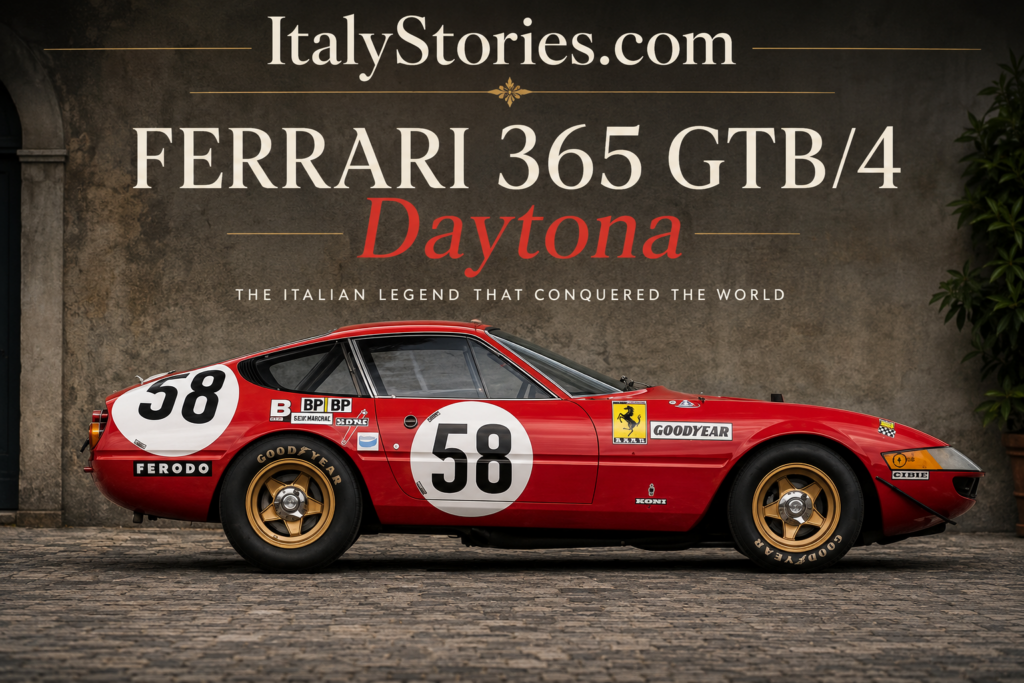
In the late 1960s, the future of the high-performance automobile appeared to belong to the mid-engined supercar. Lamborghini had stunned the world with the Miura, a machine so radical that many believed the traditional front-engined grand tourer had suddenly become obsolete. Ferrari, however, responded in characteristically defiant fashion. Instead of imitating its rival, Maranello created one of the fastest, most beautiful and most formidable front-engined cars ever built: the Ferrari 365 GTB/4, universally remembered as the Daytona.
Presented at the Paris Motor Show in October 1968, the 365 GTB/4 replaced the celebrated 275 GTB/4. Its official name followed Ferrari’s traditional system. “365” indicated the approximate displacement of each of the engine’s twelve cylinders, “GTB” meant Gran Turismo Berlinetta, and “4” referred to the four overhead camshafts. Yet almost nobody would remember it by that technical designation.
The name “Daytona” was never officially adopted for the production model by Ferrari. According to the most widely accepted explanation, journalists began using it in honour of Ferrari’s extraordinary performance at the 1967 24 Hours of Daytona. During that race, three Ferrari prototypes crossed the finish line together in first, second and third place, deliberately recreating Ford’s famous formation finish at Le Mans the previous year. The victorious cars were a 330 P3/4, a 330 P4 and a 412 P. The triumph was so emphatic that the name of the Florida circuit became permanently associated with Ferrari’s next great road car.
Beneath the Daytona’s exceptionally long bonnet was a 4,390-cubic-centimetre Colombo V12. Fed by six twin-choke Weber carburettors, the engine produced approximately 352 horsepower at 7,500 rpm. Its soundtrack combined mechanical precision with the unmistakable metallic howl of a classic Ferrari twelve-cylinder engine.
Power reached the rear wheels through a five-speed manual gearbox mounted at the back of the car as part of a transaxle arrangement. Placing the gearbox beside the rear differential helped balance the weight of the large engine at the front. Independent suspension and ventilated disc brakes on all four wheels completed a layout designed not merely for straight-line speed, but also for stability during rapid continental journeys.
With a claimed maximum speed of around 280 kilometres per hour, or approximately 174 miles per hour, the Daytona was among the fastest production cars of its era. Contemporary road tests demonstrated that its performance was not theoretical. It could travel across Europe at extraordinary speed while offering the luggage space, driving position and relative comfort expected of a true grand tourer.
The body was created at Pininfarina under the direction of Leonardo Fioravanti, then still a young designer. Its proportions were dramatic: an apparently endless bonnet, a compact passenger compartment positioned toward the rear and a sharply cut tail. The pointed nose and taut surfaces represented a decisive departure from the softer, rounded Ferraris of the early 1960s.
Early examples carried their headlights behind a transparent full-width panel, giving the nose an especially clean and futuristic appearance. Changes to American safety regulations led Ferrari to introduce retractable headlights, which became one of the model’s most recognisable features. The bodies were constructed by Scaglietti before the cars received their mechanical components and final assembly at Ferrari.
Despite its elegance, the Daytona was not an effortless car. Its steering could feel extremely heavy at low speed, its clutch demanded determination and its controls expected concentration. It was created during an era before electronic driving aids, power-assisted steering and selectable driving modes. Mastering it required strength and respect, but this demanding personality became an essential part of its appeal.
Ferrari also created the open 365 GTS/4, commonly called the Daytona Spider. Only 122 factory Spiders were produced, making them considerably rarer than the Berlinetta. Their desirability later encouraged workshops to convert ordinary coupés into open cars, which means that not every Daytona Spider encountered today began life as an authentic GTS/4.
The Daytona’s reputation was strengthened by competition. Ferrari initially showed limited interest in developing an official racing version, but private teams recognised the car’s potential. Fifteen factory-prepared 365 GTB/4 Competizione examples were eventually constructed in three groups of five between 1971 and 1973.
These cars received lighter body panels, Plexiglas windows, wider wheels and progressively more powerful versions of the V12. Unlike Ferrari’s prototype racing cars, they were generally entered by important private organisations such as North American Racing Team, Ecurie Francorchamps, Scuderia Filipinetti and Automobiles Charles Pozzi rather than by the official Scuderia Ferrari.
Their greatest demonstration came at the 1972 24 Hours of Le Mans. The Charles Pozzi Daytona driven by Claude Ballot-Léna and Jean-Claude Andruet finished fifth overall and won its GT class. Four more Daytonas followed it in the overall classification, giving the model the first five positions in its category. It was a remarkable result for a car derived from a luxurious road-going grand tourer competing against purpose-built racing machinery.
The Competizione returned to win its class at Le Mans in 1973 and again in 1974. Chassis 15667, the victorious GT car in 1972, also won the Tour de France Automobile that year with Jean-Claude Andruet and his co-driver Michèle Espinosi-Petit, better known as “Biche.”
The Daytona’s competitive life lasted far longer than anyone might have expected. In 1979, years after production had ended, a privately entered example finished second overall at the 24 Hours of Daytona and won its class. By then, the automotive world had been transformed by mid-engined designs, aerodynamic experimentation and turbocharging, yet Ferrari’s supposedly traditional front-engined machine was still capable of fighting near the front of an international endurance race.
Production of the Berlinetta ended in 1973 as Ferrari prepared to enter a new era with the mid-engined 365 GT4 Berlinetta Boxer. Approximately 1,284 Daytona coupés were built, together with the 122 factory Spiders and fifteen official Competizione cars.
The Daytona is often described as the last of the great traditional front-engined Ferrari grand tourers, although front-engined V12 models would eventually return to the company’s catalogue. Its importance lies not simply in being the final chapter of an era. It proved that a supposedly old-fashioned engineering formula could still produce a car capable of challenging the most advanced machines in the world.
More than half a century after its debut, the Ferrari 365 GTB/4 remains a monument to Italian confidence. It was elegant enough for the grand boulevards of Europe, fast enough for the unrestricted highways of its time and strong enough to survive twenty-four hours at Le Mans.
The world called it Daytona. Ferrari called it the 365 GTB/4. History remembers it as both.