

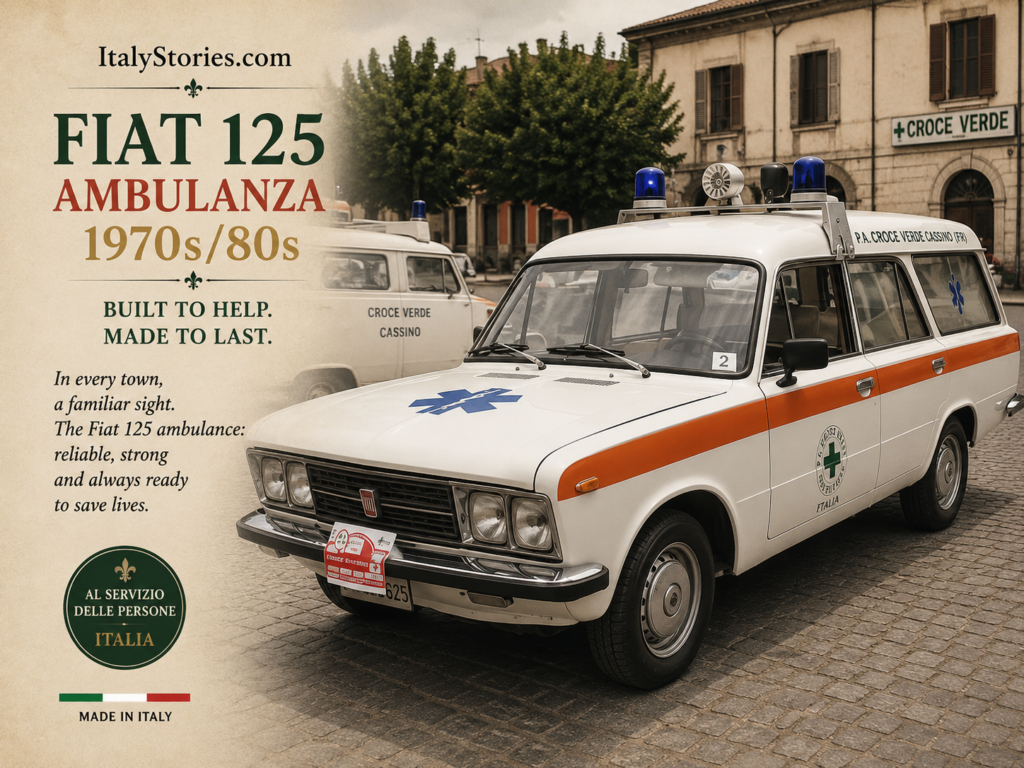
There was a time when an ambulance did not necessarily look like a large, purpose-built emergency vehicle. In the Italy of the late 1960s and 1970s, the sound of a siren approaching through the narrow streets of a town might announce the arrival of something surprisingly elegant: a Fiat 125 transformed into an ambulance.
Long before modern emergency vehicles became rolling intensive-care units, many Italian rescue organisations relied on cars adapted by specialist coachbuilders. These vehicles had to be fast, dependable and sufficiently spacious to carry a patient, a stretcher and the limited medical equipment available at the time. The Fiat 125 possessed several of those qualities, even though it had originally been designed as a comfortable family saloon.
Fiat introduced the 125 in April 1967. The company needed a new upper-middle-class model quickly and gave its engineers only a remarkably short period in which to develop it. The result combined proven components with more advanced mechanical features, producing a car that was conventional in appearance but surprisingly sophisticated beneath its bodywork.
Its 1,608 cc four-cylinder engine used two overhead camshafts, a solution more commonly associated with expensive sporting automobiles. In its original form, it produced approximately 90 horsepower, while the later 125 Special increased output to around 100 horsepower and added a five-speed gearbox.
For an ordinary Italian family, this meant comfort and excellent performance. For a rescue organisation, it meant something even more important: the ability to travel quickly over roads that were often far less efficient than those of today.
The standard Fiat 125 was, of course, a four-door saloon and could not simply accommodate a stretcher. Specialist coachbuilders therefore created ambulance conversions with an extended roof, a lengthened rear compartment and large side or rear doors. Among the Italian companies associated with Fiat 125 ambulance bodies was Fissore, one of the many coachbuilders that turned mass-produced mechanical platforms into vehicles for highly specialised purposes.
These ambulances were not generally identical vehicles produced on a large Fiat assembly line. Their construction could vary according to the coachbuilder, the customer and the intended service. Different examples might be operated by the Italian Red Cross, local public-assistance organisations, volunteer associations or municipal rescue services. Equipment, markings and internal arrangements were therefore not always the same.
The transformation was extensive. The rear passenger area was reorganised to make room for a stretcher, while cupboards or brackets held blankets, bandages, oxygen cylinders and first-aid equipment. Depending on the configuration, a doctor, nurse or volunteer could sit beside the patient. A raised roof created additional working space, while warning lights and an electrically or mechanically operated siren announced the vehicle’s urgent passage.
By modern standards, the interior was extremely basic. There were no sophisticated monitoring systems, advanced defibrillators or computerised communications. Many of these vehicles were intended primarily to transport a sick or injured person to hospital as rapidly as possible. The people working inside them relied on experience, improvisation and a relatively small collection of medical instruments.
Yet the Fiat 125 offered an advantage that should not be underestimated: performance. It was considerably more powerful and faster than many commercial vehicles of its time. Its twin-cam engine allowed it to maintain high speeds on open roads, while its saloon-derived chassis provided a level of comfort that was valuable when carrying an injured patient.
It was also a rear-wheel-drive automobile with a reputation for mechanical strength. Its suspension was not especially modern—the rear axle still used leaf springs—but that robust construction could tolerate demanding service, uneven roads and the additional weight of an ambulance body and medical equipment.
Driving one required concentration. There was no electronic stability control, no anti-lock braking system and none of the assistance now taken for granted in an emergency vehicle. The driver had to manage the weight of the conversion, the traffic and the urgency of the mission using little more than skill, judgement and a constantly sounding siren.
These ambulances belonged to a very different Italy. Emergency calls were not managed through today’s integrated systems, and the organisation of medical rescue varied considerably from one area to another. In many towns, volunteers played an essential role. When the telephone rang at the local headquarters, they left their jobs, homes or evening meals, climbed into the ambulance and set off to help a stranger.
The Fiat 125 would wait outside a hospital, a small association headquarters or a local clinic. Its blue warning lights, white bodywork and coloured stripe made it instantly recognisable. Children watched it pass, shopkeepers stepped into the street, and motorists moved aside as the twin-cam engine carried it toward another emergency.
The model was never as spacious or practical as a Fiat 238 van, which became one of the most familiar Italian ambulances of the period. The 238 offered greater headroom and a more functional interior, while the Fiat 125 remained fundamentally a passenger car adapted for rescue work. For this reason, 125 ambulances were comparatively uncommon and were gradually replaced by larger, more specialised vehicles.
Their rarity is precisely what makes the surviving examples so fascinating today. A preserved Fiat 125 ambulance is more than an unusual classic car. It represents the history of local medical assistance, volunteer organisations and the men and women who worked with equipment that now appears primitive but was once considered essential.
Unlike a racing car, an ambulance does not collect trophies. Its most important victories are rarely recorded. We do not know the names of most of the patients carried inside these vehicles, the drivers who hurried through the night or the volunteers who tried to reassure frightened families. Their stories disappeared into hospital records, association archives and private memories.
The Fiat 125 ambulance therefore reminds us that automotive history is not composed only of glamorous sports cars, famous designers and international competitions. Some vehicles earned their place in history by performing ordinary, difficult and indispensable work.
Today, its square body, chrome bumpers and simple blue beacons may appear almost gentle compared with a modern ambulance. But when its siren sounded through an Italian town half a century ago, nobody regarded it as a museum piece.
It meant that help was coming.