

When people think of Group B rallying, they usually picture the Audi Quattro, Lancia 037, Peugeot 205 Turbo 16 and Lancia Delta S4. Yet hidden among the official records of that extraordinary period is a much humbler—and surprisingly fascinating—Italian name: the Fiat Ritmo Abarth 125 TC.
Introduced in 1978, the Fiat Ritmo was designed to replace the highly successful Fiat 128. With its circular headlights, plastic bumpers, unusual door handles and boldly modern shape, it looked completely different from the conventional family cars of its day. Fiat even promoted it as a car “handbuilt by robots,” highlighting the advanced automated production system used at the Cassino factory.
Beneath its practical hatchback body, however, the Ritmo possessed considerable sporting potential. Fiat’s performance specialists at Abarth transformed it into a much more aggressive machine. The Ritmo Abarth 125 TC, presented in 1981, received a 1,995 cc twin-cam engine producing approximately 125 horsepower, a five-speed ZF gearbox, stronger suspension components and more powerful brakes.
It was still a front-wheel-drive family hatchback, but it had become fast, lively and full of character. It represented an age when performance cars demanded attention and respect from their drivers—without electronic stability systems, driving modes or computers constantly correcting their mistakes.
What many enthusiasts do not know is that the Fiat Ritmo Abarth 125 TC was officially homologated by the FIA in Group B. Homologation number 202 came into effect at the beginning of 1982, placing the Ritmo’s name inside the same legendary regulatory category that would soon produce some of the most extreme rally cars ever created.
However, the Ritmo was never developed into a spectacular factory Group B weapon comparable to the Audi Quattro or Lancia 037. Its Group B identity was largely connected to the transitional regulations of the period, rather than to an unlimited-budget programme created to fight for the World Rally Championship.
That distinction is important. The Ritmo Abarth was a genuine Group B-homologated automobile, but it was not one of the purpose-built monsters that later defined the category. It retained front-wheel drive, a naturally aspirated engine and a strong connection with the production car sold to ordinary customers.
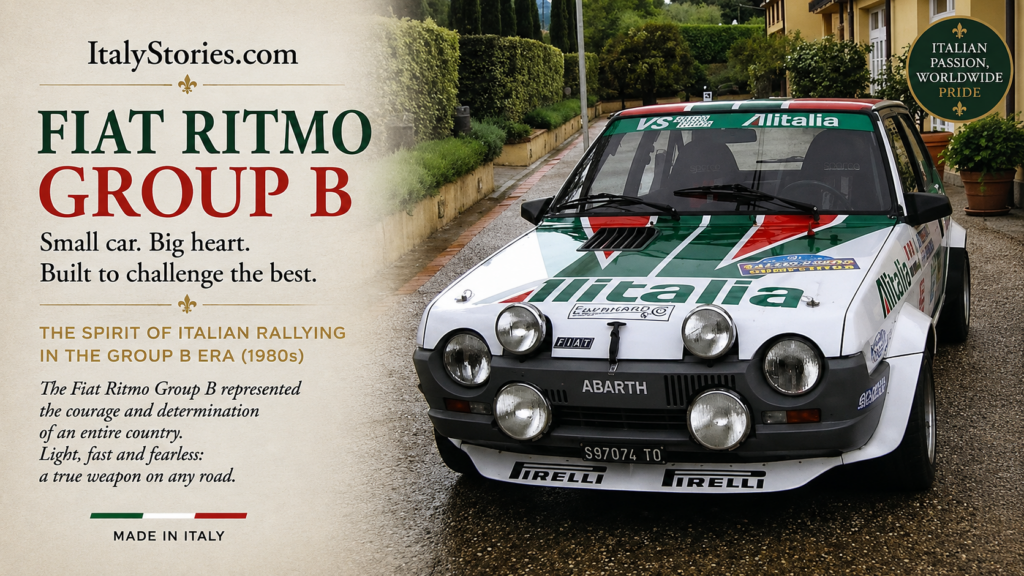
Before and during this period, competition versions of the Ritmo appeared in rallies and other motorsport events, often wearing some of the most memorable liveries of the era. The Alitalia colours, forever associated with great Italian rally cars, make the angular Fiat look particularly dramatic. With widened arches, additional headlights and Abarth lettering, the friendly family hatchback suddenly appears ready to attack a dark mountain road.
Its greatest charm comes from this contrast. The Ritmo was not born as an exotic racing machine. It was the sort of car people used for commuting, shopping and family holidays. Seeing one transformed for competition was like discovering that the quiet neighbour next door secretly spent weekends racing through forests.
The later Ritmo Abarth 130 TC, introduced in 1983, pushed the concept even further. Its two-litre twin-cam engine produced around 130 horsepower, making it one of the most exciting front-wheel-drive hot hatchbacks of its generation. It competed with cars such as the Volkswagen Golf GTI, but offered a distinctly Italian personality: louder, sharper and slightly less predictable.
The Fiat Ritmo never became a dominant force in the World Rally Championship, and its Group B chapter remained a small footnote beside the achievements of Lancia and Audi. Nevertheless, the car deserves recognition. It represents the more accessible side of motorsport—the point where an ordinary production model could receive an Abarth badge, competition equipment and enough character to become unforgettable.
Today, genuine Ritmo Abarth models are increasingly rare. Many disappeared through rust, accidents or years of hard use. Surviving examples remind us of a period when Fiat was willing to be daring, both in design and engineering.
The Ritmo Abarth Group B may not have conquered the world’s rally stages, but it carried the spirit of Italian competition: compact, courageous, unconventional and always ready to challenge larger and more powerful rivals.
Sometimes legends are not created by winning every race. Sometimes they are born simply because someone looked at an ordinary little Fiat and decided that it deserved a chance to fight.