

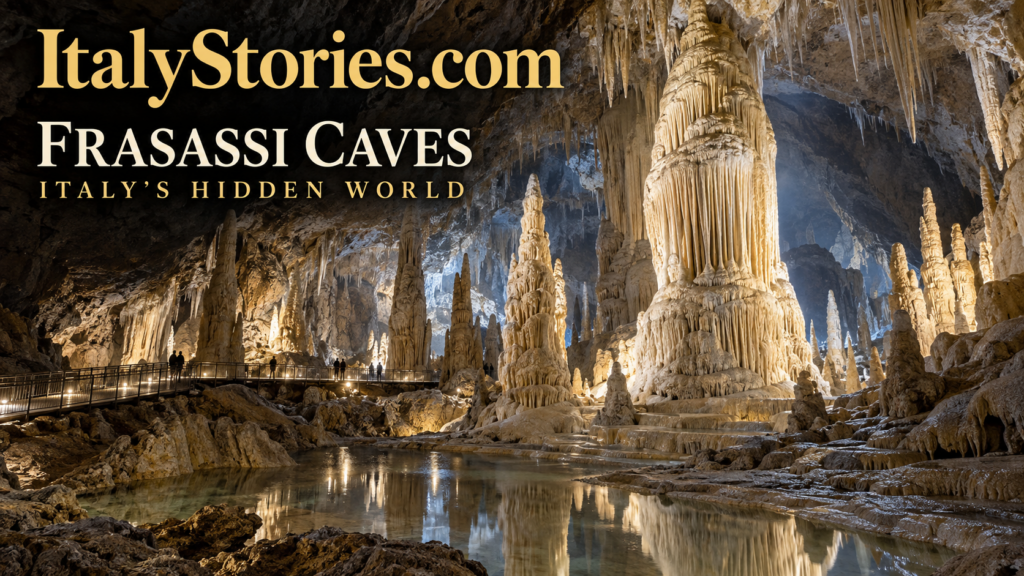
Beneath the green mountains of the Marche region lies a world that remained hidden from human eyes for an astonishing length of time. It is a landscape without sunlight, seasons or horizons, shaped slowly by water and stone. Here, enormous chambers open beneath the Apennines, delicate stalactites descend from the ceilings and towering columns rise from the darkness like the architecture of a forgotten civilisation.
These are the Frasassi Caves, one of Italy’s most extraordinary natural wonders. Located near the small town of Genga, in the province of Ancona, the caves form part of a vast karst system inside the Regional Natural Park of Gola della Rossa e di Frasassi. Above ground, the Sentino River flows through a dramatic limestone gorge surrounded by forests and steep cliffs. Below it, another landscape extends through chambers, shafts, tunnels and underground lakes.
The contrast could hardly be greater. Outside, birds move through the trees and sunlight reaches the white rock of the gorge. Inside, the temperature remains close to 14 degrees Celsius throughout the year, humidity approaches saturation and the passage of time is measured in drops of water.
The most remarkable part of the story is that the immense underground world known today was discovered only in 1971.
THE DISCOVERY OF THE ABYSS
Caves in the Frasassi area had been known for centuries, and speleologists had already begun exploring parts of the underground system in the mid-20th century. The Grotta del Fiume, or River Cave, was discovered in 1948, while other entrances and passages were investigated during the following decades. Nobody, however, imagined the scale of the void concealed inside the mountain.
On 25 September 1971, members of the Speleological Group of the Marche section of the Italian Alpine Club in Ancona were exploring the slopes of Mount Valmontagnana. Rolando Silvestri located a small opening in the ground from which a strong current of air emerged. In cave exploration, moving air is an important clue: it often suggests that a small entrance is connected to a much larger underground space.
The opening was narrow and unremarkable. There was nothing on the surface to indicate that one of Europe’s most impressive underground chambers lay beneath it. After widening the passage, the explorers entered a small cavity and discovered a dark shaft descending beyond the reach of their lights.
They dropped a stone into the opening and listened.
For several seconds, there was only silence.
When the sound finally returned from below, the explorers understood that they were standing above an extraordinary depth. Their first calculations, based on the time taken by the falling stone, suggested an abyss more than one hundred metres deep. Later expeditions, using suitable ropes and equipment, descended into the cavern and revealed its true dimensions.
The chamber was named Abisso Ancona, the Ancona Abyss, in honour of the city of the speleologists who discovered it. It measures approximately 180 metres in length, 120 metres in width and nearly 200 metres in height. It is so vast that Milan Cathedral could fit inside it.
Numbers alone, however, cannot adequately describe the sensation of entering such a space. Human vision is accustomed to measuring distance through familiar objects: buildings, trees, roads and people. Inside the Ancona Abyss, almost every reference disappears. The ceiling seems impossibly far away, the illuminated formations appear smaller than they really are and the voices of visitors are absorbed by the immensity of the chamber.
The discovery continued during the following months. On 8 December 1971, explorers found a connection between the Grotta del Fiume and the Grotta Grande del Vento, proving that the chambers belonged to the same enormous underground system. New tunnels, rooms and passages were gradually mapped, revealing a complex that extends for many kilometres beneath the mountains.
After extensive engineering work, part of the Frasassi Caves was opened to the public on 1 September 1974. The access tunnel and visitor path were designed to allow people to enter the main chambers without using ropes or specialist equipment. Since then, millions of visitors have crossed the threshold into this hidden world.
A LANDSCAPE BUILT ONE DROP AT A TIME
The Frasassi Caves are a masterpiece of geology created through the patient interaction of water and limestone. The rock itself originated from sediments deposited in an ancient sea millions of years ago. Over geological time, movements of the Earth lifted these layers and helped form the Apennine Mountains.
Rainwater absorbed carbon dioxide from the atmosphere and soil, becoming slightly acidic. As it entered fractures in the limestone, it slowly dissolved the rock. Tiny cracks widened into channels, channels became tunnels and tunnels expanded into enormous chambers.
The process did not end when the empty spaces were created. Water continued to move through the stone, carrying dissolved calcium carbonate. When a drop reached the ceiling of a cavern, part of that mineral was left behind. Repeated countless times, the deposits formed a stalactite growing downwards. When the drop fell to the floor and released more material, it produced a stalagmite growing upwards.
Sometimes the two eventually met, creating a column. Elsewhere, mineral deposits formed curtains, thin tubes, flowstones, terraces and formations resembling frozen waterfalls. Their apparent stillness can be deceptive: many are continuing to grow, although the change is far too slow to be observed during a human lifetime.
A stalactite can be destroyed in seconds, but may require thousands of years to form. This is why touching the formations is forbidden. Oils and dirt from a human hand can alter the surface over which the mineral-rich water flows, interrupting a process that began long before recorded history.
THE GIANTS OF FRASASSI
The first formations encountered in the Ancona Abyss include a group known as the Giants. These enormous stalagmites rise from the cave floor like a gathering of silent figures. Some reach approximately twenty metres in height, making a standing visitor nearby appear almost insignificant.
Among the other famous formations is the Niagara Falls, an immense flowstone cascade whose folds resemble water suddenly frozen across the rock. There is also the Obelisk, a tall isolated stalagmite that rises like a natural monument, and the Organ Pipes, a group of formations capable of producing different sounds when gently struck by drops of water.
These names reveal how the human imagination attempts to understand the unfamiliar. Rock becomes a giant, a bear, a castle, a waterfall or a pipe organ. The formations themselves were created without design, yet the mind constantly searches them for recognisable shapes.
The path continues into Sala 200, named for its considerable length, and towards increasingly intricate environments. The Grand Canyon is crossed by crevices and water-filled depressions, while the Hall of Candles contains clusters of small, slender stalagmites surrounded by circular pools. They resemble candles placed on dishes, turning mineral deposits into what appears to be a silent underground ceremony.
The Hall of the Bear takes its name from a rock formation that, from a certain angle, seems to resemble a bear. The Hall of the Never-Ending, or Sala dell’Infinito, has an even more curious story. Its irregular circular shape reportedly confused the first explorers, who repeatedly returned to the same points while believing they were progressing through the cave. In complete darkness, without familiar landmarks, even an experienced speleologist can lose all sense of direction.
There are also white chambers where layers of almost pure calcite create luminous surfaces, dark passages inhabited by bats and areas accessible only to specialist teams. The ordinary tourist route reveals only a small part of the entire system. Beyond its lights and walkways, Frasassi continues into darkness through passages still reserved for scientific research and speleological exploration.
LIFE WITHOUT SUNLIGHT
A cave may initially appear lifeless, but Frasassi contains a delicate subterranean ecosystem. Bats use some of its chambers, while cave-dwelling salamanders and small invertebrates survive in environments with little or no natural light. Underground waters contain tiny crustaceans adapted to permanent darkness.
These creatures often have reduced pigmentation and limited eyesight because colour and vision offer little advantage in a world without sunlight. Instead, they rely on touch, chemical signals and extremely sensitive perceptions of movement.
Microorganisms are particularly important in the deeper Frasassi system. Some survive by obtaining energy from chemical reactions involving sulphur compounds rather than from sunlight. Their existence has attracted scientific interest because it demonstrates how life can develop in conditions radically different from those on the surface.
The caves also provide an unusual natural laboratory. Constant temperature, darkness and isolation have allowed researchers to study human biological rhythms and the effects of living without normal indications of day and night. Underground, the body can no longer rely on sunrise, sunset or changing temperatures to measure time.
THE GORGE ABOVE THE CAVES
The experience of Frasassi does not end at the cave entrance. The surrounding territory is one of the most beautiful areas of the Marche Apennines. The Gola di Frasassi is a narrow gorge cut through limestone by the Sentino River. Forests cover the slopes, eagles and other birds of prey circle above the cliffs, and paths lead towards panoramic viewpoints, medieval villages and ancient religious sites.
Nearby stands the Abbey of San Vittore alle Chiuse, one of the finest examples of Romanesque architecture in the Marche. Built from pale stone and surrounded by mountains, the church has a compact, almost fortress-like appearance. Its severe geometry contrasts with the irregular forms of the cliffs and caves around it.
The medieval village of Genga rises above the valley, enclosed by stone walls and overlooking the wooded landscape. It was the birthplace of Annibale della Genga, who became Pope Leo XII in 1823. His connection to the area would help create another of Frasassi’s most remarkable monuments.
THE TEMPLE INSIDE THE MOUNTAIN
On the opposite side of the gorge, a steep path climbs towards a vast natural cave. Inside it stands a small octagonal church of white travertine commonly known as the Temple of Valadier. The building was commissioned by Pope Leo XII and completed during the 1820s.
For many years, its design was traditionally attributed to the celebrated architect Giuseppe Valadier, although more recent research has questioned his direct involvement. Whatever its precise authorship, the little temple remains an unforgettable sight: an elegant Neoclassical structure enclosed by rough limestone walls, as if a fragment of Rome had been carried into the heart of the mountain.
The temple once contained a marble image of the Virgin and Child produced by the workshop of Antonio Canova. The original is now preserved in a museum, while a copy remains inside the sanctuary.
A short distance away stands the much older hermitage of Santa Maria Infra Saxa, meaning “Saint Mary among the rocks.” Partly built against the cave wall, the sanctuary was used by Benedictine nuns and is documented from the Middle Ages. Its simple stone structure feels entirely different from the elegant temple nearby. Together, the two buildings reveal how people separated by centuries responded to the same powerful setting.
The cave had, however, attracted human activity long before either Christian sanctuary was built. Archaeological discoveries in the area indicate that prehistoric communities also used the natural shelter. The mountain was therefore a place of protection and ritual thousands of years before modern visitors arrived.
A JOURNEY INTO DEEP TIME
Visiting the Frasassi Caves changes the ordinary perception of time. Human lives are measured in decades, monuments in centuries and civilisations in millennia. Inside a cave, even these periods seem brief. A formation only a few centimetres long may have begun growing before many of the world’s most famous buildings existed.
Water continues to fall from the ceiling exactly as it did before the caves were discovered. The chambers do not need visitors, names or electric lights. They existed in total darkness, untouched and unseen, while empires rose and disappeared above them.
This is perhaps the greatest fascination of Frasassi. The caves remind us that some of the most extraordinary landscapes on Earth are hidden beneath familiar ground. For centuries, people travelled through the gorge, built villages and crossed the mountains without realising that an underground cathedral was lying below their feet.
The 1971 explorers did not create this world. They simply found the narrow opening through which humanity could finally enter it.
Today, carefully positioned lights reveal the stone without eliminating the darkness completely. Visitors walk through the enormous chambers, hear the continuous sound of dripping water and look upwards towards ceilings that seem to disappear. For a brief time, they become guests in a landscape governed by a different scale.
The Frasassi Caves are not ruins, although they can resemble a buried city. They are not architecture, although their columns and vaults surpass many human buildings. They are a living geological process, still being shaped drop by drop beneath the mountains of the Marche.
When visitors return to the surface, daylight can feel almost surprising. Trees move in the wind, the Sentino River continues through the gorge and the ordinary world resumes. Yet beneath the road and the forest, the hidden chambers remain exactly where they have always been: silent, immense and still growing.
Follow ItalyStories.com to discover the landscapes, monuments and extraordinary hidden places that make Italy endlessly surprising.