

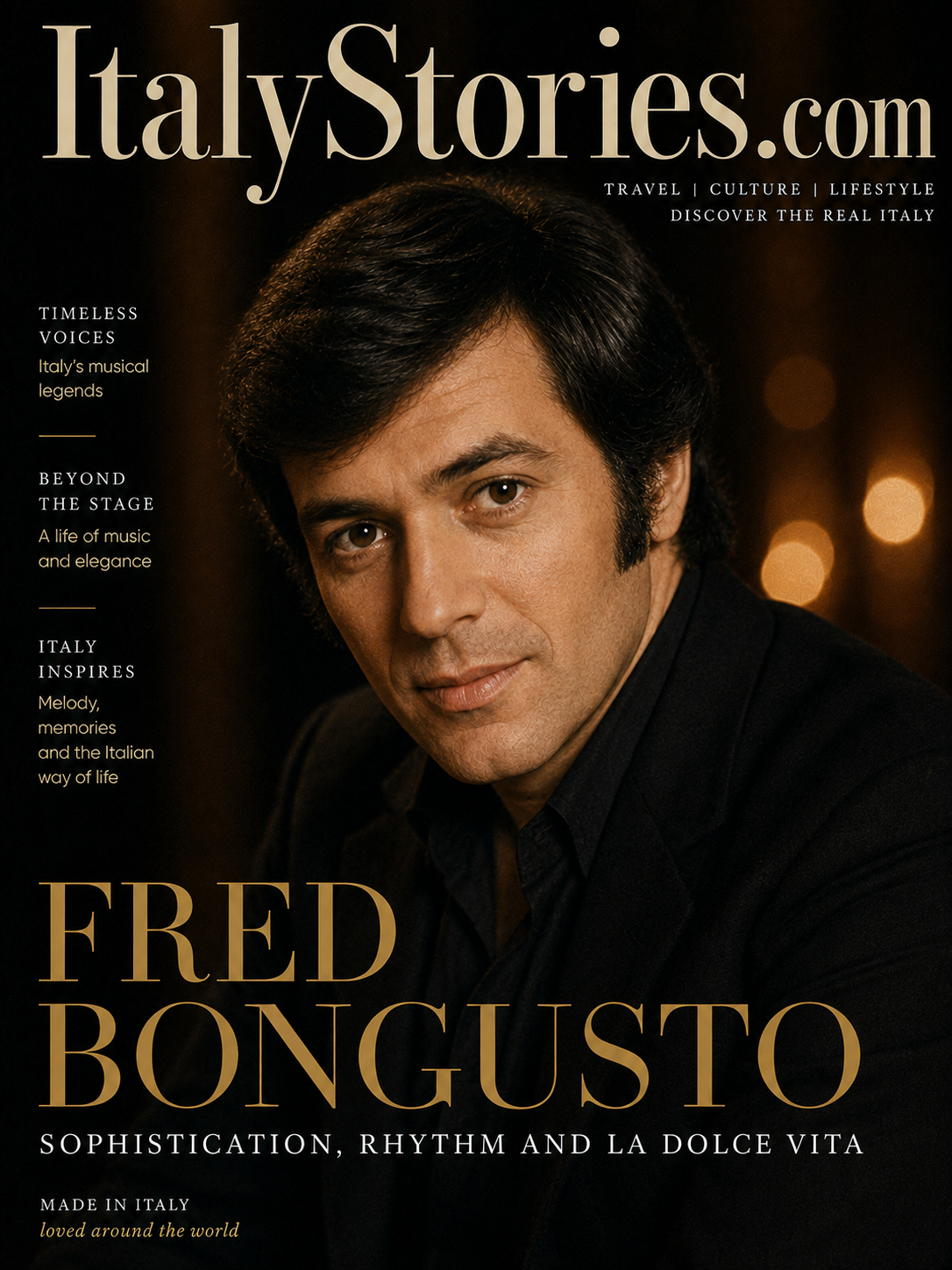
There is a particular kind of Italian summer evening that seems to have been waiting for Fred Bongusto. A table near the water. Music arriving from a hotel terrace or a radio behind an open window. The heat finally loosening its grip. Two people speaking more quietly because the night has made ordinary conversation feel intimate.
In 1964, “Una rotonda sul mare” gave that scene a permanent melody. The song became Fred Bongusto’s signature, but its success was not based on spectacle. It moved at the pace of memory. The famous circular pavilion by the sea was less a physical address than a place to which the singer and the listener could return together.
Bongusto would spend much of his career inside that emotional territory: summer, desire, elegant regret, nightclubs, seaside towns and the unstable moment when happiness is already becoming nostalgia. It made him one of Italy’s defining crooners of the 1960s and 1970s. Yet the label “romantic singer” captures only part of the story. He was also a songwriter, a musician shaped by jazz and Neapolitan song, a composer for cinema, an interpreter of Brazilian music and an artist whose work travelled through South America.
Behind the smooth public image stood a boy from Campobasso who had known loss early, imagined a future in sport, learned music in local groups and understood that apparent ease is usually the result of discipline.
Campobasso, Loss and the First Music
Fred Bongusto was born Alfredo Antonio Carlo Buongusto in Campobasso on 6 April 1935. The city, capital of Molise, was far from the record companies and fashionable nightclubs that would later define his image. Its musical culture, however, placed him between several traditions: songs from Naples, local bands, church and popular music, and the American sounds that became increasingly present in postwar Italy.
His father died during the Second World War, when Alfredo was still a child. Accounts of his early life describe a period of study in Padua before his return to Campobasso. The experience of leaving and returning would later enter his relationship with his native city, sometimes affectionate, sometimes uneasy. He eventually dedicated work to Molise and Campobasso, but he resisted being reduced to a regional emblem.
As a young man he was interested in sport as well as music. Football attracted him first, and tennis remained a serious passion. The sporting ambition is revealing. Bongusto’s stage manner would appear relaxed, but it depended on control, timing and competitive concentration—the same virtues required on a court.
Music gradually won. He played with local groups and developed an ear for jazz, swing and the confidenziale tradition of singers who treated the microphone not as an amplifier but as a partner. By 1960 he had joined I 4 Loris as lead vocalist. The group gave him practical experience and led to his first recordings.
Becoming Fred
The name change from Alfredo Buongusto to Fred Bongusto did several things at once. “Fred” suggested American modernity and the world of jazz clubs; “Bongusto,” close to the family name, sounded playful and immediately memorable. It fitted an Italy fascinated by international style but still attached to recognizably domestic personalities.
With I 4 Loris he recorded “Madison italiano” and “Notte d’amore” in 1961. The titles already reveal the musical climate. Imported dances, Italian melody and nightlife were mixing rapidly. The economic boom was changing leisure: more records, more cars, more holidays, more clubs and a growing youth audience with money to spend.
The first decisive solo opportunity came through composer Ghigo Agosti, associated with “Bella bellissima.” The record helped Bongusto move from local musician to national performer. “Doce doce,” sung in Neapolitan, showed that the American-sounding stage name had not disconnected him from southern Italian traditions.
He learned early that identity could be plural. He could sing a bossa nova phrase, approach a standard with the poise of a crooner, then turn toward Naples without treating any of those languages as costume. That flexibility became the foundation of his career.
The Crooner and the Microphone
The Italian term cantante confidenziale describes a singer who creates intimacy through the microphone. Bongusto belonged to a line that included Nicola Arigliano, Teddy Reno, Johnny Dorelli and Bruno Martino, while his admiration for Frank Sinatra gave the style an international reference.
His voice was warm, rounded and conversational. He did not attack a phrase; he entered it. Consonants were softened without losing clarity, and rhythm remained central even in slow songs. The listener heard not only the melody but the slight suspension before a word, the smile implied by a vowel, the controlled fall at the end of a line.
This style depends on technology. Before microphones, a popular singer had to project across a theatre. The crooner could reduce the distance. Bongusto made a large audience feel like a small room, and that illusion became one of his most valuable gifts.
The ease was carefully constructed. Singing softly leaves little protection. Breath, pitch and timing must be exact because the arrangement does not hide the voice. Bongusto’s finest performances seem unforced precisely because the technique has disappeared into the mood.
“Una rotonda sul mare”: Architecture of Memory
Released in 1964, “Una rotonda sul mare” became inseparable from Bongusto’s name. The song describes the memory of a seaside dance and the hope of recovering a love associated with it. Its setting is specific enough to be seen yet open enough for every listener to supply a personal coastline.
The rotonda is important because it is circular. The form suggests return: music, memory and desire moving back toward a place that time has changed. Bongusto does not sing the story as a grand tragedy. He lets the melody carry the ache while the voice remains composed.
The song arrived during the expansion of Italian mass tourism. Coastal roads, beach resorts and summer holidays were becoming symbols of prosperity. Yet Bongusto’s summer is never only consumption and sunshine. It is already haunted by the knowledge that seasons end.
This is why the song survived. A fashionable dance hall might disappear, but the emotional mechanism remains familiar. People attach love to places, then return and discover that the place has become a container for the past.
“Una rotonda sul mare” turned Bongusto into a national star. It also created a productive risk: for the rest of his career, audiences would expect him to provide summer again.
Beyond the Rotonda: Songs of Appetite and Distance
Bongusto did not escape his signature song; he expanded the world around it. “Prima c’eri tu” won Un disco per l’estate in 1966. The competition was designed for songs that could accompany the season, and Bongusto understood that a summer hit needed more than brightness. It needed an emotional shadow that would remain after August.
“Spaghetti a Detroit,” released in 1967, approached Italian identity from a playful international angle. The title juxtaposed the most globally recognizable Italian food with an American industrial city. Beneath the humor was the experience of a country learning to see itself through foreign eyes. Italy was exporting songs, films, design and cuisine while absorbing American rhythms and images.
“Tre settimane da raccontare,” “La mia estate con te” and “Balliamo” continued his exploration of time-limited happiness. Three weeks, one summer, one dance: Bongusto’s titles often place a frame around pleasure. The frame makes it precious.
“Balliamo,” released in 1977, travelled beyond Italy and was adapted in Spanish, gaining visibility in Latin markets. The invitation to dance was perfectly suited to a singer who understood rhythm as social communication rather than display.
Jazz, Brazil and the South Atlantic Imagination
Bongusto’s romantic image sometimes obscures the range of his listening. Jazz phrasing informed his approach, and Brazilian music became one of his deepest affinities. Bossa nova offered a model of sophistication without heaviness: harmonically rich, rhythmically subtle and vocally intimate.
His relationships with Toquinho and Vinicius de Moraes connected him to the same Italian-Brazilian cultural bridge that fascinated other artists of his generation. He interpreted Brazilian repertoire and absorbed its rhythmic language without abandoning Italian melody.
The relationship also extended to João Gilberto, who recorded Bongusto’s “Malaga.” RAI Cultura reports that Gilberto regarded it as a perfect song. The compliment makes musical sense. “Malaga” possesses the clarity and harmonic space that invite reinterpretation. It can be Italian, Mediterranean and Brazilian at once.
Bongusto’s popularity in South America was not an accidental afterlife. His music already spoke a transatlantic language made of romance, nightlife, guitar, syncopation and memory. Italian emigrant communities provided one audience, but the appeal reached beyond them.
The connection challenged narrow ideas of national music. Bongusto did not present Italy as a sealed tradition. He presented it as a port: open to Naples, the United States, Brazil and the wider Mediterranean.
Cinema: Music Behind the Image
From the late 1960s onward, Bongusto developed a substantial parallel career composing and arranging music for films. Treccani identifies scores ranging from Dino Risi’s “Il tigre” to “Peccato veniale,” “Fantozzi contro tutti” and “Malizia 2000.” RAI Cultura credits him with work on roughly thirty soundtracks.
Cinema used a different part of his talent. A three-minute song can establish its own world; film music must support characters, pacing and visual atmosphere without always asking to be noticed. Bongusto’s command of mood made him well suited to the task.
His association with films by directors including Dino Risi, Salvatore Samperi and Alberto Lattuada placed him inside a central period of Italian Cinema. Commedia all’italiana, erotic comedy and social satire required music capable of moving between elegance, irony and desire. Those were already Bongusto’s colors.
The score for “Malizia,” in particular, belongs to the cultural atmosphere of the 1970s, when sensuality, changing morality and nostalgia met in popular cinema. Bongusto could suggest seduction without musical aggression. His melodies observed the scene with the same half-smile present in his singing.
Film work also protected him from being understood only through hit singles. It revealed a professional musician able to think structurally and collaborate with directors, editors and orchestras.
Television, Radio and the Familiar Face
Bongusto’s rise coincided with the period when RAI could turn a singer into a shared national presence. He appeared in variety programs and participated in multiple editions of Canzonissima. In July 1965 he began “Musica per i vostri sogni,” a radio feature he directed and presented through song.
Radio was a natural medium for him. Without the visual image, the intimate voice became even more effective. He could create a room through sound alone.
Television added the public persona: elegant clothes, controlled gestures, charm without obvious effort. He appeared in musical films during the early 1960s and later conducted television segments. The screen reinforced the idea of Fred Bongusto as a man who belonged to the night even when performing in a brightly lit studio.
This familiarity carried both value and danger. It made him beloved, but it could encourage critics to dismiss the work as easy listening. The apparent smoothness concealed careful musicianship and a catalogue wider than the most frequently repeated summer songs.
“Fred Goodtaste” and the Pleasure of Experiment
In 1973 Bongusto recorded Stevie Wonder’s “Superstition” under the pseudonym Fred Goodtaste, a literal English joke on “Buongusto.” The episode reveals a playful, curious artist willing to step outside the expected romantic format.
The choice of “Superstition” was bold. Wonder’s original depended on a fiercely distinctive groove. Bongusto did not become a funk singer overnight, but the experiment showed how closely he followed international music.
Pseudonyms can provide freedom. “Fred Bongusto” had become a brand associated with candlelight, the sea and romantic confidence. “Fred Goodtaste” could try something else without requiring the audience to reconcile it with the established image.
The experiment also reminds us that Italian popular music in the 1970s was far more open than rigid genre histories suggest. Singers moved among jazz, soul, bossa nova, soundtrack composition, television orchestras and festival songs. Bongusto’s coherence came not from staying inside one genre but from bringing his sense of timing and atmosphere to each one.
Love, Image and the Public Man
Bongusto was often presented as a symbol of masculine charm, even a “latin lover.” The label suited publicity but could flatten the songs. His best performances are not about conquest. They are about anticipation, memory and the fear that intimacy is temporary.
He married actress Gabriella Palazzoli, and the couple became part of the public world around cinema and music. Bongusto nevertheless maintained a degree of privacy. The emotional directness of the songs did not require detailed exposure of his personal life.
In 1979, violence entered that private sphere when armed extremists invaded his Rome home in his absence, assaulting and restraining his wife and the housekeeper before stealing valuables, including a gold record. The documented episode belongs to the wider tension of Italy’s Years of Lead. It should not be used for sensationalism. Its significance lies in the collision between the elegant public world associated with Bongusto and the political violence surrounding ordinary life.
He continued to work, but the event is a reminder that entertainers do not live outside history. The same Italy that danced to summer songs was also confronting terrorism, fear and social conflict.
Ischia: A Place to Withdraw and Begin Again
Bongusto developed a particularly strong relationship with Ischia and the village of Sant’Angelo. The island offered a retreat from Rome and the entertainment industry, but it also provided the landscapes his music seemed to require: sea, hotels, evening light and the slow rhythm of a resort after the crowds have thinned.
Ischia is close to Naples geographically and culturally, and Bongusto’s affinity with Neapolitan song gave the island more than decorative value. It was a working atmosphere and an emotional refuge.
Artists often become associated with places that appear to confirm their public image. In Bongusto’s case the relationship was reciprocal. His songs helped listeners imagine the Italian coast; the coast gave those songs a believable climate.
The island years also represented an alternative to the demand for constant visibility. As television and pop fashions changed, he could continue composing and performing without treating every season as a campaign for renewed celebrity.
The Years After the Peak
During the 1980s and 1990s, Bongusto remained active while his position in mainstream Italian pop changed. He returned to Sanremo in 1989 with “Scusa.” The appearance connected him to the festival system but did not attempt to recreate the 1960s.
He recorded, appeared on television and maintained international ties, especially with Brazil and South America. In 1996 he released the live project “Due ragazzi così” with his friend Peppino di Capri, bringing together two interpreters associated with elegance, southern roots and enduring popular affection.
Later albums included “Back to Rome” in 2010, while compilations kept the classic songs available. The industry increasingly sold artists of his generation through nostalgia, but Bongusto’s musicianship did not depend on nostalgia. A strong melody and well-placed phrase remain present-tense experiences whenever they are heard.
In 2007 he was appointed a Commander of the Order of Merit of the Italian Republic. The honor recognized a career that had moved through records, radio, television, international performance and film music.
Bongusto died in Rome on 8 November 2019 after a long illness. He was eighty-four.
Campobasso and the Difficult Return Home
Bongusto’s relationship with Campobasso was not always simple. Leaving a small city for national fame creates expectations on both sides. The hometown may claim the artist; the artist may resist becoming a monument before the work is finished.
He returned through songs and public appearances, including work dedicated to Campobasso and Molise. RAI’s regional reporting has described a reconciliation with his origins late in life. A statue was inaugurated in Campobasso in 2020, one year after his death.
The memorial is fitting only if it does not freeze him. Bongusto’s connection to Molise was productive because it contained tension: affection, distance, irony and the awareness that identity is never a simple postal address.
His career expanded the cultural map of Italian music. The major record centers were Milan and Rome; Naples possessed an immense song tradition. Bongusto came from Campobasso and carried that less internationally familiar place into the national imagination.
What the Numbers Can—and Cannot—Explain
The reliable milestones are clear. “Una rotonda sul mare” became his defining 1964 success. “Prima c’eri tu” won Un disco per l’estate in 1966. He wrote music for numerous films from the late 1960s onward, returned to Sanremo in 1989 and received a major state honor in 2007.
His catalogue contains dozens of albums, singles and soundtracks, but an exhaustive list would obscure the artistic shape. Bongusto’s importance lies in the connections among those formats: the singer taught the film composer about intimacy; the jazz listener taught the pop star about rhythm; the Italian songwriter learned from Brazil.
Claims about total worldwide sales vary and are not necessary to establish his reach. The international evidence is present in tours, foreign-language adaptations, South American success and collaborations with major Brazilian artists.
Why Fred Bongusto Still Matters
Fred Bongusto understood a truth that popular culture often forgets: lightness is not the absence of craft. A melody that seems to float may depend on exact harmony. A singer who sounds relaxed may be making dozens of technical decisions. A summer song can carry an entire history of migration, prosperity, borrowed rhythms and approaching loss.
His image belongs to a recognizable Italy—nightclubs, dinner jackets, seaside dances, RAI variety shows and cinema—but the music is not merely a postcard. Listen closely and the confidence is frequently shadowed by impermanence. The night will end. The holiday will end. The person beside you may become a memory. Dance anyway.
That mixture explains his durability. “Una rotonda sul mare” returns every summer because it is not really about one summer. It is about the human desire to re-enter a moment after time has closed it.
Bongusto made that return sound possible for three minutes. The rotonda lights up, the orchestra begins, and the lost evening is waiting by the sea.
Thank you for spending time with the story of Fred Bongusto. Continue exploring the music, cinema and places that shaped modern Italy through ItalyStories.com.