

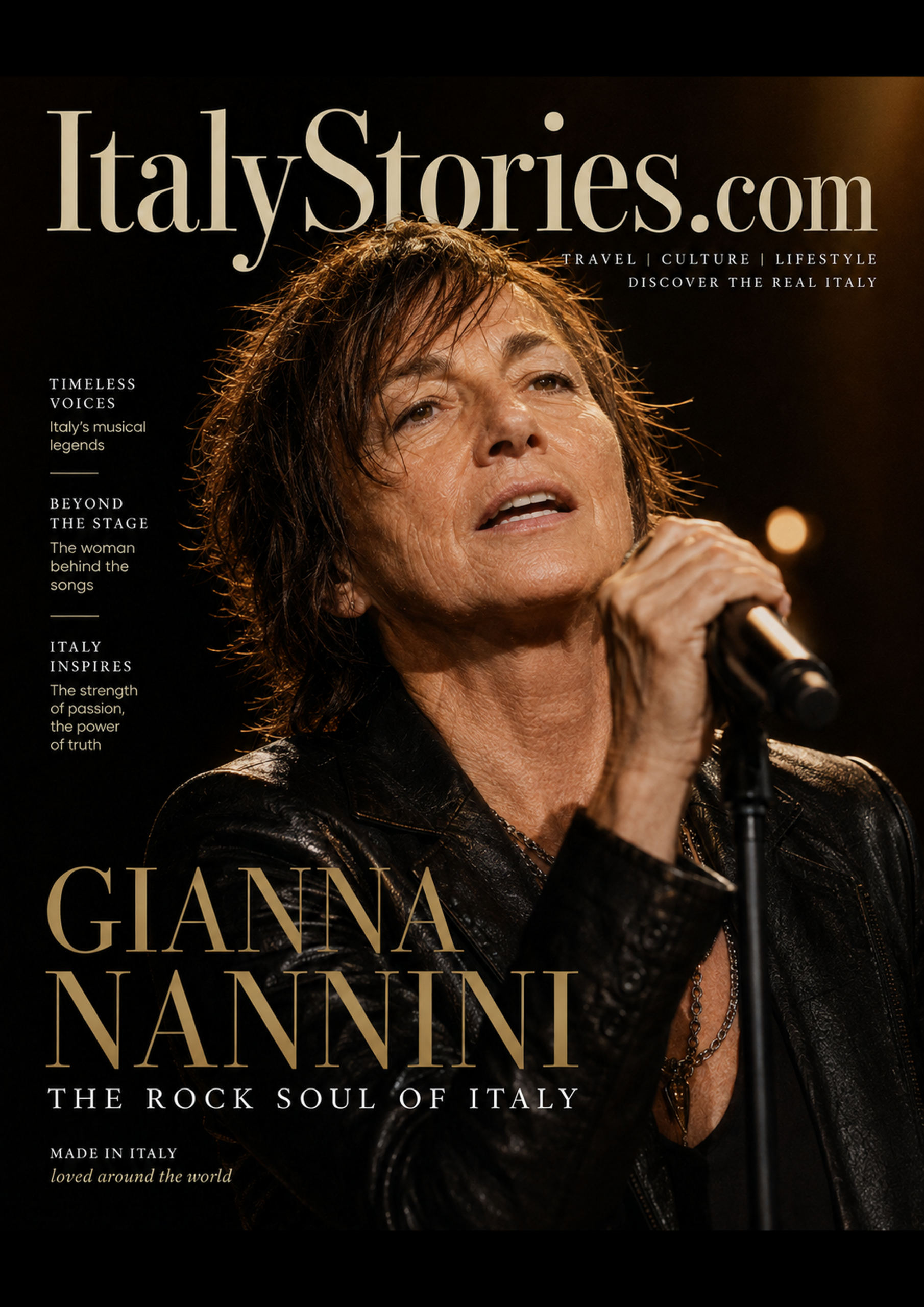
The Summer When a Voice Broke Through the Screen
In 1984, Italian television was still one of the great national stages. A song could enter a living room and, within weeks, become part of the language of an entire summer. That year, a woman from Siena appeared with a voice that did not sound polished in the traditional Italian sense. It scratched, pushed, cracked open, then suddenly turned tender. The song was “Fotoromanza.”
The video was directed by Michelangelo Antonioni, one of the giants of European cinema. The collaboration itself said something about Gianna Nannini: she was already moving in a territory where rock, visual art, cinema and popular music could meet without asking permission from one another. “Fotoromanza” became the song of the summer, won Festivalbar, and helped the album Puzzle become one of the defining records of her career.
But the triumph had come after a period Nannini would later describe as a kind of personal collapse and rebirth. In her autobiography, she treated 1983 not as an ordinary year but as a fracture: a moment when success, pressure and identity collided so violently that she felt she had to reconstruct herself. The artist who emerged afterward was more focused, more uncompromising and, paradoxically, more accessible to a mass audience.
That tension has always been central to Gianna Nannini. She became enormously popular without becoming smooth. She could fill arenas without becoming predictable. She could write songs of love that sounded bruised rather than decorative, and political or social songs that retained the immediacy of rock. For more than five decades she has remained one of the most recognizable Italian voices in Europe, especially in Germany, Switzerland and Austria, while continuing to reinvent the relationship between Italian melody and rock energy.
Her story begins in Siena, but it does not stay there for long.
Siena, the Contrada dell’Oca and the Family She Had to Leave
Gianna Nannini was born in Siena on June 14, 1954, and grew up in the world of the Contrada dell’Oca. Siena is a city where belonging is felt physically: streets, colors, neighborhood loyalties, rituals and the Palio turn geography into identity. That sense of place would never disappear from Nannini’s imagination, even when her career became international.
Her family was involved in the confectionery business. The official story of her youth contains a detail that sounds almost invented, except that it became one of the central myths of her biography. While working in the family pastry business before school, she injured her left hand severely, losing parts of two fingers. The accident compromised the classical piano studies she had pursued for years. She later joked that the terrible scream she let out after the accident gave her the rock voice she would use for the rest of her life.
The joke hides a serious turning point. Classical study had offered one possible path, disciplined and respectable. Nannini wanted another. Her family did not initially support the idea of a professional life in music, and when she was still very young she left home and went to Milan. According to her own account, the insurance money from the hand injury helped finance the escape.
This was not the glamorous migration of a future star arriving in the capital of the record industry with a contract waiting. It was a declaration of independence. Milan in the 1970s was industrial, political, restless and musically alive. It was also difficult. A young woman determined to become a rock musician faced a business still governed largely by male executives, male bands and expectations about how female singers should look and sound.
Nannini’s response was not to become more acceptable. It was to become more herself.
Milan: Mara Maionchi, the First Contract and a Voice Too Rough for the Rules
In the mid-1970s Nannini attracted the attention of the Numero Uno environment, including Claudio Fabi and Mara Maionchi, and sang with the group Flora Fauna Cemento. It was an important entrance into professional music, but her real ambition was already centered on her own songs and identity.
Ricordi signed her, and her self-titled debut album appeared in 1976. The record was not yet the sound that would later conquer Europe, but it contained the seeds: a forceful singer-songwriter approach, social themes, provocation and a refusal to behave like a decorative pop personality. One song, “Morta per autoprocurato aborto,” confronted abortion in a way that was strikingly direct for the period. Italy was in the middle of intense political and cultural conflicts around divorce, women’s rights, sexuality and the role of the Catholic Church. Nannini entered those debates not as a commentator from a safe distance, but through songs.
Una radura followed, and the early albums showed an artist still searching for the best frame for her voice. She collaborated with musicians from the Italian progressive and experimental scene, explored piano-and-voice formats, and gradually moved away from conventional cantautrice expectations.
The fact that the first records did not immediately turn her into a superstar was probably useful. She had time to build a musical personality rather than inherit one from a marketing department. The central question was becoming clearer: how could an Italian songwriter use the emotional directness of Italian melody while embracing the physical force of rock?
The answer would come partly from travel.
America: A Provocation Becomes a European Breakthrough
Nannini went to the United States to get closer to the music that fascinated her. She wanted to hear rock not as an imported style but as a lived environment. The trip strengthened her attraction to blues, soul, electric guitars and the idea that a voice did not need to be immaculate to be powerful.
In 1979 she released California, the album that transformed her career. Its breakthrough single was “America,” a song whose title seemed to promise geography but whose subject was more intimate and provocative. Nannini used “America” as a metaphor for sexual self-discovery; the album cover famously played with the Statue of Liberty in an irreverent way.
The song’s success was especially significant outside Italy. It reached audiences in Germany and Northern Europe, and California achieved strong sales across several European markets. Suddenly, Nannini was not simply an Italian rock singer with foreign influences. She was becoming a European rock artist in her own right.
The international response changed the scale of her career. Germany in particular would become one of her strongest markets, and this relationship was not temporary. Over the following decades she would tour repeatedly in German-speaking countries and become a familiar figure to audiences who did not need to understand every Italian word to understand the emotional force of the performance.
That is one of the most important facts about Nannini’s music. Her Italian language has rarely been an obstacle. The voice carries meaning before the dictionary does.
From Latin Lover to the Crisis of 1983
The early 1980s brought further development. Albums such as G.N. and Latin Lover moved Nannini toward a sharper, more modern rock sound. She was becoming more confident in using repetition, rhythm, synthesizers and guitar textures without abandoning melody.
Yet success did not produce a simple upward line. Nannini later described 1983 as a period of severe psychological crisis, a break in her sense of self that became a central episode of her autobiography Cazzi miei. Her own official biography even describes her as having been “reborn” in Cologne that year.
It would be easy to romanticize the crisis as the price of genius. That would miss the point. What matters is how Nannini understood it afterward: as a rupture that forced her to reclaim control of her artistic identity from the pressures surrounding her. The record business had its own ideas about image, production and success. She had hers.
The songs that followed were not the work of someone retreating. They were the work of someone returning with greater force.
Puzzle, “Fotoromanza” and the Moment Everything Aligned
Puzzle arrived in 1984 and gave Nannini one of the most complete artistic breakthroughs in Italian rock. The album had atmosphere, attack, modern production and songs that could survive outside the album format.
“Fotoromanza” became the centerpiece. Its title evokes the illustrated romantic photo-stories that had been part of Italian popular culture for decades, but Nannini’s song was not nostalgic. It transformed the idea of romantic melodrama into something tense, physical and modern. The melody was immediate, but the vocal performance resisted sweetness. She sang love as an unstable force.
Michelangelo Antonioni directed the video, giving the project a visual authority rare in mainstream music television of the period. Antonioni had spent his film career studying desire, alienation, bodies and modern space. Pairing him with Nannini was not an accidental prestige gesture. Their sensibilities met in a fascination with emotional restlessness.
The song dominated the summer and won major popular awards. Puzzle went platinum in Italy, while Nannini’s European touring expanded. Berlin, Cologne, Montreux and other international stages became part of her regular geography.
She had found the balance she had been seeking since the 1970s: Italian melody, European production, rock force, and a voice whose imperfections were the source of its personality.
“Bello e impossibile,” “Profumo” and the Making of a European Rock Star
The mid-1980s confirmed that Puzzle was not an isolated peak. Profumo, released in 1986, became a major international success and sold more than a million copies according to Nannini’s official career archive. The title track and, above all, “Bello e impossibile” pushed her to a wider audience.
“Bello e impossibile” is built on one of the oldest engines in popular song: attraction toward someone who is both desired and unreachable. What makes the track distinct is the physical confidence of the performance. Nannini does not sound like a passive observer waiting to be chosen. Desire belongs to her.
That shift mattered in the cultural context of the 1980s. Female pop stars were increasingly visible, but they were still often packaged through male expectations. Nannini’s image – leather, short or untamed hair, direct stare, androgynous elements, physical stage presence – resisted the demand to be easily categorized. She could be sensual without becoming ornamental.
In 1987 the compilation Maschi e altri consolidated her European reach, while “I maschi” was presented at the World Popular Song Festival in Tokyo. Around the same period she appeared in an unusual Hamburg program with Sting and Jack Bruce performing music associated with Bertolt Brecht and Kurt Weill. That detail is revealing. Nannini was a chart artist, but she remained drawn to theater, literature and art music.
The international map kept widening.
Malafemmina, Censorship and an Artist Who Would Not Behave
Malafemmina followed in 1988, co-produced with Alan Moulder, who would later become known for work with major alternative rock acts. The album continued Nannini’s interest in tougher textures and a less polished form of mainstream rock.
Her career had also begun to accumulate confrontations with censorship and conservative taste. Videos were sometimes considered too provocative; imagery could be judged disturbing; subjects could unsettle broadcasters. Nannini did not seek scandal as an end in itself, but she had little patience for the idea that popular music should remain harmless.
The title Malafemmina itself carries layers of Italian cultural meaning: the “bad woman,” the dangerous woman, the woman who refuses the moral role assigned to her. Nannini understood the symbolic power of that figure and turned it into part of her artistic language.
By this point, the rebel image was not marketing. It had been earned through more than a decade of choices.
“Un’estate italiana”: Rock Meets the 1990 World Cup
One of the most widely heard songs associated with Nannini came from an unexpected context: football.
For the 1990 FIFA World Cup in Italy, Giorgio Moroder composed the music that became “Un’estate italiana,” performed by Gianna Nannini and Edoardo Bennato. Nannini and Bennato worked on the Italian text. The song became inseparable from the visual memory of Italia ’90: stadiums, flags, summer nights, and a country presenting itself to the world.
On paper, a World Cup anthem might seem too ceremonial for Nannini. In practice, the song worked because she did not sing it politely. Her voice gave the grand melody urgency. Bennato’s rougher rock personality provided a natural counterpart, and Moroder’s production supplied the international scale.
The song remains one of the most enduring football anthems ever recorded in Italy. Nannini’s official biography notes that royalties connected with the lyrics were donated to Amnesty International, a detail consistent with her increasing involvement in humanitarian and political causes.
“Un’estate italiana” also demonstrates a recurring strength in her career: she could enter a mass national ritual without disappearing into it. The event was larger than any individual singer, but the voice remained unmistakable.
A Philosophy Degree, Cinema and the Refusal to Stay in One Art Form
Nannini’s intellectual curiosity has always been greater than the stereotype of the instinctive rocker suggests. In 1994 she graduated in philosophy from the University of Siena with honors. Her thesis examined the relationship between body and voice from the perspective of musical anthropology.
That subject could almost serve as a theoretical description of her entire career. For Nannini, the voice has never been only sound. It is bodily. It strains, breathes, attacks, cracks and pushes against musical structure. The philosophy degree did not transform her into a different artist; it gave language to concerns she had already explored physically on stage.
Her interest in cinema and visual art was equally persistent. Songs appeared in film soundtracks, she worked with directors and composers, and she contributed music to projects beyond conventional albums. She wrote for Momo alla conquista del tempo, whose score earned recognition including a Nastro d’Argento, and later worked on music connected with films such as Viola di mare and Genitori & Figli.
She also collaborated with contemporary artist Michelangelo Pistoletto on sound installations and performance projects. These experiments make sense when seen beside the Antonioni video, the Brecht-Weill concert and her long fascination with the body in performance. Nannini’s career has never been only a list of hit singles. It has been an ongoing argument that popular music can speak to every other art form.
“Meravigliosa creatura,” Greenpeace and the Mid-1990s
In 1995 Nannini released Dispetto, an album that contained one of her most enduring songs, “Meravigliosa creatura.” The track has a curious history: it was introduced at the very beginning of the year and initially did not become the immediate career-defining hit one might assume from its later status. Over time, however, it grew into one of the songs most closely identified with her.
Its emotional mechanism is simple and powerful. The beloved is addressed not as an ordinary romantic partner but as an almost miraculous being. Yet Nannini’s voice prevents the song from becoming delicate in a conventional sense. Love is again physical, urgent and slightly dangerous.
The same period showed her increasingly public commitment to causes beyond music. She performed in solidarity events for immigrants and Tibet and became involved with Greenpeace. In one memorable protest against France’s decision to resume nuclear testing at Mururoa, she joined activists in an action at Palazzo Farnese, the French Embassy in Rome, and staged an impromptu musical protest.
This is an important counterweight to the image of Nannini as purely individualistic. Her career has celebrated personal freedom, but she has repeatedly connected that freedom to wider questions of rights, environment and social responsibility.
From Cuore to Aria: When Rock Learned New Technology
The late 1990s and early 2000s brought another period of sonic change. Cuore, produced with Fabrizio Barbacci, opened a collaboration that placed Nannini beside younger Italian rock production. Will Malone also became an important artistic partner, especially in orchestral and string arrangements.
In 2002 Aria pushed further into electronic textures. Rather than treating electronics as an enemy of rock authenticity, Nannini used them as another surface against which her voice could fight. The contrast was effective: digital atmosphere around an unmistakably human, rough-edged vocal instrument.
This willingness to change production while preserving the core voice explains much of her longevity. Nannini has never needed to reinvent herself visually every two years, but she has continually changed the musical environment around the voice. The center remains stable; the weather changes.
In 2004 Perle took the opposite approach. The acoustic project stripped away much of the machinery and put the voice close to the listener. Its success, including strong sales in Italy and Switzerland, proved that the catalog could survive both electronic experimentation and near-acoustic exposure.
Few artists can make those two directions feel equally natural.
Grazie and “Sei nell’anima”: A New Peak After Thirty Years
In 2006, three decades after her first album, Nannini achieved one of the biggest commercial successes of her career with Grazie. Produced with Will Malone and enriched by orchestral strings, the album reached number one in Italy, achieved diamond-level certification according to her official biography, and became the best-selling album of the year in the country.
The key song was “Sei nell’anima.”
It is difficult to overstate how perfectly that title fits Nannini. “You are in the soul” could describe the way her most successful songs work: not through vocal perfection, but through emotional penetration. The song combined mature writing with the same urgency she had shown in the 1980s. It reached listeners who had grown up with her and a younger generation encountering the voice for the first time.
The track later appeared in film contexts and was even released in English as “Hold the Moon” in the United Kingdom. Nannini also recorded “Ama, credi e vai” with Andrea Bocelli, another example of her ability to move between rock and more classically inflected Italian voices without losing identity.
Grazie proved that longevity did not mean gradual disappearance. Nannini could still produce a record that dominated the mainstream.
Pia de’ Tolomei, Opera and the Tuscan Imagination
The project Pia – Come la canto io, developed around the medieval figure Pia de’ Tolomei, brought Nannini back toward Tuscany, literature and theatrical form. Rather than simply making a concept album, she approached the material as a rock opera, exploring how an old Italian story could be voiced through contemporary music.
The choice was characteristically Nannini. Pia is a woman remembered through literature, violence, mystery and the problem of who gets to tell a woman’s story. Nannini, who had spent her career resisting imposed definitions, was naturally drawn to re-voicing such a figure.
The project also demonstrated that her ambitions had never been limited to radio. Popular success gave her the freedom to attempt forms that were less obvious commercially. She used that freedom.
Motherhood, Abbey Road and “Io e te”
In 2010 Gianna Nannini became a mother to her daughter Penelope. The event drew enormous media attention because Nannini was in her mid-fifties, and public discussion often became intrusive. She responded as she had throughout her career: by insisting on personal autonomy rather than asking permission for her choices.
The album Io e te followed in 2011. It was recorded at Abbey Road Studios in London and featured orchestral arrangements associated with Will Malone. The record quickly became a major seller in Italy, and the tour was extensive both domestically and in Europe.
Motherhood did not soften Nannini into a new public role. Nor did she treat it as a marketing reinvention. It became another part of a life in which personal and artistic identity had never been separable for long. Her songs continued to deal with love, attachment, fear, body and independence, but the emotional vocabulary had expanded.
At an age when the music industry often begins treating women as heritage acts, Nannini was still releasing new material, touring aggressively and making choices that forced public debate.
Inno, Hitalia, Amore Gigante and La Differenza
The 2010s confirmed that Nannini’s career had entered a new phase without becoming retrospective. Inno arrived in 2013, followed by Hitalia in 2014, a project that reinterpreted Italian songs through her voice. Hitstory then presented the catalog not as a museum but as an evolving body of work.
Amore Gigante in 2017 and La Differenza in 2019 continued the pattern: new production, new songs, the same instantly recognizable vocal center. La Differenza arrived after more than forty years of recordings, a span that would be remarkable for any artist and is especially notable in a business that frequently discards women as they age.
Nannini’s continued visibility in Germany and across Europe was equally important. She never became an Italian star who occasionally toured abroad. She was a genuine European performer whose career developed in parallel across several countries.
2024: “Sei nel L’Anima” Becomes an Album, a Film and a Self-Portrait
In 2024 Nannini returned with Sei nel L’Anima, her first album of new material in five years. Released on March 22, it was presented as a return toward the soul and blues roots underlying her rock language. The single “Silenzio” introduced the project, while tracks such as “Io voglio te” connected the album directly to the emotional intensity of her classic work.
But the title extended beyond the record. On May 2, Netflix released Sei nell’anima, a biographical film inspired by Nannini’s life and based on her 2016 autobiography Cazzi miei. Letizia Toni played Nannini, and the film focused primarily on the first decades of her life and career, leading toward the crisis and rebirth she associates with 1983.
Nannini participated in the screenplay, making the film less an external attempt to explain her than a collaboration in the construction of her own mythology. The autobiographical book was reissued as Sei nell’anima (Cazzi miei), explicitly connecting the printed memoir and its screen interpretation.
The 2024 project was therefore more than a comeback album. It was a coordinated act of self-portraiture across music, cinema and autobiography. Few artists get the chance to revisit their own beginnings after nearly fifty years of work; fewer still do it while continuing to tour as an active rock performer.
2025-2026: From “Panorama” to GiannaGold
The story did not stop with the 2024 retrospective moment. Nannini continued touring heavily through 2025, including major Italian and European shows, and released the single “Panorama” in May 2025.
In 2026 she turned the fiftieth anniversary of her debut album into a new project called GiannaGold. The idea was not simply to repackage old recordings. It was to reopen the catalog and connect it to new music. In July she released “America inc.” featuring Marracash, a dialogue between one of her foundational songs and a leading voice of contemporary Italian rap. In late August came “Meraviglioso errore,” written by Nannini with Brunori Sas and Antonio Dimartino and mixed by Grammy-winning engineer Manny Marroquin.
Her official site also announced a major GiannaGold concert at Berlin’s Waldbuhne for September 19, 2026, followed by a Celebration Tour planned for 2027. The Berlin location is symbolic. Germany was one of the first countries outside Italy to embrace her music after California and “America.” Half a century after her debut, she is returning there not as a nostalgia act but as a performer still releasing new songs.
That continuity may be the most extraordinary statistic in her career.
The Voice: Why Nobody Else Sounds Quite Like Gianna Nannini
Technically, Nannini’s voice is fascinating because its appeal lies in qualities that classical training often teaches singers to control or remove. There is rasp, grain, pressure, breath, attack and sometimes an edge that seems dangerously close to breaking.
But the apparent roughness is highly communicative. She uses consonants rhythmically, attacks vowels with physical force and can turn a crack in the tone into emotional punctuation. In ballads, the same instrument can become unexpectedly vulnerable. The listener always hears the body inside the sound.
Her 1994 philosophy thesis on the body-voice relationship seems almost prophetic in this respect. Nannini’s singing is embodied thought. She does not stand outside the lyric and interpret it beautifully. She enters it physically.
This is also why the voice travels across language barriers. A German or French listener may not understand every Italian word, but the emotional direction is unmistakable. Desire, anger, tenderness, exhaustion and defiance are carried by tone before grammar.
The voice is not perfect. It is particular. In popular music, particularity is often the greater gift.
The People Around Her: From Maionchi to Moroder, Malone and the Next Generation
Nannini’s career is often told as a story of individual rebellion, but it has always depended on important collaborators.
Mara Maionchi and Claudio Fabi were part of the early professional environment that recognized her before the wider public did. Producers and musicians helped shape the changing sonic worlds around her. Michelangelo Antonioni gave “Fotoromanza” a visual language worthy of its psychological tension. Giorgio Moroder gave “Un’estate italiana” international pop architecture, while Edoardo Bennato provided the ideal rock counterpart.
Will Malone became a crucial figure in the mature period, especially through orchestral arrangements that allowed Nannini’s rough voice to collide with strings rather than merely sit above them. Pacifico contributed to lyrics during the Grazie era. Michelangelo Pistoletto opened doors toward contemporary art and installation. Andrea Bocelli created a striking meeting between two utterly different Italian vocal traditions.
The 2026 collaborations with Marracash, Brunori Sas and Antonio Dimartino show that Nannini remains interested in conversation with younger generations rather than protecting a sealed legacy.
That openness has kept the catalog alive.
Europe’s Italian Rocker
International success is sometimes discussed in Italian music as though the only meaningful destination were the United States. Nannini’s career tells a different story. Europe was her true international territory.
Germany, Switzerland and Austria embraced her particularly strongly from the period of California onward. Her records charted, tours sold out, and she developed an audience that remained loyal across decades. This made her one of the few Italian rock artists whose foreign career was not dependent on one novelty hit.
The European identity also suited her music. Nannini’s work was Italian in language and emotional structure, Anglo-American in some of its rock and blues influences, German-connected through production and touring, and cosmopolitan in its artistic collaborations. She did not need to choose one cultural home.
This is why describing her simply as an “Italian singer” undersells the historical role. She is one of the artists who helped prove that Italian-language rock could belong to the broader European mainstream.
Why Gianna Nannini Still Matters
Gianna Nannini matters because she has spent fifty years resisting the idea that freedom is something an artist receives once and keeps forever. In her career, freedom has had to be won repeatedly: from family expectations, from record-industry categories, from gender expectations, from censorship, from age, from the pressure to repeat success, and at times from her own internal crises.
She has written hit songs, but she has also made rock opera, film music, sound installations and books. She has sung in football stadium mythology and contemporary art museums. She has been provocative, commercial, experimental, intimate and public. She has survived periods when critics expected rock to sound one way and periods when the industry expected women to age another way.
The catalog explains part of the legacy: “America,” “Fotoromanza,” “Bello e impossibile,” “I maschi,” “Un’estate italiana,” “Meravigliosa creatura,” “Sei nell’anima” and many others. But the deeper legacy is a model of artistic presence.
Nannini never became timeless by standing still. She became timeless by insisting on movement while keeping one thing unmistakably constant: that scarred, urgent, human voice.
In 1976, the young woman who had left Siena was still trying to convince the music business that there was room for her. Fifty years later, the question has been reversed. Italian rock history is now difficult to imagine without her.
A Final Thank You from ItalyStories.com
Thank you for spending time with this story. ItalyStories.com was created to explore the people, places, voices and ideas that have shaped Italy far beyond its borders. If Gianna Nannini’s journey has made you curious about another chapter of Italian music and culture, we would be delighted to welcome you to the next story.