

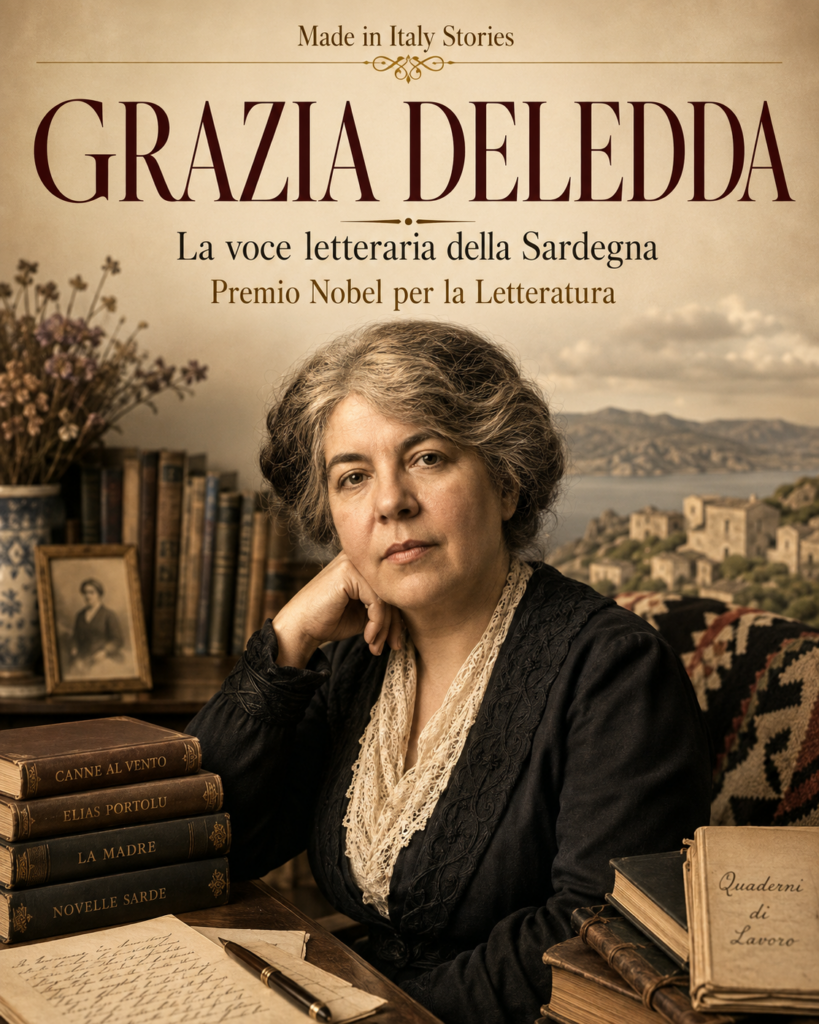
The Literary Voice of Sardinia: Nobel Prize in Literature
Grazia Deledda became one of the great voices of Italian literature by writing from a place many cultural elites of her time considered peripheral. She was born in Sardinia, educated only briefly in formal school, began writing when a literary career for a provincial young woman seemed almost an act of insolence, and eventually received the Nobel Prize in Literature. Her journey from Nuoro to international recognition is remarkable enough. What matters more is what she carried with her: a Sardinia of wind, silence, guilt, desire, ritual, poverty, landscape and moral conflict, transformed by imagination into literature that could speak far beyond the island.
She was born in Nuoro on 27 September 1871, into a relatively comfortable family. Her father, Antonio, owned land and was involved in local affairs, and the Deledda household received visitors from the surrounding region. The young Grazia listened. Stories entered the house with travelers, relatives, neighbors and people carrying news from villages and countryside. Long before she became a novelist, she was learning one of the writer’s central skills: noticing what people reveal when they think they are merely talking.
Her formal education was limited, as was common for girls in her environment. She attended school only through the early elementary years and later received private lessons in Italian. Yet the restriction of formal schooling did not become a restriction of mind. She read voraciously, taught herself through books and began writing while still in her teens. Different biographical accounts give slightly different details about her very first publication, but the essential fact is clear: she entered print extraordinarily young, sending stories beyond Sardinia before she had any established literary network.
That early ambition was not universally welcomed. A young woman who wrote about passion, crime, sexuality, family conflict and village life risked social criticism in a conservative environment where private behavior was closely watched. Deledda nevertheless continued. She published stories, collected folklore and gradually developed a voice that combined observation with symbolism, regional detail with moral intensity. Her early works included Fior di Sardegna and Anime oneste, and by the end of the nineteenth century she was attracting attention from important critics on the Italian mainland.
The Sardinia she wrote was not a postcard. This distinction is crucial. Deledda loved the island and never stopped drawing upon it, but she did not flatten it into picturesque costume. Her landscapes are beautiful and often lyrical, yet the people who inhabit them confront guilt, violence, honor, poverty, religious fear, forbidden love and the pressure of social judgment. Mountains, wind and vegetation are not background scenery. They behave almost like moral forces. Human beings bend under circumstances as reeds bend in the wind – an image that would eventually give her most famous novel its title.
In 1899 Deledda met Palmiro Madesani, a civil servant from the Italian mainland. They married in 1900 and moved to Rome. The move changed her physical life but did not sever her imaginative connection with Sardinia. On the contrary, distance may have sharpened it. Rome gave her greater access to publishers, journals and the national literary world, while memory gave her the material she understood most deeply. She and Madesani had two sons, and her domestic life in Rome was generally private and disciplined. Writing became the central labor of her adulthood.
The first Roman years produced several of the books that established her international reputation. Elias Portolu, published in 1903, explores desire, guilt and religious conflict through a man torn between passion and moral obligation. Cenere followed in 1904, a novel of abandonment, motherhood and social judgment that later became the basis of the only film starring Eleonora Duse. L’edera, Colombi e sparvieri, Marianna Sirca and other works continued to examine characters trapped between impulse and law, desire and duty, the individual and the community.
Then came Canne al vento in 1913. The title, Reeds in the Wind in English, offers perhaps the clearest image of Deledda’s worldview. Human beings struggle, hope, resist and make choices, yet they are also bent by forces larger than themselves: family inheritance, poverty, social rules, passion, fate and the mysterious weight of conscience. The novel is set in Sardinia but reaches toward universal questions. That ability to move from one island landscape to common human vulnerability is one of the reasons Deledda traveled so well across languages.
Her literary style is often discussed in relation to verismo, the Italian tradition associated with writers such as Giovanni Verga, but Deledda never fits neatly into one school. There is realism in her attention to rural life and social conditions, but also symbolism, biblical gravity, romantic feeling and a lyrical sense of nature. She read widely, including Russian novelists and contemporary Italian authors, yet she transformed influences through a voice unmistakably her own. Critics have debated her classification for more than a century, which is often what happens when a writer refuses to behave politely inside categories.
Women in Deledda’s fiction are particularly important. Mothers, daughters, widows, lovers and women constrained by family structures often carry enormous emotional weight. She did not write ideological manifestos about female emancipation in the manner of some contemporaries. Her approach was quieter and in some ways more unsettling. She showed how moral systems were lived inside bodies and households, how women could become both victims and enforcers of tradition, and how desire could expose the fragility of social order.
Her relationship with modernity was complicated. Deledda moved to Rome and became an internationally published author, yet much of her imaginative world remained tied to archaic rhythms, religious ideas and communities in which honor and memory mattered intensely. This is not a contradiction so much as the engine of her work. She wrote at the moment when Italy was transforming economically and culturally, and Sardinia occupied an ambiguous place within that national story: geographically distant, culturally distinct, often misunderstood and frequently romanticized by outsiders. Deledda gave the island a literary voice without pretending it was simple.
Recognition accumulated slowly but steadily. Her books were translated, reviewed abroad and read across Europe. The highest honor arrived with the Nobel Prize in Literature for 1926, which she received in Stockholm in 1927. The Nobel committee praised writing that portrayed life on her native island with clarity while treating universal human problems with depth and sympathy. Deledda became the first Italian woman to receive the Nobel Prize in Literature, and she remains one of the most important women in the history of the prize.
The image of Deledda receiving the Nobel can easily become a triumphal ending, but her career continued. She kept writing with remarkable regularity. Works such as Annalena Bilsini, Il paese del vento and La chiesa della solitudine belong to her later period, when her settings and psychological concerns broadened further. She was never the kind of celebrity who seemed to enjoy making herself into a public spectacle. Her fame was large; her personal style remained restrained.
One of her most revealing works appeared after her death. Cosima, published posthumously in 1937, is an autobiographical novel in which Deledda revisits childhood, family, grief, desire and the awakening of literary ambition through the figure of Cosima. The book allows readers to see how closely memory and invention were intertwined in her imagination. The domestic world of Nuoro, the tragedies that touched her family and the feeling of a young woman trying to write herself beyond the limits around her become part of a literary self-portrait.
Deledda died in Rome in August 1936. She had spent more than three decades away from Sardinia, yet no one could reasonably say she had left it behind. The island lived inside her work with such intensity that generations of readers around the world came to know an imagined Sardinia through her pages. That created both admiration and debate. Sardinian writers after her sometimes had to negotiate the enormous shadow of the island she had made famous.
Her legacy is especially interesting because she succeeded without following the most obvious path to literary prestige. She was not formed by a famous university. She did not emerge from an influential salon. She was not based from youth in Florence, Turin or Milan. She came from Nuoro, largely educated herself and wrote insistently until the center had no choice but to notice the supposed periphery. In that sense, her life is a story not only about talent but about geography and cultural authority.
There is also a beautiful connection among the women in this collection of Italian stories. Eleonora Duse, the great actress, chose Deledda’s Cenere for her only film appearance in 1916. Two women who had each transformed their field met through one story: the Sardinian novelist and the revolutionary performer. Italian cultural history is full of these crossings, and they remind us that biographies are never truly isolated.
Today Deledda is read not merely as a regional writer but as a novelist of conscience, fate and human fragility. Her Sardinia is specific enough to smell of earth and shrubs, yet broad enough to contain questions recognizable anywhere: What do we owe our family? Can guilt be escaped? How much freedom do we really possess? What happens when love collides with the rules of a community? These are not provincial questions. They are human ones.
If Grazia Deledda’s story makes you curious about Sardinia beyond its beaches, follow Made in Italy Stories and tell us in the comments whether you have read Canne al vento, Elias Portolu, La madre or another of her works. And if you have visited Nuoro, what did you feel in the landscape that gave Italy its first female Nobel laureate in literature?