

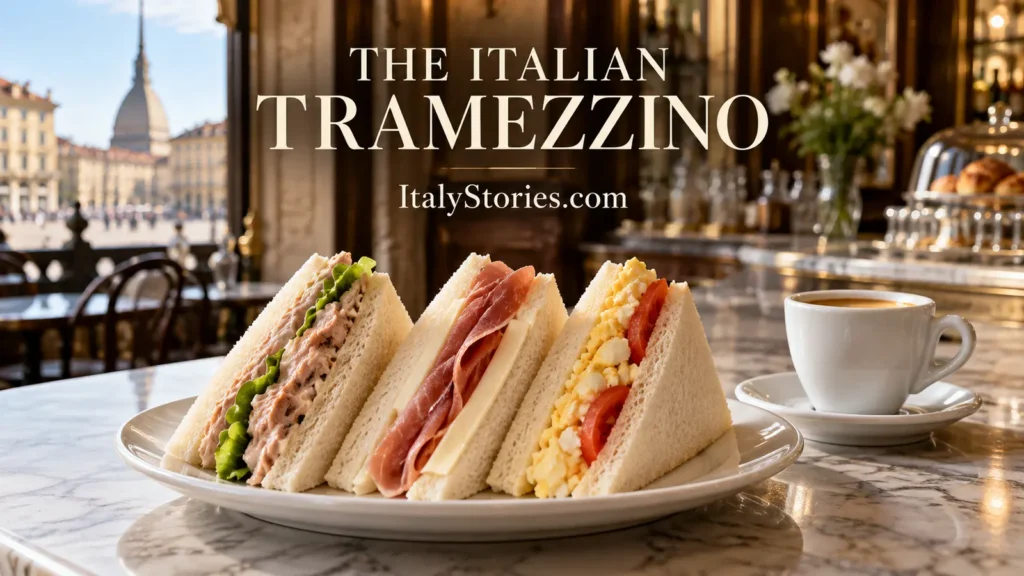
The Italian tramezzino looks almost too simple to deserve a story of its own. Two slices of soft white bread, the crusts carefully removed, a generous but balanced filling and the unmistakable triangular cut. Yet behind this apparently modest sandwich lies nearly a century of Italian taste, regional creativity and everyday life. It can be an elegant snack served in a historic café, a quick lunch eaten at the bar or a small pleasure enjoyed with an aperitivo. It is inexpensive, practical and endlessly adaptable, but preparing a truly good tramezzino requires considerably more attention than simply putting something between two slices of bread.
Unlike the rustic panino, which usually relies on bread with a firm crust and a substantial filling, the tramezzino is soft, delicate and almost theatrical in appearance. Its bread should remain moist without becoming soggy, while the filling must reach every corner. A badly made tramezzino is dry at the edges, overloaded in the centre and forgotten in a refrigerated display case. A good one is tender, fresh and balanced, with every bite containing the right proportion of bread, sauce and filling.
The Turin origins of the Italian tramezzino
The history of the Italian tramezzino is traditionally associated with Caffè Mulassano, one of the historic cafés of Turin. During the mid-1920s, the owners reportedly introduced small sandwiches made with soft white bread after returning from the United States, where similar preparations were already popular. They adapted the idea to Italian tastes, using local ingredients and creating combinations that were more refined than the ordinary sandwich.
The English word “sandwich” did not sound particularly Italian, especially during a period in which foreign words were often replaced with domestic alternatives. The poet and writer Gabriele D’Annunzio is traditionally credited with popularising the name “tramezzino”, derived from tramezzo: something placed in the middle or consumed between two principal moments. It was an elegant word for a small meal eaten between breakfast and lunch, or between lunch and dinner.
Whether every detail of the story unfolded exactly as later tradition described it is less important than the transformation that followed. Italy took a foreign idea and made it unmistakably Italian. The bread became softer, the presentation more elegant and the fillings increasingly connected to local products. The tramezzino left Turin and travelled across the country, finding a particularly enthusiastic welcome in Venice and throughout northeastern Italy.
What makes a real tramezzino different?
A tramezzino is not simply a triangular sandwich. Its most recognisable characteristic is the bread: very soft, pale and without crust. It should be thin enough to remain delicate but strong enough to contain the filling without tearing. The slices are normally rectangular before being cut diagonally into triangles.
Mayonnaise is frequently used, not only for flavour but also to create a protective layer between the bread and wetter ingredients. It helps preserve the characteristic softness and prevents vegetables, sauces or tuna from soaking directly into the bread. The amount matters. Too little leaves the sandwich dry; too much overwhelms the filling and turns lunch into a test of manual dexterity.
The filling must be distributed carefully. A tramezzino should look generous, particularly along the cut edge, but it should still be easy to eat. The best examples are assembled with patience, spreading the ingredients towards the corners and arranging them so that the sandwich does not collapse after the first bite.
Traditional tramezzini are served cold or at room temperature. Toasting them would change their identity, turning the soft bread crisp and moving the result closer to a toast or grilled sandwich. Their appeal lies precisely in that cool, gentle texture.
The classic fillings
Tuna and mayonnaise is one of the most familiar fillings, often enriched with sliced egg, olives, capers, tomato, artichokes or lettuce. The tuna should be drained carefully so that the filling remains creamy rather than oily. Tuna and artichoke is an especially popular combination because the slightly bitter freshness of the artichoke balances the richness of the mayonnaise.
Ham and cheese is another classic, although even this apparently simple pairing offers countless variations. Cooked ham may be combined with a mild cheese, mushrooms, artichoke cream or lettuce. Raw ham works well with mozzarella or another delicate cheese, provided that the ingredients are sliced thinly enough to preserve the softness of the sandwich.
Egg is frequently used either as the main ingredient or as an addition. Sliced hard-boiled egg can be paired with tuna, tomato, asparagus or a small amount of anchovy. Other traditional fillings include shrimp with pink sauce, crab-flavoured seafood, mozzarella and tomato, chicken salad, roast beef, mushrooms and combinations based on seasonal vegetables.
Modern cafés have expanded the possibilities enormously. Today it is possible to find tramezzini with smoked salmon, avocado, grilled vegetables, pistachio cream, burrata or gourmet cured meats. Vegetarian and vegan versions have become common, while chefs occasionally transform the humble sandwich into a sophisticated creation. Nevertheless, the best tramezzino does not necessarily contain the most expensive ingredients. Its success depends on proportion, freshness and harmony.
Turin and Venice: two different personalities
Turin preserves the tramezzino’s connection with elegant cafés and the culture of refined snacks. The Piedmontese version is generally neat, well-balanced and relatively restrained, reflecting the atmosphere in which it first became famous.
Venice developed a more exuberant interpretation. Venetian tramezzini are often generously filled, with a rounded centre that appears almost inflated between the two soft slices of bread. The filling is deliberately visible along the edges, making the sandwich immediately tempting from behind the glass counter.
In Venice, the tramezzino became part of the daily rhythm of bars and bacari. It can be eaten as a mid-morning snack, a light lunch or with an aperitivo and a small glass of wine. It belongs to the same informal social world as cicchetti: food designed not for a long formal meal but for conversation, movement and spontaneous meetings.
Other regions created their own interpretations. In Rome, Milan, Bologna and many other Italian cities, the tramezzino became a standard feature of bar counters, train-station cafés and small food shops. Some places remained faithful to the classic recipes, while others adapted the fillings to local tastes.
How to make the perfect Italian tramezzino
The first rule is to use fresh, soft sandwich bread without crust. If ordinary bread is used, the crust should be removed cleanly without crushing the slices. The bread must not be stale, toasted or excessively thick.
A thin layer of mayonnaise, soft cheese or another spread should cover the bread almost to the edges. This provides flavour and helps protect it from moisture. Watery ingredients such as tomatoes, mozzarella and washed lettuce should be dried carefully before assembly. Tuna must be drained, eggs should be completely cool and cooked vegetables should not carry excess oil.
The ingredients are then arranged in even layers. A mountain of filling placed only in the centre may look impressive before the sandwich is cut, but it produces dry corners and an unstable result. The secret is generosity with discipline: enough filling to make the tramezzino satisfying, but not so much that the bread can no longer contain it.
Once assembled, the sandwich is cut diagonally with a sharp knife. Pressing down heavily should be avoided because it compresses the bread and forces the filling out. If it is not served immediately, the tramezzino should be covered closely so that the exposed bread does not dry out. Traditionally, cafés keep them protected and refrigerated, but they are at their best when fresh rather than icy cold.
Balance is the real secret. Creamy ingredients need something fresh or slightly acidic; delicate fillings should not be buried under strong sauces; crunchy vegetables can add contrast, but they should never make the sandwich difficult to bite. The perfect tramezzino feels soft first, then reveals the textures and flavours inside.
A small meal for every moment
Part of the tramezzino’s success comes from its extraordinary flexibility. It can be eaten quickly without cutlery, carried easily and adapted to almost every preference. One triangle may be enough for a snack, while two or three can replace lunch. A selection of smaller tramezzini is also ideal for parties, buffets and aperitivi.
For generations of Italians, the tramezzino has been associated with railway journeys, office breaks, afternoons in the city and hurried lunches at the bar. Almost everyone has encountered disappointing examples, dry and nearly empty, but almost everyone also remembers a favourite café where the filling is abundant and the bread always fresh.
This familiarity has occasionally worked against its reputation. Because the tramezzino is everywhere, it can be overlooked. It rarely receives the same international attention as pizza, pasta or focaccia. Yet it tells an equally revealing story about Italian food culture: the ability to transform simple ingredients through care, proportion and presentation.
It also reflects the social role of the Italian bar. Bars are not merely places where people drink coffee. They are meeting points woven into the daily life of neighbourhoods, cities and small towns. The tramezzino lives naturally in this environment, ready for the customer who has missed lunch, the student with little time or the friends sharing an aperitivo before dinner.
More Italian than it first appears
The tramezzino began as an adaptation of a foreign sandwich, but its evolution is profoundly Italian. It acquired an Italian name, regional variations and a place within the country’s everyday traditions. Turin gave it refinement, Venice gave it abundance and every bar added its own favourite filling.
Its ingredients may change, but its identity remains surprisingly precise: soft crustless bread, a moist and balanced filling, a triangular shape and the promise of something quick but pleasurable. There is no need for luxury or complicated technique. What matters is freshness and the quiet attention paid to every layer.
The Italian tramezzino is proof that even the smallest foods can carry a remarkable history. It is not merely something to eat between meals. It is a piece of Italian daily life, served on a small plate beside an espresso, enjoyed in a historic café or unwrapped during a journey.
To discover more stories about Italian food, cities, people and traditions, continue following ItalyStories.com