

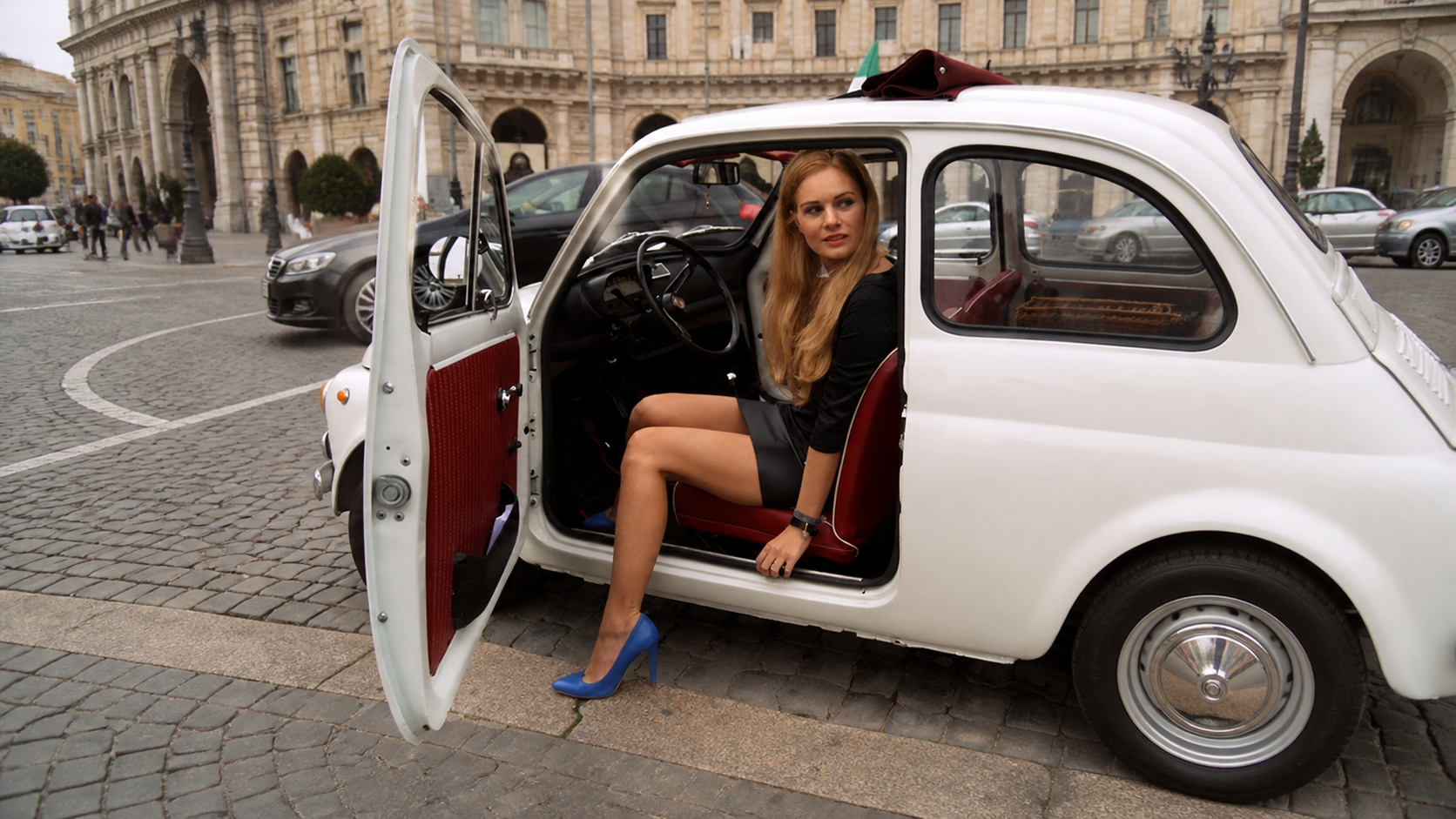
Certo. Questa foto funziona molto bene come apertura perché racconta subito il tema senza bisogno di spiegazioni: **una donna italiana, una piccola automobile, eleganza e libertà**. Non le attribuisco un’identità specifica; la uso come immagine simbolica del rapporto tra donne italiane e motori.
Qui sotto trovi l’articolo in inglese, pensato nello stesso stile emozionale dei precedenti e pronto per WordPress.
They were photographed beside beautiful cars, but the real story began when they stopped standing beside them and started driving them.
There is something almost cinematic about the photograph.
A small Italian car.
The driver’s door wide open.
A young woman sitting behind the wheel, one foot already outside, as though she has just arrived somewhere or is about to leave.
There is elegance in the scene, certainly. Italy has always known how to place beauty beside machinery.
But look at the photograph a little longer.
The important detail is not the dress.
Not the shoes.
Not even the charming little automobile.
It is the driver’s seat.
She is sitting in it.
And that changes everything.
Because the story of Italian women and automobiles is not really a story about fashion, glamorous photographs, racing drivers or famous actresses leaning against Alfa Romeos.
It is a story about movement.
About independence.
About the gradual disappearance of an invisible sentence that for generations had followed millions of women everywhere:
**You need someone to take you there.**
The automobile helped erase that sentence.
Not immediately.
Not completely.
And certainly not without resistance.
But one woman at a time, one driving licence at a time, one Fiat key at a time, the relationship between Italian women and the road changed.
And as it changed, Italy changed with it.
For an American or British reader, it can be tempting to imagine Italian motoring mainly through Ferrari, Lamborghini, Alfa Romeo, Maserati, Lancia and the great red racing machines of Monza.
But the automobile’s deepest revolution was often quieter.
It happened outside apartment buildings.
Outside schools.
In small towns.
In the courtyards of factories.
At petrol stations.
In the driver’s seat of a Fiat 500.
A Fiat 600.
A 127.
A 126.
A Panda.
Cars that did not roar.
Cars that simply allowed someone to go.
And sometimes, that was the greater revolution.
*Before the Car Meant Freedom
For much of the first half of the twentieth century, the automobile in Italy was far from being an ordinary possession.
Cars were expensive.
Road infrastructure was limited.
Private motoring was strongly associated with wealth and, socially, overwhelmingly associated with men.
Women certainly drove.
Some had done so almost from the beginning of the automobile.
There were wealthy women, adventurous women, aristocrats, sportswomen and pioneers who refused to accept that machines had a gender.
But they were exceptions.
For most ordinary Italian women, particularly outside the wealthier urban classes, everyday life happened locally.
The family.
The neighborhood.
The market.
The church.
The school.
The workplace, for those who worked outside the home.
Public transport mattered enormously.
So did bicycles.
So did walking.
And so did husbands, fathers and brothers.
Mobility depended on circumstances.
Then came war.
And after war came reconstruction.
Italy emerged from the Second World War damaged, divided and poor, but also hungry for a future.
Factories restarted.
Cities expanded.
Internal migration transformed the country.
Millions moved from rural areas and southern regions toward industrial centers.
New jobs appeared.
New housing appeared.
Household appliances began entering homes.
Television changed the living room.
The Vespa and Lambretta changed the streets.
And then the family automobile began to change everything else.
If Ferrari represented the Italy people dreamed about, Fiat represented the Italy people actually lived in.
That distinction matters.
A Ferrari could decorate a teenager’s bedroom wall.
A Fiat could be parked beneath his mother’s apartment.
The Fiat 600 arrived in the mid-1950s.
The Nuova 500 followed in 1957.
Later would come the 850, 124, 127, 126, 128 and many others.
For ordinary families, these cars represented access to a different life.
And for women, small cars were particularly important.
Consider the Fiat 500.
Tiny.
Light.
Simple.
Easy to park.
Economical.
It did not possess the intimidating dimensions of a large automobile.
Italian streets suited it.
Italian cities suited it.
And increasingly, Italian women suited it.
A woman could take the children somewhere without waiting for her husband.
She could go shopping farther from home.
She could visit her parents.
She could travel to work.
She could take a child to the doctor.
She could leave the city.
She could go to the beach.
She could simply decide that she wanted to go somewhere.
That last sentence may sound trivial today.
It was not trivial.
Mobility is power disguised as convenience.
Give someone the ability to move independently and you quietly change the architecture of their life.
Imagine an Italian woman in the early 1960s.
Perhaps she lives in Rome.
Perhaps Turin.
Perhaps Bologna.
Her husband drives the family car most of the time.
She has a licence, but still hears the familiar comments.
Women cannot park.
Women panic in traffic.
Women do not understand engines.
Women should be careful.
Women should let men drive.
The stereotypes were so ordinary that people often repeated them as though they were scientific facts.
Then one morning she takes the car alone.
Maybe the journey is insignificant.
Five kilometers.
Ten.
Perhaps to a market.
Perhaps to work.
Perhaps to visit her mother.
She gets in.
Closes the door.
Starts the engine.
And leaves.
Nothing dramatic happens.
There is no newspaper headline.
No crowd applauds.
History does not record her name.
But for her, the geography of life has changed.
She no longer occupies the passenger seat by necessity.
That is how social revolutions often happen.
Quietly.
Without music.
A key turns.
An engine starts.
Someone goes somewhere alone for the first time.
Postwar Italy was changing socially as dramatically as it was changing economically.
The image of the Italian woman inherited from previous generations was being challenged by reality.
Women increasingly worked outside the home.
Girls remained in education longer.
Cities grew.
Consumer culture expanded.
Cinema introduced new images of femininity.
Fashion changed.
Relationships changed.
Expectations began changing.
The automobile became part of this transformation.
Look through advertising and magazines from the 1950s and 1960s and you can see manufacturers trying to understand the female motorist.
Sometimes the imagery looks painfully old-fashioned today.
Women were often presented decoratively.
A beautiful woman could be placed beside a car simply to make the car more desirable to a male buyer.
But gradually another image appeared.
The woman was no longer beside the automobile.
She was using it.
Driving it.
Buying it.
Choosing it.
And that distinction may look small in an advertisement, but culturally it was enormous.
The car ceased being exclusively a man’s machine.
Italy’s historic cities created a particularly strong argument for compact automobiles.
Rome was never designed around the automobile.
Neither was Florence.
Or Naples.
Or Palermo.
Or Genoa.
The old streets had existed long before internal-combustion engines.
The tiny Italian cars that appeared after the war were therefore not merely cheap.
They were geographically intelligent.
A Fiat 500 could pass through narrow streets.
It could fit into ridiculous parking spaces.
It consumed little fuel.
It could survive dense urban traffic with a kind of cheerful determination.
And the more approachable the automobile became, the easier it was for new motorists to enter the culture of driving.
Women were among them.
Soon the sight became ordinary.
A woman in sunglasses.
One hand on the wheel.
Children in the back.
Shopping beside her.
A scarf moving in the air through an open window.
Perhaps a cigarette between her fingers — another very different era.
Perhaps the radio playing Mina.
Or Patty Pravo.
Or Ornella Vanoni.
The automobile was becoming part of the visual language of modern Italian femininity.
While thousands of women were quietly claiming everyday roads, others were attacking one of the most aggressively male environments imaginable.
Motor racing.
The history of women in Italian motorsport contains extraordinary figures who deserve far greater international recognition.
Among the most important is **Maria Teresa de Filippis**.
Born in Naples in 1926, de Filippis became one of the true pioneers of international motor racing.
Her story began, wonderfully, with a challenge.
Her brothers reportedly doubted she could drive quickly.
She decided to prove them wrong.
That decision eventually took her into a world where women were barely expected to participate at all.
De Filippis raced sports cars and eventually reached Formula One.
In 1958, she became the first woman to compete in a Formula One World Championship Grand Prix.
Think about the date.
1958.
The Fiat 500 was barely a year old.
Many Italian families still did not own an automobile.
And an Italian woman was racing a Maserati at Grand Prix level.
It is difficult now to fully appreciate the cultural wall she was driving through.
Motor racing was dangerous for everyone during that era.
Cars had little of the safety technology we take for granted.
Circuits could be unforgiving.
Fatal accidents were tragically common.
Drivers were expected to accept risk as part of the profession.
And in that environment stood Maria Teresa de Filippis.
Not participating in a women’s category.
Not driving an exhibition.
Racing against men.
De Filippis also encountered the kind of prejudice that reveals just how extraordinary her achievement was.
She later recalled being prevented from competing at the French Grand Prix at Reims, with the race director reportedly making the infamous remark that the only helmet suitable for a woman was one worn at the hairdresser.
Whether retold in slightly different wording over the years, the spirit of the story is unmistakable.
She was not being judged solely as a driver.
She was being judged as a woman who had entered a place some men believed did not belong to her.
Yet she had already proved the only point that truly mattered.
She was there because she could drive.
The importance of Maria Teresa de Filippis goes beyond statistics.
She gave motorsport a new possibility.
Once somebody has done the impossible, it becomes slightly less impossible for the next person.
If Maria Teresa de Filippis opened the door, another Italian woman would later write her name permanently into Formula One history.
**Lella Lombardi.**
Born Maria Grazia Lombardi in Piedmont in 1941, she came from a very different background from the glamorous stereotype often associated with racing.
Her father was a butcher.
She learned to drive vehicles while helping with the family business and gradually found her way into motorsport.
She raced touring cars.
Formula Three.
Formula 5000.
Sports cars.
And eventually Formula One.
In 1975, during the Spanish Grand Prix at Montjuïc, Lombardi finished high enough in a shortened race to receive half a championship point.
Half a point sounds tiny.
Historically it is enormous.
Lella Lombardi remains the only woman to have scored points toward the Formula One World Championship.
One Italian woman.
One half point.
An immortal place in racing history.
But again, the emotional meaning matters more than the statistic.
Lombardi was not playing at being a racing driver.
She was one.
She competed because she belonged there.
Motorsport history tends to concentrate around Formula One because Formula One commands international attention.
But Italy had other remarkable female racers.
**Ada Pace** was one of them.
Racing in the 1950s and 1960s, Pace competed successfully in touring and sports cars and became a familiar presence in Italian competition.
She was known affectionately as “Sayonara,” a nickname associated with the message she sometimes carried on the rear of her racing car — essentially telling competitors goodbye as she disappeared ahead of them.
There was humor in that.
And defiance.
Women also competed in rallies, endurance events and hill climbs.
Some arrived from privileged backgrounds.
Others fought their way upward with very little.
The details differed, but the resistance they faced had a common theme.
Why are you here?
The fastest answer was always the same.
Because I can drive.
There is an uncomfortable part of motoring history that should not be avoided.
For decades, automobile culture loved women while often failing to respect them.
A beautiful woman beside a sports car became one of advertising’s easiest formulas.
Auto shows used models.
Magazines used glamorous women to sell machinery.
Motorsport used grid girls.
Posters combined curves of bodies with curves of automobiles.
Italian advertising was certainly no exception.
The imagery could be sensual, elegant and artistically sophisticated.
But the message was frequently obvious.
The woman was part of the scenery.
The man was the driver.
Reality was already more complicated.
Women were driving those same cars.
Buying them.
Maintaining them.
Racing them.
Working in factories that produced them.
Designing elements of them.
Writing about them.
Using them to construct independent lives.
And gradually photography changed too.
This is why the image accompanying this article is interesting.
A woman seated in a small Italian car can initially resemble the familiar language of fashion.
But she occupies the driver’s seat.
She does not merely decorate the machine.
She controls its direction.
That is the more interesting story.
Italian cinema helped fuse automobiles with femininity in the international imagination.
The 1950s and 1960s created an image of Italy that traveled around the world.
Rome.
Cafés.
Sunglasses.
Scooters.
Sports cars.
Beautiful women.
The Mediterranean.
The road.
Italian actresses became global icons.
Sophia Loren.
Gina Lollobrigida.
Monica Vitti.
Claudia Cardinale.
Later Ornella Muti.
They belonged to an era when Italian cinema made the country seem simultaneously ancient and modern.
Automobiles were often part of that modernity.
A car could represent arrival.
Escape.
Romance.
Wealth.
Youth.
Danger.
Independence.
Cinema understood something advertisers understood too: a woman and an automobile together created an immediate story.
But the most compelling version was increasingly the one where she held the steering wheel.
There is a reason the Fiat 500 became associated so naturally with women.
It was not merely size.
It had personality without aggression.
Many automobiles communicate power by appearing dangerous.
The 500 communicated friendliness.
Round headlights.
Small wheels.
Curved bodywork.
A fabric roof.
Bright paint.
Chrome details.
It did not ask its driver to prove anything.
And because Italian style has often been built on the ability to make ordinary objects beautiful, the 500 could become part of personal identity.
A handbag.
Sunglasses.
Shoes.
A scarf.
And a little Fiat.
The combination almost became cultural shorthand for a certain idea of Italian life.
But underneath the beauty remained the important thing.
The car moved.
The woman drove.
The romantic image is attractive.
The reality was more important.
By the 1960s and 1970s, more women needed mobility because more women were participating in professional life.
The car therefore became practical infrastructure for social change.
Consider a teacher.
A secretary.
A nurse.
A shop worker.
An office employee.
A factory worker.
A mother whose children attended different schools.
Public transport could provide mobility, especially in large cities.
But the automobile provided control over time.
That distinction is fundamental.
A bus takes you where its route goes.
A car goes where you decide.
A train leaves when the timetable says.
A car leaves when you turn the key.
For women balancing employment, family responsibilities and household expectations, that control could be transformative.
The car did not eliminate inequality.
Sometimes it simply allowed women to perform even more responsibilities in the same day.
But it also expanded personal autonomy.
Freedom and burden frequently arrived together.
There is something emotional about the first driving licence.
Especially when getting it represents more than learning a technical skill.
Ask older Italian women about the moment they learned to drive and many stories begin appearing.
A father teaching in an empty square.
A husband who became impossibly nervous in the passenger seat.
A Fiat with a difficult clutch.
Repeated attempts at parking.
An examiner who appeared terrifying.
The first solo drive afterward.
That first drive matters.
There is nobody beside you who can intervene.
Nobody deciding the route.
You are responsible.
The steering wheel suddenly feels different.
You accelerate.
You change gear.
You enter traffic.
And at some point, perhaps after several minutes, you realize something.
You are doing it.
That is one of adulthood’s purest sensations.
By the 1970s the image was changing dramatically.
Italy itself was changing violently and rapidly.
Social movements.
Political turmoil.
Feminism.
Divorce reform.
Changes in family structure.
New ideas about work and sexuality.
Television.
Mass consumer culture.
The automobile was simply one object within this much larger transformation.
But everyday images matter.
A woman driving alone no longer looked extraordinary in the way it once had.
New generations grew up assuming they would obtain a licence.
Small Fiats multiplied.
The Fiat 127 became enormously important.
So did other compact cars from Italian and foreign manufacturers.
A car was gradually ceasing to be “his car.”
Families increasingly needed a second car.
And very often the second car was driven primarily by the woman of the household.
There is an irony here.
Advertising sometimes described these machines as “women’s cars,” a phrase that could diminish them by suggesting they were somehow lesser machines.
But the practical consequences were profound.
A second car meant two independent mobility systems inside one family.
The husband could go one way.
The wife could go another.
Geography no longer forced them into the same timetable.
The stereotype survived anyway.
It survives even now.
Women cannot park.
Women are too cautious.
Women are unpredictable.
Women do not understand mechanics.
The jokes are ancient and astonishingly persistent.
But prejudice has a useful weakness.
Reality does not require its permission.
Every morning millions of women simply drove.
They parallel parked.
They navigated Rome.
They survived Naples.
They crossed mountain passes.
They drove children to school.
They commuted.
They crossed Italy.
They raced.
They repaired cars.
They worked in the automotive industry.
Eventually the stereotype became less a description of reality than evidence of the person repeating it.
And perhaps nothing destroyed the myth more effectively than ordinariness.
The truly revolutionary sight was not Lella Lombardi at a Grand Prix, remarkable though she was.
It was the woman next door starting her Fiat every morning.
Think about how much life happened inside these cars.
A mother drove children to school.
Then went shopping.
Then perhaps to work.
Then collected the children.
Then visited an elderly parent.
Then returned home.
The automobile became a mobile extension of domestic organization.
Receipts in the glove compartment.
Children’s objects in the back.
Shopping bags.
An umbrella.
A cardigan.
A bottle of water.
Coins for parking.
Perhaps lipstick in a small compartment.
Perhaps cigarettes in another era.
A car reveals its owner through accumulation.
And women’s cars became private spaces in a way that is rarely discussed.
For someone whose home life constantly involved other people, the ten minutes alone behind the wheel could be genuinely private.
Radio on.
Door closed.
Nobody asking anything.
Sometimes freedom is not a thousand-mile road trip.
Sometimes it is twelve quiet minutes between work and home.
As Italy’s motorway system expanded, the psychological scale of the country changed.
Driving from one region to another became increasingly normal.
For women, long-distance driving carried another symbolic weight.
The woman traveling alone.
The woman taking her children across Italy.
The woman on a business trip.
The woman deciding to leave Rome for Florence.
Or Milan for Liguria.
Or Turin for the mountains.
The road offered anonymity.
Nobody on the motorway knew whether you were somebody’s wife, mother, daughter or sister.
You were simply another driver.
There can be something liberating in being reduced to traffic.
By the 1980s, Italian women’s relationship with automobiles was no longer remotely unusual.
The culture itself had changed.
Fashion became louder.
Cities became wealthier.
Professional life expanded.
Cars became increasingly sophisticated.
The Fiat Panda arrived at the beginning of the decade and became another landmark of democratic Italian motoring.
Designed with ruthless practicality, the Panda was almost impossible not to like.
It could belong to anyone.
Farmer.
Student.
Doctor.
Mother.
Architect.
Grandmother.
Young couple.
Its genius was indifference to status.
The Panda did not care who you were.
Get in.
Drive.
Women adopted it naturally because everybody did.
Perhaps this marks the final victory.
Not a special automobile for women.
Not a woman’s version.
Simply a useful car.
Equality can sometimes look wonderfully boring.
But women were never limited to small cars.
There is another image worth destroying: that women appreciate automobiles only as practical tools while men care about performance.
Anyone who has spent time around serious enthusiasts knows how ridiculous this is.
Women have collected Ferraris.
Raced Alfa Romeos.
Driven Porsches.
Loved Lancias.
Restored classics.
Studied engines.
Competed in rallies.
The passion for machinery is not contained on the Y chromosome.
Italian motorsport history proved that decades ago.
And today’s enthusiast culture continues proving it.
The only reason male enthusiasts can sometimes appear more numerous is historical access.
For generations boys were encouraged toward machines while girls were gently or explicitly directed away from them.
Give equal access long enough and passions emerge where they always existed.
There is a beautiful relationship between understanding a machine and becoming less dependent on other people.
Older generations of motorists often knew their cars more intimately than contemporary drivers do.
Check the oil.
Check water.
Recognize a weak battery.
Change a wheel.
Understand a strange noise.
Women who learned these skills acquired another form of independence.
The cultural stereotype expected a stranded female driver to wait for a man.
Reality offered another possibility.
Open the bonnet.
Find the problem.
Solve it.
There is no more efficient way to destroy a stereotype than with a spanner.
Italian culture is famously social.
Family life can be close.
Sometimes extremely close.
Multiple generations interact constantly.
Privacy has not always been abundant.
The automobile created a new kind of room.
One with wheels.
Young women understood this.
Young couples certainly understood it.
A car could become a place to talk without parents hearing.
A place to argue.
A place to cry.
A place to kiss.
A place to listen to music.
A place to decide whether to go home yet.
It is almost impossible to measure the social consequences of this.
The automobile did not merely connect places.
It created private space between them.
Millions of personal stories happened parked somewhere after the engine had stopped.
Now imagine July.
The little Fiat is hot.
Of course it is hot.
Proper air conditioning belongs to another world.
The windows are down.
The road leads toward the sea.
A woman drives.
Her sunglasses are too large because this is Italy and sunglasses are allowed to have opinions.
There is music on the radio.
A beach bag somewhere behind her.
Perhaps children.
Perhaps friends.
Perhaps nobody.
The landscape becomes brighter as she approaches the coast.
At some point the first blue appears.
The Mediterranean.
This is the other relationship between Italian women and cars.
Pleasure.
Not work.
Not necessity.
Not emancipation as an academic concept.
Simply the ability to say:
**I’m going to the sea.**
And then go.
Before widespread private mobility, romance operated within geography.
You met where people met.
Neighborhoods.
Town squares.
Work.
Church.
School.
Family circles.
Public transportation had schedules.
Parents had expectations.
The automobile complicated everything.
A young woman with access to a car could expand her world.
So could the man she was dating.
Distances between towns became socially smaller.
Evening could last longer.
The coast could become part of a date.
The countryside could become private.
The car was not merely transportation between romantic moments.
It became part of romance itself.
Italian films understood this perfectly.
So did popular music.
Return again to the photograph.
White little car.
Red interior.
Open door.
A woman sitting naturally behind the steering wheel.
There is no racetrack.
No mechanic.
No expensive supercar.
Nothing aggressive.
That simplicity is exactly why the image works.
Italy’s relationship with the automobile has always contained two stories.
One is mechanical greatness.
Ferrari engines.
Alfa Romeo racing.
Maserati.
Lancia innovation.
Lamborghini drama.
The other story is intimacy.
A little car parked outside a café.
A first date.
A drive to the sea.
A woman adjusting the mirror.
The second story may actually explain Italy better.
Eventually another transformation occurred.
Women stopped simply driving family cars and increasingly became automobile customers in their own right.
That changes an industry.
A customer chooses.
Design.
Comfort.
Safety.
Price.
Fuel economy.
Visibility.
Practicality.
Style.
Manufacturers had to stop imagining the automobile buyer as automatically male.
Women became economically impossible to ignore.
And once that happens, stereotypes encounter something they cannot defeat.
Purchasing power.
Today seeing an Italian woman driving carries no revolutionary shock.
And that is precisely the achievement.
She may be driving a Fiat Panda through Rome.
A family SUV outside Milan.
An electric city car.
A vintage Alfa Romeo.
A Ferrari.
A delivery van.
A bus.
A racing car.
Nobody should find the basic act remarkable.
But history gives ordinary things depth.
Every woman driving through Italy today occupies a road widened socially by women who were considered unusual simply for wanting the same freedom.
The pioneers did not all race.
Most names are unknown.
That does not make them less important.
There was a first woman in every family who learned.
A grandmother.
An aunt.
A mother.
A sister.
Someone who said:
Teach me.
Someone who passed the examination.
Someone who took the keys.
This would be a wonderful experiment.
Ask an older Italian woman:
“What was the first car you drove?”
Watch her face.
Perhaps:
Fiat 500.
600.
601.
602.
603.
Maybe a Bianchina.
Maybe something completely different.
Then ask:
“Who taught you?”
Another story appears.
Then:
“Where did you drive alone for the first time?”
Now you are no longer discussing cars.
You are discussing youth.
Memory does this constantly.
We begin with machinery and end with people.
Perhaps she remembers the steering wheel.
Perhaps the color.
“My Fiat was light blue.”
That detail will be completely certain.
The exact year may be forgotten.
The registration number lost.
But the color remains.
She remembers the seat.
A dent.
A problem with the starter.
She remembers parking outside work.
The first trip with friends.
The first time she drove at night.
Perhaps she remembers her father reluctantly allowing her to borrow it.
Perhaps her husband insisted she would damage the clutch.
Perhaps she proved him wrong.
And somewhere between the laughter and details, the real story appears.
She remembers who she was.
Because this is not only Italian history.
America also understood the automobile as personal freedom more deeply than almost any nation on Earth.
The American road represents possibility.
Route 66.
Drive-ins.
First cars.
Road trips.
Leaving home.
Teenage independence.
Italy’s version happened on smaller roads and in much smaller automobiles.
But emotionally, the language is remarkably similar.
The Cadillac and Fiat 500 could not be more different mechanically.
Yet both could represent the same sentence:
**I can go.**
That is why the story translates so well.
Freedom does not care about engine displacement.
Britain understands the small automobile intimately.
The Mini made compact motoring into genius.
The Morris Minor became family.
The Austin Seven helped democratize motoring decades before.
British readers therefore know that an automobile does not need twelve cylinders to become culturally enormous.
Italy’s little Fiats did something similar.
They entered homes.
Families.
Photographs.
Memories.
And women were central to that transformation.
The machine becomes interesting not because it is Italian.
It becomes interesting because human beings used it to enlarge their lives.
There is an important distinction to make.
The automobile did not liberate Italian women.
Women liberated themselves.
Through education.
Work.
Political struggle.
Economic independence.
Legal reform.
Personal courage.
Changing family expectations.
The car was a tool.
But tools matter.
A door is only a piece of architecture until someone needs to leave.
A key is only metal until it unlocks something.
A steering wheel is only a mechanism until the person holding it chooses the direction.
The automobile could not create independence.
But it could make independence mobile.
We remember Maria Teresa de Filippis because Formula One keeps records.
We remember Lella Lombardi because championship points are permanent.
But I sometimes wonder about the woman nobody remembers.
The first woman in a small Italian village who bought her own car.
The widow who learned to drive because there was nobody left to drive her.
The factory worker who saved until she could afford a used Fiat.
The girl whose father insisted she learn because he believed his daughter should never depend on anyone.
The mother who drove three children across Italy on holiday.
The young woman who loaded a suitcase into the back and moved to another city.
No trophies.
No photographs in newspapers.
No biographies.
But these were victories too.
Imagine one last scene.
Italy.
Perhaps 1964.
Early morning.
An apartment window opens somewhere above the street.
Below sits a Fiat 500.
A woman walks toward it carrying a handbag.
Someone watching from the window may be her mother.
She opens the driver’s door.
Gets inside.
Places the key in the ignition.
The little engine comes alive behind her.
Perhaps she is going to work.
Perhaps somewhere more exciting.
We do not need to know.
She checks the mirror.
Selects a gear.
The car moves away.
The street becomes quiet again.
To everyone else it was simply another Fiat disappearing around a corner.
But perhaps for her it was the first morning nobody had needed to take her anywhere.
And that may be one of the most beautiful things an automobile has ever done.
For decades, the visual history of motoring showed us men.
Men designing cars.
Men racing cars.
Men repairing cars.
Men buying cars.
Men standing proudly beside them.
Women appeared too often as decoration.
But history becomes more interesting when we look beyond the advertising photograph.
Women were already moving toward the driver’s seat.
Once there, they never really left.
They drove tiny Fiats through Rome.
They raced Maseratis against men.
They scored Formula One championship points.
They transported children.
They went to work.
They went shopping.
They crossed borders.
They traveled alone.
They got lost.
They learned.
They parked badly sometimes.
Men did too.
They crashed.
Men did too.
They became motorists.
Not female motorists.
Motorists.
And perhaps that is the end of the revolution.
When nobody needs the adjective anymore.
Cars are changing again.
Electric power.
Autonomous technology.
Digital dashboards.
Connected navigation.
Cities questioning the role of private automobiles.
A woman receiving her first car in 2026 lives in an entirely different technological world from the woman climbing into a Fiat 500 sixty years ago.
But one emotion may remain unchanged.
The first time you sit alone behind the wheel.
The destination is yours.
The route is yours.
You can turn left.
You can turn right.
You can continue.
You can come home.
Or not yet.
That choice is what the automobile offered.
And for generations of Italian women, having that choice mattered far more than horsepower.
Look once more at the woman sitting in the little car.
Forget the fashion.
Forget the photograph.
Look at her hand near the controls.
Look at the open road implied beyond the frame.
Perhaps that is the real image of Italian women and motoring.
Not woman and machine.
Woman and possibility.
Because the greatest thing the automobile gave Italian women was never speed, style or status.
It was something far simpler.
**A key, a steering wheel, an open road — and the extraordinary right to decide for themselves where they were going next.**