

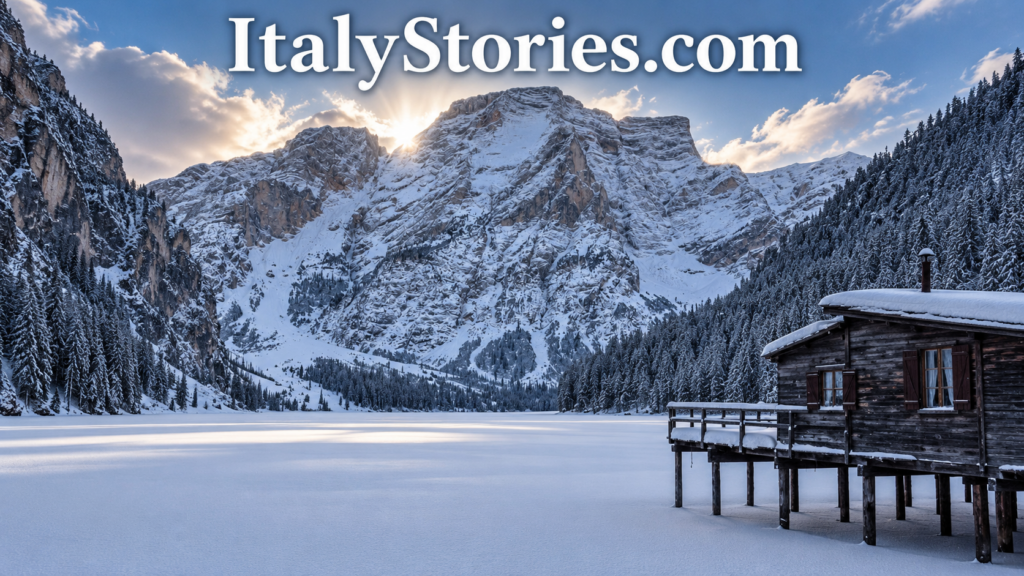
There are places that seem to belong to two completely different worlds depending on the season. In summer, Lake Braies is famous for its emerald water, wooden rowing boats and crowded shoreline. In winter, the colours disappear beneath snow and ice, the boathouse falls silent and the enormous wall of the Croda del Becco rises above the frozen landscape like the entrance to another world.
Lake Braies, known in German as Pragser Wildsee, lies in the Braies Valley of South Tyrol, in northern Italy. It is located at approximately 1,500 metres above sea level inside the Fanes-Sennes-Braies Nature Park, one of the most spectacular protected areas of the Dolomites.
The lake covers roughly 31 hectares and reaches a maximum depth of about 36 metres. It was created when a natural landslide blocked the valley and trapped the water flowing down from the surrounding mountains. Today, its position beneath the towering Dolomite cliffs makes it one of the most recognisable alpine lakes in Europe.
During the warmer months, Lake Braies is known for its brilliant green and turquoise reflections. The wooden boathouse, with its long line of traditional rowing boats, has become one of the most photographed scenes in the Italian Alps. When winter arrives, however, the boats are stored away, the building stands above a white expanse and the entire landscape changes character.
Temperatures can remain below freezing for long periods, allowing ice to form across the lake. Snow then covers its surface, sometimes hiding the water so completely that the basin resembles an enormous white meadow surrounded by dark forests and pale limestone walls.
The silence is perhaps the most surprising part of the winter experience. In summer, voices, boat oars and cameras create a constant background noise. On a cold winter morning, the loudest sound may be the wind moving through the spruce trees or the crunch of snow beneath a visitor’s boots along the shore.
Dominating the southern end of the lake is the Croda del Becco, called Seekofel in German. Rising to more than 2,800 metres, the mountain creates the dramatic backdrop seen in countless photographs. Its huge rock face reflects beautifully in the open water during summer, while in winter its ledges, gullies and vertical walls are emphasised by lines of snow.
The historic wooden boathouse is another essential part of the view. Standing partly on stilts at the water’s edge, it appears almost fragile beneath the surrounding mountains. In winter, with snow resting on its roof and no boats moving across the lake, it resembles an isolated cabin from a northern fairytale.
Yet Lake Braies is neither a film set nor a digital creation. Its extraordinary appearance is entirely natural, although television helped transform it into an international destination. The Italian series “Un passo dal cielo” used the lake and the surrounding mountains as major locations, introducing millions of viewers to a landscape that had previously been much less famous outside the region.
The success brought opportunities but also enormous pressure. Lake Braies became a social-media phenomenon, attracting visitors from around the world. During the busiest summer periods, traffic restrictions and special transport arrangements may be introduced to reduce congestion in the valley.
Winter offers a very different experience. The great summer crowds are usually absent, the rowboats are not operating and the surrounding hotels and restaurants may follow reduced or seasonal opening schedules. Visitors should therefore check local information before travelling rather than assuming that every service will be available.
The lake can generally be reached by road, but winter conditions require appropriate equipment. Snow, slush and ice may affect the Braies Valley, and vehicles should be prepared with winter tyres and, when required, snow chains. Public transport may provide a useful alternative, depending on the seasonal timetable.
Walking beside the lake can be unforgettable, but conditions must always be evaluated carefully. Snow-covered paths may hide ice, and some sections of the summer circuit can become difficult or unsafe after heavy snowfall. Proper winter footwear is essential, while traction devices or snowshoes may be useful depending on the conditions.
The most important warning concerns the frozen lake itself. A white surface can appear solid even when the ice below is thin, uneven or weakened by changing temperatures and underwater currents. Nobody should assume that the lake is safe to cross simply because other people are standing on it or because photographs show footprints in the snow.
Visitors should remain on authorised routes, follow posted notices and respect any barriers or instructions issued by local authorities. If access to the ice is not explicitly permitted, the safest and most responsible choice is to admire the landscape from the shoreline.
There are several winter activities available in the surrounding Braies Valley. Marked paths lead through snow-covered forests, while snowshoeing routes continue towards the Val Foresta and nearby mountain pastures. The wider Dolomites region also offers cross-country skiing, winter hiking and panoramic trails suitable for different levels of experience.
Weather in the mountains can change quickly. A clear morning can give way to cloud, wind or snowfall, and temperatures fall rapidly after sunset. Warm layered clothing, waterproof boots, gloves and sufficient daylight should be considered essential even for a relatively short visit.
For photographers, winter creates exceptional conditions. Early morning light reaches the mountain walls while the lake remains in shadow, producing a contrast between warm peaks and cold blue snow. Mist, fresh snowfall and low clouds can transform the same viewpoint within minutes.
The most famous composition places the boathouse on one side and the Croda del Becco in the background. Yet the lake deserves to be explored beyond this single photograph. The forests, frozen streams and quieter paths of the valley reveal a landscape that feels more intimate than the familiar view seen online.
Lake Braies is sometimes called the Pearl of the Dolomites, a description that suits its summer colours. In winter, however, it becomes something different. It is no longer a jewel shining in the sunlight but a silent, almost monochrome world shaped by rock, snow and cold.
This is when the lake appears most unreal—and perhaps most authentic. Without the boats and summer crowds, attention returns to the scale of the mountains and the vulnerability of the small wooden buildings beneath them.
Standing beside the frozen water, it is easy to understand why so many people describe Lake Braies as magical. The word may be overused in travel writing, but here it feels unusually appropriate. The landscape does not need special effects. Winter has already provided them.