

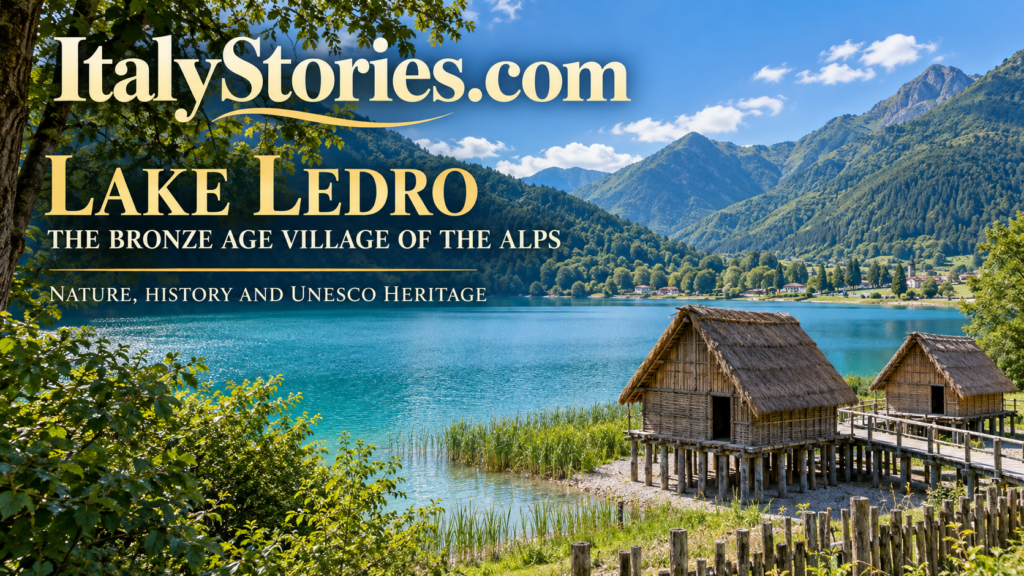
Hidden among the green mountains of Trentino, Lake Ledro appears at first to be the perfect Alpine retreat: clear turquoise water, wooded slopes, peaceful beaches and small villages scattered around its shores. Yet beneath this tranquil landscape lies a story almost four thousand years old.
Lake Ledro is not famous only for its natural beauty. On its eastern shore, near Molina di Ledro, archaeologists discovered the remains of one of the most important prehistoric pile-dwelling settlements in the Alpine region. Thousands of wooden posts preserved beneath the water and lakebed revealed that a large community had lived here during the Bronze Age.
The discovery happened almost by accident in 1929, when the lake’s water level was temporarily lowered during work connected with the construction of a hydroelectric power station. As the shoreline retreated, an extraordinary field of ancient wooden piles emerged from the mud. Archaeologists soon understood that these were the remains of houses belonging to a prehistoric village.
The settlement was occupied during different phases of the Bronze Age, approximately between 2200 and 1350 BC. Its inhabitants built wooden dwellings close to the lakeshore, supported by piles driven into the damp ground. The exact appearance and construction of these settlements changed over time, but the surviving evidence allows us to imagine an organised community living between the lake, forests and surrounding mountains.
The people of Ledro were not primitive wanderers struggling merely to survive. They were farmers, craftspeople, hunters, fishermen and traders. Archaeological discoveries include pottery, stone and bronze tools, weapons, ornaments, loom weights and objects made from bone and wood. Seeds and traces of food have helped researchers understand what the villagers cultivated and ate.
They grew cereals, gathered wild fruits, raised animals and exploited the resources of the forest and lake. The discovery of amber and other materials from distant regions also suggests that the community participated in trade networks extending far beyond the Ledro Valley. Even thousands of years ago, these Alpine populations were not isolated from the wider European world.
Fire struck the settlement more than once. Archaeological layers preserve evidence of destruction and rebuilding, suggesting that the village experienced several different phases before it was eventually abandoned. The wet conditions of the lakeshore later protected organic materials that would normally have disappeared, turning the site into an exceptional archive of everyday prehistoric life.
Today, reconstructed pile dwellings stand beside the lake near the archaeological area. Built using timber, reeds and materials inspired by ancient techniques, they help visitors imagine how the Bronze Age community may have lived. Rather than presenting prehistory as something distant and abstract, the reconstruction gives it walls, roofs, tools and domestic spaces.
The Ledro site forms part of the UNESCO World Heritage property known as the “Prehistoric Pile Dwellings around the Alps.” Added to the World Heritage List in 2011, this international group includes 111 archaeological sites distributed across six European countries. Together, they preserve an extraordinary record of prehistoric communities that lived around Alpine lakes and wetlands.
What makes Lake Ledro particularly memorable is the contrast between its ancient history and its peaceful modern appearance. The water changes from deep blue to brilliant turquoise according to the light, while forests descend almost to the shoreline. Paths follow the lake, and the surrounding mountains reflect on its surface during calm mornings.
It is easy to admire the landscape without realising that people were building homes, cultivating crops and navigating these waters thousands of years before the Roman Empire existed. Every view carries two different stories: the visible beauty of the Alpine lake and the hidden memory of the community preserved beneath it.
Lake Ledro therefore offers something more than a beautiful panorama. It creates a rare connection between archaeology and nature, allowing the modern traveller to stand beside the same water that sustained families during the Bronze Age.
The reconstructed huts may be silent, but the objects discovered around them speak clearly. They tell us that these ancient inhabitants worked, cooked, traded, raised children and rebuilt their homes after disaster. Their world was very different from ours, yet their daily concerns were surprisingly familiar.
Surrounded by mountains and protected by clear blue water, Lake Ledro remains one of Trentino’s most fascinating places—a landscape where Alpine beauty and human history have lived together for nearly four millennia.