

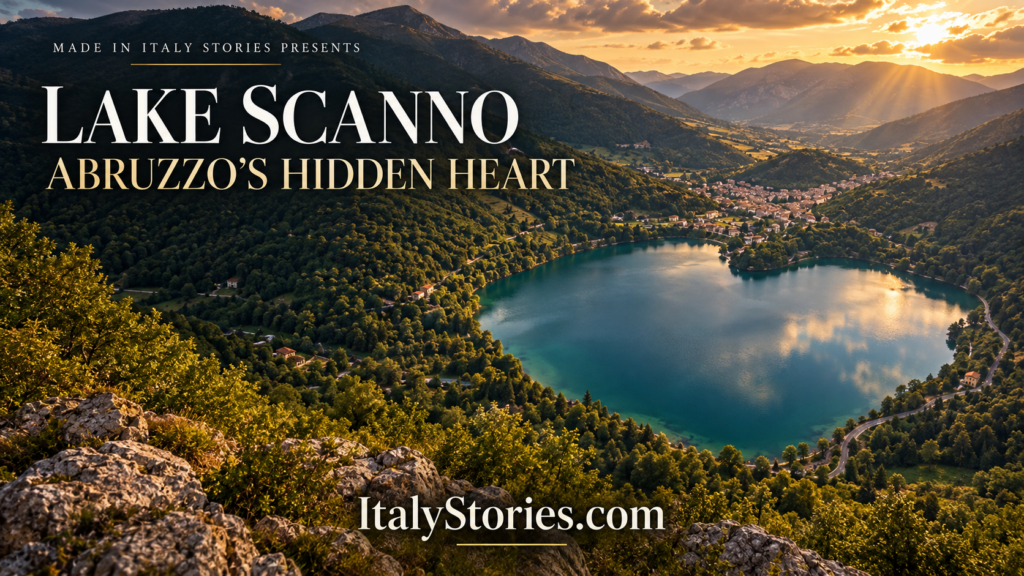
There are places that reveal themselves immediately, and others that seem to wait for the right distance, the right light and the right point of view. Lake Scanno belongs to the second kind. From its shores, it appears as a serene mountain lake surrounded by forests and the high ridges of the Central Apennines. From a particular viewpoint above the valley, however, its irregular outline changes before the eyes and becomes something unexpected: a heart resting among the mountains. This vision has transformed Lake Scanno into one of the most photographed natural landscapes in Abruzzo, but the famous shape is only the beginning of its story.
Located in the province of L’Aquila, at approximately 922 metres above sea level, Lake Scanno is the largest natural lake in Abruzzo. Its waters occupy a quiet mountain basin between the territories of Scanno and Villalago, in a landscape where roads bend around rocky slopes, forests descend toward the shoreline and villages seem to grow directly from the stone. This is an Italy far removed from crowded art cities and celebrated coastlines: a country of shepherds’ paths, small churches, traditional costumes, winter silence and communities that have learned to live with the beauty and severity of the mountains.
The lake is often described as romantic, but its origins were dramatic. It was created by a vast natural event that changed the geography of the valley, interrupting the course of water and forming a basin where none had existed before. Over time, that geological accident became a landscape of remarkable harmony. Nature transformed destruction into beauty, and the people of the valley gradually built their lives around it.
The result is a place where geology, history, photography and tradition meet. Lake Scanno is not merely a view to admire. It is the entrance to a deeper Abruzzo, a region whose identity has always been shaped by mountains, migration, craftsmanship and an extraordinary ability to preserve memories.
The Ancient Landslide That Created a Lake
Long before travelers climbed the Path of the Heart with cameras and mobile phones, the valley was crossed by the River Tasso. Then an enormous landslide descended from the mountains of the Genzana group, blocking the natural course of the water. Rocks, soil and debris formed a barrier, and the waters accumulated behind it until the present lake gradually emerged.
Lake Scanno is therefore a natural landslide-dammed lake. Its beauty was born from geological violence, although the event itself belongs to a distant past whose exact dating has long been discussed by researchers. The mountain closed the valley, the river changed its behavior, and a new ecosystem began to develop.
Unlike an artificial reservoir, the lake was not designed according to a regular shape. Its shoreline follows the uneven contours created by the terrain, which is why it does not resemble a perfect heart when observed from every direction. The celebrated shape appears from a particular elevated perspective, where the curves of the shoreline overlap visually and produce the romantic silhouette that has made the lake famous.
This detail makes the experience more interesting, not less. The heart is not an artificial symbol imposed upon the landscape. It is a visual secret created by distance and perspective. The mountains do not give it away immediately. They ask the visitor to walk, climb and look again.
The surrounding terrain still tells the story of movement and transformation. Rocky walls rise above narrow roads, forests cover old scars, and the valley preserves evidence of the forces that shaped the Central Apennines. Nearby villages have also experienced earthquakes, harsh winters and periods of isolation. Life in this part of Abruzzo has never been effortless, and the peaceful surface of the lake conceals a landscape formed by powerful natural events.
Yet water softened the valley. Trees grew around the basin, animals found shelter along its shores and human settlements adapted to its presence. What began as an interruption became a source of identity. The lake entered local stories, daily life and eventually the international imagination.
The Path of the Heart
The most famous view of Lake Scanno is reached along the Sentiero del Cuore, the Path of the Heart. The name sounds as if it were created for modern tourism, but the trail follows the natural relationship between the lake, the slopes and the small Hermitage of Sant’Egidio, a place long associated with local devotion and rural life.
As the path climbs, the lake repeatedly disappears behind trees and rocks before returning in fragments of blue. The experience is gradual. There is no theatrical curtain rising over the landscape; instead, the view changes step by step. A stretch of water appears between branches, then a curve of the shoreline, then the opposite mountain. Only from the panoramic point does the complete image come together.
From there, Lake Scanno seems to form a heart surrounded by dense woodland. The roads and houses become small details, while the mountains create a natural amphitheatre around the water. Depending on the season and hour, the lake can appear deep blue, turquoise, silver or almost black. Clouds travel across its surface as reflections, and the color changes before the observer has time to define it.
At sunrise, the valley may still be filled with cool shadow while the highest ridges receive the first light. In the afternoon, the water reflects the open sky and the green of the forests. At sunset, the mountains become layers of blue and violet, and the last sunlight touches the lake as if illuminating it from within.
Autumn brings perhaps the richest palette. The forests surrounding the lake turn gold, copper, red and dark green. In winter, snow can transform the valley into a landscape of silence, while spring returns water, flowers and movement to the slopes. Summer is brighter and more social, with visitors walking along the shore and enjoying the mountain air.
The heart-shaped view has become an emblem of romantic Abruzzo, but the path offers something more valuable than a photograph. It changes the scale of the landscape. From the shore, the lake surrounds the visitor; from above, the visitor finally understands how completely the lake belongs to the mountains.
Scanno, the Village of Photographers
A short distance from the water lies Scanno, one of the most distinctive historic villages in the Abruzzo Apennines. Built at more than a thousand metres above sea level, the town appears as a compact arrangement of stone houses, sloping streets, stairways, arches and small squares. Its historic center seems to follow the shape of the mountain rather than any formal urban plan.
Walking through Scanno requires attention. Streets suddenly narrow, steps disappear beneath covered passages, doorways open onto unexpected courtyards and buildings lean toward one another across shadowed lanes. Stone is everywhere, but the village never feels monotonous. Balconies, carved portals, ironwork, fountains and religious images introduce small variations that reward a slow walk.
The principal church of Santa Maria della Valle dominates part of the historic center, while other churches and chapels preserve the religious history of the community. Sant’Eustachio, San Rocco, Sant’Antonio da Padova and the Hermitage of Sant’Egidio are not simply monuments. They belong to a network of faith, festivals and collective memory that has helped hold the village together across generations.
Scanno became internationally known not only for its architecture but also for the photographers who recognized its extraordinary visual character. During the twentieth century, its streets and inhabitants attracted some of the most important names in European photography.
The German photographer Hilde Lotz-Bauer arrived before Scanno had become a celebrated destination. Her images paid particular attention to women, work and daily life. They recorded gestures, clothing and expressions without reducing the villagers to decorative figures.
Henri Cartier-Bresson later photographed Scanno with the sensitivity that made him one of the masters of street photography. The village offered him exactly what his eye sought: sudden alignments, human figures emerging from shadow, stairways dividing the frame and ordinary moments that lasted only an instant.
Mario Giacomelli created some of the most haunting photographs ever associated with Scanno. His images did not present the village as a picturesque tourist destination. Deep blacks, intense contrasts and blurred figures transformed its streets into a psychological landscape. His celebrated image commonly known as Scanno Boy placed a sharply focused child among dark, almost spectral adult figures, creating a scene suspended between reality, memory and dream.
The photograph became part of the international story of Italian photography. Yet Scanno was never merely a backdrop. Its architecture, traditional clothing and compact social world actively shaped the images produced there.
Other photographers followed, drawn by the same relationship between people, stone and light. Scanno consequently earned a reputation as the village of photographers, a place where almost every corner seems naturally framed. Even today, visitors often discover that the most memorable pictures are not necessarily the broad panoramas. They are the smaller scenes: an elderly resident crossing a square, laundry moving above an alley, a dark doorway, a staircase illuminated by a narrow beam of afternoon light.
The Women of Scanno and a Living Tradition
Among the most recognizable symbols of the village is the traditional female costume of Scanno. Its dark, sculptural silhouette appears in historic photographs and has contributed greatly to the visual identity of the town. The clothing developed over centuries and shares elements with other communities of the Conca Peligna, Alto Sangro and Marsica, while retaining features that make the Scanno version immediately distinctive.
The costume was not originally created for performances or historical commemorations. It was clothing connected to real lives, social roles, marriage, family status and community belonging. Every component carried meaning, from the full skirt and fitted bodice to the apron, sleeves and characteristic headdress.
The women photographed in the streets of Scanno were not actors representing a vanished Italy. Many were wearing garments that still belonged to their daily or ceremonial experience. Their presence gave the village a visual continuity that fascinated outside observers, but behind the photographs stood demanding work and considerable responsibility.
For long periods, men from the mountain communities followed sheep along the routes of transhumance, worked in distant regions or emigrated abroad. Women managed homes, children, land, animals and local relationships. They preserved customs not simply out of nostalgia, but because traditions created stability in a world often marked by absence and economic uncertainty.
Scanno also developed refined forms of craftsmanship. Lace-making, embroidery and goldsmithing were connected to family ceremonies and the traditional costume. Jewelry was both ornament and a visible sign of identity. The presentosa, the star-shaped gold pendant associated with Abruzzo, became one of the region’s best-known symbols of affection, engagement and marriage.
Local goldsmiths produced elaborate pieces whose forms combined personal devotion, social meaning and artistic skill. The jewelry worn by women during important occasions transformed the dark tones of the costume with points of gold and light.
Today, the traditional dress is rarely part of ordinary daily life, but it survives during ceremonies, cultural events and historical celebrations. Its continued presence allows Scanno to remember its past without turning the entire village into a museum. The costume remains connected to people, families and stories.
A Mountain Culture Shaped by Departure
The history of Scanno and the wider Abruzzo region cannot be separated from pastoralism and migration. For centuries, flocks moved along the tratturi, the ancient grassy routes connecting the high summer pastures of the Apennines with the warmer plains farther south. Transhumance shaped the economy, food, language and imagination of many communities.
The annual departure of shepherds created a rhythm of separation and return. It influenced family roles and connected isolated mountain towns to distant markets and landscapes. Wool, cheese, leather and livestock supported local life, while the routes carried news, customs and ideas between regions.
Later, economic migration took people much farther. Families from Scanno and neighboring towns left for Rome, northern Italy, Europe and the Americas. Some returned with savings and new habits; others built permanent lives abroad while maintaining strong emotional ties to Abruzzo.
This history of departure explains part of the atmosphere visitors still perceive in many mountain villages. Beautiful houses may stand closed for much of the year. Family names appear in distant countries. Summer brings descendants back to the places their grandparents left, filling streets and homes that become quieter again when the season ends.
Lake Scanno sits within this human geography of memory. For local families, it is not simply a landscape promoted in travel magazines. It is connected to childhood summers, religious celebrations, family walks and stories repeated across generations.
Even the romantic heart seen from the mountain acquires another meaning in this context. It can represent not only love between two people, but the attachment of emigrants to a place they continued to call home.
The Lake Through the Seasons
Lake Scanno changes character throughout the year. Summer brings swimmers, walkers, families and small boats. The shoreline becomes a meeting place, and the mountain basin briefly acquires the easy rhythm of a holiday destination. Yet even during the busiest period, the surrounding peaks prevent it from feeling like a conventional resort.
Move a short distance from the most frequented areas and the quieter identity of the lake returns. Reeds move at the water’s edge, birds cross the surface and forest sounds replace human voices. The relationship between leisure and wilderness is delicate, and preserving the quality of the water and surrounding habitat remains essential to the future of the area.
Spring arrives gradually at this altitude. Snow may remain on distant slopes while the lower woods begin to turn green. Streams carry meltwater, and the lake reflects a landscape in transition. The season reveals how closely local life remains tied to elevation and weather.
Autumn is slower and more introspective. The forests become the main spectacle, and the water intensifies the colors by reflecting them. Villages prepare for colder months, fireplaces return to use and local food becomes richer and more substantial.
Winter is perhaps the season that most clearly reveals the true mountain identity of Scanno. Cold, snow and silence reduce the landscape to its essential elements. Stone, water, forest and sky dominate once again. The lake may appear severe, but its beauty becomes more intimate.
Each season attracts a different kind of visitor. Summer belongs to movement and outdoor life, autumn to photographers, winter to those who appreciate silence, and spring to walkers who want to see the valley awaken.
Wild Abruzzo
The mountains surrounding Lake Scanno form part of a much larger natural world. Not far away are the protected landscapes of the National Park of Abruzzo, Lazio and Molise, one of Italy’s most important conservation areas. These valleys and forests are associated with the Marsican brown bear, the Apennine wolf, deer, wild boar, golden eagles and an extraordinary variety of mountain wildlife.
Seeing one of the region’s symbolic animals is never guaranteed, nor should wildlife be pursued carelessly. The value of the landscape lies in the fact that these species still have space to live. Their presence changes how people experience the mountains, even when the animals remain invisible.
A broken branch, a footprint in mud or a distant movement among trees can remind visitors that the forest is not merely a scenic background. It is a living environment governed by rhythms very different from those of human tourism.
The lake supports its own ecosystem of fish, birds and aquatic life. Its condition depends on the balance between natural processes and human activity. Responsible tourism therefore matters. Avoiding waste, respecting marked paths, keeping distance from animals and treating the shoreline carefully are not minor gestures. They help preserve the qualities that make the place worth visiting.
Abruzzo often presents itself as Europe’s green heart, and around Lake Scanno the expression feels appropriate. Mountains protect the water, forests conceal villages, and human settlements remain small compared with the landscape surrounding them.
Flavors of the Valley
The identity of Scanno can also be discovered at the table. Mountain cuisine developed from ingredients that could survive long winters, travel with shepherds or be produced by small rural communities. Bread, legumes, potatoes, cheese, preserved meats and handmade pasta formed the foundation of everyday meals.
Pecorino reflects the history of sheep farming and transhumance. Ricotta, cured meats and rustic soups connect modern restaurants to older domestic traditions. Maccheroni alla chitarra, shaped using the stringed wooden tool that gives the pasta its name, belong to the wider culinary culture of Abruzzo.
Local sweets often accompany religious festivals, weddings and family celebrations. Their recipes vary from household to household, preserving small differences that rarely appear in formal cookbooks. In nearby Sulmona, the tradition of confetti adds another celebrated element to the food culture of the province of L’Aquila.
Eating in Scanno is not simply a matter of tasting regional dishes. It is an opportunity to understand how geography determines cuisine. Mountain food speaks of livestock, forest herbs, seasonal work and the need to transform limited ingredients into something generous.
After walking the Path of the Heart or exploring the historic center, a simple meal of local cheese, bread, pasta and wine can feel more connected to the landscape than an elaborate menu. The flavors belong to the same world as the stone houses, wool traditions and old shepherds’ routes.
More Than a Heart-Shaped Lake
It would be easy to reduce Lake Scanno to its most famous image. Social media has made the heart-shaped panorama instantly recognizable, and many visitors understandably arrive hoping to reproduce it. Yet the lake deserves more time than a photograph requires.
The real experience lies in the relationship between the water and the village, between geological history and human memory, between the mountain path and the streets photographed by Cartier-Bresson and Giacomelli. It lies in the women who preserved the traditional costume, the artisans who worked gold and lace, the shepherds who traveled along the tratturi and the families who carried Scanno with them when they emigrated.
The heart visible from the mountain is therefore not merely an optical curiosity. It has become an appropriate symbol for a place built on attachment. Scanno is a town people have photographed, left, remembered and returned to. The lake reflects not only the surrounding peaks but generations of stories.
Perhaps this is why the view feels so moving. The path demands a little effort, the landscape reveals itself slowly, and the famous shape appears only when all the elements align. A few steps away, it may begin to disappear again.
Lake Scanno teaches a quiet lesson about Italy. Some of the country’s most powerful places are not those that display their beauty immediately. They are the ones that ask us to change our perspective.
Follow ItalyStories.com to discover more Italian villages, landscapes, people and traditions that reveal the deeper soul of Italy.