

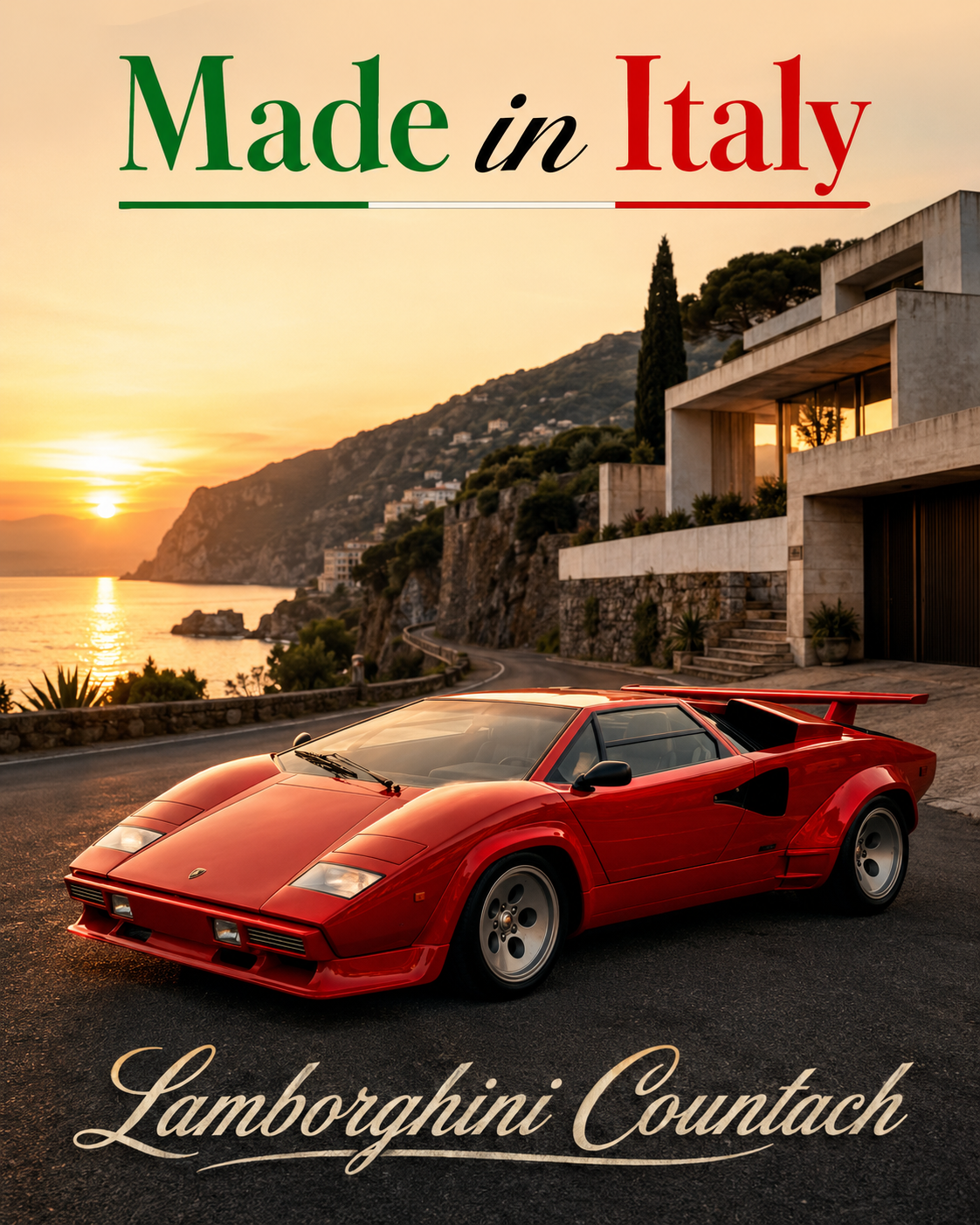
Lamborghini Countach: The Wedge That Turned a Supercar into a Legend
At dusk, the Countach looks less like a conventional car than a piece of Italian industrial theatre that has slipped out of a design studio and onto the road. Its body sits improbably low, its windscreen appears almost horizontal, and a scissor door rises beside the cabin like a stage prop. Then the V12 catches, and the spectacle becomes mechanical: twelve cylinders, a manual gearbox, a dense transmission tunnel and an engine mounted behind the driver.
The Countach was never a discreet automobile. It was created to be seen, heard and remembered. Lamborghini built it from 1974 to 1990 in five principal series: LP 400, LP 400 S, 5000 S, 5000 Quattrovalvole and 25th Anniversary. It replaced the Miura at a moment when Lamborghini needed a new flagship, but it also changed the visual language of the supercar. Sharp lines replaced curves; width became a statement; cooling intakes became part of the drama. Its silhouette ended up in films, posters, toy boxes and magazines around the world.
## Italy Was Ready to Look Forward
The Countach was born in an Italy caught between confidence and uncertainty. The post-war economic miracle had given the country a growing motorway network, powerful industry and an extraordinary design culture. Turin built cars. Milan shaped fashion and advertising. Emilia-Romagna had become a concentrated landscape of engineering talent, racing knowledge and specialist suppliers.
The early 1970s were not carefree, however. Oil prices, inflation and political tension changed Europe’s mood. Building an extreme, thirsty V12 supercar was therefore not a rational answer to the decade. It was an act of conviction. Lamborghini already knew, from the Miura, that a road car could use a mid-mounted V12. The Countach had to take that idea into another era.
At the Geneva Motor Show in 1971, the LP 500 prototype did exactly that. Its name came from a Piedmontese expression of astonishment. The story fits the car: “Countach” sounded like a reaction to its sharp, unexpected shape. The production LP 400 followed with a 4.0-litre V12. Ferruccio Lamborghini soon withdrew from his industrial activities, but the car that bore his company’s name had begun a life far larger than any one owner.
## Marcello Gandini and a New Geometry
The Countach is inseparable from Marcello Gandini, then working for Bertone. Gandini had already helped define the Miura, but the Countach rejected the idea that an exotic car needed voluptuous bodywork. It was a wedge: low at the front, broad at the rear, cut with diagonal lines and openings that became visual signatures.
The styling was radical for functional reasons as well as theatrical ones. The very low nose gave the car a dramatic frontal profile. The windscreen and cabin shape reduced height. The rear haunches made room for the V12, wide wheels and the cooling requirements of a high-output engine. Side ducts were not decoration; they fed air to a machine that produced serious heat. The scissor doors answered a practical question—how to open the doors of an extremely wide car in tight spaces—but their theatrical effect became inseparable from Lamborghini’s identity.
The early LP 400 is the purest expression of the original idea. It wore relatively clean wheel arches and a distinctive roof channel, producing the “Periscopio” nickname. Later Countachs became wider and more extrovert: wheel-arch extensions, deep spoilers, broad Pirelli tyres, side skirts and, on some cars, a rear wing. Purists often prefer the early shape. The later cars, however, are the Countach remembered by popular culture.
The 25th Anniversary version, introduced in 1988, revised many aerodynamic details. Its rear-fender intakes were reshaped, and some body panels used carbon fibre. It was not a new car, but it was a serious final refinement of an idea first shown in 1971.
## The Longitudinal V12
LP stood for Longitudinale Posteriore: the engine was mounted lengthways behind the passenger compartment. The Countach used Lamborghini’s celebrated V12, originally developed for the company’s earliest road cars, but arranged in a low mid-engined installation.
Its packaging was unusual. The five-speed gearbox sat ahead of the engine, between the occupants and the V12, while a driveshaft passed back through the engine’s sump to the final drive. This made it possible to package a long V12 in a low car, but it also created a famously warm, mechanically dense cabin. Nothing about the Countach was casual or hidden.
The LP 400 used a 3.9-litre V12. Later versions enlarged it. The 5000 S took displacement to 4.8 litres, improving torque. The 5000 Quattrovalvole grew to 5.2 litres and used four valves per cylinder. More valves allowed the engine to breathe more effectively at high rpm; the result was more power without abandoning the character of the V12. Lamborghini cites 455 CV for the carburetted Quattrovalvole and 420 CV for the injected version, figures that should not be mixed because specifications varied by market and fuel system.
## Technical Specifications: Countach 25th Anniversary
The figures in this section refer to the late Countach 25th Anniversary rather than every Countach variant.
– Production years: 1988–1990
– Engine: naturally aspirated 5.2-litre Lamborghini V12
– Valve gear: four valves per cylinder
– Layout: longitudinal mid-rear engine, rear-wheel drive
– Transmission: five-speed manual
– Power: 455 CV at 7,000 rpm for the carburetted specification
– Structure: steel tubular chassis with aluminium body panels and selected carbon-fibre elements
– Production: 658 examples
The Countach was not a modern supercar in the sense of being easy. The clutch was heavy, the gearbox needed a deliberate hand and visibility to the rear was limited by the broad bodywork. Its cabin could become hot. Carburettors required careful tuning. These were not minor inconveniences, but they explain the car’s character. It demanded attention and rewarded commitment.
## From Wolf Special to Quattrovalvole
The Countach evolved because owners, markets and regulations changed. The LP 400 S was shaped by special Countachs commissioned by Canadian enthusiast Walter Wolf. It added flared arches, a lower aero element and the famous “phone dial” wheels. Those details became the visual shorthand of the Countach for a generation.
The 5000 S arrived in 1982. The changes were more mechanical than visual. The larger 4.8-litre V12 offered stronger torque, an important advantage as the Countach had gained wider tyres and more equipment. Lamborghini revised the transmission and improved trim and comfort.
In 1985 the Quattrovalvole arrived. The larger 5.2-litre V12 needed a revised engine cover with a pronounced hump, one of the easiest ways to identify the version. The 25th Anniversary followed in 1988, revising surface details and aerodynamic appendages rather than abandoning the Countach philosophy. In 1990 the Diablo succeeded it, but the new car inherited the Countach’s central lesson: a Lamborghini flagship had to be an event.
## A Road Car That Conquered Culture
The Countach did not gain its legend through a factory campaign at Le Mans, in Formula One or in the World Rally Championship. It was not a homologation special pretending to be a road car. Its real arena was the public imagination: television, cinema, poster culture, the arcade era and the global appetite for Italian exotica.
That absence of a conventional motorsport record matters. It makes the Countach’s cultural power more unusual. Rival cars offered other kinds of excellence. Ferrari’s Berlinetta Boxer and Testarossa made their own flat-12 statements. Porsche’s 911 Turbo represented a more compact and technically different approach to performance. But the Countach made the strongest argument for visual drama.
It became a symbol of Italy not through folklore but through precision, audacity and confidence. It looked engineered and sculpted at the same time. The body announced airflow, heat, speed and mechanical complication. It did not ask to be universally usable. It asked the world to accept that a production car could look like the future.
## Why the Countach Still Matters
The Countach established a durable supercar vocabulary: wedge proportions, a central V12, scissor doors, extreme width and a name that sounded like an exclamation. Later Lamborghini flagships, from Diablo to Aventador and Revuelto, inherited parts of that language.
For collectors, condition and originality matter intensely. Correct bodywork, period specification, documented maintenance, original mechanical components and sympathetic restoration can be more important than fashionable modification. Values in the historic-supercar market move continually, so any current valuation should be checked through specialist sources rather than treated as permanent.
The Countach survives because it makes no attempt to be neutral. It is difficult, loud, hot, visually uncompromising and unmistakably Italian. Those qualities were once practical compromises. Over time, they became part of the mythology.
## Closing / ItalyStories.com
The Lamborghini Countach did not blend into Italy’s roads. It made those roads look newly cinematic. It carried the craft of Sant’Agata Bolognese, Gandini’s uncompromising design language and Lamborghini’s V12 heritage into a form that still stops conversation.
Thank you for sharing this journey through one of Italy’s most audacious automobiles. Discover more stories of design, engineering and speed in Italian Motors on ItalyStories.com.
## Building a Car That Could Be Seen Before It Arrived
Countach production also explains why the car feels different from a mass-produced performance car. Lamborghini was a small manufacturer in Sant’Agata Bolognese, and the first Countach bodies marked an important change: the company brought the hand-made bodywork process in-house. That decision gave Lamborghini more control over the final form, but it also meant that the car retained the visible human character of a specialist-built machine. Panel fit, interior details and finishing evolved over the years, sometimes unevenly, yet the Countach never lost the sense that people rather than an anonymous production system had made it.
The company’s circumstances made the achievement more remarkable. Lamborghini passed through changes of ownership and financial pressure during the Countach era. A car with such limited production could not rescue a company through volume alone. Its value was strategic: it kept the marque visible, credible and aspirational in markets where an Italian V12 was expected to be something no other company could quite duplicate. The Countach remained a halo car before “halo car” became marketing language.
The interior exposed the contrast between fantasy and reality. From outside, the Countach looked as if it should have contained a minimalist cockpit from a science-fiction film. Inside, it was recognisably Italian in a more complicated way: leather, deeply set instruments, a broad centre tunnel and switchgear that reflected the specialist industry of its time. The seating position was low, the windscreen view dramatic, and the driver’s relationship with the front corners unusually direct. It could feel intimate rather than spacious, but intimacy was part of the point. This was a car that made its occupants participants in the machine rather than passengers protected from it.
The Countach also helps explain the difference between beauty and design significance. Some enthusiasts regard the early LP 400 as the most beautiful Countach because it is closest to Gandini’s initial proposal. Others love the later Quattrovalvole and 25th Anniversary cars precisely because they are exaggerated: broad tyres, vents, skirts and spoilers turned an already radical object into an emblem of the 1980s. Both views are valid. The history is not a story of one correct body shape and several mistakes. It is a record of how a design adapted to changing engines, tyres, regulations, markets and customer expectations.
## The Rivals Could Not Copy Its Personality
The Countach faced formidable rivals, but none occupied exactly the same emotional territory. Ferrari’s Berlinetta Boxer and Testarossa used flat-twelve engines and expressed speed through a different kind of drama: more horizontal, more architectural, often more grand touring in intent. The Porsche 911 Turbo brought turbocharged force and a recognisable shape refined across decades. Aston Martin appealed to another audience, one that valued long-distance civility and traditional luxury alongside performance.
The Lamborghini chose excess with unusual discipline. Its proportions were not random. The car was wide because the wheels, cooling system and chassis needed space. The rear was high because a V12 and its ancillaries needed room. The cabin was low because the whole concept began with a wedge. Yet the finished object did not read as an engineering diagram. It read as an Italian declaration.
That balance is why the car succeeded internationally. Buyers outside Italy did not need to understand every technical detail to understand its message. The Countach represented an Italy capable of turning advanced engineering into an emotional object. It offered no apology for its size, its noise or its visual confidence. In markets where sports cars were often measured by racing records or pragmatic performance, the Countach made theatre itself part of performance.
## A Legacy Beyond Performance Figures
Top-speed and acceleration numbers matter in the Countach story, but they do not explain the whole car. A later machine can be faster, more efficient, safer and easier to use. The Countach’s enduring influence comes from what it made possible in the imagination. It taught a generation that the supercar could be a complete design statement, not merely a powerful engine wrapped in attractive bodywork.
It also preserved the relevance of the naturally aspirated V12. As engines became more regulated and performance increasingly electronic, the Countach remained a reminder of an older relationship between driver and machine: mechanical linkage, revs, heat, noise and physical effort. That relationship was demanding, but it was honest. The driver could not mistake the Countach for an appliance.
For that reason, the Countach is best remembered not as a single specification but as a long-running conversation between Italian design and engineering. The LP 400 began it with purity. The LP 400 S added muscularity. The 5000 S gave it more torque. The Quattrovalvole sharpened the engine. The 25th Anniversary brought the story to its most developed late form. Together they created a car that still makes people pause before they have even heard it start.