

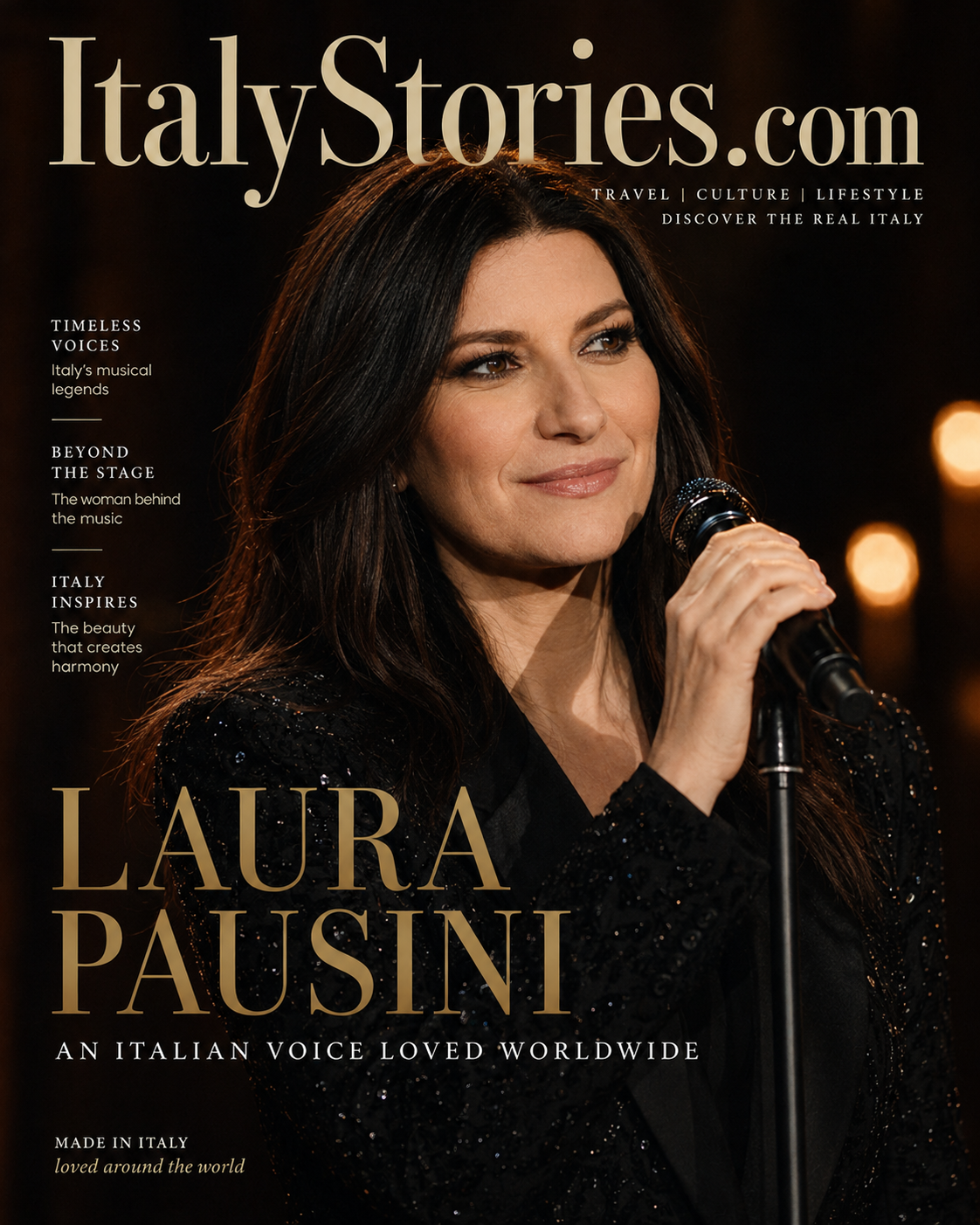
The Night an Eighteen-Year-Old Song Became a Passport On February 27, 1993, Laura Pausini walked onto the stage of the Teatro Ariston in Sanremo carrying a song about absence. She was eighteen years old, came from Solarolo, a small town in Romagna, and had grown up thinking of music not as an abstract dream of celebrity but as something people did in restaurants, piano bars and local evenings where a singer had to hold a room with little more than a microphone and a melody. The song was “La solitudine.” Its story was adolescent and almost disarmingly simple: Marco is gone, school feels empty, the train leaves without him, ordinary objects become reminders, and a young woman discovers that distance can make an entire world feel wrong. Nothing in the lyric sounded like a strategic attempt to launch an international star. That was precisely why it worked. Pausini won the Newcomers section of the Sanremo Music Festival. Italy suddenly knew her name. Within a year, millions of Spanish-speaking listeners would know the same song as “La soledad.” What looked like a national debut became the opening of one of the most unusual international careers in modern Italian popular music. The astonishing part is not merely that Laura Pausini became famous abroad. Many Italian singers have enjoyed foreign hits. The remarkable part is that she built a durable parallel career in the Spanish-speaking world, recording, touring, giving interviews and developing a relationship with audiences in Spain and Latin America that eventually became almost as important as her relationship with Italy. More than three decades later, the girl who had once arrived at Sanremo from a town surrounded by fields would return to the Ariston in 2026 not as a nervous competitor but as co-host of all five nights of the Festival. By then she had won a Grammy, multiple Latin Grammys, a Golden Globe, received an Academy Award nomination, sold tens of millions of records, toured in dozens of countries and been named the Latin Recording Academy’s Person of the Year. Yet the emotional mechanism of her music remained recognizable. Pausini’s greatest songs have rarely depended on mystery. They tell you exactly where the wound is. Solarolo, Piano Bars and a Father Who Understood Songs Laura Pausini was born on May 16, 1974, in Faenza, in the province of Ravenna, and grew up in nearby Solarolo. Romagna is important to her biography not because it provides a picturesque background but because it formed the practical way she learned music. Her father, Fabrizio Pausini, was a musician and piano-bar performer. Laura later recalled watching him rehearse and learning from him that songs mattered because people used them to accompany their own lives. This was music as a craft before it was music as a career: setting up equipment, learning repertoire, reading an audience, working late, repeating the same song without making it feel repeated. As a child and teenager she began joining him at performances. She also sang in local contexts and recorded demos. These were not glamorous apprenticeship years. They were useful ones. A piano bar gives a young singer an education that a rehearsal room cannot. The audience may be eating, talking, celebrating a birthday or paying no attention at all. A performer learns how to enter a room emotionally, how to shape a familiar song so that it feels personal, how to recover when something goes wrong and how to understand that the public does not owe the singer silence. This helped form a characteristic that remained central to Pausini’s later career: direct communication. Her voice could be large, but her manner was rarely distant. In interviews she laughed easily, spoke quickly and often seemed less interested in cultivating mystery than in making herself understood. On stage, the same instinct turned even highly produced pop concerts into something closer to conversation. Before Sanremo, she moved through the familiar Italian system of local competitions and opportunities. The decisive encounter came when producers and songwriters connected with the emerging artist placed “La solitudine” in her hands. The composition was written by Angelo Valsiglio and Pietro Cremonesi, with lyrics by Federico Cavalli and Cremonesi. The song’s adolescent point of view suited Pausini because she was close enough to that world for the details to feel lived rather than performed. There was also a striking personal coincidence. Pausini has explained in interviews that the song’s emotional situation strongly resembled an experience from her own life. The original male name in the lyric was changed to Marco, making the song even more intimately connected with the young singer who would carry it onto the Ariston stage. What happened next was too large to fit inside the normal story of a Sanremo winner. “La solitudine”: When a School Desk Became Universal Sanremo has launched careers, revived careers and occasionally given Italy songs that survive long after their competitive ranking becomes irrelevant. “La solitudine” belongs to that final category. The song works because it is built from ordinary details. A train. An empty school desk. Homework. A photograph in a diary. A father whose job has taken a boy away. These are not grand operatic symbols, yet Pausini sings them with the emotional urgency of a major separation. That balance became one of her signatures. Her best ballads are often physically large in sound but emotionally domestic in subject. After Sanremo, “La solitudine” became a major success in Italy and spread through other European countries. The following year it was translated into Spanish as “La soledad,” helping introduce Pausini to listeners in Spain and Latin America. The translation could have produced a temporary novelty: an Italian singer adapting a hit for another market. Instead, it opened a door she would never really close. In 1994, Pausini returned to Sanremo among the established artists with “Strani amori.” She finished third. The result mattered less than the confirmation. A second major song proved that “La solitudine” had not been an accident. “Strani amori” also expanded her emotional territory. The song deals with relationships that people continue to inhabit even when they know they are unstable, irrational or painful. The young singer who had first been presented through a school-age separation was now addressing a broader and more adult form of romantic confusion. The Italian album Laura followed, while her first Spanish-language album, Laura Pausini, gathered translated material and began circulating through Spain and Latin America. This is where the story becomes historically interesting. Italian popular music had long traveled abroad, especially in Europe and Latin America. Artists such as Domenico Modugno, Mina, Eros Ramazzotti, Ricchi e Poveri, Umberto Tozzi and others had found international audiences in different eras. But Pausini’s career developed during a 1990s music industry increasingly organized around language markets, multinational labels, music television and promotional systems that could either localize an artist or make her disappear. She chose localization without erasing identity. Pausini did not pretend to be Spanish or Latin American. She remained publicly and proudly Italian. But she learned Spanish, recorded carefully adapted versions, traveled constantly and treated the Spanish-speaking audience as a central part of her career rather than an export department. Years later she would describe Latin America as a place that had, in an emotional sense, adopted her. Two Languages, One Career The release of Le cose che vivi in 1996, alongside its Spanish version Las cosas que vives, showed how sophisticated Pausini’s bilingual model had become. By now the idea was no longer to translate a hit after it succeeded in Italy. Albums were conceived as parallel projects. Songs existed in Italian and Spanish almost simultaneously, and Pausini developed a public vocabulary that allowed her to move from one audience to another without seeming like a visitor. “Incancellabile” – “Inolvidable” in Spanish – is a useful example. The title itself contains the emotional promise that defines much of Pausini’s repertoire: some relationships remain inside a person even after time and circumstance have changed everything around them. The album also marked an important artistic development because Pausini was becoming more involved in writing. The shift matters. A singer who begins with songs selected by producers and songwriters can remain an interpreter forever. Pausini gradually moved toward a stronger authorial role, co-writing lyrics and shaping the themes that would recur through her work. Her subjects were not revolutionary in the conventional sense. Love, distance, self-respect, memory, disappointment, friendship, family and emotional survival had been pop themes for decades. What distinguished Pausini was the intensity with which she inhabited them and the consistency of her emotional language across cultures. Listeners did not need to decode irony. When she sang loss, she sounded hurt. When she sang anger, the vowels sharpened. When she sang hope, the melody usually opened rather than retreated. That transparency helped in international markets. A listener can feel the architecture of emotion before understanding every word. By the late 1990s, albums such as La mia risposta and its Spanish counterpart Mi respuesta continued the international expansion. Pausini performed in major venues, developed a growing live audience and collaborated with musicians beyond the Italian pop scene. She was also learning a difficult truth about international success: the more countries an artist enters, the more versions of that artist the industry tries to create. The Voice: Power Without Distance Laura Pausini is often described simply as a powerful singer, but volume alone does not explain her durability. Her voice is a bright, muscular pop instrument with a strong middle register and an ability to rise into high, sustained phrases without losing the sense of spoken emotion underneath. The sound has changed with age, becoming darker and more textured, but the identity remains immediate. One of her most recognizable habits is the way she attacks a line conversationally and then allows it to expand. A verse may begin almost as speech; by the chorus, the same thought has become a declaration. This is especially effective in songs built around emotional accumulation. Pausini does not usually seduce the listener by withholding. She builds pressure until the feeling can no longer remain private. Her diction also matters. In both Italian and Spanish, consonants are clear and vowels remain central to the melody. That gives her songs singable contours, which is one reason audiences in different countries often sing entire choruses back to her. Critics who prefer understatement sometimes find her style too emphatic. That criticism is not entirely unfair. Pausini belongs to a tradition of Mediterranean pop in which emotion is permitted to become large. The question is whether the singer can make that scale feel earned. At her best, she can. The crucial point is that the bigness of the voice is not the same as emotional distance. Even in arenas, she often sings as though the person addressed by the song is standing only a few feet away. “Tra te e il mare” and the Mature Pop Star By 2000, Pausini was no longer the surprise discovery from Sanremo. She was an established international artist facing a harder problem: how to mature without abandoning the listeners who had grown with her. Tra te e il mare, released in Spanish as Entre tú y mil mares, became one of the key albums of that transition. The title track was written by Biagio Antonacci, one of the Italian songwriters most closely associated with emotional pop of the period. The song’s central image – being suspended between a person and an immense sea – gave Pausini a larger metaphor than the everyday details of “La solitudine,” but the core remained the same: separation, uncertainty and the refusal to pretend that distance does not hurt. Her 2001 greatest-hits project, The Best of Laura Pausini: E ritorno da te, functioned as a first summation of a career that was not yet ten years old. That in itself was revealing. She had already accumulated enough recognizable material in multiple languages to justify a retrospective. The new song “E ritorno da te” became another signature. Rather than freezing her early work in nostalgia, the collection helped reintroduce it to an expanding audience. At this stage, Pausini had become one of the most visible Italian singers abroad. But the next move showed both her ambition and the limits of international marketing. The English Experiment: From the Inside In 2002, Pausini released From the Inside, her first full English-language album. On paper, the logic was obvious. She had already succeeded in Italian and Spanish. The United States represented the largest music market in the world. An English album could, in theory, complete the transformation from international star to global mainstream pop act. The record contained polished contemporary pop and dance-influenced production. “Surrender,” its best-known single, reached number one on Billboard’s Dance Club Songs chart in the United States. Yet From the Inside did not transform Pausini into an American pop star, and the experience became a useful contrast with the success of her Spanish-language career. Spanish had become part of her artistic identity because it developed through years of travel, translated repertoire, interviews and direct relationships with audiences. English arrived more as an industry expansion plan. Pausini later expressed discomfort with aspects of how the project was marketed. The lesson was significant: international success works best when an artist’s emotional identity travels with the language. She did not abandon English entirely, but she did not reorganize her career around it. Instead, the next period brought her back toward the musical territory where she had the strongest sense of ownership. Resta in ascolto, Escucha and the Grammy Resta in ascolto, released in 2004 with the Spanish version Escucha, is one of the decisive albums in Pausini’s career. The title can be translated as an invitation to keep listening, but the record itself sounded like a singer asking to be heard differently. The material was more adult, the production broader, and Pausini’s role as co-writer and producer more visible. Songs such as “Resta in ascolto,” “Vivimi” and “Come se non fosse stato mai amore” gave her a repertoire that could sit beside the early hits without sounding like replicas of them. The Spanish-language version, Escucha, became historically important in 2006 when Pausini won the Grammy Award for Best Latin Pop Album. The award mattered on several levels. First, it was a major American recognition for an Italian artist working substantially in Spanish. Second, it confirmed that her relationship with Latin music was no longer a commercial curiosity. By then, she had spent more than a decade building that audience. The Grammy did not arrive because she had finally succeeded with an English-language album. It arrived through Spanish. That detail says almost everything about the unusual geography of her career. The same era brought Latin Grammy recognition as well. Pausini became a recurring presence in the Latin recording industry, eventually accumulating four competitive Latin Grammy wins and multiple nominations, while continuing to record primarily in paired Italian and Spanish editions. She had, in effect, built two home markets. Io canto: Paying the Debt to Italian Songwriters In 2006, Pausini released Io canto, with the Spanish-language counterpart Yo canto. The album was a collection of songs associated with Italian songwriters and performers. Rather than using the project to display obscure taste, she chose repertoire that had genuinely shaped the modern Italian songbook. The concept was personal and strategic at the same time. After years of representing Italy abroad, Pausini turned the spotlight toward the writers whose songs had formed the culture she came from. For international listeners, the album also functioned as an introduction to a larger Italian repertoire beyond Pausini’s own hits. This role – interpreter of Italy abroad – became increasingly important in her public image. She collaborated over the years with figures including Luciano Pavarotti, Andrea Bocelli, Ray Charles, Michael Bublé, Phil Collins, Alejandro Sanz, Marc Anthony, Kylie Minogue and others. The list looks eclectic because her career has never been tied to one musical tribe. Opera stars, Latin pop artists, Anglo-American pop singers and Italian cantautori could all enter her world as long as the song allowed for emotional directness. At the same time, Pausini’s live career expanded. She performed in arenas and major venues across Europe and the Americas, and her concerts increasingly demonstrated how deep the Spanish-language catalog had become. In some countries, the audience knew the translated versions more intimately than the Italian originals. For an Italian artist, that is not a side effect. It is a second musical biography. Stadiums, San Siro and the Public Scale of a Private Song The central paradox of Pausini’s performance style became clearer as venues grew larger. Her songs often describe intensely private situations, yet they work remarkably well in stadiums. A ballad such as “La solitudine” begins with one absent boy and one empty school desk. In a stadium, tens of thousands of people sing the same words, each attaching a different memory to them. The song becomes collective without losing its original intimacy. Pausini’s large concerts in Italy, including major appearances at Milan’s San Siro stadium, demonstrated that a female Italian pop singer could command the same monumental spaces long associated with the biggest male rock and pop acts. She did not respond to that scale by becoming more remote. Her concerts often included long spoken passages, jokes, visible emotion and direct contact with fans. That lack of coolness is central to her appeal. Pausini has never seemed especially interested in appearing untouchable. She can be glamorous, but the glamour is frequently interrupted by laughter, tears, self-deprecation or spontaneous speech. In an era when pop stars often construct highly controlled personas, she has built loyalty partly by allowing the machinery to remain visible. The public sees the star and the woman managing the star at the same time. Primavera in anticipo, Inedito and a Life Expanding Beyond the Stage Primavera in anticipo, released in 2008 with the Spanish title Primavera anticipada, continued the mature phase of her pop writing. The album included collaborations and reinforced her international presence. The title track, recorded with James Blunt, was a typical Pausini concept: spring arriving early as an image for emotional renewal. Inedito followed in 2011. By then, the central challenge was no longer proving that she could survive changing trends. She had already done that. The challenge was how to let life outside music enter the work without turning the songs into autobiography by checklist. Motherhood became part of that transformation. The birth of her daughter Paola in 2013 changed the emotional vocabulary around Pausini, both publicly and privately. Family had always been central to the way she spoke about herself, but now she was no longer only the daughter who had learned music from her father. She was also a mother deciding how much of her own child should enter the public story. The anniversary collection 20 – The Greatest Hits, released in 2013, placed two decades of songs beside new collaborations and re-recordings. The project made clear how much the sound of the early records belonged to another production era, but also how durable the melodies had remained. A listener could hear a young Pausini and the mature singer almost in conversation with each other. Simili, Fatti sentire and the Question Every Long Career Faces Long careers eventually encounter a form of prejudice that has little to do with music: the industry’s obsession with youth. For female pop singers, the pressure is especially severe. At a certain point, the same qualities once praised as maturity can be reframed as evidence that an artist belongs to the past. Pausini has spoken openly about periods in which doubts about age, radio relevance and changing musical fashion affected her confidence. The albums Simili in 2015 and Fatti sentire in 2018 belong to this period of persistence and reinvention. Simili – released in Spanish as Similares – presented a singer interested in connection and difference, while the Spanish edition later earned a Grammy nomination. Fatti sentire, paired with Hazte sentir, carried an even more explicit message of presence: make yourself heard. Hazte sentir won the Latin Grammy for Best Traditional Pop Vocal Album in 2018. The award arrived twenty-five years after Sanremo. That timing matters. Pausini was no longer being rewarded as an exciting new European discovery. She was being recognized as an established figure in Latin pop with a catalog that had survived changes in format, radio, streaming, fashion and audience generations. The Spanish-speaking market had not merely tolerated her longevity. It had become one of the places where that longevity made sense. When Cinema Opened Another Door: “Io sì (Seen)” In 2020, Pausini’s career entered a new arena through “Io sì (Seen),” written for The Life Ahead, the film directed by Edoardo Ponti and starring Sophia Loren. The song was composed by Diane Warren, with Italian lyrics involving Warren, Pausini and Niccolò Agliardi. Its message – the need to be seen and recognized as a human being – matched the emotional world of the film and also connected naturally with Pausini’s longstanding interest in songs about people whose inner lives are not immediately visible. In 2021, “Io sì (Seen)” won the Golden Globe for Best Original Song. Then came an Academy Award nomination for Best Original Song. For an artist whose career had begun at an Italian song festival, the image was almost surreal: Laura Pausini, the girl from Solarolo, was now part of the Oscar conversation. She did not win the Academy Award, but the nomination became one of the most important milestones of her career because it placed her inside a global film context without requiring her to become a different kind of artist. The song remained unmistakably aligned with the Pausini emotional vocabulary: dignity, vulnerability, recognition and the belief that being heard can change a person’s relationship with the world. It also connected generations of Italian culture – Pausini, Sophia Loren, contemporary Italian cinema – inside an international production seen by a global audience. Humanitarian Work and the Use of Celebrity Pausini’s public work has repeatedly extended beyond recording and touring. She has supported humanitarian and social causes, including campaigns related to hunger, children, gender equality, violence against women and LGBTQ+ rights. In 2014 she was named a Goodwill Ambassador for the United Nations World Food Programme. These activities matter in her biography because they fit the way she understands visibility. Pausini’s music is built around communication: say the thing, do not hide the feeling, make the person on the other side understand. Her humanitarian work often follows the same logic, using celebrity not merely as a platform for self-promotion but as an amplifier for issues that would otherwise receive less attention. Like all celebrity activism, it can be judged in different ways. What is difficult to dispute is its continuity. This has not been a late-career image adjustment. She has participated in benefit projects and social campaigns across decades. That continuity became part of the reasoning behind one of the greatest honors she would receive from the Latin music world. Person of the Year: The Latin World Says She Belongs In 2023, the Latin Recording Academy named Laura Pausini its Person of the Year. The recognition was extraordinary for an Italian-born, non-native Spanish-speaking artist. By then Pausini had spent almost thirty years recording in Spanish, touring throughout Latin America and Spain, collaborating with Latin artists and appearing at the Latin Grammys. The honor acknowledged not simply record sales but cultural belonging. Pausini herself spoke about the emotional force of being told that the Latin world had adopted her. That is perhaps the most important international achievement of her career. Awards can recognize a recording. Charts measure a period. Adoption is different. Audiences in Mexico, Argentina, Chile, Colombia, Spain, Peru and many other countries did not treat Pausini as an Italian singer who occasionally arrived with translated songs. For generations of listeners, “La soledad,” “Amores extraños,” “Se fue,” “Inolvidable,” “Entre tú y mil mares” and the later Spanish catalog became part of their own musical memory. In 2023 she also celebrated thirty years since Sanremo with a symbolic twenty-four-hour live marathon linking New York, Madrid and Milan – three cities representing the international arc of her career. The same year brought Anime parallele and its Spanish counterpart Almas paralelas, her first new studio album in five years. The project explored different lives existing beside one another, connected by shared spaces but not necessarily by identical experiences or beliefs. It was an appropriate theme for an artist whose career had been built on parallel cultural identities. Italian and Spanish. Home and travel. Private woman and public figure. Small-town origin and global scale. The title could almost describe the career itself. 2026: Returning to Sanremo from the Other Side of the Stage In 2026, Pausini returned to Sanremo in a role unimaginable on the night of her 1993 debut. She co-hosted the Festival with Carlo Conti across all five nights. The symbolism was almost too perfect. Sanremo had once been the place where judges and viewers decided whether Italy should notice her. Now she stood on the same stage as one of the people guiding the entire national event. The return also demonstrated how much her relationship with Italy had changed through decades spent abroad. International success can create a strange distance from the home audience. Pausini has sometimes spoken about feeling that spending so much time outside Italy altered the way parts of the Italian public perceived her. Sanremo 2026 offered another kind of contact: not a three-minute song, not a super-guest appearance, but five nights in which viewers saw her speak, joke, improvise, introduce other artists and inhabit the Festival as a television personality as well as a singer. At the same time, her recording career continued with Io Canto 2 in February 2026 and its Spanish counterpart Yo Canto 2 in March. The idea returned to the concept of her 2006 tribute project but from a later stage of life. Io Canto 2 revisited songs connected with Italian music and with artists whose work formed part of the culture Pausini represents internationally. The Spanish-language Yo Canto 2 extended the gesture toward influential Latin composers and repertoire from the countries that had made her a star. It was a revealing pair of albums. After more than thirty years, Pausini no longer needed to choose between celebrating Italian identity and acknowledging the Latin world. The two traditions had become part of the same artistic biography. The People Around the Voice No international career of this length is created by one person alone. Fabrizio Pausini gave his daughter the first working model of what a musician’s life looked like. The early producers and songwriters who shaped “La solitudine” and the first albums helped identify a young voice that could carry direct melodic pop without irony. Dado Parisini became an important production figure in major phases of her career. Songwriters such as Biagio Antonacci contributed material that became closely associated with Pausini’s mature repertoire. Her longtime musical and personal partner Paolo Carta has also been central to the later sound and live organization surrounding her work. International collaborators expanded the frame. Luciano Pavarotti placed her beside one of the great symbols of Italian vocal culture. Andrea Bocelli represented another route through which Italian voices reached global audiences. Latin stars such as Alejandro Sanz and Marc Anthony reinforced the fact that Pausini was not simply translated into Spanish but embedded in the Latin industry itself. Diane Warren opened the door to “Io sì (Seen)” and the film-award world. The career is therefore less the story of a solitary voice conquering countries than of a singer repeatedly entering new musical communities without abandoning the one she came from. The Public Laura: Why Her Lack of Mystery Became a Strength Some stars are compelling because nobody seems to know who they really are. Laura Pausini built almost the opposite relationship with the public. She talks. She laughs. She cries. She argues. She sometimes overexplains. She can be polished and then suddenly disarm the polish with a joke or a spontaneous reaction. For critics of celebrity culture, that openness can look excessive. For fans, it creates continuity. The young woman who seemed surprised by her own success in the early 1990s remains visible inside the experienced professional. That is valuable in a career spanning several generations because it prevents the star from becoming only an institution. Her visual image changed – fashion became more sophisticated, productions larger, tours more theatrical – but the emotional persona remained accessible. This also helps explain her unusual ability to connect with Latin American audiences. Language learning is not only pronunciation. It is rhythm, humor, conversational confidence and the willingness to make mistakes in public long enough for another culture to recognize that the effort is genuine. Pausini did that work. She did not merely sing Spanish phonetically on records. She lived professionally inside the language. The Critic’s Objection: Is the Emotion Too Much? Any serious article about Pausini should acknowledge the criticism that has followed her style. Her music is unapologetically emotional. Arrangements can be large. Choruses often rise toward catharsis. Lyrics may state feelings directly rather than conceal them behind metaphor. To listeners who prefer minimalism, indie restraint or lyrical ambiguity, Pausini can sound excessive. But excess is partly a matter of cultural expectation. Italian melodic pop and much of Latin ballad tradition have long treated emotional clarity as a virtue. The singer’s task is not necessarily to hide the feeling but to deliver it convincingly. Pausini’s career suggests that millions of listeners continue to want precisely that. Her greatest artistic achievement may not be innovation in the narrow sense. She did not invent a new genre, a new production technology or a radical vocal technique. She perfected a form of transnational emotional pop. The melodies travel. The lyrics can be translated. The voice remains recognizable. The emotional stakes survive the border crossing. That is more difficult than it sounds. Numbers, Awards and What They Actually Mean Industry profiles now place Pausini’s global record sales above seventy-five million, while her streaming totals run into the billions. She has performed across more than forty countries over the course of her career. She has one Grammy Award, won for Escucha, and two Grammy nominations in total. The Latin Recording Academy lists four competitive Latin Grammy wins from eleven nominations through its most recent tallies, in addition to naming her Person of the Year in 2023. “Io sì (Seen)” brought a Golden Globe and an Academy Award nomination. Her career has also accumulated a long list of national and international honors, humanitarian recognitions and chart achievements. Numbers matter because they show scale. But they do not explain loyalty. The better measurement is time. A listener who discovered Pausini with “La soledad” in 1994 could have a child old enough to attend her concerts thirty years later. A song that once described a schoolgirl’s loneliness now belongs to adults who hear their own adolescence when the opening notes begin. That kind of cultural memory cannot be manufactured by a marketing campaign. It accumulates. Why Laura Pausini Still Matters The most important fact about Laura Pausini is not that she left Italy. It is that she found a way to carry Italy with her without making it a barrier. She came from a specific place: Faenza, Solarolo, Romagna, a musical family, the piano-bar world, Sanremo, Italian melodic pop. She did not erase those origins to become international. Instead, she translated them. In Spanish, the translation became so successful that it created a second cultural home. In English, the experiment was less defining, which only made the lesson clearer: language works when relationship grows around it. Her career also changed the idea of what an Italian female pop singer could do internationally. She could build separate album versions for different language markets, fill major venues, win Latin music awards, collaborate with artists across continents, return to Sanremo as a national institution and still release songs whose emotional logic remained connected to the teenager who sang “La solitudine.” There is a temptation, when writing about a career this long, to describe it as a straight climb: small town, Sanremo, Europe, Latin America, Grammy, Golden Globe, Oscar nomination, legend. Real careers are not straight. There were records that worked better than others, markets that resisted, doubts about age and relevance, the imperfect English-language experiment, changing radio formats, an industry transformed by digital music and streaming, and the psychological burden of being expected to remain the same person while continually producing something new. Pausini survived because she understood what could change and what could not. The production could change. The language could change. The venues could become larger. The collaborations could become more prestigious. The format could move from CD to streaming. The girl from Solarolo could become a Grammy-winning global star. But the emotional contract with the listener had to remain recognizable. Someone is missing. Someone needs to be heard. Someone is trying to begin again. Someone wants to be seen. Laura Pausini has spent more than thirty years giving those people a voice loud enough to cross an ocean. A Final Thank You from ItalyStories.com Thank you for spending time with this story. ItalyStories.com was created to explore the people, places, songs, ideas and traditions that have carried Italy far beyond its borders. If Laura Pausini’s journey has made you curious about another chapter of Italian culture and music, we would be delighted to welcome you to the next story.
[…] afterward belongs to the public. Domenico Modugno needed Sanremo, but Sanremo also needed Modugno. Laura Pausini arrived as a young newcomer and left with the beginning of an international career. Vasco Rossi did […]