

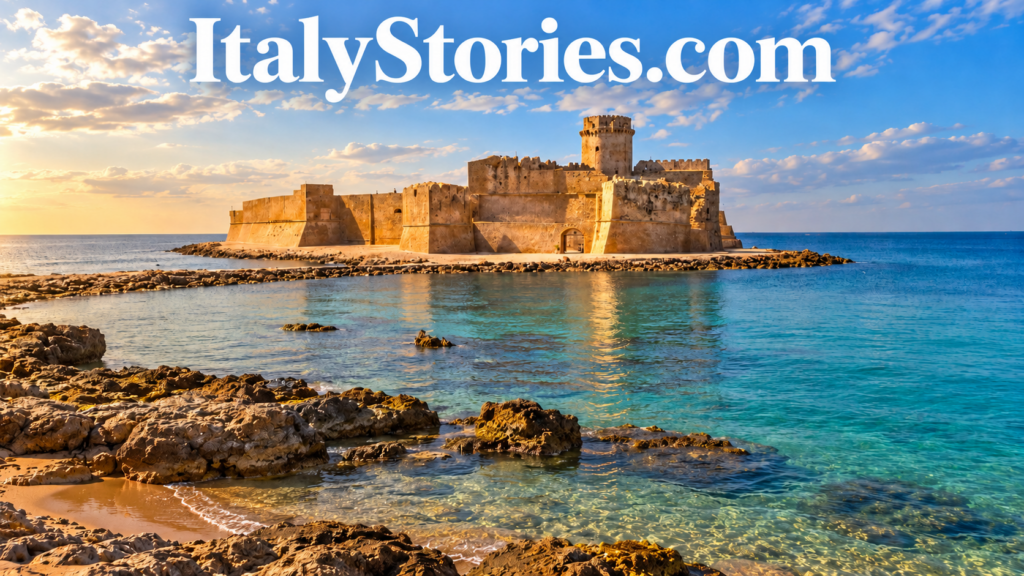
There are castles built on hills, castles hidden in forests and castles overlooking ancient cities. Then there is Le Castella, a fortress that appears to rise directly from the turquoise waters of the Ionian Sea. Seen from the shore, its weathered stone walls seem to float between sea and sky, connected to the mainland by such a narrow strip of land that, during rough weather and high tides, the entire structure looks almost completely isolated. It is one of Calabria’s most unforgettable sights: a place where military history, Mediterranean legends and extraordinary natural beauty exist side by side.
Le Castella is a small seaside village belonging to the municipality of Isola di Capo Rizzuto, in the province of Crotone. It stands at the eastern end of the Gulf of Squillace, along Calabria’s Ionian coast, within the protected waters of the Capo Rizzuto Marine Reserve. Although it is commonly known as the Aragonese Castle, the monument was never simply a noble residence. It was primarily a military fortress, built in a strategic position from which soldiers could control the gulf, watch approaching ships and protect the coast from enemy attacks. Its location was almost perfect: surrounded by water, difficult to approach and visible from a great distance.
The history of the site is much older than the fortress itself. Archaeological discoveries show that the small island was already occupied during the Bronze Age. Remains of a Greek military outpost dating from the fourth century BC were later incorporated into the medieval structures. The oldest surviving part of the present fortress is the imposing cylindrical tower, built during the Angevin period in the thirteenth century. Inside the tower were several floors connected by a spiral staircase, while a chamber at its base collected and stored rainwater—an essential feature for soldiers who might remain isolated during a siege.
The fortress acquired much of its present appearance under Aragonese rule during the fifteenth century. Further defensive works were carried out between 1510 and 1526, when the massive square bastions were constructed according to Spanish military principles. These thick, sloping walls were designed to withstand cannon fire and provide better protection against increasingly powerful weapons. What visitors see today is therefore not the result of one single building project, but a fascinating combination of Greek foundations, medieval towers, Aragonese walls and sixteenth-century bastions.
Inside the fortifications there was once a small settlement containing houses, workshops, military rooms, a chapel and other buildings. Le Castella was not merely a lonely outpost occupied by soldiers. In dangerous periods, local inhabitants could also seek protection behind its walls. Between the sixteenth and eighteenth centuries, the Calabrian coast was repeatedly attacked by Ottoman forces and Barbary pirates. During one of these raids, a local man named Giovanni Dionigi Galeni was captured. He later converted to Islam and became known as Uluç Ali Pasha, one of the most powerful admirals in the Ottoman Empire. His astonishing journey from a small Calabrian village to the command of an imperial fleet sounds almost like fiction, yet it remains one of the most remarkable stories associated with Le Castella.
Even the name of the village contains a mystery. “Le Castella” is plural, and historians have never reached complete agreement about its origin. It may refer to several ancient fortifications that once stood in the area, or perhaps to buildings constructed on a small group of islands that later disappeared beneath the sea. Archaeological remains, submerged quarries and traces of ancient structures have actually been found in the surrounding waters, suggesting that the coastline looked very different in the distant past. Beneath the calm, transparent sea may lie fragments of settlements, roads and defensive works that once stood above the surface.
The coastline is also famous for its warm, reddish sand, although not every beach directly in front of the fortress has the same intense colour. The most spectacular red tones can be found along other parts of the Capo Rizzuto coast, particularly at the nearby Le Cannella beach, whose name refers to the cinnamon-like colour of its sand. Combined with the clear blue water, Mediterranean vegetation and golden stone of the fortress, these colours create a landscape that seems almost painted.
Today Le Castella is far more peaceful than it was during the centuries of raids and naval battles. Visitors can walk along the narrow causeway, enter the fortress, explore the remains of its small village and climb to viewpoints overlooking the Ionian Sea. At sunset, the ancient walls turn gold and the reflection of the tower stretches across the water. It is then that the fortress reveals its most enchanting side: no longer simply a military monument, but a stone ship anchored permanently off the Calabrian coast.
Le Castella is a place where nearly three thousand years of history are compressed into one small island. Greeks, Angevins, Aragonese soldiers, pirates, fishermen and ordinary families have all left something behind. Perhaps that is why the fortress feels so extraordinary. It does not merely stand beside the sea—it seems to belong to it.