

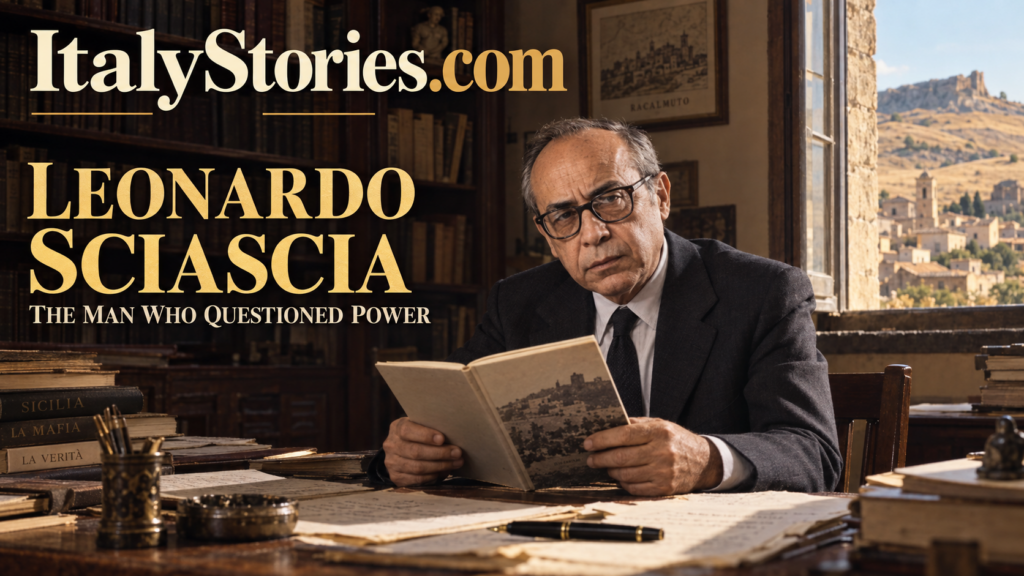
Leonardo Sciascia was not simply a writer from Sicily. He was a man who used Sicily as a lens through which to examine an entire country, its institutions, its fears and its carefully protected lies. From the small town of Racalmuto, in the province of Agrigento, he observed the mechanisms of power with the patience of a detective and the scepticism of someone who knew that official truths are not always the whole truth.
He wrote about the Mafia before many Italians were prepared even to admit that it existed as an organised system. He investigated political mysteries, judicial errors, corruption and the relationship between criminals and respectable society. But Sciascia was never satisfied with easy answers. He distrusted heroic slogans almost as much as he distrusted silence, and this independence made him admired, feared and frequently misunderstood.
Born in Racalmuto on 8 January 1921, Leonardo Sciascia grew up in a part of inland Sicily shaped by sulphur mines, poverty, rigid social hierarchies and ancient forms of authority. Racalmuto was a world of miners, landowners, teachers, priests, public officials and families who had learned that survival often depended on knowing when to speak and when to remain silent. This landscape would later reappear in his work under fictional names, most famously Regalpetra, a town that was invented on paper but recognisably built from the streets, people and contradictions of his birthplace.
His family knew the world of the sulphur mines directly. His grandfather had worked his way up from being a child labourer in a mine, while his father was employed as a mine accountant. The sulphur industry was not merely an economic activity; it created an entire social order. Underground, men and children worked in brutal conditions. Above ground, wealth and authority were concentrated in very few hands. Sciascia learned early that injustice rarely appeared as a single dramatic act. More often, it functioned quietly, protected by habits, favours, fear and resignation.
Books offered him another world. As a young man he read Italian and European literature, developing a particular admiration for writers capable of combining intelligence, clarity and moral tension. He studied in Caltanissetta, where one of his teachers was Giuseppe Granata, an important antifascist intellectual who helped shape his political and cultural outlook. Sciascia briefly attended university without completing a degree, worked for the agricultural administration and eventually became an elementary-school teacher in Racalmuto.
Teaching gave him a close view of post-war Sicily. His pupils came from families marked by hardship, limited opportunities and traditions that seemed almost impossible to change. The classroom was a miniature version of the society around it, and Sciascia watched how poverty could be transmitted from one generation to the next. He did not describe these conditions sentimentally. His writing was controlled, lucid and often ironic. He believed that pity without understanding was of little use.
His first important prose work, The Parishes of Regalpetra, published in 1956, transformed Racalmuto into literature. It was neither a conventional novel nor a simple piece of reportage. It combined memory, social investigation, observation and storytelling. Through the fictional town of Regalpetra, Sciascia described schools, local politics, miners, landowners and the subtle cruelty of everyday inequality. Sicily was presented not as an exotic island of colourful traditions, but as a complicated moral landscape.
LEONARDO SCIASCIA AND THE DAY OF THE OWL
In 1961, Sciascia published the book that made him internationally famous: The Day of the Owl. At the time, the Mafia was still publicly denied or reduced to folklore by politicians and officials. Sciascia instead presented it as a modern system of power based on murder, economic interests, political protection and collective silence.
The novel begins with a man being shot as he runs to catch a bus. There are witnesses, but nobody has seen anything. Nobody remembers anything. The investigation is led by Captain Bellodi, a Carabinieri officer from northern Italy who attempts to follow evidence and logic through a world governed by fear and hidden alliances. He gradually understands what happened, but understanding the truth and proving it within the institutions are two very different things.
This became one of the central ideas in Sciascia’s work. His stories often resemble detective novels, but they rarely provide the comforting conclusion expected from the genre. The investigator may discover the truth, yet the system is capable of hiding it, neutralising it or turning it into another version of events. Justice does not automatically follow knowledge. Sometimes everyone understands what happened, but power decides what can officially be said.
The Day of the Owl was remarkable because it did not portray the Mafia as a collection of picturesque bandits. It showed a network able to communicate with politicians, businessmen and public institutions. It also showed the psychological power of omertà: not merely silence, but a shared understanding that speaking could be dangerous and that official authority might not be able, or willing, to offer protection.
Sciascia continued to explore these themes in To Each His Own, published in 1966. The story follows a pharmacist who receives an anonymous death threat and is later murdered. Professor Laurana, an intelligent but politically inexperienced man, begins investigating. He believes that reason will protect him, but he is trying to solve a crime inside a society where other people already know far more than they admit. His mistake is not intellectual. It is believing that truth alone is enough.
This bleak vision did not come from resignation. Sciascia wrote because he believed reason mattered, even when it lost. His characters are often defeated, but the act of examining the facts remains a form of resistance. For him, refusing to understand was worse than discovering that justice might not prevail.
A WRITER BEYOND THE MAFIA
Reducing Leonardo Sciascia to an anti-Mafia writer would be convenient, but it would also be inaccurate. His interests extended across literature, history, politics, art, law and the psychology of power. He was fascinated by judicial documents, forgotten trials, historical mysteries and cases in which an official version concealed uncertainty.
In The Council of Egypt, he returned to 18th-century Palermo and told the story of a clever forger who invents an ancient manuscript capable of changing the interpretation of Sicilian history. Behind the humour and historical setting lies a modern question: if people accept a false document because it serves their interests, does the truth still have any practical power?
In The Context and Todo Modo, Sciascia moved beyond Sicily to create dark political allegories. The institutions in these books are mysterious, absurd and threatening. Politicians, judges, policemen and religious figures operate inside systems whose real rules are never openly stated. Crimes occur, investigations begin, but the search for truth becomes it under the very institutions that are supposed to protect it.
His work on the mysterious disappearance of physicist Ettore Majorana showed another side of his method. Sciascia approached the case not as a conventional historian but as a writer-investigator, reading letters, documents and contradictions in an attempt to understand whether Majorana had died, disappeared deliberately or rejected the scientific world he inhabited. The book provoked debate because Sciascia was willing to propose possibilities that could not be conclusively demonstrated. For him, unanswered questions were not failures. They were often the most honest part of an investigation.
THE MORO AFFAIR AND POLITICAL ITALY
The kidnapping and murder of former Italian prime minister Aldo Moro by the Red Brigades in 1978 became one of the defining events of Sciascia’s public life. During the 55 days of Moro’s captivity, the Italian state maintained a policy of refusing negotiations. Moro wrote letters from imprisonment, appealing to political colleagues and describing his abandonment.
In The Moro Affair, Sciascia read those letters with extraordinary attention. While many political leaders dismissed them as documents written under pressure and therefore lacking authenticity, Sciascia treated Moro’s words as the desperate but lucid testimony of a man who understood that his former allies had decided not to save him. Once again, Sciascia challenged an official narrative. He was not defending terrorism; he was questioning the moral certainty of a state that presented its political choice as an unavoidable principle.
The book caused intense controversy. Sciascia’s critics believed he was weakening the institutions at a moment of national emergency. His supporters saw something more courageous: an intellectual refusing to surrender his judgement to reasons of state.
Sciascia entered politics directly, although he was never comfortable inside party structures. In 1975, he was elected to Palermo’s city council as an independent candidate on the Communist Party list, but resigned two years later after becoming increasingly disappointed with the experience. In 1979, he was elected with the Radical Party to both the European Parliament and the Italian Chamber of Deputies, choosing to serve in the national parliament.
There he became a member of the parliamentary commission investigating the Moro case. His political work reflected the same concerns found in his books: individual responsibility, civil rights, the abuse of authority and the need to examine evidence without bending it to party loyalty.
A DIFFICULT AND INDEPENDENT VOICE
Sciascia’s independence also led him into painful controversies. In 1987, he published an article criticising what he saw as the danger of transforming anti-Mafia commitment into a source of automatic prestige or professional advancement. The article became associated with the expression “anti-Mafia professionals” and caused a fierce reaction.
Some interpreted his position as an attack on magistrates risking their lives. Others argued that Sciascia was defending an essential principle: even a just cause must remain open to criticism, because every form of power can become dangerous when it considers itself morally unquestionable.
The controversy continues to influence discussions about Sciascia. Yet portraying him as an opponent of the anti-Mafia struggle would be deeply misleading. Few Italian writers had exposed the Mafia’s political and social structure as early and as clearly as he had. What made him difficult was his refusal to divide the world neatly into saints and villains. He feared the Mafia, but he also feared injustice committed in the name of fighting it. His loyalty was not to a faction. It was to doubt, evidence and individual conscience.
For Sciascia, doubt was not weakness. It was a moral duty. A democratic society, he believed, should be judged not by the nobility of its declarations but by how it treated facts, defendants, minorities and inconvenient questions.
THE SICILY INSIDE HIS BOOKS
Sciascia loved Sicily without idealising it. In his writing, the island is beautiful, intelligent and wounded. Its sunlight can be dazzling, but beneath that light lie old injustices and invisible agreements. Its people possess humour, dignity and extraordinary endurance, but they can also become trapped by suspicion and fatalism.
He rejected the romantic image of Sicily as a timeless land populated only by peasants, aristocrats and picturesque criminals. His Sicily was connected to Europe and to the great questions of modern civilisation. Racalmuto could explain Palermo; Palermo could explain Rome; and Rome, in turn, could explain how power operates almost anywhere.
This is one reason his books travelled so well beyond Italy. Readers in other countries recognised the mechanisms he described: public lies repeated until they become respectable, crimes hidden behind bureaucracy, institutions protecting themselves and ordinary people learning to live with truths that cannot safely be spoken.
His language was precise and economical. He did not need long speeches or spectacular scenes. A glance, a hesitation or a small contradiction could reveal an entire political system. His irony was sharp but rarely noisy. He wrote like a man placing evidence on a table, one document at a time, while quietly asking the reader to reach a conclusion.
THE FINAL YEARS AND HIS LEGACY
During the 1980s, Sciascia continued writing essays, articles, historical investigations and fiction. Open Doors examined the conscience of a Sicilian judge who opposes the death penalty during the Fascist era. The Knight and Death presented a seriously ill investigator confronting crime, corruption and his own approaching end. A Simple Story, one of his final works, appeared only days before his death.
Leonardo Sciascia died in Palermo on 20 November 1989. He was buried in Racalmuto, the town that had given him his first landscape, his first characters and his lifelong understanding of Sicily. The inscription associated with his tomb expresses the hope that humanity will remember its brief passage through this planet. It is a fitting message from a writer so concerned with memory and with the consequences of forgetting.
Today, the Leonardo Sciascia Foundation in Racalmuto preserves books, letters, photographs, works of art and documents connected with his life. But his true monument remains his writing. Every time political language attempts to hide reality, every time an investigation produces more questions than answers, and every time justice is confused with convenience, Sciascia seems to return.
His novels are not always comforting. The guilty may escape, the innocent may be abandoned and the truth may survive only in the mind of one person. Yet this is precisely why his work remains so powerful. Sciascia did not promise that reason would always win. He argued that abandoning reason would guarantee defeat.
Leonardo Sciascia belongs to Sicily, but his questions belong to everyone. Who controls the official version of events? What happens when institutions protect themselves instead of citizens? Can justice exist without doubt? And how much truth is a society really prepared to tolerate?
More than three decades after his death, those questions have lost none of their urgency. Sciascia continues to speak because the world continues to produce power, silence, fear and convenient explanations. His answer was literature: calm, exact, courageous and impossible to silence completely.
Follow ItalyStories.com to discover the writers, artists, places and remarkable stories that reveal the many faces of Italy.
[…] wider Agrigento area also shaped two of modern Italy’s most beloved writers. Leonardo Sciascia was born in Racalmuto, not far from the city. His novels and essays examined Sicily through […]