

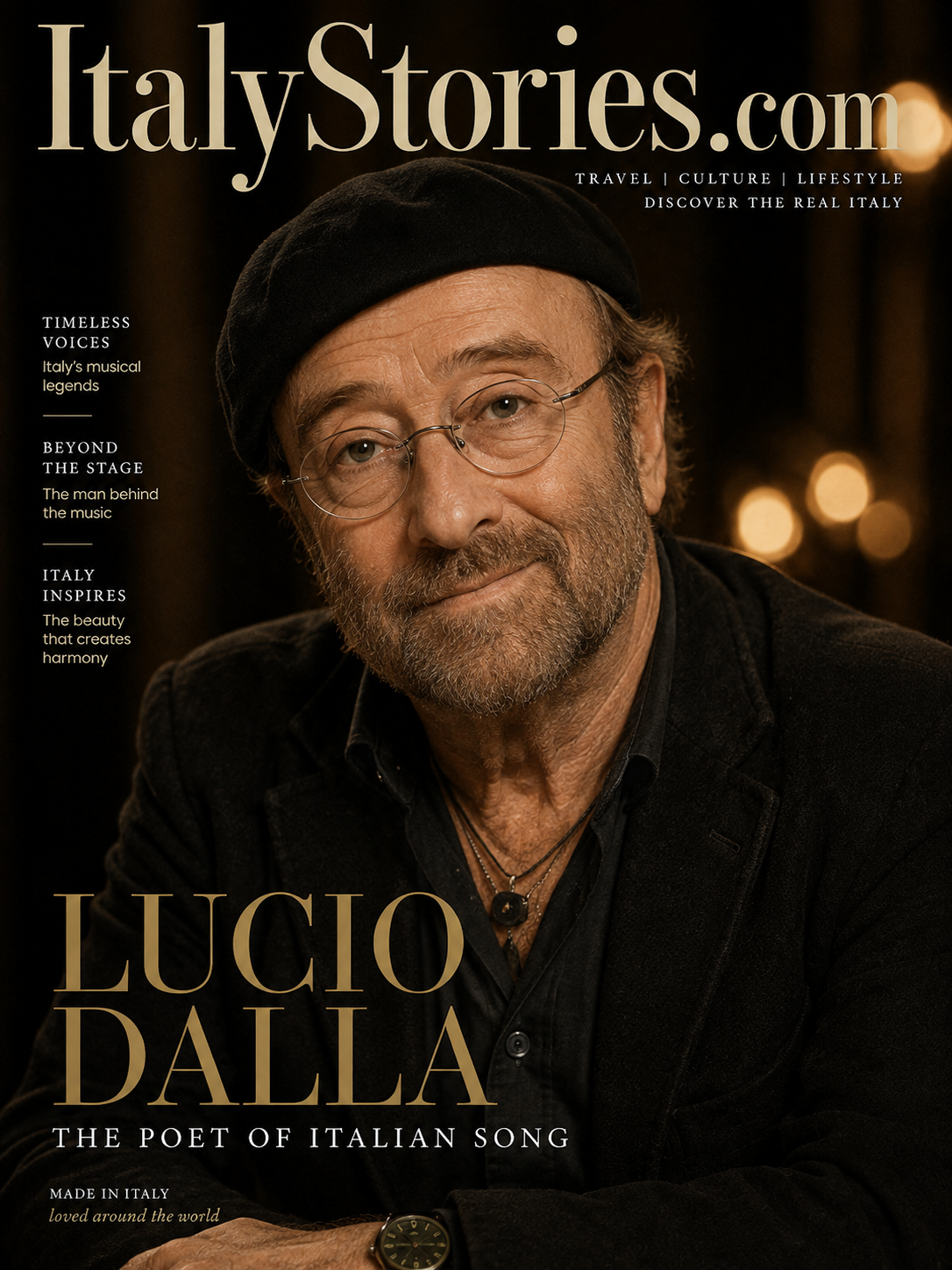
The Night Before His Birthday On February 29, 2012, Lucio Dalla performed in Montreux, Switzerland. He was on tour, still working, still moving, still doing what he had done for most of his life: treating music not as a monument to the past but as a living conversation. The next morning, March 1, he died suddenly of a heart attack. Three days later he would have turned sixty-nine. The date of his birth, March 4, 1943, had long since become famous far beyond any biography. It was the title of the song that transformed his career in 1971, a song whose original name had been censored and replaced with Dalla’s own birthday. In a strange way, the calendar had become part of his art. His life began on a date that became a melody, and it ended only days before that date returned once again. Italy responded to his death not simply as it responds to the loss of a famous singer. It mourned a figure who had become inseparable from the country’s imagination. Dalla had written about the lonely, the eccentric, the homeless, lovers, children, sailors, cities, fear, desire, the future, the sea and the mysterious ways people survive. He had sung in a voice that could sound playful, broken, theatrical, tender or almost primitive. He had played clarinet, saxophone and keyboards, written film music, directed theater, experimented with television, collaborated across generations and moved constantly between popular song and more ambitious forms. Most importantly, he had never allowed himself to become predictable. The path from jazz clubs in Bologna to ‘Caruso’, from early failures to huge international recognition, was not a straight ascent. It was a career of mutations. Dalla reinvented himself several times, and each reinvention seemed to reveal not a different person but another hidden room inside the same restless artist. That is why his story remains so alive. He was never merely a singer. He was a way of looking at people. Bologna During the War: A Child of Noise and Imagination Lucio Dalla was born in Bologna on March 4, 1943, the only child of Giuseppe Dalla and Iole Melotti. His first years coincided with the final phase of the Second World War, when the city lived under air-raid alarms, shortages and the nervous rhythms of survival. Later accounts of his childhood retained fragments of that atmosphere: the movement toward shelters, the anxiety of adults, the dull violence of explosions somewhere above the city. These were not yet memories a child could interpret politically. They were sounds, flashes and sensations. Dalla would spend a lifetime turning exactly this kind of sensory fragment into art. His father died when Lucio was still very young. The loss left a deep mark, even if Dalla rarely turned autobiography into simple confession. His mother, Iole, became the dominant emotional figure of his childhood. She worked in fashion and supported her son’s theatrical and musical instincts with an unusual degree of belief. The young Lucio was already a performer. Friends remembered a lively, comic, attention-seeking child capable of imitating entertainers and turning himself into a small stage personality. For a period he took part in theatrical entertainment, learning something that would later become crucial: how to hold an audience without looking conventionally heroic. Dalla never possessed the physical image expected of an Italian pop idol. He was short, unconventional, immediately recognizable. Instead of treating that as a limitation, he eventually transformed it into an advantage. His face, gestures, hats, beard, glasses and restless body became part of a unique visual language. At first, however, none of this suggested that he would become one of the central songwriters in Italian history. He was simply an unusually imaginative boy in a city that would soon give him the next great obsession of his life: jazz. The Clarinet and the Jazz City Bologna in the 1950s and early 1960s had a vibrant jazz culture. Small clubs, passionate amateurs and visiting musicians created a world that felt freer and stranger than the melodic music dominating Italian radio. Dalla was drawn to it completely. He had experimented with accordion, but the clarinet became his defining early instrument. He approached music with instinct rather than academic discipline. He did not become a conservatory-trained virtuoso. He learned by listening, imitating, playing with others and throwing himself into situations before he was entirely prepared for them. This instinctive formation shaped the artist he later became. Jazz taught him that music could stretch, breathe, improvise and refuse neat boundaries. It also taught him that rhythm and phrasing could carry personality as strongly as melody. As a teenager he began playing in local groups and eventually entered the Second Roman New Orleans Jazz Band. In Rome he encountered a wider network of musicians and performers, then joined the Flippers, a group that brought him into the world of professional entertainment. By the early 1960s he was no longer simply a young enthusiast from Bologna. He was becoming a working musician. The Flippers period exposed him to touring, television, pop audiences and the strange machinery of Italian show business. The group appeared at the Cantagiro and accompanied major singers, including Edoardo Vianello. Dalla’s clarinet and comic energy helped make him noticeable. But another musician saw something more. Gino Paoli encouraged him to step forward as a singer. It was a risky suggestion. Dalla did not have the polished voice or look of the standard romantic frontman. His voice was raw, elastic and odd. His appearance was equally unconventional. Precisely for those reasons, it was his own. A Solo Career That Almost Failed Dalla began his solo career in the mid-1960s, signing with RCA and releasing early singles that did little commercially. Some live audiences reacted badly. Accounts from the period describe hostility, mockery and even vegetables thrown toward the stage. This is one of the most revealing episodes in his story. The qualities that later made Dalla beloved—his strange appearance, nervous energy, unusual phrasing, comic instinct and resistance to convention—were initially difficult for the public to understand. Originality is often celebrated only after it becomes familiar. He appeared at the Sanremo Music Festival in 1966 with ‘Paff…Bum’, performed in partnership with the Yardbirds. The combination itself seems surreal in retrospect: an eccentric young Italian singer sharing the festival’s ritual with one of the important British rock groups of the era. Yet no immediate breakthrough followed. Dalla continued recording, acting and performing. He appeared in films, worked in television, and released the album 1999 in 1966. Later came Terra di Gaibola in 1970. None turned him into a major star. He had talent, personality and curiosity. What he still lacked was the song that could make the public understand him. That song arrived in 1971, and even its title was the result of conflict. “4 Marzo 1943”: Censorship Creates an Immortal Title The song that changed Lucio Dalla’s life was originally called ‘Gesù Bambino’. The lyrics were written by Paola Pallottino, and Dalla set them to music. The story follows a young woman, a sailor from far away and a child born into poverty and social marginality. Its imagery was tender, irreverent and far from the sanitized language usually expected at Sanremo. Festival censorship intervened. Words considered unacceptable were changed, and the title ‘Gesù Bambino’ was rejected. The replacement was Dalla’s own date of birth: ‘4 marzo 1943’. The accident was brilliant. When Dalla performed the song at Sanremo in 1971, the title immediately connected the mysterious narrative to the small, unusual man singing it. The piece finished third, but the ranking mattered less than the effect. The audience remembered it. The recording became a major success. The song also traveled internationally. Chico Buarque adapted it in Portuguese as ‘Minha história’, and Dalida recorded a French version. A song born from the peculiar constraints of Italian television suddenly proved that Dalla’s emotional imagination could cross languages. More importantly, ‘4 marzo 1943’ established a theme that would remain central in his work: dignity among people society overlooks. Dalla was fascinated by outsiders. Prostitutes, homeless people, lonely figures, dreamers, drifters and people without conventional power repeatedly appear in his songs. He rarely turned them into symbols from a distance. He gave them rooms, gestures, voices and contradictory desires. In 1971 the public finally understood that the strange man from Bologna was not merely strange. He was telling stories nobody else told quite the same way. “Piazza Grande”: The Homeless Man at the Center of the Song A year later came ‘Piazza Grande’, another song that would become part of the permanent Italian repertoire. The music was written by Dalla with Ron, while the lyrics were created by Gianfranco Baldazzi and Sergio Bardotti. The song was presented at Sanremo in 1972. Once again, the festival result was less important than the life the song acquired afterward. Its protagonist is a homeless man who lives in a square, survives without conventional security and insists that his life belongs to him. He wants affection, dreams, prayer and human contact, but he refuses to exchange his freedom for a respectable existence imposed from outside. The character is one of the earliest perfect examples of the Dalla universe: vulnerable but not pathetic, poor but not spiritually empty, outside the system yet full of interior life. The ‘Piazza Grande’ of the song has been associated not with Bologna’s grand Piazza Maggiore but with the more intimate Piazza Cavour, near the environment of Dalla’s childhood. Whether the listener knows the geography or not, the square becomes larger than a location. It becomes a stage on which the invisible person is finally seen. Dalla still was not writing all his own lyrics. But he was becoming the ideal interpreter of a poetic world that already seemed to belong to him. The next transformation would come through one of the most intellectually demanding collaborations in Italian popular music. Roberto Roversi: When Pop Met Poetry and Politics Between 1973 and 1976 Dalla collaborated intensely with the Bolognese poet Roberto Roversi. The partnership produced Il giorno aveva cinque teste, Anidride solforosa and Automobili. The records were dense, experimental and politically charged. Roversi’s language was far removed from conventional pop lyricism. He wrote about industrial society, technology, alienation, power, consumption and the violent transformations of modern Italy. Dalla responded with music that refused easy formulas. For listeners accustomed to the accessible narrative of ‘4 marzo 1943’ or ‘Piazza Grande’, these albums could be difficult. But artistically they were decisive. Roversi forced Dalla to confront words as serious material rather than simply as something to carry melody. Dalla, in turn, discovered how much freedom could exist inside the relationship between language and music. The collaboration eventually ended, in part because the two men had different ideas about the music industry and artistic compromise. Yet the breakup was fertile. Dalla had learned enough from Roversi to attempt something he had previously avoided: writing his own lyrics. This moment is essential to understanding his career. The great Lucio Dalla of ‘L’anno che verrà’, ‘Anna e Marco’, ‘Futura’, ‘Cara’ and ‘Caruso’ was not born fully formed. He had spent years interpreting other people’s words. Roversi helped reveal that the language he needed was already inside him. When Dalla finally began writing his own texts, the result was not an imitation of Roversi. It was something stranger, more conversational, more dreamlike and entirely personal. The Sea Opens: “Come è profondo il mare” In 1976 Dalla’s mother died. The loss shook him deeply. He withdrew for a time to the Tremiti Islands, a place that had long offered him refuge and inspiration. Out of that period came Come è profondo il mare, released in 1977: the album that marks the decisive birth of Lucio Dalla as the complete songwriter the public now remembers. For the first time, Dalla took full responsibility for the lyrics. The result was astonishing. The title song, ‘Come è profondo il mare’, uses the sea not simply as landscape but as metaphor for freedom, thought, survival and the forces that try to control them. The text moves between irony, politics, fable and dream with a logic that feels less literary than musical. Images appear, collide and dissolve. This became the signature of Dalla’s writing. He could move from ordinary speech into surreal poetry without warning. He could be funny and frightening in the same verse. His songs often seem easy to understand emotionally even when they resist neat explanation. The album represented liberation from both the role of interpreter and from the expectation that Italian song lyrics must behave in a certain way. Dalla had found his language. From this point forward, his greatest period began. 1979: “Lucio Dalla” and the Country Listening to Itself The album Lucio Dalla, released in 1979, contains a sequence of songs so strong that it resembles a national anthology. There is ‘L’anno che verrà’, written as a letter to a distant friend, beginning with everyday intimacy and gradually opening into one of the most memorable reflections on hope and uncertainty in Italian music. The song looks toward a coming year in which life might improve, yet beneath the optimism lies the unmistakable knowledge that people invent hope because the present is difficult. There is ‘Anna e Marco’, a miniature film about two young people carrying loneliness through the city until their paths meet. Dalla creates characters rapidly, with details that feel almost cinematic. He does not explain them psychologically. He lets movement, setting and desire do the work. There is ‘Tutta la vita’, ‘Cosa sarà’ with Francesco De Gregori, and other songs that blend folk, pop, jazz instincts and urban storytelling. The album made Dalla one of the undisputed central figures of the Italian cantautore tradition, but he still did not resemble the classic image of the solemn songwriter with guitar. He could be comic, theatrical, musically sophisticated and emotionally direct. He could perform like a jazzman, write like a screenwriter and sing like a street storyteller. Italy was no longer merely listening to Lucio Dalla. It was beginning to recognize itself in his songs. Banana Republic: Dalla and De Gregori Turn a Tour into History In 1979 Dalla and Francesco De Gregori created Banana Republic, one of the landmark live projects in Italian music. The pairing was fascinating because the two artists were very different. De Gregori cultivated a more reserved, literary and enigmatic presence. Dalla was spontaneous, theatrical and openly playful. Together they created a productive tension. The tour brought the cantautore tradition into large outdoor spaces on a new scale. It demonstrated that singer-songwriters could command mass audiences without abandoning authorship or complexity. The live album and film documented not only songs but a cultural moment. Italy in the late 1970s was emerging from a period of political violence, ideological intensity and social transformation. A large audience gathering around two major songwriters suggested a different form of collective experience. The friendship and artistic dialogue between Dalla and De Gregori would continue intermittently for decades. In 2010 they returned to the stage together with Work in Progress, proving that the old chemistry had not been a historical accident. Banana Republic also revealed something central about Dalla: he was generous in collaboration. He did not need every stage to belong entirely to him. He often became more interesting when another strong personality stood beside him. “Dalla” and “Futura”: The 1980s Begin with a Masterpiece The 1980 album Dalla continued the extraordinary run. Among its songs was ‘Futura’, one of Dalla’s most celebrated compositions. The song imagines two lovers near the Berlin Wall, speaking about a child who might be born into a divided world. Love, politics, fear and hope coexist without becoming a slogan. The genius of ‘Futura’ lies partly in its scale. The Cold War becomes intimate. History is not described through leaders or ideology but through two people imagining a life not yet born. The album also included ‘Cara’, another of Dalla’s defining songs, and confirmed his ability to write music that was structurally sophisticated yet immediately popular. During these years he became a central force in Italian culture. Albums such as 1983, Viaggi organizzati and Bugie extended the repertoire. His sound absorbed electronic production and changing studio technology without losing the warmth of his writing. Dalla was never a purist. He did not treat new instruments or production methods as threats to authenticity. If a synthesizer, rhythm machine or unusual arrangement helped create the world of a song, he used it. The jazz improviser had become a pop architect. Sorrento, Enrico Caruso and a Song Heard Around the World In 1986 Dalla wrote ‘Caruso’, the song that would become his greatest international standard. The inspiration came during a stay in Sorrento at the Grand Hotel Excelsior Vittoria, a place connected to the final period of the great tenor Enrico Caruso’s life. Dalla stayed in the historic environment associated with Caruso, and the stories surrounding the tenor, his illness, his voice and his emotional life fused with the view over the Gulf of Naples. Out of that atmosphere came a song that sounds as though it had existed for a century. ‘Caruso’ is not a conventional biography of the tenor. It is an imagined emotional scene. A man near the end of life looks at the sea and sings to a young woman. The Neapolitan refrain gives the song both local identity and universal immediacy. Dalla’s own performance is remarkable because he does not attempt to imitate an operatic tenor. He remains himself—rough, vulnerable, conversational—and lets the composition carry the grandeur. The song traveled everywhere. Luciano Pavarotti, Andrea Bocelli, Céline Dion, Julio Iglesias and countless others performed or recorded it. It became one of the most widely interpreted Italian songs of the modern era. For many international listeners, ‘Caruso’ became their first encounter with Lucio Dalla. Its success demonstrated something extraordinary: Dalla, an artist rooted in Bologna, jazz, slang, absurdity and highly personal storytelling, could write a song that seemed to belong to the entire world. The live album DallAmeriCaruso, associated with this period, amplified that international recognition. After more than twenty years of career, Dalla had written his global standard almost accidentally, inspired by a hotel room, a story and the sea. The 1990s: “Attenti al lupo” and Another Generation Many artists who peak creatively in the 1970s and 1980s struggle when pop culture changes. Dalla did not disappear. In 1990 he released Cambio, an album that introduced him to a younger generation with ‘Attenti al lupo’. Written by Ron, the song was lighter and more immediately playful than much of Dalla’s classic material, but his performance turned it into a huge popular success. The video, the refrain and Dalla’s unmistakable presence made the song part of early-1990s Italian mass culture. Other albums followed, including Henna, Canzoni and Ciao. Dalla continued to write successful songs while also expanding his work in television, cinema and theater. This period showed another side of his durability. He was capable of serious artistic ambition, but he never became embarrassed by popularity. He understood that a simple song could be as valuable as a complex one if it carried life. He also remained deeply curious about younger musicians, often inviting them into his orbit, producing, encouraging or collaborating with emerging talent. Dalla’s authority did not harden into distance. He stayed porous. Film, Television, Theater and the Refusal to Stay in One Medium Music was the center of Lucio Dalla’s work, but never the boundary. He wrote film music for important Italian directors and contributed to projects including Carlo Verdone’s Borotalco, Mario Monicelli’s I picari and later films associated with Pupi Avati. His songs and compositions often worked naturally in cinema because he thought visually. Characters, rooms, streets and landscapes already existed inside his lyrics. Television attracted him for the opposite reason: it was immediate, unstable and public. Dalla created and participated in programs in which music could coexist with comedy, conversation and improvisation. He also became increasingly involved in theater and opera. He worked on projects inspired by classical repertoire, including Tosca. Amore disperato, and directed stage works linked to composers such as Busoni and Stravinsky. To some observers these ventures might have looked like digressions. For Dalla they were all part of the same curiosity. He did not believe that popular music had to remain culturally obedient to its category. A pop singer could enter opera. A jazz clarinetist could make television. A songwriter could direct theater. A celebrity could write stories. The connecting principle was not genre. It was imagination. Bologna, the Tremiti Islands and the Geography of Lucio Certain places are inseparable from Dalla’s identity. Bologna was the deepest one. The city appears not merely as background but as emotional structure: arcades, squares, cafés, musicians, students, football, winter fog, jokes and sudden intimacy. Dalla’s house in Via D’Azeglio became famous not because he turned it into a public monument during his lifetime, but because it reflected his appetite for art, objects, music and conversation. Then there were the Tremiti Islands, especially San Domino. The sea gave Dalla a different form of solitude. He returned there repeatedly to think, compose and escape. The islands are linked to major moments in his creative life, including the writing and conception of important songs. Sorrento became permanently connected with ‘Caruso’. Rome belonged to his professional beginnings. Milan, Sanremo, New York, Berlin, Montreux and countless other places entered his story through performance and imagination. Dalla was a traveler, but not in the polished sense of an international celebrity moving from luxury hotel to luxury hotel. He treated places as sources of stories. He listened to them. The Voice: A Human Instrument More Than a Beautiful One Lucio Dalla did not possess a conventionally beautiful voice. That sentence is not criticism. It is the beginning of understanding him. His voice was nasal, rough, flexible and unpredictable. It could suddenly rise, crack, become comic, imitate another person, slide into a cry or soften into an almost whispered intimacy. Because he had come from jazz, he treated the voice as an instrument rather than merely as a vehicle for correct melody. Timing mattered. Accent mattered. Silence mattered. A syllable could be delayed, bent or attacked in a way that made the line sound improvised even when the song was carefully constructed. This made many of his songs difficult for other singers. The notes can be reproduced, but the internal rhythm belongs to Dalla’s body. His clarinet background remained audible in the way he phrased. He could stretch a melodic line as though breathing through an instrument. The voice also suited his characters. A polished singer might have made some of Dalla’s homeless men, lonely women, sailors or dreamers sound decorative. Dalla sounded as though he had met them. Perhaps that is why listeners trusted him. Friendships and Collaborations: De Gregori, Morandi, Pavarotti and Others Dalla’s career is full of collaborations because he was fundamentally curious about other artists. Francesco De Gregori was one of the most important, from ‘Cosa sarà’ and Banana Republic to the later Work in Progress reunion. Gianni Morandi, another Bolognese-area figure of Italian popular culture, shared long-standing personal and professional connections with Dalla. Their careers crossed through songs, television and friendship. Luciano Pavarotti’s performances of ‘Caruso’ helped transform the song into a meeting point between popular songwriting and the operatic tradition Dalla admired without ever imitating. He worked or performed with Mina, Renato Zero, Ron and many others. He also supported younger musicians and songwriters, often with genuine enthusiasm rather than strategic calculation. The pattern reveals something about his personality. Dalla did not behave like an artist guarding a fixed territory. He liked collision. A collaboration gave him the chance to hear himself differently. The Final Sanremo and the Sudden End In February 2012 Dalla returned to Sanremo in a role very different from the one he had occupied forty years earlier. He accompanied the young singer-songwriter Pierdavide Carone with ‘Nanì’, a song Dalla had written. During the performance he also appeared as conductor, visibly engaged in the process of helping another artist carry the music. It was an unexpectedly appropriate final national television appearance. The man who had once arrived at Sanremo as an unconventional young performer now returned as a mentor, composer and elder statesman of Italian song. Only days later he left for further concerts in Europe. After performing in Montreux, he died on March 1, 2012. The news produced an enormous public reaction. His funeral in Bologna became a collective farewell, and the city that had formed him reclaimed him as one of its essential voices. Dalla was buried at the Certosa of Bologna. The suddenness of the death created an unfinished feeling. He had not withdrawn. He had not staged a farewell tour. He had not announced a final album. He simply stopped in the middle of work. After Lucio: A House, a Foundation and Songs That Keep Moving The years after Dalla’s death have confirmed how deeply his work remains embedded in Italian culture. The Fondazione Lucio Dalla was established in Bologna in 2014, on March 4, his birthday. Its purpose is to preserve, study and share the artistic, human and cultural legacy of an artist whose interests reached far beyond records. His home in Via D’Azeglio has become a place of guided visits and memory. To enter it is to encounter not only memorabilia but the traces of a mind that collected images, objects and possibilities. Exhibitions, concerts, documentaries, reissues and tribute projects continue to introduce his work to audiences too young to remember him alive. Yet the strongest monument remains the songs themselves. ‘L’anno che verrà’ returns every New Year’s season without becoming a novelty song. ‘Caruso’ continues to be interpreted across the world. ‘Futura’ acquires new meaning whenever Europe confronts division and fear. ‘Anna e Marco’ still sounds like two people walking through a city tonight. ‘Piazza Grande’ still asks whether society can see the person sleeping outside its respectable windows. This is the measure of a songwriter’s survival. The songs do not stay in the year in which they were written. Why Lucio Dalla Still Matters Lucio Dalla changed Italian song because he proved that popular music could contain almost anything. Jazz improvisation. Street language. Political anxiety. Children’s fables. Operatic emotion. Electronic production. Comedy. Film. Prayer. Desire. Loneliness. Football. The sea. A homeless man. A divided Berlin. An aging tenor in Sorrento. He did not organize these elements into a theory. He made them live together because that was how his imagination worked. He also changed the idea of what an Italian star could look and sound like. He was not conventionally handsome, did not sing with classical purity and did not cultivate distance. He turned eccentricity into authority. His greatest achievement, however, may be more intimate. Dalla had an extraordinary ability to notice people. He noticed the person at the edge of the square, the couple nobody else sees, the friend far away, the woman waiting, the child not yet born, the old singer looking toward the sea. Then he gave them music. That is why his songs remain larger than nostalgia. They are still acts of attention. And in a culture that often moves too quickly to look closely, Lucio Dalla continues to teach listeners how deep the sea can be. A Final Thank You from ItalyStories.com Thank you for spending time with this story. ItalyStories.com was created to explore the people, places, voices and ideas that have shaped Italy far beyond its borders. If Lucio Dalla’s journey has made you curious about another chapter of Italian music and culture, we would be delighted to welcome you to the next story.
[…] has even returned to the hotel. The Premio della Critica “Mia Martini” and the Sala Stampa “Lucio Dalla” prize acknowledge that Sanremo has multiple constituencies. The public may love one song, the […]