

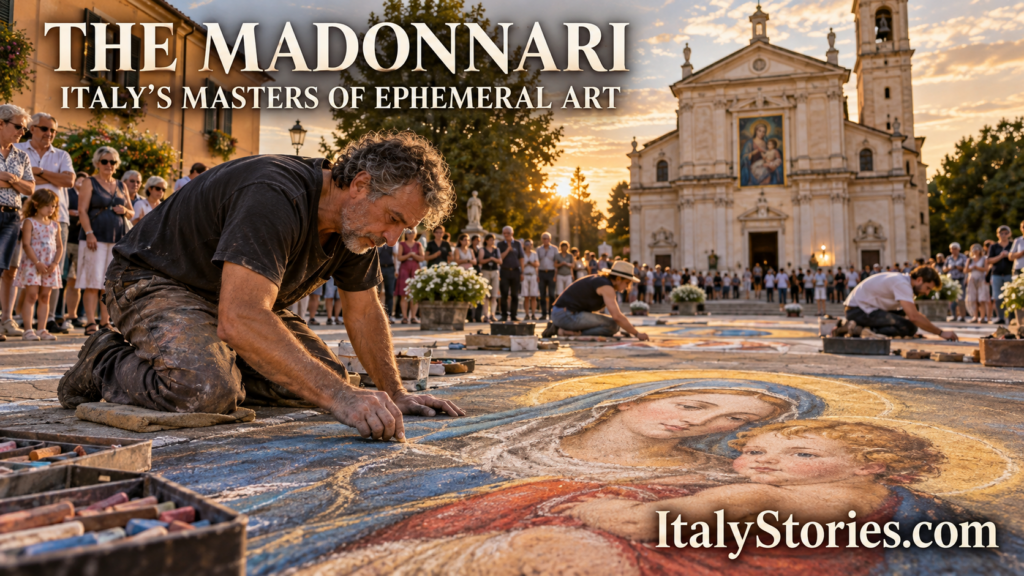
They kneel on stone pavements beneath the Italian sun, surrounded by boxes of colored chalk, broken pastels and clouds of pigment. Slowly, an empty square of road becomes a face, a fold of blue fabric, a golden halo or the tender gesture of a mother holding her child. For a few hours, the street is transformed into a cathedral without walls.
These artists are known as the Madonnari, the traditional Italian street painters whose images were historically inspired by the Madonna, saints and scenes from Christian devotion. Their works can be extraordinarily sophisticated, reproducing the softness of Renaissance painting, the drama of the Baroque and the intense expressions of sacred art. Yet they are created on the ground, walked around by crowds and left exposed to wind, footsteps and rain.
A madonnaro knows from the beginning that the work will disappear. That is not an accident or a failure. It is part of the meaning of the art.
Who Are the Madonnari?
The word madonnaro comes from Madonna, the Italian name traditionally used for the Virgin Mary. Its plural form, madonnari, originally identified itinerant artists who created religious pictures in public spaces, particularly near churches, sanctuaries, markets and pilgrimage routes.
They were not painters protected by royal courts or wealthy patrons. Many lived by moving from one town to another, following the calendar of religious celebrations. When a patron saint was honored, a pilgrimage began or a popular fair attracted large crowds, the madonnari arrived with their modest materials and chose a place on the pavement.
There they drew the Madonna and Child, the Crucifixion, saints, angels or scenes familiar from the great masters of Italian art. Passersby stopped to watch and left small coins in appreciation. In some places, the artists received food or temporary shelter from local families, religious communities and pilgrims.
The exact origins of the tradition are difficult to document. Street art was rarely considered important enough to enter official archives, and the works themselves disappeared within days. The custom is commonly traced to early modern Italy and is often associated with the sixteenth century, although its roots may be connected to much older forms of popular devotion, votive images and temporary decorations created for religious festivals.
Unlike frescoes preserved on church walls, these paintings left almost no physical evidence. Their history survived through memory, oral tradition and the artists who taught their techniques to younger generations.
A Museum Without Walls
Italy is filled with religious images. They appear in cathedrals, small country chapels, roadside shrines and niches placed on the corners of ancient buildings. In cities such as Rome, Florence, Venice and Naples, sacred art is woven into the urban landscape. A figure of the Virgin may look down from a palace façade, while a painted saint protects the entrance to a neighborhood.
The madonnari brought this visual language onto the street. They transformed ordinary pavement into a temporary sacred space that belonged to everyone. A person did not need to enter a museum, purchase a ticket or understand the complex vocabulary of art history. The image appeared directly in the path of daily life.
A market trader, farmer, child, nobleman or pilgrim could watch the painting emerge. The artist worked at ground level, close to the people, while the audience observed every decision: the first lines of the composition, the shadows beneath a face, the color of a robe and the final touches of light.
This made the work both visual art and public performance. The finished picture mattered, but so did the process of its creation. Conversations developed around the artist. Children asked questions. Strangers offered encouragement. An entire community watched a sacred figure appear from dust.
The Colors of the Earth
Traditional madonnari worked with simple, inexpensive materials. Chalk, charcoal, fragments of colored stone, brick dust and natural pigments could be carried easily from one town to another. Modern artists frequently use high-quality soft pastels and specially prepared chalks, but the essential relationship between pigment and pavement remains unchanged.
The surface is never neutral. Every stone has cracks, irregularities and changes of color. Asphalt absorbs pigment differently from old paving slabs. Heat softens some materials, humidity alters others, and a strong wind can carry away the finest powder before it settles.
Before beginning, the artist studies the available space and plans the composition. Large works are often divided into sections using a grid, allowing a small preparatory drawing to be enlarged accurately. The first outlines establish proportions and perspective. Dark areas usually follow, then broader fields of color, gradual transitions and highlights.
Because viewers normally approach the picture from one principal direction, the artist must also consider perspective from a low and unusual angle. A face that looks perfectly proportioned from several meters away may seem strangely stretched when viewed from directly above. Madonnari learn to anticipate this optical transformation.
Their physical endurance is as important as their technical skill. They work for hours on their knees or bent forward under the summer sun. Their hands, clothing and faces become covered in color. Every movement must be careful, because an elbow, shoe or misplaced piece of equipment can erase a completed section.
The work requires discipline, patience and acceptance of imperfection. The pavement cannot be completely controlled, and neither can the weather.
Grazie di Curtatone: The Spiritual Home of the Madonnari
The most celebrated gathering of madonnari takes place at Grazie di Curtatone, a small village near Mantua in Lombardy. Surrounded by the landscape of the Mincio, Grazie is known for the Sanctuary of the Blessed Virgin of the Graces and for an ancient fair held around the Feast of the Assumption.
The sanctuary has deep roots in the history and devotion of the Mantuan territory. Its present form is traditionally connected with Francesco I Gonzaga, who ordered the construction of a church at the end of the fourteenth century following a vow made during a time of plague. Over the centuries, the sanctuary became an important destination for pilgrims, fishermen, farmers and families seeking protection or giving thanks for a grace received.
Inside, ex-votos and unusual devotional objects tell stories of illness, danger, war, survival and gratitude. Outside, the broad square becomes one of the world’s most remarkable open-air studios.
Since 1973, the village has hosted the Incontro Nazionale dei Madonnari, created to preserve a tradition that appeared to be disappearing. Despite its original national title, the gathering soon attracted artists from many countries and helped transform Grazie into an international reference point for pavement painting.
The event takes place around August 14 and 15, during the celebrations for the Assumption of Mary. Before the competition begins, the chalks are traditionally blessed. It is a simple gesture, but one that expresses the character of the gathering: artistic skill, popular faith and collective ritual remain closely connected.
Once work begins, the square changes hour by hour. Empty rectangular spaces become fields of blue, red, gold and white. Artists continue into the evening and often through the night, taking advantage of the cooler air. Lamps illuminate faces and hands while spectators move carefully between the pictures. By the morning of Ferragosto, the pavement has become an enormous temporary gallery.
The Blessing of the Chalks
Few artistic competitions begin with a religious blessing. At Grazie di Curtatone, however, the blessing of the chalks is more than a ceremonial opening. It recalls the devotional origins of the madonnari and recognizes the humility of their materials.
Chalk is fragile. It breaks easily, stains the fingers and can be washed away in minutes. Unlike marble or bronze, it makes no promise of permanence. Blessing it gives dignity to something ordinary and temporary—the same transformation the artist performs on the pavement.
The ceremony also connects contemporary painters with anonymous predecessors who traveled between Italian towns centuries ago. Today’s participants may arrive from Europe, the Americas or Asia. They may have studied in academies, worked as illustrators or built international careers in street painting. Yet when they kneel on the square with a piece of chalk in their hands, they repeat an ancient gesture.
The categories traditionally associated with the gathering reflect a path of artistic growth, from less experienced participants to qualified artists and recognized masters. Titles are earned through practice and evaluation, reinforcing the idea that pavement painting is not an improvised pastime but a discipline with techniques, traditions and standards.
Sacred Art Beneath the Feet
The position of the image is one of the most striking aspects of madonnaro art. In churches, sacred figures are usually raised above the viewer on altars, domes and decorated ceilings. The madonnaro places them on the ground.
At first, this might seem disrespectful. In reality, it expresses a different form of closeness. The image shares the same space as the people who gather around it. The Madonna is no longer distant; she appears among the crowd, surrounded by children, pilgrims, artists and curious visitors.
The act also recalls the humility central to many Christian traditions. Beauty is created from dust and returned to dust. A masterpiece can exist briefly without becoming an object of possession. Nobody can buy the original pavement, remove it from the square or lock it inside a private collection.
The work belongs to the place and to the moment. Those who witness it carry away photographs and memories, but the physical picture remains behind.
This temporary nature changes the relationship between artist and artwork. Painters normally protect their creations from damage, humidity and sunlight. Madonnari must release theirs almost immediately. Once the final detail is complete, the image has already begun to fade.
When the Rain Arrives
Rain is the natural ending of a madonnaro painting. A few drops darken the pavement. Colors begin to run. Carefully modeled faces lose their outlines, robes dissolve into streams of blue and red, and halos become pools of golden pigment.
For visitors, the disappearance can feel tragic. After watching an artist work through the night, it is difficult to see the finished image vanish. For the madonnaro, however, impermanence is part of the tradition.
The painting does not survive as an object, but its disappearance gives intensity to the time in which it exists. People stop because they know they may never see it again. The street becomes valuable precisely because its transformation is brief.
This idea connects the madonnari with other temporary Italian traditions: flower carpets created for the Infiorata, sand sculptures made for religious celebrations, festival decorations dismantled after a procession and elaborate foods prepared only on a particular feast day. In each case, communities invest enormous skill in something destined to last for a limited time.
The value lies not in possession but in participation.
From Renaissance Masters to Original Visions
Many madonnari reproduce celebrated works by artists such as Raphael, Michelangelo, Leonardo da Vinci, Caravaggio or Correggio. This practice is not simply imitation. Translating a painting from canvas or fresco onto irregular pavement requires reinterpretation.
Colors behave differently, details must be enlarged and compositions need to be adjusted for the viewer’s position. The artist studies the techniques of the old masters while developing a personal method suited to the street.
Religious subjects remain central at historic gatherings, especially in Grazie di Curtatone, but contemporary pavement art has expanded far beyond traditional Marian imagery. Artists now create portraits, mythological scenes, landscapes, social messages and imaginative compositions. Some combine classical drawing with surrealism or popular culture.
The most spectacular modern development is three-dimensional anamorphic street painting. These works are deliberately distorted so that, when viewed or photographed from one precise position, they create the illusion of deep holes, staircases, cliffs or objects rising from the pavement.
Artists such as Kurt Wenner helped popularize this approach internationally by applying knowledge of classical perspective to large street compositions. Three-dimensional pavement art has become famous on social media, but it represents a modern branch of the tradition rather than the whole history of the madonnari. The devotional images at Grazie preserve a quieter and older relationship among art, faith and community.
An Italian Tradition Travels the World
The revival of interest in Grazie di Curtatone helped street painting travel far beyond Italy. Festivals inspired by the madonnari tradition now take place in Europe, North America, Latin America and other parts of the world.
One particularly important example began in Santa Barbara, California, in 1987. Inspired by the gathering at Grazie, the I Madonnari Italian Street Painting Festival was created at the Old Mission Santa Barbara. The event maintained a connection with its Italian model while supporting arts education for children.
Other cities adopted similar festivals, sometimes using the expression Italian street painting even when the subjects were no longer religious. This international growth introduced new materials, themes and optical techniques, while preserving the public character of the art.
People do not encounter these works silently in a gallery. They watch the artists labor, return several hours later to see the progress and often speak directly with the creators. The boundary between professional artist and audience becomes unusually open.
Children are especially fascinated because chalk is familiar to them. They recognize the material even when the result appears impossibly sophisticated. A pavement painting suggests that art does not require a distant studio or expensive equipment. It can begin with a piece of color and an available stretch of ground.
The Madonnaro as Artist and Traveler
The historic madonnaro belonged to the road. Like musicians, storytellers, puppeteers and traveling performers, these artists carried culture between cities and villages. They adapted to local celebrations and learned which sacred figures were particularly loved in each region.
A festival dedicated to Saint Francis required different imagery from a celebration of Saint Anthony, Saint Lucy or San Gennaro. A pilgrimage route in Tuscany had its own artistic memories, while the traditions of Sicily, Lombardy, Veneto and Campania offered different colors, costumes and popular devotions.
In this sense, the madonnari formed part of a wider network of Italian folk culture. They helped familiar images circulate before photography and mass printing became universal. A painter who had seen an important altarpiece in Florence, Rome or Venice could reinterpret it in a distant town, allowing people who would never visit the original church to encounter a version of its beauty.
Their social position was often uncertain. They were admired for their ability but could also be treated as beggars or outsiders. Because their art disappeared and their lives were rarely documented, the names of many talented madonnari have been lost.
Modern festivals have restored professional recognition to the tradition. Contemporary artists sign their work, compete for awards and build international reputations. Museums, cultural associations and photography archives now preserve images that would otherwise vanish with the next rainfall.
The Museo dei Madonnari
Grazie di Curtatone is also home to the Museo dei Madonnari, created to document this unusual artistic heritage. The museum preserves photographs, sketches and testimonies connected with artists whose original pavement works could not survive.
Its existence presents a fascinating challenge: how can a museum preserve an art form defined by disappearance? It cannot save the exact physical experience of standing in the square while an image is being created. Instead, it preserves the memory, techniques and human stories surrounding the work.
Photographs record completed paintings, but they also reveal changing styles, clothing, tools and audiences. Preparatory drawings demonstrate how artists planned large compositions. Historical documents help reconstruct the revival that began in the twentieth century.
The museum ensures that impermanence does not become oblivion. The street paintings remain temporary, but the tradition that created them can be studied and passed forward.
More Than Street Art
Calling the madonnari street artists is correct, but incomplete. Their work occupies a special place between fine art, popular culture, religious devotion and public performance.
Like muralists, they create images outside conventional galleries. Like classical painters, they study anatomy, composition, perspective and light. Like artisans, they develop precise knowledge of materials. Like performers, they work in front of an audience. And like pilgrims, they accept a journey in which the destination is temporary.
Their art also changes the meaning of public space. A road is normally designed for movement: people cross it, vehicles pass over it and nobody expects to stop. A madonnaro asks the crowd to pause and look downward. The most ordinary surface in a city suddenly becomes worthy of attention.
For a short time, the pavement is no longer merely pavement. It is a canvas, an altar, a meeting place and a shared memory.
Beauty That Does Not Ask to Be Possessed
The Madonnari offer a quiet lesson in a world obsessed with preserving, collecting and displaying everything. They devote long hours to an image they cannot keep. They know that sunlight will fade it, footsteps will blur it and rain will eventually carry its colors away.
Still, they begin.
They kneel in the square, open their boxes of chalk and draw the first line. Around them, a village gathers. The façade of a sanctuary watches over the pavement. Children lean forward, pilgrims arrive, photographers search for the right angle and strangers begin talking to one another.
Then, from the rough surface of the street, a face appears.
The miracle of the madonnari is not that their paintings survive. It is that artists continue to create them despite knowing they will disappear. For one day, color defeats the gray pavement. Art leaves the museum and enters the life of a community. When the rain finally comes, the image vanishes—but the people who saw it remember where it had been.
Follow ItalyStories.com to discover more Italian artists, cities, villages, sacred places, popular traditions and extraordinary stories hidden in the cultural landscape of Italy.