

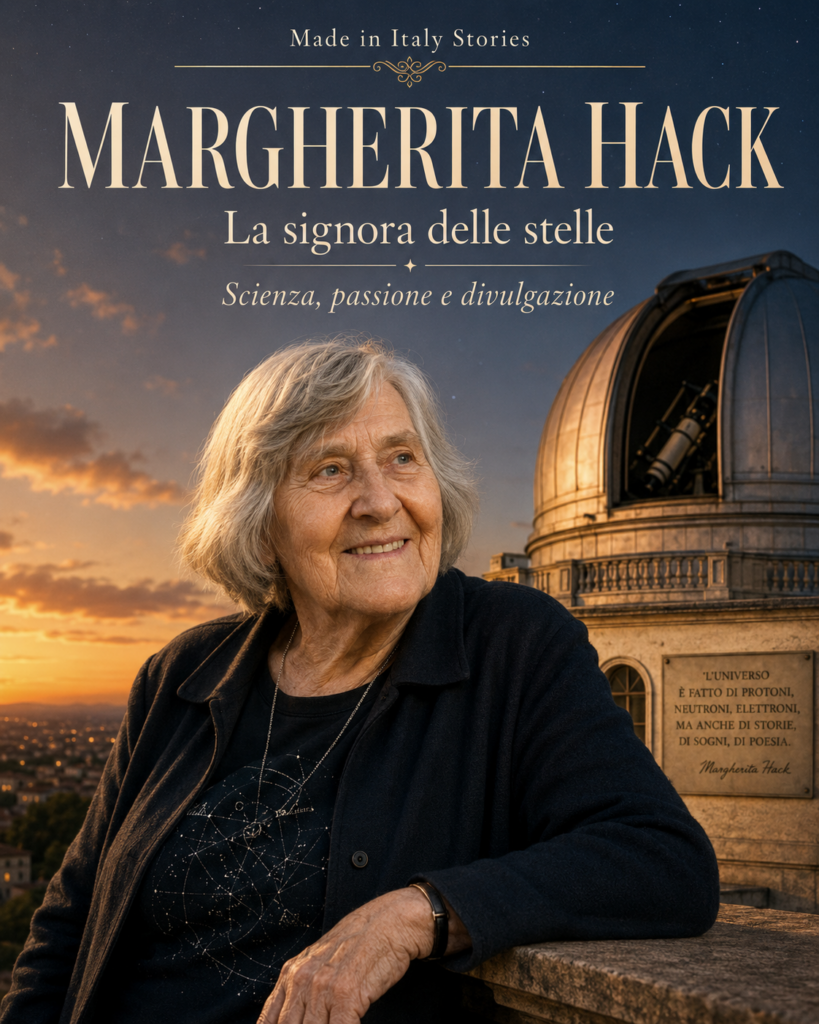
The Lady of the Stars: Science, Passion and Public Understanding
Margherita Hack had the rare gift of making the universe sound like something that belonged to everyone. She could speak about stellar spectra, ultraviolet astronomy and the evolution of stars without turning science into a sacred language reserved for specialists. To generations of Italians she became the unmistakable face and voice of astronomy: direct, witty, secular, stubborn, curious and gloriously uninterested in unnecessary ceremony. She was a major scientist, but she was also something more unusual – a public intellectual who convinced ordinary people that looking at the stars was not an escape from reality. It was one of the most intelligent ways to understand it.
She was born in Florence on 12 June 1922. Her childhood unfolded in a family environment that encouraged independence, tolerance, contact with nature and freedom of thought. She grew up in a city overflowing with art and history, yet what eventually captured her imagination was the physical universe. Before that happened, however, sport was one of her great passions. She ran, cycled, played basketball and later practiced athletics competitively. Physical movement remained part of her personality throughout her life. There was always something athletic in the way she approached intellectual work as well: train hard, keep going, do not complain too much and certainly do not waste time posing.
Hack studied at the University of Florence during the difficult years of the Second World War. She had initially considered literature, but physics soon won. During the academic year 1942-43 she attended astronomy courses connected with the Arcetri Observatory and became increasingly interested in the stars. Her thesis focused on Cepheid variable stars, and in January 1945 she graduated in physics with research that already pointed toward the field that would define much of her scientific career: stellar spectroscopy.
Spectroscopy sounds forbidding until one understands the idea. Light carries information. When astronomers break starlight into its spectrum, they can learn about the chemical composition, temperature, motion and physical conditions of objects that are impossibly distant. Hack became an expert in interpreting that light. She studied stellar atmospheres, variable stars and especially classes of hot stars whose spectra reveal complex physical behavior. In other words, she spent a lifetime learning to read messages that stars send without ever intending to communicate with us.
In 1944 she married Aldo De Rosa, a childhood friend with a literary and humanistic temperament quite different from her own scientific one. Their marriage lasted for the rest of her life and became one of the stable centers of her biography. The contrast was part of its strength: the scientist and the man of letters, the outspoken secular thinker and the more traditionally spiritual companion. Hack often spoke of him with affection and gratitude. In an age that liked to imagine successful women as necessarily lonely or domestically defeated, their long partnership quietly contradicted the stereotype.
After the war she worked at Arcetri and began building an international scientific career. The 1950s and early 1960s were years of travel, research and collaboration at a time when European astronomy was rapidly modernizing. Hack worked in Paris, Utrecht and Berkeley, among other centers, and developed professional relationships with leading astronomers. She collaborated with Otto Struve, one of the important figures in twentieth-century stellar astronomy, and co-authored work on stellar spectroscopy. These experiences connected Italian research to an increasingly international scientific network and gave Hack the confidence to think beyond the limits of local academic custom.
Her decisive professional turning point came in 1964, when she obtained the chair of astronomy at the University of Trieste and became director of the city’s astronomical observatory. She was the first woman in Italy to direct an astronomical observatory. The appointment was historic, but Hack did not spend much time admiring the symbolism. There was work to do. The institution she inherited had limited staff and resources. She expanded research groups, attracted younger scientists, improved instrumentation and encouraged international collaboration. Under her leadership Trieste strengthened its position in modern astrophysics.
The transformation of the Trieste Observatory is one of the most important parts of her legacy and sometimes receives less public attention than her television appearances. Hack supported the development of an observing station at Basovizza on the Karst plateau and broadened research into areas including radio astronomy, photometry and stellar spectroscopy. She also helped connect the observatory to the new age of space astronomy. In the 1970s and 1980s Trieste participated in projects involving orbiting observatories, including NASA’s Copernicus satellite and the International Ultraviolet Explorer, a major NASA-ESA-UK collaboration. For a scientist trained at ground-based telescopes, the move into ultraviolet data from space represented an extraordinary expansion of the astronomical toolkit.
Hack understood that scientific institutions grow through people as much as through instruments. She encouraged young researchers, international exchanges and a team culture that helped turn Trieste into one of Italy’s most dynamic scientific cities. Her presence coincided with a larger transformation in the city, which was becoming home to international research institutions and advanced schools. She was part of that ecosystem and helped give it visibility.
Yet the reason millions of Italians knew her name was not only research. Hack believed strongly in scientific communication. She wrote books and articles for general audiences, gave lectures, appeared on television and radio, and helped create spaces in which astronomy could be discussed without being trivialized. In 1978 she became associated with the founding of the popular science magazine L’Astronomia, and later she directed Le Stelle. Her style was plain, vivid and impatient with unnecessary mystification. She never seemed to think that explaining something clearly made it less serious. On the contrary, clarity was part of seriousness.
That public voice extended beyond astronomy. Hack was a declared atheist and a defender of secularism and rational inquiry. She spoke against pseudoscience and supported organizations devoted to critical thinking. She also took public positions on civil rights, animal welfare and political questions. People did not always agree with her – she would probably have found a world in which everyone agreed with her rather suspicious – but few doubted that her opinions were genuinely hers. She had no talent for pretending to be neutral when she was not.
Her love of animals became almost as famous as her love of stars. Cats, dogs and other animals were part of her domestic life, and she spoke often about respect for living creatures. She was also strongly associated with the bicycle, which she used not as a lifestyle accessory but because she genuinely loved cycling. Photographs and recollections of her on a bicycle, in sports clothes or at an observatory give an impression very different from the traditional image of the remote academic professor. Hack made science look lived-in.
She also became a symbol for women in science, although she rarely packaged herself in ceremonial language. In the Italy in which her career began, senior scientific institutions were overwhelmingly male. Her appointment in Trieste broke an obvious barrier, but her deeper achievement was to make female authority in astronomy seem normal. She did not become important because she was a woman scientist; she became important because she was an excellent scientist who happened to expose how absurd it had been to assume leadership belonged naturally to men.
Scientifically, her contribution centered on the physics and classification of stars, stellar atmospheres and spectroscopy. She published extensively in international journals and worked within professional astronomical organizations. Her research career stretched across a period of enormous change: from photographic plates and classical spectroscopy to satellites, ultraviolet astronomy and increasingly sophisticated electronic instrumentation. Few scientists have the opportunity to witness such a transformation from within, and fewer still help guide institutions through it.
Her public popularity sometimes created a paradox. The more famous she became as a communicator, the easier it was for casual audiences to forget that the authority behind her explanations came from decades of technical research. She was not a television personality who happened to like science. She was an astrophysicist who understood that science belongs in public culture. That difference matters.
Hack retired from her university career but did not retire from public life. She continued writing, lecturing, debating and appearing before audiences well into old age. Her unmistakable Tuscan-inflected directness, silver hair and lack of theatrical self-importance made her instantly recognizable. She died in Trieste on 29 June 2013 at the age of ninety-one. The city that had become her scientific home mourned her, but so did a much wider public that felt it had lost a familiar guide to the cosmos.
What makes Margherita Hack particularly important in Italian history is the combination of scientific excellence and democratic communication. She helped modernize an observatory, trained researchers, worked on international projects and contributed to stellar astrophysics. At the same time, she helped dismantle the idea that science should be culturally isolated. She spoke to children, adults, specialists and non-specialists with the same assumption: people are capable of understanding more than they are often given credit for.
There was also something deeply Italian about her public presence, though not in the stereotypical sense. She argued, joked, gestured, refused solemnity and made abstract ideas conversational. She could move from the temperature of a star to the irrationality of a superstition with the speed of someone who had already decided life was too short for artificial boundaries. In a country where science and humanistic culture have too often been treated as separate worlds, Hack and Aldo De Rosa even embodied a private version of the opposite idea: literature and physics can share the same house quite comfortably.
Perhaps her greatest cultural achievement was this: she made curiosity look like a lifelong duty rather than a childhood phase. She remained interested, argumentative and open to evidence until the end. The universe, in her telling, was immense, material and indifferent to human vanity – and that was not depressing. It was liberating. We are small, yes. But we are capable of understanding something about the stars. For Hack, that was reason enough to keep asking questions.
If Margherita Hack ever made you look at the night sky differently, follow Made in Italy Stories and tell us in the comments what you remember about her. Was it her science, her television appearances, her fierce rationalism, her love of animals, or simply the way she made the universe feel a little less distant?