

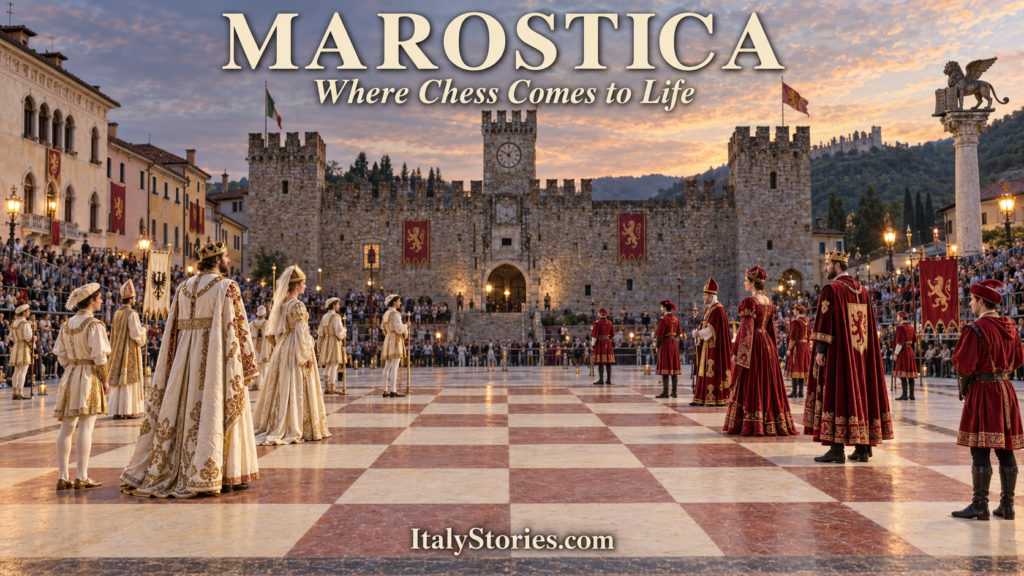
Imagine a chessboard large enough to walk across, with kings and queens who breathe, turn their heads and wait for the next move. Around them, a town square becomes a theatre. Costumes catch the light, banners rise above the crowd, and stone battlements frame a scene that seems to belong to another century. In Marostica, in Italy’s Veneto region, chess becomes a shared spectacle, transforming a familiar game into a story told by an entire community.
The setting is Piazza Castello, often called Piazza degli Scacchi, where the great chessboard forms part of the square itself. The Lower Castle provides the backdrop, giving the performance an architectural presence that a conventional stage could hardly reproduce. Even before the performers arrive, the space invites the imagination to work. The squares on the ground suggest movement, confrontation and possibility: a board waiting for its pieces to come alive.
At the heart of the performance is a romantic legend set in 1454. Two noblemen, Rinaldo d’Angarano and Vieri da Vallonara, fall in love with Lionora, daughter of the Venetian governor Taddeo Parisio. Their rivalry threatens to end in a duel, but the governor proposes a different contest. The question will be settled through chess, with living figures taking their places on the board. Within the story, a potentially deadly confrontation becomes a public test of intelligence.
This is the legendary setting of the spectacle, rather than evidence of an uninterrupted medieval custom. The modern living chess event began in 1923 through the initiative of Francesco Pozza. In 1954, the artist and writer Mario Mirko Vucetich helped reshape it into the elaborate theatrical production associated with Marostica today. Understanding that distinction makes the event more interesting: its identity brings together a medieval setting and generations of modern creativity.
What unfolds in the square extends well beyond the movement of chess pieces. Heralds, musicians, soldiers, noble families and standard-bearers help create a ceremonial world around the game. The costumes give each group a distinct presence, while the processions establish a sense of anticipation. The chessboard becomes the centre of a larger drama, surrounded by characters whose entrances and gestures help tell the story.
There is something particularly compelling about seeing a familiar game translated into human scale. On an ordinary board, a piece moves with a brief motion of the hand. Here, movement takes time and occupies real space. A figure must cross the distance between squares, watched by the audience and surrounded by other performers. Waiting becomes visible. So does the distance separating the two sides. Even someone with little knowledge of chess can respond to that transformation.
The spectacle also changes the relationship between the square and the people who fill it. A piazza normally allows many small activities to happen at once: conversations, footsteps, encounters and pauses. During the performance, those scattered rhythms gather around a single event. Spectators look towards the same space, follow the same movement and share the same anticipation. For a while, the town’s public centre becomes a place of collective attention.
Held on a biennial cycle, the production brings together hundreds of costumed participants. Its scale depends on the commitment of the community as well as theatrical direction, music and staging. Behind the finished spectacle lies the work needed to coordinate people, prepare costumes and bring a large performance into a historic setting. That effort is part of what gives a living tradition its meaning: people continue to choose to make it happen.
For visitors, Marostica offers an encounter with Italy that goes beyond looking at old buildings. The architecture becomes part of an unfolding story, and the town’s identity is expressed through movement, sound and performance. The medieval atmosphere is theatrical, but the human involvement is immediate. These are people sharing a place and a story with an audience gathered around them.
The chessboard remains a memorable image even when imagined without its performers. It turns the ground beneath your feet into a field of possibilities. During the spectacle, those possibilities acquire faces and costumes, and the familiar geometry of chess becomes unexpectedly expressive. A king waits. A pawn advances. The audience follows.
Marostica reminds us that a town can preserve its character through the stories it chooses to perform together. Here, an ancient game provides the language, a historic square provides the setting, and a community brings both to life.
Follow ItalyStories.com for more remarkable places, traditions and stories from across Italy.