

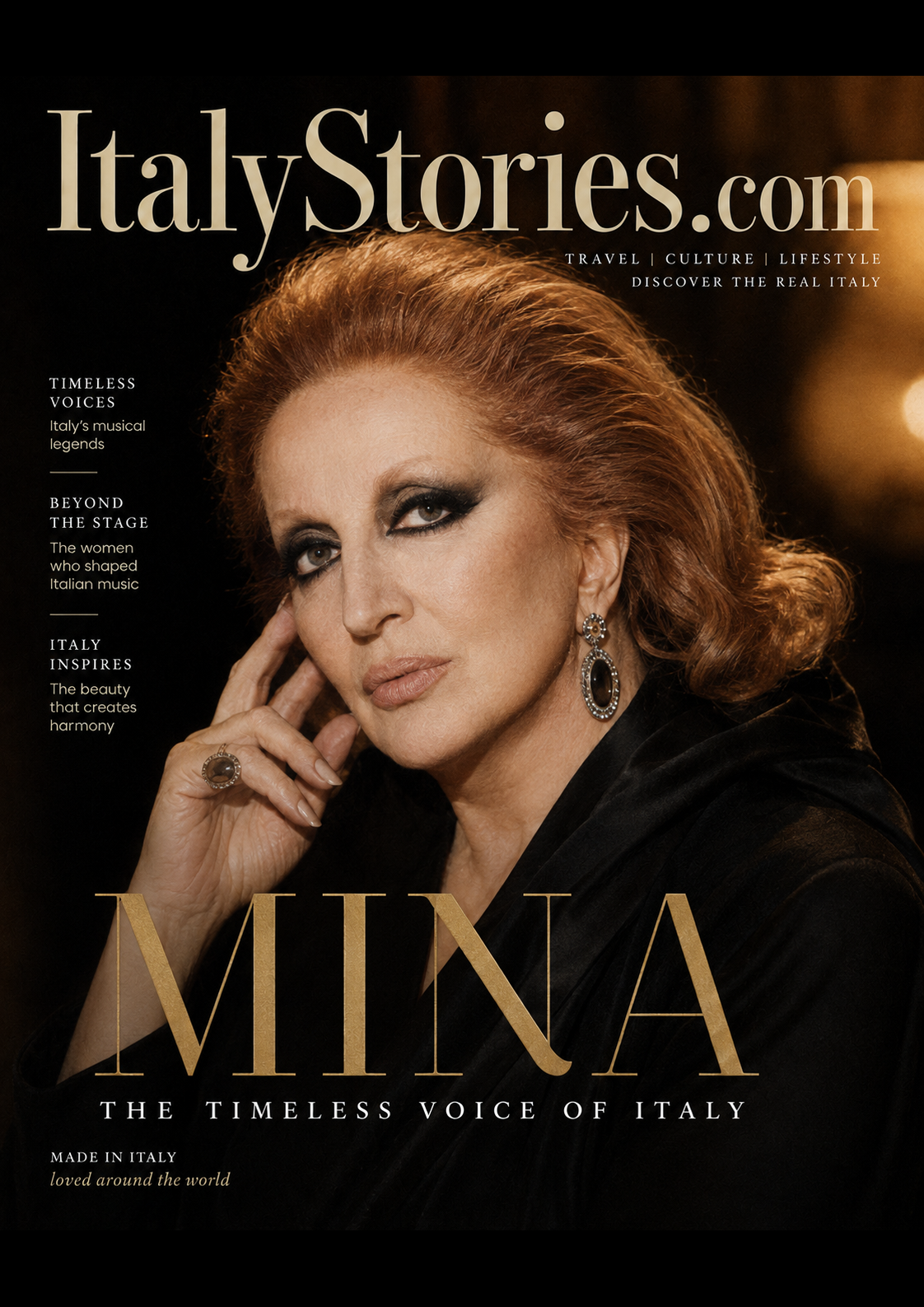
The Last Concert That Never Really Ended
On the evening of August 23, 1978, at Bussoladomani in Tuscany, Mina walked onto a stage and did something that no one in the audience could fully understand at the time: she sang as if it were a normal concert, while quietly bringing an entire public life to an end.
She was thirty-eight years old. By then she had already been a teenage sensation, a television star, a scandalized young mother, a sophisticated interpreter, a record-industry power in her own right and one of the most instantly recognizable voices in Italy. She had sung rock and roll, jazz, Brazilian music, ballads, television themes, American standards, songs by the greatest Italian writers and songs that became greater because she sang them. She had been everywhere: on the radio, in living rooms, in magazines, at festivals, in clubs, on the biggest variety shows on national television.
Then she left the stage.
What followed was not silence. That is what makes Mina’s story so unusual. She stopped appearing in public, but she did not stop recording. She withdrew from television, live concerts and the machinery of celebrity while continuing to release new music for decades. The face disappeared and the voice remained. In most careers, absence weakens fame. In Mina’s case, absence became part of the fame.
More than four decades after that last concert, new Mina albums could still enter the Italian charts, collaborations with younger artists could still become events, and archival performances could still circulate with the strange freshness of something that belongs both to history and to the present.
To understand how that happened, it is necessary to go back to the beginning – before the heavy eye makeup, before Studio Uno, before “Se telefonando,” before the nickname “Tigre di Cremona.” Back to a girl named Mina Anna Maria Mazzini, born in Lombardy and raised in a country that was about to change almost as quickly as she did.
Busto Arsizio, Cremona and a Girl Who Refused to Sing Politely
Mina Anna Maria Mazzini was born on March 25, 1940, in Busto Arsizio, in the province of Varese. When she was still a small child, her family moved to Cremona, the city that would become so strongly attached to her public identity that she would eventually be known everywhere as the “Tigre di Cremona” – the Tiger of Cremona.
The Italy of Mina’s childhood was still close to war, scarcity and social discipline. By the time she entered adolescence, however, the country was beginning to accelerate toward the economic boom. New consumer goods, new fashions, new forms of leisure and, above all, new music were entering Italian life. Radio and jukeboxes carried American voices into cafes and dance halls. Rock and roll disturbed the calm surfaces of traditional popular song. Young people were discovering a physical relationship with music that their parents often regarded with suspicion.
Mina belonged instinctively to that new world.
She was not trained to behave like a conventional, carefully controlled female singer. She liked rhythm, movement, jazz phrasing and the explosive energy of American music. Her early performances had a looseness that Italian audiences were not used to seeing from a young woman. She could stretch a note, attack a phrase, bend time and then suddenly explode upward. She was not merely louder than the singers who had come before. She sounded less obedient.
She first appeared in the late 1950s, sometimes using the English-sounding stage name Baby Gate for her rock-oriented material. The name now feels like a charming artifact of an era fascinated by imported modernity, but it reveals something important: at first, Mina did not fit comfortably into the traditional machinery of Italian song. The industry was still learning what to do with performers who belonged to the new generation of “urlatori” – the shouters.
The label was crude, but it captured the shock. Mina’s voice could be enormous. Yet even in the earliest recordings, there was more than volume. Behind the teenage energy was flexibility, rhythmic intelligence, a strong sense of pitch and a rare ability to change color from one phrase to the next.
Italy first noticed the force. It would take a little longer to understand the sophistication.
Baby Gate, the Urlatori and the Birth of a New Television Star
Mina’s rise coincided with the moment Italian television was becoming a national mirror. RAI did not simply broadcast entertainment; it helped define style, language, manners and celebrity for millions of viewers. A singer who succeeded on television did more than sell records. She entered family life.
Mina did that almost immediately. In 1959, songs such as “Tintarella di luna” helped turn her from a promising newcomer into a phenomenon. The title itself belonged perfectly to the optimistic new Italy: sun, youth, beaches, modern leisure. Yet Mina’s delivery made the material feel less innocent than the words suggested. There was swing in it, wit in it, a tiny sense of provocation.
By 1960 she was already appearing at the Sanremo Music Festival. Sanremo was the most powerful institution in Italian popular music, but Mina’s relationship with it would be surprisingly brief. She competed in 1960 and 1961, then never returned as a contestant. Her 1961 song “Le mille bolle blu” remains one of the best remembered from that phase, but Mina’s destiny was larger than any festival ranking.
Television gave her the ideal space. She could sing, move, joke, introduce guests and transform from one musical personality to another within minutes. She was glamorous without looking manufactured, funny without losing mystery, technically formidable without appearing academic.
This is where the public began to understand that the “shouter” label was far too small. Mina could be wild, but she could also be intimate. She could sing a sophisticated standard and then throw herself into a contemporary pop song. She could dominate a big orchestra or make a conversational lyric feel almost whispered into one listener’s ear.
That versatility would become her central artistic identity. Mina did not create a narrow genre and repeat it. She became the interpreter who could walk into almost any genre and make it sound as if it had been waiting for her.
“Il cielo in una stanza”: The Song That Changed the Scale of Her Career
In 1960, Mina recorded a song written by a young Gino Paoli: “Il cielo in una stanza.” It became one of the defining recordings of her life and one of the great standards of Italian popular music.
The song is built on a beautiful impossibility. Two people are together in a room, yet the walls seem to disappear. The ceiling opens into sky. Ordinary space is transformed by intimacy. It is a lyric of emotional expansion, and Mina understood that the song did not need to be attacked. It needed to bloom.
Her performance helped reveal an entirely different singer from the one who had first been marketed through rock and roll energy. The voice was still unmistakable, but now the power was controlled. She could let a phrase float, give weight to a vowel, and make the transition from conversational closeness to open-throated release feel inevitable.
The record became her first truly monumental hit. Official Mina discography records it as a 1960 release, arranged by Tony De Vita; Italian chart histories place it at number one for an extended run. Its success confirmed that Mina could move beyond novelty and youth culture. She was becoming a serious interpreter.
The relationship with songwriters would be crucial from this point onward. Mina rarely depended on writing her own repertoire. Her art was interpretation in the richest sense: selecting, inhabiting and transforming songs. Gino Paoli, Bruno Canfora, Ennio Morricone, Maurizio Costanzo, Ghigo De Chiara, Mogol, Lucio Battisti, Alberto Testa, Giorgio Calabrese, Paolo Limiti and many others would all become part of the larger story because Mina had the ability to make a composer’s idea feel newly complete.
That is one reason her catalog became so vast. She was never tied to a single songwriting team. She was a great reader of songs.
1963: When a Private Life Became a National Scandal
At the height of her early fame, Mina’s life collided with the moral boundaries of early-1960s Italy.
She had begun a relationship with the actor Corrado Pani, who was legally married though separated. In 1963, Mina gave birth to their son, Massimiliano Pani. Today the facts may appear private and unremarkable. In the Italy of the time, they were treated as a public scandal.
The legal and social climate was entirely different. Divorce had not yet been introduced. The public role of women was policed with an intensity that is difficult to reconstruct without understanding the cultural atmosphere of the period. A famous unmarried mother having a child with a married man became not merely gossip, but a test of public morality.
RAI removed Mina from its screens. Newspapers debated her conduct. Her private choices were transformed into a national argument about respectability.
Yet something unexpected happened: the audience did not abandon her.
When Mina returned to live performance, the public reception was warm and protective. Record buyers continued to support her. The attempt to discipline her image ultimately exposed the distance between institutional morality and popular feeling. An academic study of the scandal has since used Mina’s case to show how conventional ideas about women, motherhood and respectability were being challenged in precisely those years.
This episode is important not because scandal made Mina interesting, but because her refusal to disappear helped change the meaning of female celebrity in Italy. She did not apologize herself out of existence. She remained visible, talented and commercially successful until the institution that had excluded her had to accept the obvious: the public still wanted Mina.
Her eventual return to television was therefore more than a professional comeback. It was a cultural reversal.
Studio Uno: The Living Room of Italy Belonged to Mina
By 1965, Mina was back at the center of Italian television in Studio Uno under the direction of Antonello Falqui. The program became one of the great showcases of her career and one of the defining entertainment formats of its era.
Studio Uno allowed Mina to do what few singers could do so naturally: be both the star and the host. She introduced guests, moved through sketches and musical sequences, and then – sometimes with almost no visible effort – delivered a performance that changed the emotional temperature of the room.
The show also demonstrated the extraordinary breadth of her repertoire. She could sing Italian songs, American standards, jazz material and specially written showpieces. Bruno Canfora’s “Brava” became a famous display of her agility, control and range. It was not simply a difficult song; it was a challenge constructed around the fact that Mina could do things other popular singers could not.
RAI’s archival material now makes clear how central Mina was to the visual language of 1960s Italian television. She appeared with major actors, comedians and musicians, not as a singer temporarily visiting variety television but as one of the medium’s natural rulers.
Her glamour also evolved. The young woman associated with striped shirts, beach songs and rock energy became a more sophisticated visual figure, helped by stylists, photographers and television directors who understood the power of her face. The eyes, hair, gestures and graphic makeup gradually became iconography.
But the image never replaced the voice. Mina’s television success rested on the fact that she could survive any close-up because the musical performance was real. She could be playful one minute and devastating the next.
This combination – technical authority, humor, sensuality and apparent spontaneity – made her more than a singer on television. She became television itself.
“Se telefonando”: Three Minutes of Modernity
Few recordings explain Mina better than “Se telefonando,” released in 1966.
The music was composed by Ennio Morricone, with lyrics by Maurizio Costanzo and Ghigo De Chiara. The song had been conceived in connection with the television world, but Mina’s recording turned it into something much larger: one of the masterpieces of sophisticated Italian pop.
Morricone’s melody is built around a recurring musical cell that keeps lifting the emotion without providing easy release. The lyric describes a love that has already ended almost as soon as it has begun. The repeated conditional phrases – if I could call you, if I could see you, if I could tell you enough – create a kind of emotional trap.
Mina sings the song with remarkable control. She does not begin in melodrama. She lets the tension accumulate. Each return of the melodic figure feels stronger because the voice grows around it. By the end, the listener has the sense not that the song has become louder, but that the emotional space has become larger.
The recording also demonstrates the intelligence of her diction. Mina can make Italian consonants percussive when rhythm requires it, then dissolve them into long vowels when the melody needs air. She never loses the words inside the sound.
“Se telefonando” is now inseparable from Mina, even though many other singers have interpreted it. That is a characteristic of her best recordings: after she sings a song, later versions often feel like conversations with her version rather than fresh starts.
PDU: When Mina Took Control of the Record-Making Machine
As the 1960s progressed, Mina became not only a star but a more autonomous professional force. Her work eventually became closely associated with PDU, the label and production structure that gave her unusual control over recordings, repertoire, artwork and long-term career strategy.
This independence matters. Pop stars are often described as powerful because they are famous; real power in the record business comes from controlling what is recorded, how it is released and how the catalog is managed. Mina increasingly operated from that position.
Her move toward Switzerland and the development of recording activity around Lugano helped create a protected space away from the noise of Italian celebrity. Over time, the studio became part of the Mina myth: an artist physically absent from public life but intensely present in the work.
The PDU era also encouraged one of the most remarkable features of her career – sheer discographic continuity. Mina recorded with a consistency that would be exhausting for many artists. She moved through annual projects, double albums, themed records, collaborations, standards, contemporary songs and reinterpretations.
Instead of treating an album as a rare autobiographical confession, she often treated recording as a craft practiced continuously. That old-fashioned work ethic is crucial to understanding her longevity. Mina did not wait for the culture to declare that a comeback was necessary. She was already in the studio.
The result is a catalog so large that no single greatest-hits collection can represent it adequately. The famous songs are only the visible peaks of a much wider landscape.
The Battisti-Mogol Connection: When Great Songs Met Their Great Interpreter
The early 1970s brought some of Mina’s most enduring recordings and some of her most important encounters with the songwriting world of Lucio Battisti and Mogol.
Songs such as “Insieme,” “Io e te da soli” and “Amor mio” allowed Mina to inhabit the emotional architecture that Battisti and Mogol were redefining in Italian pop. Battisti’s compositions could be rhythmically surprising and melodically unconventional; Mogol’s lyrics often made private feelings sound plainspoken and immediate. Mina brought to them a different kind of scale.
She could make the material more theatrical without making it false. In her hands, a Battisti-Mogol song could feel both intimate and enormous. The collaboration is also a reminder that the history of Italian popular music is not a collection of isolated stars. It is a network: composers writing for interpreters, singers borrowing songs from cantautori, arrangers shaping identities, television carrying music into homes.
Mina’s special role within that network was as the interpreter whom important authors wanted to hear sing their work. Her version could reveal new possibilities in a song. She did not simply reproduce the demo more beautifully. She rebalanced it around her timing, her breath, her emotional intelligence.
That talent made her a kind of laboratory for Italian songwriting. If a song could survive Mina, it could often become larger than its original context.
“Grande grande grande” and the Art of Emotional Excess
In 1971 Mina recorded “Grande grande grande,” written by Tony Renis and Alberto Testa. The song became another of her defining performances.
Its emotional logic is deliberately excessive. The narrator complains, accuses, remembers, resists and finally surrenders to the scale of love. The repetition of “grande” might become sentimental in a weaker performance. Mina makes it psychologically precise.
She understands that the song is not about a calm declaration of affection. It is about contradiction – loving someone who irritates, overwhelms and remains impossible to reduce. Mina’s phrasing gives the lyric an adult complexity. She can sound ironic inside one line and wounded in the next.
This ability to live inside contradiction is one of her great interpretive gifts. Mina rarely sings love as a single emotion. Desire can contain annoyance; tenderness can contain pride; surrender can contain resistance. Her mature repertoire is full of women who know what is happening to them even when they cannot stop it.
That is part of why her recordings aged so well. They are not innocent fantasies. They often contain emotional intelligence beneath the glamour.
“Parole parole”: A Duet That Became Everyday Language
In 1972, Mina recorded “Parole parole” with actor Alberto Lupo for the television program Teatro 10. The song would become one of the most imitated and internationally adapted pieces of Italian popular music.
Its structure is theatrical. Mina sings while Lupo speaks. His seductive declarations accumulate; she responds with increasing skepticism. The title – “Words, words” – becomes the verdict on romantic rhetoric that has lost credibility.
What makes the recording work is the chemistry of tone. Lupo’s deep, polished voice performs masculine seduction almost as a parody of itself. Mina does not merely reject him. She plays with the language, allowing amusement, attraction and impatience to coexist.
The song travelled far beyond Italy through adaptations in other languages, including the famous French version associated with Dalida and Alain Delon. Yet the Mina-Lupo original remains culturally definitive because it captured a television moment, a gender dynamic and a musical idea all at once.
It also shows Mina’s instinct as an actress of song. She did not need cinema or theater to create character. A microphone was enough.
Milleluci: The Final Great Television Season
By 1974, Mina had spent well over a decade at the center of Italian television. That year she co-hosted Milleluci with Raffaella Carrà, bringing together two women who represented different but equally powerful forms of Italian show-business modernity.
The pairing was extraordinary. Carrà was kinetic, smiling, choreographic, unmistakably television-born. Mina was increasingly monumental, musically dominant and already moving toward withdrawal. Together they created one of RAI’s legendary variety shows.
Rai Teche identifies Milleluci as Mina’s last great television show. After years in which her face had been one of the most familiar in the country, she was preparing to leave the medium that had helped create her myth.
This decision is easy to romanticize in retrospect, but it should be understood in practical terms as well. Television production was exhausting. Mina had been exposed to extraordinary public scrutiny since she was a teenager. She had already learned how destructive the relationship between celebrity and private life could become.
Withdrawal offered freedom.
The paradox is that stepping away from television did not make Mina smaller. It concentrated attention on the voice. Once the stream of appearances stopped, each photograph, recording or rare piece of information acquired greater weight.
A star who had once been everywhere was learning the power of not being seen.
Bussoladomani 1978: The Door Closes
Mina continued live performance after leaving regular television, but even that phase ended in 1978. Her final public concert took place at Bussoladomani on August 23, an event preserved on the album Mina Live ’78.
The significance of that concert grew afterward. At the time, audiences could not know that it would become the definitive boundary between Mina the public performer and Mina the recording artist.
There was no farewell tour stretched across a year, no industry campaign about a final bow, no giant retrospective designed to monetize departure. Mina simply stopped.
The reasons have been discussed endlessly: exhaustion, dislike of touring, a desire for privacy, impatience with celebrity, personal temperament. It is probably a mistake to reduce the decision to one dramatic cause. What matters is that she maintained it.
For a performer with her earning power and public demand, staying away required more resolve than returning would have. Every few years the culture could have offered her a triumphant comeback. She refused the ritual.
That refusal changed how the public listened. Mina became a voice without a present-day body attached to it. The absence was not mystical in itself, but the consistency of the choice made it powerful.
She had discovered a form of artistic sovereignty almost unknown in popular entertainment: she could remain central without being available.
The Voice: Power, Range, Rhythm and the Intelligence of a Phrase
Mina’s reputation rests ultimately on the instrument itself and on what she learned to do with it.
Her voice has extraordinary range and flexibility, but raw range is only part of the story. The greater achievement lies in control of color. Mina can sound metallic, smoky, bright, soft, amused, angry, breathy or almost instrumental. She can move from chest resonance to lighter upper textures without making the listener feel that the technique has interrupted the emotion.
Rhythm is equally important. Her early experience with rock and roll and jazz left permanent traces. Mina can sit behind the beat, push against it or stretch a phrase across the bar line. She often treats a melody not as a fixed sequence of notes but as material to be spoken, bent and lived through.
Her diction is famously clear, yet she can also use words as sound. Consonants can sharpen a rhythm; vowels can carry emotional weight. She can make a repeated word mean something different each time.
Another essential quality is fearlessness. Mina does not appear intimidated by difficult material. Whether facing Morricone, Gershwin, Brazilian repertoire, a Battisti melody or a theatrical pop ballad, she approaches the song as though interpretation is an act of possession.
This is why technical descriptions alone fail. Mina’s voice is not important because it is large. It is important because it thinks.
The Great Disappearance That Became a New Kind of Presence
After 1978, the entertainment world expected that Mina’s absence would eventually end. It did not.
She continued to record from Switzerland, and over the decades the public became accustomed to a strange arrangement: one of Italy’s biggest singers was permanently active and permanently absent. New albums arrived, but no promotional tour followed. Photographs were controlled or stylized. Covers became a field of visual invention, sometimes showing Mina transformed, illustrated, altered or replaced by concepts rather than conventional glamour portraits.
This strategy did not begin as a marketing theory, yet it became one of the most effective anti-marketing identities in pop history. Mina deprived celebrity culture of what it usually demands most: access.
The choice protected her private life, but it also changed the artistic hierarchy. Without interviews and red carpets to consume, the public had to return to the records.
There is a deeper cultural reason the strategy worked. Mina had already given Italy so many images of herself during the television years that absence did not erase her. The archive remained alive. RAI reruns, photographs and old performances allowed each generation to discover the visible Mina, while new recordings allowed the invisible Mina to remain contemporary.
She became two artists at once: a historical television icon and a current recording voice.
Mina and Celentano: Two Giants Meet Without Competing
Among Mina’s later projects, her collaborations with Adriano Celentano occupy a special place. The two artists had been central figures in Italian popular culture since the late 1950s, each representing a different kind of rebellion against the older musical order.
Their 1998 album Mina Celentano became a major event, not simply because two famous names were printed together but because their vocal personalities were so different. Celentano’s elastic, conversational phrasing and rough theatrical instinct met Mina’s precision, scale and interpretive sophistication.
They returned together with Le migliori in 2016. The album topped Italy’s annual FIMI album ranking for that year, demonstrating how extraordinary their reach remained decades after both had first become famous.
The collaboration works because neither singer tries to erase the other. Mina does not become more casual to match Celentano, and Celentano does not attempt to out-sing Mina. The pleasure lies in contrast.
Their partnership also reminds us that Italian pop history is unusually long-lived. Artists who emerged when television was black-and-white could still dominate the album market in the streaming age.
That continuity is not nostalgia alone. It is the result of catalogs strong enough to carry new work into the present.
Mina Fossati and the Late-Career Art of Choosing
In 2019 Mina released Mina Fossati with Ivano Fossati, another encounter between two major figures from different branches of Italian songwriting.
Fossati’s writing is literate, rhythmically subtle and often emotionally oblique. Mina’s interpretive intelligence suits that world because she does not need a song to declare itself immediately. She can live inside ambiguity.
The album felt less like a celebrity pairing than a conversation between mature artists. That distinction matters. By this stage of her career, Mina no longer needed projects to prove relevance. Relevance was almost beside the point. What mattered was repertoire.
Her later discography continued through projects such as Italian Songbook, Ti amo come un pazzo and Gassa d’amante. Treccani’s updated profile lists these among the recent chapters of a recording career that never accepted the conventional idea of retirement.
In 2026, the official Mina catalog also presented 1963/1967 Mina Inediti, a collection of rare and previously unreleased recordings from the Ri-Fi period, produced by Massimiliano Pani and restored and remastered at the PDU studios in Lugano. The release created a beautiful loop in the story: archival voices from Mina’s early career re-entering the present through the studio world she had built around herself.
Even her past, in other words, continued to produce new listening.
The People Around Mina
Mina’s career is often described as though a unique voice simply passed through history collecting masterpieces. The reality is more collaborative and more interesting.
Gino Paoli gave her “Il cielo in una stanza.” Bruno Canfora wrote and arranged material that displayed both her technique and television personality. Ennio Morricone, Maurizio Costanzo and Ghigo De Chiara created “Se telefonando.” Mogol and Lucio Battisti supplied songs that helped define her early-1970s maturity. Tony Renis and Alberto Testa gave her “Grande grande grande.” Alberto Lupo became the perfect spoken countervoice in “Parole parole.”
Arrangers such as Augusto Martelli and later musicians and producers around PDU shaped the soundscape in which her voice operated. Massimiliano Pani eventually became an important producer and guardian of the recording legacy. Photographers, television directors such as Antonello Falqui, costume designers and graphic artists helped create the visual Mina alongside the musical one.
The point is not to reduce Mina’s authorship of interpretation. It is to understand its scale. Great interpreters are relational artists. They hear what others bring and decide what to reveal.
Mina’s genius was partly curatorial. She recognized strong material and then made it difficult to imagine without her.
A Woman Before the Culture Was Ready for Her
Mina’s place in Italian history cannot be separated from gender.
She emerged in a society that expected female performers to remain desirable but respectable, glamorous but controlled, modern but not threatening. Mina repeatedly exceeded those boundaries. Her body moved too freely for early television conventions. Her voice was too commanding to be decorative. Her private life refused moral discipline. Later, her withdrawal refused the opposite demand – that a famous woman must remain permanently visible and available.
This is why the 1963 scandal matters historically. Mina became a test case for how modern Italy treated a woman who made private choices outside accepted norms. The attempt to punish her did not destroy her popularity. In the long run, it strengthened the perception that she belonged to the public more deeply than institutions did.
Her later refusal of celebrity also has a gendered dimension. Female stars are often subjected to relentless visual judgment as they age. Mina stepped outside that system. The public had to confront the voice without being offered a continuously updated body to evaluate.
That decision made her unusual not only in Italy but internationally.
She had first broken rules by appearing too modern. She later broke them by disappearing.
Why Mina Still Matters
Mina matters because she changed several things at once.
She changed the idea of what a female Italian pop singer could sound like. She brought rhythmic freedom, jazz intelligence, physical power and emotional complexity into the center of mainstream entertainment.
She changed television. At her peak, she was not merely a guest who sang between sketches; she was one of the defining presences of Italian variety TV.
She changed the role of the interpreter. In an era increasingly fascinated by singer-songwriters, Mina proved that interpretation could itself be authorship – not ownership of the written page, but ownership of meaning.
She changed celebrity by withdrawing from it. The decision to stop appearing publicly did not end her career. It separated artistic production from public availability in a way few stars have ever managed.
And she changed the afterlife of songs. “Il cielo in una stanza,” “Se telefonando,” “Grande grande grande,” “Parole parole,” “Amor mio,” “Insieme,” “Io e te da soli” and many others remain alive not only because they were well written, but because Mina gave them performances that became reference points.
The most extraordinary fact is that the story never truly settled into the past. Mina has been absent from the stage since 1978, yet she has never become merely an archival artist. New records kept arriving. New generations kept discovering old television clips. New singers kept measuring themselves against songs associated with her.
The last concert, then, did not end the relationship between Mina and the public. It only changed its form.
She left the room, and somehow the voice made the room larger.
A Final Thank You from ItalyStories.com
Thank you for spending time with this story. ItalyStories.com was created to explore the people, places, voices and traditions that have shaped Italy far beyond its borders. If Mina’s extraordinary journey has made you curious about another chapter of Italian culture, we would be delighted to welcome you to the next story.
[…] Celentano brought rock-and-roll body language and a refusal to behave like the old-style crooner. Mina transformed the idea of the Italian female singer through extraordinary vocal command and a modern, […]