

The Tuscan Hill Town Where History, Beauty and Brunello Meet
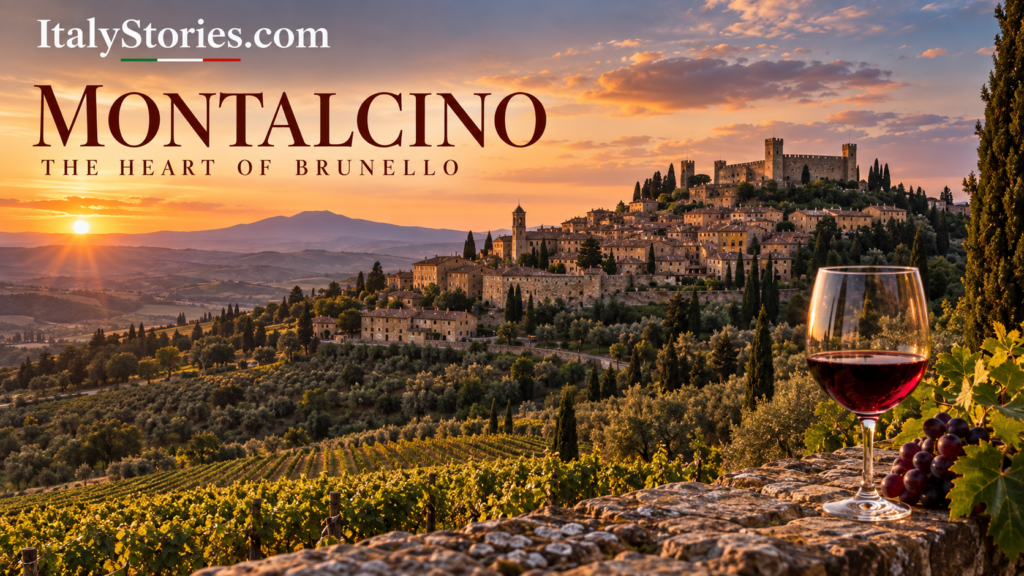
Montalcino rises above the countryside of southern Tuscany like a stone ship floating over a sea of vineyards, olive groves and softly folding hills. From its medieval walls, the landscape seems to extend without end: the Val d’Orcia in one direction, the valleys of the Ombrone and Asso in another, and the dark profile of Monte Amiata on the horizon. The town is known throughout the world as the birthplace of Brunello di Montalcino, one of Italy’s most prestigious wines, but wine is only one chapter of a much older and more dramatic story.
Long before Brunello bottles appeared in celebrated restaurants and private cellars, Montalcino was a strategic fortress, a proud ally of Siena, a refuge for a defeated republic and a centre for leatherworking and agriculture. Its narrow streets preserve medieval buildings, churches, workshops and small squares where history does not feel separated from daily life. The surrounding territory contains one of Tuscany’s most beautiful Romanesque abbeys, ancient farms, cypress-lined roads and vineyards cultivated with an almost architectural precision.
Montalcino is not a stage set created for visitors. It is a real hill town that survived wars, political isolation and economic hardship before transforming its most difficult agricultural land into the source of an internationally admired wine.
A Hill Above Southern Tuscany
Montalcino occupies an exceptionally commanding position approximately 40 kilometres south of Siena. The town stands on a hill at an elevation of more than 500 metres, high enough to offer immense views across the surrounding countryside.
The landscape changes with the seasons. In spring, the hills are intensely green and wildflowers appear along the roads. Summer turns fields to gold while the vineyards deepen in colour beneath the Tuscan sun. Autumn brings the grape harvest, morning mist and changing leaves. In winter, the countryside becomes quieter and more austere, revealing the shape of the land beneath the vegetation.
The name Montalcino is commonly connected with the Latin expression Mons Ilcinus, meaning the mountain of holm oaks. These evergreen trees once covered much of the hill and still form part of the natural landscape. The exact origin of the name remains open to interpretation, but the association with the ilex, or holm oak, has endured for centuries and appears in the town’s traditional identity.
The hill was probably inhabited during the Etruscan period. Its position made it a natural point of observation and defence, controlling routes through a territory that connected inland Tuscany with the areas toward the coast and Rome.
Montalcino appears in written records from the early ninth century, when the surrounding territory was linked to the powerful Abbey of Sant’Antimo. During the following centuries, the settlement expanded and fortified itself, gradually developing into the town whose medieval structure can still be recognised today.
Between Siena and Florence
Medieval Tuscany was not a peaceful landscape of wine tastings and sunset photographs. It was divided among rival cities, noble families, religious authorities and military powers. Siena and Florence fought repeatedly for influence over the territory, and Montalcino’s strategic position made it highly desirable.
The town generally remained loyal to Siena. That loyalty came at a considerable price. Montalcino endured attacks, sieges and destruction as control of southern Tuscany shifted between competing forces.
Its defensive walls were strengthened, and in 1361 the Sienese constructed the great fortress that still dominates the highest part of town. The architects Mino Foresi and Domenico di Feo created a compact pentagonal structure incorporating parts of earlier fortifications, including existing towers and sections of the town walls.
The Fortezza di Montalcino was not designed to be a romantic castle. It was a serious military machine, with thick walls, powerful towers and wide views over every possible approach. Its architecture is severe and remarkably harmonious. From its ramparts, the strategic importance of the site becomes immediately clear.
The fortress appears to grow directly from the hill. It guarded the town through one of the most dramatic periods in Tuscan history and later became the symbol of Montalcino’s resistance.
The Last Republic of Siena
In 1555, after a long and devastating war, Siena fell to the forces of Florence and its Spanish allies. For many Sienese citizens, soldiers and officials, however, surrender was unacceptable.
Hundreds escaped to Montalcino, where they established a government in exile known as the Republic of Siena in Montalcino. Protected by the town’s fortifications and supported by France, they attempted to preserve the political institutions and independence of their defeated republic.
For almost four years, Montalcino became the final capital of free Siena. The exiled government continued issuing documents, maintaining diplomatic relations and defending the idea that the republic still existed, even though its principal city was now controlled by the Medici.
The resistance ended only in 1559, following the wider European peace settlement of Cateau-Cambrésis and the withdrawal of French support. Montalcino passed into the political system dominated by Cosimo I de’ Medici and eventually became part of the Grand Duchy of Tuscany.
This episode remains central to the town’s character. Montalcino was not simply a minor settlement absorbed by a larger power. For a brief, extraordinary period, it carried the identity of an entire republic within its walls.
The fortress still seems to preserve something of that stubbornness. It is compact, austere and proud, standing above the vineyards as a reminder that the town’s history was shaped by resistance long before it became associated with wine.
Inside the Medieval Town
Montalcino’s historic centre is best discovered slowly. Its streets climb, descend and turn unexpectedly between buildings of warm stone and brick. Arches open onto quiet courtyards, stairways disappear between houses and small windows frame fragments of the surrounding countryside.
At the heart of town is Piazza del Popolo, dominated by the Palazzo dei Priori, the medieval town hall. Its slender tower rises above the square, while coats of arms decorating the façade recall the officials and political powers that governed Montalcino over the centuries. Nearby loggias create a sheltered public space that has long served the commercial and social life of the community.
The square is not monumental in the manner of Siena’s Piazza del Campo. Its scale is more intimate. Cafés, shops and public buildings share the space, preserving the feeling of a living town rather than an open-air museum.
The Church of Sant’Agostino, with its simple Romanesque-Gothic façade, dates largely from the fourteenth century and contains important religious artworks. The former convent beside it forms part of the town’s museum complex, preserving paintings, sculptures and archaeological material from the surrounding territory.
Montalcino’s cathedral, dedicated to the Santissimo Salvatore, presents a different architectural language. Rebuilt in neoclassical form during the nineteenth century, it demonstrates that the town did not stop developing at the end of the Middle Ages.
The real pleasure of Montalcino, however, often lies between the recognised monuments. It can be found in a worn stone doorway, a glimpse of vineyards at the end of an alley, laundry moving above a medieval wall or the sudden opening of a panoramic terrace.
The Abbey of Sant’Antimo
A few kilometres from Montalcino, near the small village of Castelnuovo dell’Abate, stands the Abbey of Sant’Antimo. Surrounded by vineyards, olive trees and fields, it is one of the finest examples of Romanesque religious architecture in Tuscany.
According to a famous tradition, the abbey was founded or greatly favoured by Charlemagne. The emperor is said to have stopped in the area while returning from Rome during the eighth century. When members of his army became ill, they supposedly recovered after drinking an infusion prepared with local herbs, prompting Charlemagne to establish a religious foundation in gratitude.
The story is captivating, but the precise historical role of Charlemagne remains uncertain. The site’s religious origins are older and more complex, and documentary evidence confirms the abbey’s importance during the Carolingian period. A document issued in 814 by Louis the Pious, Charlemagne’s son and successor, granted privileges and possessions to the monastery.
Sant’Antimo became an influential Benedictine abbey controlling churches, farms, castles and large areas of land. Its position near routes used by pilgrims, merchants and officials contributed to its importance.
The present church was constructed principally during the twelfth century. Its pale stone walls possess a luminous quality that changes throughout the day. The interior is severe, balanced and deeply atmospheric. Tall columns guide the eye toward the apse, while carved capitals include plants, animals and symbolic figures.
The abbey’s setting is inseparable from its beauty. There is no dense town around it, only cultivated countryside and the quiet rhythm of rural Tuscany. The building appears not to dominate the landscape but to belong to it.
Before Brunello, There Was Moscadello
Montalcino’s connection with wine is much older than the modern fame of Brunello. The area’s inhabitants cultivated vines for centuries, and historical accounts praised the quality of its wines long before a formal denomination existed.
For a considerable period, Montalcino was especially known for Moscadello, a sweet white wine made from aromatic Moscato grapes. It was admired during the Renaissance and later centuries, appearing in literary references and on the tables of aristocratic families.
The development of Brunello gradually changed the town’s international identity. By the nineteenth century, local growers were experimenting with a particular form of Sangiovese that adapted well to Montalcino’s climate and soils.
The name Brunello was originally used locally for what many believed to be a distinct grape variety. It was eventually understood to be a local expression of Sangiovese, sometimes called Sangiovese Grosso because of certain characteristics associated with the berries.
The revolutionary step was not simply growing Sangiovese, which was already widespread across Tuscany. It was using the grape alone and creating a wine capable of developing through exceptionally long ageing.
The Birth of Brunello di Montalcino
The history of modern Brunello is closely connected with the Santi and Biondi-Santi families. During the nineteenth century, Clemente Santi experimented with selecting Sangiovese vines and producing wines intended for long maturation. A red wine presented by him received recognition at an agricultural exhibition in 1865.
His grandson Ferruccio Biondi-Santi continued developing the idea. Ferruccio had fought with Giuseppe Garibaldi during the Risorgimento before returning to the family estate. He refined the selection of Sangiovese and produced a wine that differed from the traditional Tuscan practice of blending several grape varieties.
The vintage of 1888 is generally regarded as the beginning of Brunello di Montalcino in its recognisably modern form. The wine was aged for many years in large wooden casks, emerging with unusual concentration, structure and longevity.
Production remained extremely limited. Brunello was not initially a popular local drink made in large quantities. It was rare, expensive and released only in years considered suitable. For decades, the Biondi-Santi family produced only a handful of celebrated vintages, including 1888, 1891, 1925 and 1945.
These wines helped establish Brunello’s reputation for extraordinary ageing. Bottles could develop for decades, gradually exchanging youthful power for complex aromas of dried fruit, leather, tobacco, forest floor, herbs and spice.
After the Second World War, more Montalcino producers began to recognise the potential of the style. The number of estates increased, vineyards expanded and Brunello slowly moved from a local rarity to an international symbol of Italian wine.
Brunello di Montalcino received DOC recognition during the 1960s and was among the first Italian wines to obtain the higher DOCG classification in 1980. These regulations protected its geographic origin, production methods and identity.
One Grape, Many Expressions
Brunello di Montalcino must be produced entirely from Sangiovese grown within the territory of the municipality. No international grape variety may be added to soften, darken or modify the wine.
This rule gives Brunello a remarkably clear identity, but it does not mean every bottle tastes the same. The territory of Montalcino contains significant variations in altitude, exposure, soil and temperature.
Northern vineyards are generally cooler and often produce wines with particular elegance, fragrance and acidity. Southern areas receive more warmth and Mediterranean influence, frequently giving richer and more powerful fruit. Vineyards closer to Monte Amiata benefit from the mountain’s protective presence, while different combinations of limestone, marl, clay, sand and decomposed rock influence drainage and vine growth.
Altitude can vary considerably. Grapes grown on higher slopes experience cooler nights and slower ripening, helping preserve acidity and aromatic freshness. Lower and warmer sites may produce greater concentration and softness.
Each estate must interpret these conditions through decisions in the vineyard and cellar. Harvest dates, extraction, fermentation, barrel size and ageing philosophy can all change the final personality of the wine.
Traditional producers often favour large Slavonian oak casks, which allow slow development without contributing an obvious flavour of new wood. Other estates use smaller French oak barrels for at least part of the maturation, creating different textures and aromatic profiles.
The debate between tradition and modernity has animated Montalcino for decades. Yet the finest wines are not defined by the size or nationality of their barrels. They succeed when the technique respects the identity of Sangiovese and the character of the vineyard.
The Patience Behind Every Bottle
Brunello cannot be released immediately after fermentation. The production rules require an extended period of maturation, including at least two years in wooden containers and additional time in the bottle.
The standard wine reaches the market only after several years have passed from the harvest. Brunello Riserva requires an even longer period before release. Producers therefore wait years before receiving a return on their work, while the wine occupies cellar space and continues developing.
This long process helps explain the price of Brunello, but it also forms part of its philosophy. The wine belongs to a culture of patience. The vine takes years to establish itself, a growing season can be changed by a few days of rain, and a young wine may need a decade or more before revealing its full character.
Not every vintage behaves in the same way. Warm years may give generous fruit and early accessibility, while cooler seasons can produce wines requiring greater patience. The best bottles can continue evolving for several decades when stored properly.
Brunello’s colour is generally garnet rather than opaque purple. Its strength lies not in exaggerated darkness but in aroma, acidity, structure and the ability to transform with age.
Rosso di Montalcino
The territory also produces Rosso di Montalcino, another wine made entirely from Sangiovese. Rosso requires less ageing and can be released much earlier.
It is sometimes described as Brunello’s younger brother, although that expression can be misleading. Rosso di Montalcino is not simply an inferior version of the more famous wine. It offers producers flexibility and allows Sangiovese to be expressed in a fresher, more immediate style.
An estate may select particular vineyards or barrels for Rosso, or decide during maturation that a wine is better suited to earlier release. For visitors wishing to understand the character of Montalcino without waiting for a Brunello to mature, Rosso can be a lively and revealing introduction.
Moscadello di Montalcino also survives, preserving the town’s older tradition of aromatic sweet wine.
Food at the Montalcino Table
Wine in Tuscany is rarely treated as an isolated object. It belongs at the table, beside food shaped by the same landscape.
The cuisine around Montalcino is rural, substantial and based on powerful but uncomplicated flavours. Handmade pici pasta may be served with a slow-cooked meat sauce, garlic and tomato, or crumbs toasted in olive oil. Wild boar appears in stews and ragù, while grilled meats benefit from the structure and acidity of Sangiovese.
Pecorino from the surrounding area, cured meats, Tuscan bread, legumes, mushrooms and local extra-virgin olive oil complete the traditional table. In autumn, dishes may include chestnuts, truffles and game.
Brunello pairs naturally with mature cheeses, roasted meat and slow-cooked dishes, but the relationship is cultural as much as technical. The same hills that produce vines also support olive trees, livestock, woodland and grain. A meal brings these elements together.
The Landscape That Created the Wine
Montalcino forms part of the wider cultural landscape of the Val d’Orcia, recognised as a UNESCO World Heritage Site in 2004. The area is admired for its harmonious combination of cultivated hills, farmhouses, medieval settlements, cypress trees and roads shaped over centuries.
This landscape appears natural, but it is also the product of generations of human work. Fields were planned, slopes cultivated, farmhouses positioned and routes developed according to agricultural and social needs. Renaissance artists celebrated similar landscapes as images of good government and an ideal relationship between humanity and nature.
The modern vineyard continues that process. Rows of vines create geometric patterns across the hills, changing colour with the seasons. Yet successful viticulture depends on preserving the land’s balance. Soil erosion, water management, biodiversity and changing temperatures have become increasingly important concerns.
Montalcino’s international success has brought prosperity, but it has also created responsibility. The landscape cannot be treated as decoration surrounding a profitable product. Without the territory, Brunello loses its meaning.
More Than a Famous Name on a Bottle
For many people abroad, the word Montalcino first appears on a wine list or label. Arriving in the actual town can therefore feel like stepping inside a name already familiar.
Yet the place quickly becomes larger than the wine. There is the fortress built for war, the memory of the Republic of Siena, the silence of Sant’Antimo, the stone streets, the panoramic terraces and the changing light over Monte Amiata.
Brunello did not create Montalcino’s history. It gave the town a new chapter after centuries of political and economic decline. Vineyards restored agricultural value to difficult land, attracted international attention and allowed old estates and buildings to find new life.
The relationship has been transformative, but Montalcino has retained its scale and identity. It remains a town where people live, work, attend school, argue in cafés and watch the seasons determine the rhythm of the countryside.
At sunset, the stone buildings turn gold and the vineyards fall gradually into shadow. The fortress remains above them, no longer defending a republic but still guarding the town’s memory. Somewhere below, in dark and quiet cellars, wines from recent harvests wait for time to complete their work.
That combination of patience, landscape and history is the real soul of Montalcino. The wine became famous because it could carry something of the place beyond Tuscany. Opened years later and thousands of kilometres away, a great Brunello can still evoke sunlit hills, cool cellars, stone walls and the long silence of the Val d’Orcia.
Follow ItalyStories.com to discover more remarkable Italian villages, landscapes, traditions and flavours.