

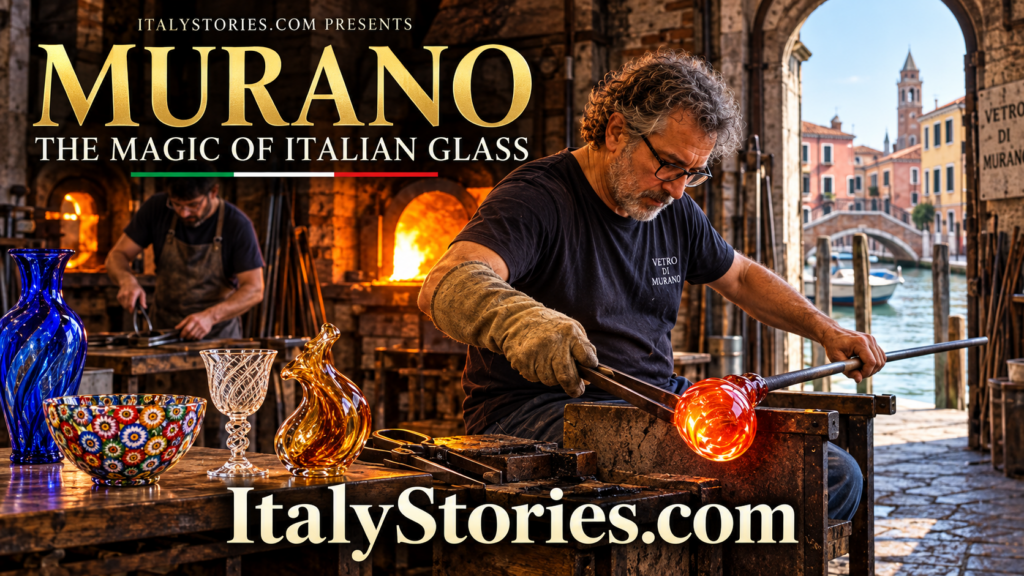
Murano Glass and the Island Forged by Fire
Murano glass is often described as magical, and the word is understandable. Inside a furnace, a nearly shapeless mass is taken from temperatures exceeding one thousand degrees Celsius and transformed into something transparent, coloured, weightless and apparently effortless. A master glassmaker turns a metal pipe, controls gravity, breathes into the molten material and uses tools whose designs have changed surprisingly little over the centuries. Within minutes, the glowing substance becomes a vase, a goblet, an animal, a chandelier component or an abstract sculpture. The performance can appear spontaneous, but every movement contains years of training and generations of accumulated knowledge.
The real wonder of Murano is not that glass can be made beautiful. Glass has been produced in many civilisations and in many regions of the world. Murano’s exceptional achievement was to build an entire artistic culture around the material, transforming a group of small islands in the Venetian Lagoon into one of Europe’s most important centres of technical innovation, luxury production and decorative design.
Murano is located a short boat ride north of Venice. It is not one isolated island but a compact group of islets connected by bridges and divided by canals. Its streets can feel quieter and more domestic than central Venice, yet the presence of glass is everywhere. Shop windows shine with cobalt, ruby, amber and emerald objects. Old factory chimneys rise above roofs. Doors open onto workshops where furnaces continue to burn, and family names associated with glassmaking appear on buildings, signs and historical documents.
To a visitor, the finished objects may dominate the experience. To understand Murano, however, one must look beyond the shops and enter the world of heat, physical effort, timing and inherited discipline that made those objects possible.
Glass Before Murano
Venetian glassmaking did not suddenly begin in 1291, despite that date often being presented as its birth. Glass had been produced and traded in the Venetian area for centuries. Archaeological and documentary evidence indicates that artisans were working with glass during the early Middle Ages, when Venice was developing its commercial connections with the Byzantine Empire and the eastern Mediterranean.
Those connections were fundamental. Venice occupied a strategic position between Europe and the East, and its merchants encountered materials, techniques and artistic traditions from regions where glassmaking already had an ancient history. Knowledge travelled with raw materials and finished objects. Venetian artisans absorbed ideas, refined them and gradually developed a style adapted to the tastes of European courts and wealthy merchants.
By the thirteenth century, furnaces were operating within Venice itself. This created an obvious danger. Much of the city was built from wood, and glass production required fires that burned continuously at very high temperatures. A furnace accident could spread rapidly through densely packed neighbourhoods.
The official decision taken in 1291 by the Great Council of Venice required glass furnaces to be moved away from the main city and concentrated on Murano. Fire prevention was probably an important reason, but it was not the only advantage. By placing glassmakers in a more contained environment, the Venetian Republic could supervise production, protect valuable technical knowledge and exercise greater control over an increasingly profitable industry.
The decree did not invent Venetian glass. It created the conditions in which Murano would become its undisputed capital.
An Island of Privilege and Confinement
Murano’s glassmakers occupied an unusual position in Venetian society. They were craftsmen, but the finest masters were treated as guardians of a strategic industry. Their work generated prestige, taxes and international trade. Glass objects travelled to courts, palaces and churches throughout Europe, carrying Venice’s reputation with them.
Master glassmakers received privileges that were exceptional for artisans. Some were permitted to wear swords, and their families could enter social circles normally closed to manual workers. The daughters of successful glassmakers could marry into Venetian patrician families without necessarily damaging the noble status of their descendants. A man who spent his days beside a furnace could therefore possess a level of social recognition unknown to most European craftsmen.
Privilege came at a price. The Republic considered glassmaking knowledge too valuable to be exported freely. Masters were discouraged or legally forbidden from leaving Venetian territory to establish competing furnaces elsewhere. The government attempted to control their movements and protect workshop secrets. Recipes for colours, methods of purification and specialised techniques could be guarded within families or shared only with trusted workers.
The image of glassmakers living as prisoners on Murano is exaggerated. The system changed over time, and craftsmen did travel. Some accepted lucrative offers from foreign rulers and established workshops in other European cities. Venetian authorities could threaten penalties or attempt to persuade them to return, but knowledge inevitably escaped. By the seventeenth century, courts and manufacturers elsewhere in Europe had recruited Venetian specialists and learned to imitate aspects of their work.
Nevertheless, Murano maintained an extraordinary concentration of skill. A young worker did not learn only from one master. He grew up inside a community where furnaces, tools, materials and conversations about glass shaped daily life. The island itself became a vast informal academy.
Angelo Barovier and the Invention of Cristallo
The fifteenth century brought one of Murano’s greatest technical revolutions. European glass of the period often contained impurities that gave it a greenish or smoky colour. Around the middle of the century, Angelo Barovier, a member of a distinguished Murano glassmaking family, became associated with the development of cristallo, an exceptionally clear and refined glass.
Cristallo was not modern lead crystal. It was a highly purified soda-lime glass whose transparency recalled natural rock crystal, an expensive and admired material. Its clarity allowed Murano artisans to create thin, delicate forms that appeared almost immaterial. Light passed through them with an elegance that heavier medieval glass could not match.
The achievement was technical as well as aesthetic. Purifying raw materials and controlling the furnace required sophisticated knowledge. The cleaner glass revealed every imperfection, so the quality of the mixture and the skill of the glassblower had to be extremely high.
Barovier and other Murano masters also developed or refined lattimo, an opaque white glass created to resemble porcelain. It provided a pale surface for painted or enamelled decoration at a time when imported Asian porcelain was rare and enormously valuable in Europe.
These innovations helped establish Murano’s international dominance during the Renaissance. Venetian glass was no longer appreciated simply as a useful material. It became a luxury art form collected by popes, princes, kings and wealthy merchants.
The Golden Age of Venetian Glass
During the sixteenth century, Murano glass achieved an extraordinary balance between technical control and visual fantasy. Masters learned to blow vessels so thin that they seemed almost fragile enough to dissolve in the hand. Goblets grew tall, stems twisted into elaborate shapes and decorative wings, flowers, animals and serpents appeared while the glass was still hot.
Unlike heavier objects designed to imitate metal, Renaissance Venetian glass celebrated the unique qualities of glass itself. Transparency, delicacy and movement became central to its beauty. A successful object demonstrated not only wealth but also the virtuosity of the person who made it.
Glass from Murano travelled throughout Europe and beyond. It reached royal banquets, aristocratic collections, pharmacies, churches and scientific workshops. Mirrors became another important field. Venice developed a reputation for producing mirror glass of exceptional quality, surrounded by frames decorated with engraved, cut or applied glass elements.
Demand encouraged experimentation. Artisans created enamelled pieces, gilded surfaces and glass containing decorative canes. They learned to imitate precious stones and to introduce metallic particles that produced glittering effects. Some recipes were difficult to control and could fail because of minor changes in temperature, timing or mineral composition. Success required the practical sensitivity of someone who had spent years reading the behaviour of molten glass.
The Anatomy of a Murano Furnace
A traditional Murano workshop is organised around the furnace. Historically, the furnace burned continuously for long periods because allowing it to cool and reheating it wasted time, fuel and material. The intense temperature shaped the architecture, the rhythm of work and even the bodies of the people inside.
The glass mixture begins with silica, usually derived from carefully selected sand, combined with fluxes that lower its melting temperature and stabilising materials that improve durability. Different minerals and metal oxides create different colours. Cobalt produces intense blues, copper can create greens and turquoise tones, manganese influences violet shades, and gold compounds can contribute to ruby glass. The exact results depend on chemistry, heat, atmosphere and the experience of the furnace team.
Once the raw materials melt into a workable mass, the glassblower gathers a quantity on the end of a long metal blowpipe. The pipe must be turned continuously. If it stops, gravity pulls the molten glass out of symmetry. The gather is rolled on a flat metal surface called a marver to centre and cool it slightly. Air blown through the pipe creates a bubble, which can then be reheated, expanded and shaped.
The master sits at a specialised bench fitted with horizontal arms that support the blowpipe. Jacks resembling large metal tweezers form necks and openings. Shears cut the hot material, wooden blocks shape curves, and wet paper may be used with astonishing confidence to guide the surface. Because glass cools quickly, it must repeatedly return to the furnace.
An assistant may add handles, feet, coloured trails or decorative elements. At a critical moment, the object is transferred from the blowpipe to a solid metal rod called a pontil so the opposite end can be opened and finished. This transfer is one of the most delicate stages. Too much heat can deform the piece; too little can cause it to crack.
When the shape is complete, the object is placed in an annealing oven. It must cool gradually over many hours. Glass that appears perfect can shatter later if internal stresses have not been removed through controlled cooling.
Watching an experienced master can create the illusion of speed and simplicity. In reality, the process is a continuous negotiation with a material that never becomes completely obedient.
Learning to Read Molten Glass
Murano craftsmanship has traditionally been organised through a hierarchy of roles. The maestro is the master responsible for the design and most difficult operations, but no important object is produced entirely alone. Assistants prepare tools, add glass, manage reheating and help coordinate each movement. A working furnace is closer to a small orchestra than to a solitary artist’s studio.
Knowledge passes largely through observation and repetition. Written instructions can explain temperatures and chemical compositions, but they cannot fully teach the artisan how the material feels through the pipe. A skilled glassmaker recognises viscosity from the way a gather bends, understands temperature through colour and predicts how quickly a form will change before it returns to the fire.
Years are required to acquire this sensitivity. Errors are immediate and often irreversible. A vessel may become asymmetrical, a handle may attach at the wrong angle or a complex decoration may collapse seconds before completion. The broken object returns to waste, but the lesson remains with the artisan.
This is why authentic Murano glass cannot be defined only by appearance. It is the product of a place, a working community and a specialised chain of knowledge. A machine can reproduce a shape, and a distant factory can imitate colours, but neither automatically reproduces the cultural process that created the original.
Murrine, Millefiori and the Language of Colour
Among the most recognisable Murano techniques is murrine. Coloured glass is layered to create a pattern inside a thick cane. While hot, the cane is stretched into a long, narrow rod. The design remains embedded throughout its length. Once cold, the cane is cut into thin cross-sections, revealing repeated stars, flowers, geometric forms or even extremely complex miniature images.
When many flower-like murrine are used together, the result is commonly called millefiori, meaning “a thousand flowers.” The small sections may be arranged on a surface, heated until they begin to fuse and then incorporated into a vessel or solid object.
Although murrine techniques have ancient origins beyond Venice, Murano artisans refined, revived and popularised them to such a degree that millefiori became internationally associated with the island. That association, however, does not mean that every millefiori object was made in Murano. The technique is now practised around the world.
Filigrana creates another distinctive visual language. Thin coloured or white glass canes are embedded in transparent glass to produce stripes, spirals or delicate networks. In reticello, sets of twisted canes cross one another, sometimes trapping tiny regular air bubbles between the lines. The result resembles lace suspended inside a transparent wall.
The apparent perfection of these patterns depends on extraordinary control. The glassblower must expand and shape the object without distorting the internal design. Every movement affects not only the outer form but also the geometry embedded within it.
Aventurine, Lattimo, Incalmo and Sommerso
Murano’s vocabulary of glass includes techniques that can appear almost supernatural to those unfamiliar with the material. Aventurine, known in Italian as avventurina, contains tiny metallic crystals that glitter inside the glass. According to tradition, its discovery resulted from an accidental mixture, an event that supposedly occurred “by chance”—all’avventura. Whether or not the legend is literally true, producing good aventurine requires careful control because the metallic particles must form without destroying the glass.
Lattimo is the opaque white glass developed to imitate porcelain. It may appear alone or provide contrast when combined with transparent and coloured sections. Incalmo involves joining two or more separately formed bubbles of glass while they are hot, creating clean bands or zones of different colours. The diameters must match with great precision, and the joined pieces must behave as a single object during further blowing.
Sommerso, meaning “submerged,” became especially celebrated in twentieth-century Murano design. A coloured mass is encased within one or more layers of transparent or differently coloured glass. The internal colour appears to float inside the object. Artists and designers working with companies such as Seguso Vetri d’Arte helped make the technique internationally famous during the mid-twentieth century.
Each method offers endless variation. Two objects made with the same general technique may differ because of the master’s hand, the furnace conditions and the unpredictable behaviour of colour under heat.
The Fall of the Republic and Murano’s Darkest Period
Murano’s dominance did not last without interruption. During the seventeenth and eighteenth centuries, Bohemian and English manufacturers developed competing glass compositions and styles. European tastes changed, while foreign producers improved the brilliance and weight of their crystal. Murano remained active, but its position became less secure.
The fall of the Venetian Republic in 1797 brought a far more serious crisis. Political upheaval, French and Austrian rule, taxes, tariffs and the loss of traditional markets weakened the industry. Furnaces closed, skills disappeared and many surviving workshops concentrated on beads or simpler commercial products.
Murano had depended on the economic and diplomatic network of Venice. When that world collapsed, the island lost not only customers but also the protective system that had supported its craftsmen. The great Renaissance tradition came dangerously close to becoming a memory.
Revival began gradually during the nineteenth century. Collectors, historians, entrepreneurs and artisans studied surviving objects and old documents. Vincenzo Zanetti played an essential role by founding the Murano Glass Museum in 1861 and encouraging the recovery of historical knowledge. Antonio Salviati helped reconnect Murano production with international markets, while firms such as Fratelli Toso revived older techniques and explored new forms.
When Venice became part of the Kingdom of Italy in 1866, the industry gained more favourable conditions. Murano began presenting itself not simply as a manufacturing centre but as the guardian of a great Italian artistic tradition.
Murano Enters the Modern World
The twentieth century transformed Murano again. Rather than merely reproducing Renaissance designs, leading furnaces collaborated with artists, architects and designers. Companies including Venini, Barovier & Toso, Seguso and many others developed a modern language of glass that could stand beside contemporary painting, sculpture and furniture.
Founded in 1921, Venini became particularly influential through collaborations with designers and artists who treated the furnace as a laboratory. Geometric forms, bold colours and experimental textures entered international exhibitions and private collections. Murano glass became part of modern design without abandoning the techniques inherited from the past.
This relationship between industry and individual creativity remains one of Murano’s defining characteristics. A designer may conceive the form, but the master glassmaker must determine whether it can physically exist. The drawing and the furnace negotiate with each other. An impossible idea may become possible through technical invention, while a seemingly simple shape may prove extremely difficult to produce.
The finished piece therefore reflects multiple authorships: the designer who imagined it, the maestro who interpreted it and the furnace team that brought it into material form.
The Problem of Authenticity
Murano’s fame has created a modern contradiction. The name is powerful enough to sell glass throughout the world, and that commercial value encourages imitation. Objects manufactured far from Venice are frequently marketed with ambiguous expressions such as “Murano style,” “Venetian glass” or “inspired by Murano.” Some are sold on Murano itself, where the location of a shop can easily persuade visitors that every object inside was made locally.
An authentic piece does not have to be ancient, extremely expensive or produced by a famous company. Contemporary artisans create objects across a wide range of prices and styles. What matters is that the glass was genuinely worked and transformed in a Murano furnace.
The official Vetro Artistico Murano trademark was established to help identify production made on the island by authorised businesses. Buyers should examine labels and documentation, ask for information about the furnace and artisan, and be cautious of prices incompatible with the amount of labour involved.
A flawless decorative animal offered for the price of an ordinary souvenir is unlikely to represent hours of specialised Italian craftsmanship. Authenticity is not determined simply by the presence of bright colours or a millefiori pattern.
Why Murano Glass Still Matters
Murano faces difficult challenges. Furnaces require enormous amounts of energy, skilled labour is expensive and younger generations may be reluctant to enter a physically demanding profession that requires years of apprenticeship. Cheap imports compete with authentic production, while mass tourism sometimes values speed and price more than provenance.
Yet Murano continues because its greatest resource is not a single recipe or decorative pattern. It is human knowledge. The master understands how chemistry, temperature, gravity and breath interact. The assistant learns when to move before an instruction is spoken. The designer understands that molten glass has its own personality and cannot be treated like stone, wood or metal.
Every authentic Murano object records this encounter. Minor variations are not necessarily flaws; they may be evidence that the piece was shaped by hand. A subtle asymmetry, a small bubble or a difference in colour can reveal the moment when liquid material became permanent form.
Murano glass is therefore more than a beautiful product associated with Venice. It represents an Italian way of combining technical intelligence, manual skill and aesthetic imagination. It connects the merchants of the medieval lagoon, Renaissance scientists, aristocratic collectors, nineteenth-century revivalists and modern designers.
The furnaces have survived political collapse, foreign competition, changing fashions and industrial mass production. They survive today because no automated process can completely replace the judgement of a person who knows precisely when glowing glass is ready to move, open, stretch or accept another colour.
When the master lifts the blowpipe and begins turning it, seven centuries of history move with his hands. The material remains hot for only a few minutes, but the knowledge required to shape it has taken generations to build.
That is the true magic of Murano: not a secret powder, a mysterious flame or a perfectly repeated flower. It is the transformation of fire into memory, performed by human beings who have spent their lives learning how to make light hold a shape.
Follow ItalyStories.com to discover more Italian traditions, remarkable artisans and stories of human creativity that continue to live behind the beauty of Made in Italy.