

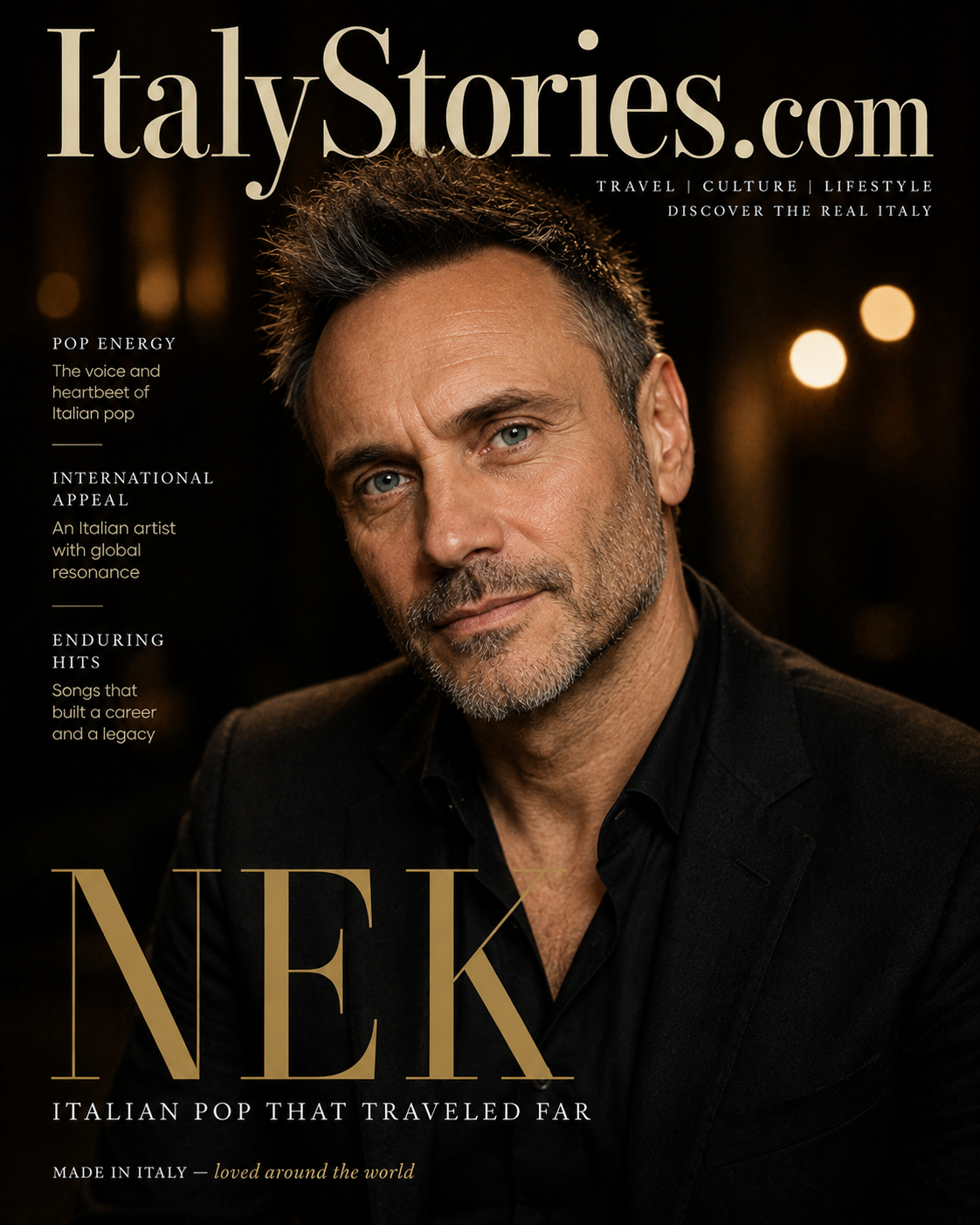
The Song That Refused to Stay in Sanremo
In February 1997, a thirty-five-year-old Italian festival was doing what it had always done: judging songs over a few crowded nights and assigning them a place in a ranking. Among the competing artists was a young singer from Sassuolo with short hair, a guitar, a direct stage presence and a song about the ghost of a past love. His name was Nek. The song was “Laura non c’è.” It finished only seventh.
The ranking turned out to be almost irrelevant.
Within months, “Laura non c’è” had become one of the most recognizable Italian pop songs of the 1990s. It crossed Europe, reached Spanish-speaking audiences as “Laura no está,” and pushed its singer into a kind of international career that very few Italian pop artists achieve. The track was translated, adapted and played in countries where the audience did not necessarily know what Sanremo was, but understood immediately the urgency in Nek’s voice and the emotional clarity of the refrain.
That moment is the best doorway into his story because it reveals one of the central truths of Nek’s career: he has always been more interesting than the label “romantic Italian singer” suggests. He is a musician first — a bassist, guitarist, drummer and songwriter who came out of local bands, absorbed Anglo-American rock and pop, learned the discipline of live performance, and gradually built a sound that could move between Italy and the Spanish-speaking world without losing its identity.
His success was not a single lucky accident. It came from persistence, craft, collaboration and a particular ability to make emotion sound energetic rather than fragile. More than three decades after his first solo album, the songs remain in circulation, and in 2026 the live project Nek Hits Live once again turned that long catalog into the center of his work. The journey from Sassuolo to international stages is not only the story of a hit. It is the story of a musician who learned how to make Italian pop travel.
Sassuolo Before the Spotlight
Filippo Neviani was born on January 6, 1972, in Sassuolo, in the province of Modena. The setting matters. Sassuolo is not Rome, Milan or one of the cities usually associated with show business. It is part of Emilia-Romagna’s industrious landscape, an area known for factories, ceramics, practical culture and strong local identity. Nek’s later public image — straightforward, energetic, grounded — has always seemed compatible with that environment.
Music entered early. As a child he learned to play drums and guitar, and the physical relationship with instruments would remain central to his identity. This is an important distinction. Nek did not grow into music only as a frontman waiting for a songwriter to hand him a melody. He learned rhythm, strings, band dynamics and arrangement from the inside.
The Italy of his childhood and adolescence was changing rapidly. Television was still enormously powerful, but local bands, dance halls, rehearsal rooms and provincial clubs remained essential training grounds. At the same time, British and American rock and pop circulated everywhere. For a boy growing up in Emilia in the 1980s, the Police, rock radio, pop-rock guitars and the increasingly polished sound of international productions could exist side by side with Italian melodic songwriting.
Nek’s career would eventually emerge from exactly that mixture. He was never an imitator of Anglo-American rock, but he absorbed its economy, rhythm and instrumental directness. At the same time, he retained the Italian instinct for melody and emotional narrative. The balance between those two worlds became one of his signatures.
The Winchester Years and the White Lady
Long before the name Nek appeared on record covers, Filippo Neviani was learning how music works in groups. In 1986 he formed the country-oriented duo Winchester with Gianluca Vaccari. It may seem surprising when placed beside the polished pop-rock career that followed, but this early experience demonstrates the breadth of his curiosity. Country music is built on direct storytelling, strong rhythmic patterns and instrumental discipline — qualities that would remain useful even when his style changed.
By 1989, he had moved into a different environment as singer and bassist of the rock group White Lady. The band initially performed covers of the Police before developing original material and recording a demo. This period was especially important because it brought together several elements of Nek’s mature identity: bass playing, a band-centered sound, admiration for international pop-rock and the desire to write his own songs.
Working in a band teaches lessons no classroom can replicate. A singer learns where to leave space. A bassist learns that movement and restraint are equally important. A songwriter learns that an idea must survive rehearsal, arrangement, noise and audience reaction before it can become a song. Nek’s later solo music often carried exactly this kind of practical intelligence. Even when the arrangements became highly produced, there was usually a sense of musicians actually playing.
The White Lady years also helped him understand that music could be a profession only if he was willing to continue after uncertainty. There was no guarantee that local success would become national recognition. The next stage required a different kind of courage: stepping forward alone.
Castrocaro and the Beginning of a Solo Career
In 1991, Filippo Neviani entered the Festival di Castrocaro with “Io ti vorrei.” He reached the final but did not win. From the distance of later success, it would be easy to treat the loss as a footnote, but early competitions matter because they test ambition under public pressure. They also reveal whether the music industry is listening even when the jury does not award first place.
Castrocaro helped open a professional door. Nek secured a recording contract with Fonit Cetra and began preparing his solo debut. The stage name Nek — short, sharp, easy to remember across languages — gave the new project a distinct identity. In 1992 he released the album Nek, introduced by the single “Amami.”
The record did not yet make him a major star, but it mattered enormously. A first album is a declaration of possibility. It moves an artist from aspiration into the permanent record of the industry. The young musician from Sassuolo was no longer simply playing covers or sending demos. He had a catalog of his own.
The early songs also show how quickly he began searching for emotional directness. Even before the great international hits, the subjects were recognizably Nek: relationships, uncertainty, desire, vulnerability, personal choices. What was still missing was the definitive sound — the production language that could make those themes feel unmistakably his. That would emerge over the next few years.
Sanremo 1993: “In te” and a Difficult Subject
Nek first reached the Sanremo stage in 1993 in the newcomers section with “In te.” He finished third, behind Laura Pausini and Gerardina Trovato. The ranking is historically interesting, but the song itself is more revealing. “In te” dealt with pregnancy and abortion, approaching a subject that was emotionally and politically sensitive in Italy.
For a young singer trying to establish himself, it was not an obvious safe choice. The song could generate discomfort precisely because it asked listeners to enter an intimate moral conflict. Whatever one’s position on the subject, the decision showed something about Nek’s artistic instinct: he was willing to place a serious issue inside mainstream pop rather than restrict himself to harmless romantic language.
Sanremo gave him national visibility. The album In te followed, and his profile grew. In the same period he also contributed as a songwriter to material performed by other artists, another sign that his ambitions extended beyond being a face on television.
Yet this first Sanremo chapter did not instantly produce the global success that would later define him. There were still years of transition ahead. That delay may have been beneficial. It gave him time to evolve before the attention became overwhelming.
“Calore umano” and the Search for a Stronger Identity
In 1994 Nek released Calore umano. The title — “human warmth” — could almost serve as a summary of the quality his music would increasingly pursue. The record continued his development while his contract with Fonit Cetra approached its end. Around the same time, he performed “Angeli nel ghetto” at the Festival Italiano, where the song placed second.
The important story of this period is not a single chart position but a transition. Nek was beginning to move away from a more conventional Italian pop framework toward a sharper, more international pop-rock language. That shift became possible after he signed with Warner Music Italy.
Record-label changes can be purely administrative, but in some careers they become artistic turning points. Nek’s move helped connect him with a team and production environment that better understood the direction he wanted to take. The change was not a rejection of Italian melody. It was a modernization of its frame.
Guitars became more central. Rhythms had greater attack. The vocal delivery gained urgency. Songs could still be romantic, but they no longer floated in a soft atmosphere; they moved. This became crucial to his later success because it allowed his music to compete with international pop-rock without sounding like a copy.
“Laura non c’è”: The Breakthrough
The album Lei, gli amici e tutto il resto arrived in 1996, but its destiny changed dramatically when Nek returned to Sanremo in 1997 with “Laura non c’è.” The song, written by Nek with Massimo Varini and Antonello De Sanctis, became the event that permanently transformed his career.
Its strength lies in a clever emotional situation. The narrator is with someone new, but the absent Laura still occupies his mind. The song is not a conventional declaration of love. It is a confession of unresolved attachment. That tension gives the lyric movement, while the arrangement gives it force. The track opens with unmistakable urgency and keeps pushing forward, creating the impression that the singer is trying to outrun a memory that refuses to disappear.
Nek’s delivery is essential. He does not sing as a passive victim of heartbreak. There is energy in the pain. This was one of the reasons the song stood out in the Italian landscape of the period. It combined the melodic readability of Italian pop with the drive of contemporary pop-rock.
At Sanremo the song placed seventh. Outside the festival, it exploded.
The album was reissued, sales accelerated and “Laura non c’è” spread across Europe. A Spanish version, “Laura no está,” opened an even larger world. The song also had an English-language version, but it was the Spanish adaptation that became most important to Nek’s future. In Spain and Latin America, audiences did not treat him as a temporary Italian curiosity. They embraced him as a working pop artist.
The breakthrough also proved the power of translation when the original musical identity is strong. Nek did not need to reinvent himself for Spanish-speaking audiences. He needed only to let the songs live in another language.
Spain and Latin America: The Second Home of a Career
After “Laura no está,” Nek became one of the few Italian pop artists of his generation able to build a durable relationship with Spanish-speaking audiences. This was not a side market added for prestige. It became a genuine second geography of his career.
His albums were recorded and released in Spanish, tours took him to Spain and Latin America, and listeners in those territories followed not only the original breakthrough but later songs as well. The importance of this cannot be overstated. International success is difficult enough; maintaining it requires cultural attention, language adaptation and repeated presence.
Nek’s voice translated particularly well because his style was already positioned between Italian melody and international pop-rock. The emotional architecture of songs like “Laura non c’è,” “Se io non avessi te,” “Sei grande” or “Ci sei tu” did not depend on local references that disappeared in translation. They were built around recognizable human situations and strong refrains.
At the same time, his Italian identity remained visible. This is one of the most interesting parts of his success. He became international not by erasing where he came from, but by making that origin compatible with a broader pop language.
In the late 1990s, this placed him alongside a small group of Italian artists — including Laura Pausini and Eros Ramazzotti — who helped make Italian pop a serious presence in the Spanish-speaking market. Nek’s version of that export was slightly different: more guitar-driven, leaner, more rooted in band energy.
“Sei grande” and “Se io non avessi te”: Proving the Success Was Real
The danger after a giant hit is obvious: the public may remember only the song and forget the artist. Nek avoided that fate because he followed “Laura non c’è” with material strong enough to prove that the breakthrough belonged to a larger catalog.
“Sei grande” became one of the important songs of the same era, showing a warmer and more affirmative emotional direction. Then, in 1998, “Se io non avessi te” introduced the album In due and became another major radio success. The song participated in Festivalbar and received the Radio award “Un disco per l’Europa.”
These tracks expanded Nek’s public identity. He could sing absence, devotion, desire and uncertainty, but always with motion. His songs rarely sounded static. Even his ballads tended to contain rhythmic architecture and a sense of forward momentum.
In due was released across Europe, Latin America and Japan, another sign that the record company now saw Nek as an international artist rather than merely an Italian singer with one crossover moment. The touring that followed confirmed the reality of the audience abroad.
By the end of the 1990s, Nek had achieved something difficult: a recognizable sound, a large domestic audience, and an international market that understood who he was.
The Voice: Clean Power, Urgency and Restraint
Nek’s voice is easy to recognize because it combines brightness with a slightly rough edge. It is not a heavy rock voice, nor a traditional Italian bel canto instrument, nor a soft romantic croon. It sits in a productive middle space: clear enough for pop, energetic enough for rock, warm enough for ballads.
His phrasing often carries urgency. He tends to push the line forward, especially in choruses, which gives emotional songs a physical charge. Yet he also knows when to pull back. This balance between force and restraint became one of his greatest strengths.
There is another important element: diction. Nek’s Italian is direct and rhythmically precise. In Spanish, he developed a version of the same clarity, allowing the songs to retain their momentum. This helped make the international recordings feel like real performances rather than awkward translations.
Most of all, the voice has remained closely connected to the musician’s body. Nek often performs with bass or guitar, and this changes how a singer experiences rhythm. He is not floating over the band; he is inside it. The vocal line and the instrumental pulse come from the same performer. That quality has always made his live work feel more muscular than his reputation as a romantic pop star might suggest.
The Bass Guitar and the Musician Behind the Singer
One of the most useful corrections to the public image of Nek is to remember that he is a serious instrumental musician. The bass guitar, in particular, became a central part of his live identity. On stage, the instrument is not a decorative prop. It places him inside the rhythmic structure of the band.
This musician-first identity explains some of the durability of his concerts. A performer who depends entirely on production trends can become trapped by them. A performer who understands the mechanics of a band can rearrange, strip down and rebuild songs over time.
Nek’s later tours increasingly emphasized this aspect. Instead of hiding behind large arrangements, he often allowed the rock core of the material to become more visible. The 2026 Nek Hits Live project made this explicit, presenting the catalog through a direct, energetic live sound and a compact formation.
The result is revealing. Songs that were originally associated with glossy 1990s or 2000s production remain convincing when reduced to bass, guitar, drums and voice. That is usually a sign that the songwriting underneath is strong.
The 2000s: “La vita è,” “Sei solo tu” and a Mature Pop Language
The new millennium did not diminish Nek’s momentum. Albums such as La vita è and Le cose da difendere continued to produce important songs and expanded his emotional range. “Ci sei tu,” “La vita è,” “Sei solo tu” and other tracks of the period demonstrated that he had moved beyond the excitement of breakthrough into a mature career.
“Sei solo tu,” associated in one version with Laura Pausini, linked two major Italian voices whose international paths had developed in parallel. The collaboration also highlighted Nek’s ability to sing in dialogue. His voice works well when placed beside another strong identity because he does not need to dominate; he maintains definition through tone and phrasing.
The early 2000s also showed a growing interest in themes of commitment, personal responsibility and the defense of what matters. The album title Le cose da difendere — “the things worth defending” — suggests this shift. The young man singing unresolved romantic obsession in “Laura non c’è” had become an adult songwriter more interested in what survives pressure.
This development was necessary. Artists who continue singing only the emotional language of their twenties often become unconvincing. Nek allowed age to enter the songs without abandoning energy. That decision helped keep his audience with him.
“Almeno stavolta” and the First Great Retrospective
In 2003, The Best of Nek – L’anno zero gathered the first decade of his major career and added new material, including “Almeno stavolta.” Greatest-hits collections can sometimes signal an artist looking backward because the present has weakened. In Nek’s case, the opposite happened. “Almeno stavolta” became one of his most enduring songs and one of the clearest proof points that his songwriting remained fully active.
The title suggests a plea — “at least this time” — and the song turns emotional urgency into a compact pop-rock structure. It was heavily played on Italian radio and became another important entry in the catalog.
The collection also allowed older songs such as “In te,” “Cuori in tempesta” and “Angeli nel ghetto” to be reconsidered alongside the later international hits. Seen together, the trajectory became clearer: the career had not begun with “Laura non c’è.” The breakthrough had been prepared by years of writing, experimentation and changes in sound.
For Nek, “L’anno zero” — year zero — was therefore not only a retrospective title. It implied restart. That impulse to begin again would become increasingly important in the later phases of his life.
“Lascia che io sia” and the Strength of Simplicity
In 2005 Nek released Una parte di me, containing “Lascia che io sia,” one of the songs most deeply associated with his mature period. The track is a good example of his ability to build emotional power without unnecessary complexity.
The title means “let me be,” a phrase that can contain resignation, dignity, separation and self-protection at once. Nek’s performance is controlled, but the chorus opens emotionally without becoming melodramatic. The song became a major radio favorite and remains central to his live repertoire.
This period also demonstrated how comfortable he had become inside his own language. By then, he no longer needed to chase an identity. He had one. The task was refinement: finding new emotional angles, stronger production and melodies that could sit beside the classics without imitating them.
Albums such as Nella stanza 26 and Un’altra direzione continued this process. The songs moved between introspection and rhythmic pop-rock, confirming that Nek’s career was not driven by radical reinvention but by steady evolution.
Sanremo 2015: The Return with “Fatti avanti amore”
Eighteen years after “Laura non c’è,” Nek returned to the Sanremo competition in 2015 with “Fatti avanti amore.” The return carried risk. When an artist comes back to the festival associated with an iconic earlier song, comparison is inevitable. Nostalgia can become a trap.
Nek avoided it by presenting a song that sounded contemporary, energetic and physically alive. “Fatti avanti amore” used a driving pop-rock arrangement with electronic energy, while the lyric turned love into movement and courage rather than passive sentiment.
The result was one of the strongest festival performances of his career. The song finished second and received both the award for best arrangement and the Lucio Dalla press-room prize from radio, television and web journalists. More importantly, it reintroduced Nek to a broad public as a current artist rather than a 1990s memory.
The album Prima di parlare followed, and the Sanremo return became a model of how a veteran can re-enter a major national event successfully: not by pretending to be young, not by repeating the old hit, but by showing that the core musical energy is still present.
The moment also connected different generations. People who had discovered him through “Laura non c’è” were now adults, while younger listeners encountered a singer who looked entirely comfortable in contemporary production. The bridge worked in both directions.
“Unici,” Television and the Broadening of the Public Role
The years after Sanremo 2015 showed Nek increasingly at ease with a wider public role. The album Unici, released in 2016, contained songs that balanced radio accessibility with reflective maturity. Collaborations, including work with J-Ax, placed him in conversation with artists from different stylistic worlds.
Television also became part of his later career. Appearances as a mentor, judge or prominent guest revealed another side of his personality: calm, practical, encouraging and focused on craft. This suited the public image he had developed over decades. Nek was never primarily a scandal-driven celebrity. His authority came from work.
This broader visibility helped keep the catalog active while also presenting him as a musician capable of speaking about performance, discipline and songwriting. Younger audiences could encounter him not only through old videos but as a living professional inside contemporary Italian music.
The evolution was natural. A singer who has survived several changes in the industry accumulates knowledge. Sharing that knowledge becomes part of the later artistic identity.
The Accident That Threatened the Music
In November 2020, Nek suffered a severe accident to his left hand while working with a circular saw at his country home. The injuries were serious and required a long operation and extensive rehabilitation. For any person, such an accident would be traumatic. For a musician who plays guitar and bass, the psychological fear carried an additional weight: the possibility that the body might no longer allow the work it had performed for decades.
Nek later spoke openly about the fear, pain and daily discipline of rehabilitation. The episode became a genuine crisis, not a manufactured dramatic chapter for publicity. He had to relearn movement slowly and confront uncertainty about his future with instruments.
The recovery eventually became part of the meaning of his later performances. When he returned to playing, the instrument carried a different symbolic weight. The bass was no longer merely part of his stage identity; it was evidence of regained ability.
This difficult period also reinforced themes already present in his mature work: gratitude, time, family, the value of ordinary days, and the awareness that control can disappear in an instant. Rather than closing his musical story, the accident deepened it.
5030, RengaNek and Friendship as Music
In 2022, Nek celebrated two milestones at once: fifty years of life and thirty years since his first solo album. The project 5030 – La teoria del caos revisited major songs through new arrangements and placed the anniversary inside a creative rather than purely nostalgic frame.
The collection included reworked versions of classics such as “Laura non c’è,” “Fatti avanti amore,” “Almeno stavolta,” “Lascia che io sia” and “Se io non avessi te.” Guests including Jovanotti, Francesco Renga and Giuliano Sangiorgi helped connect different phases of Italian pop and rock.
The collaboration with Francesco Renga grew into something larger. In 2023 the two artists released RENGANEK, a full album of new material created together, followed by extensive live work. The project was born from friendship but succeeded musically because the voices are contrasting rather than interchangeable. Renga brings a broad, dramatic vocal quality; Nek brings rhythmic precision, brightness and rock energy. Together, the differences created movement.
The album contained eleven new songs in its original release, demonstrating that the partnership was not merely a touring package built around old hits. They wanted to create a shared present.
This choice says something important about Nek’s later career. Instead of protecting his catalog behind glass, he continued placing it beside new songs, new collaborators and new configurations. The legacy remained active because he kept using it.
2026: “Nek Hits Live” and the Catalog Comes Full Circle
By 2026, Nek had more than three decades of recorded history behind him. The project Nek Hits Live turned that history into a live document and a touring manifesto. Rather than presenting the songs as museum pieces, the project emphasized the rock energy of his concerts and the direct sound of a compact band.
The collection moved through the core of the repertoire: “Almeno stavolta,” “Se una regola c’è,” “Ci sei tu,” “Lascia che io sia,” “Fatti avanti amore,” “Sei grande,” “Laura non c’è,” “Se io non avessi te” and many others. It also included Spanish-language versions, acknowledging the international career not as a historical footnote but as part of the same identity.
The 2026 tour took the music across Italy and into European dates, with further summer performances. Nek played in a power-trio configuration with bass, guitar and drums, a format that stripped the songs toward their essential pulse. This is perhaps the most appropriate late-career image of him: not a singer separated from the band, but a musician standing inside the rhythm.
It also creates a satisfying circle. The boy who learned instruments in Sassuolo, played in bands and absorbed the Police eventually became an international pop star. Decades later, he returned to the simplicity of a tight live group and discovered that the songs could still stand there.
That is a powerful test of longevity.
Why Nek Still Matters
Nek’s place in Italian popular music is sometimes underestimated because he made success look straightforward. His songs are melodic, radio-friendly and emotionally direct. But accessibility can hide craft. To write a song that millions understand immediately and still remember thirty years later is difficult.
He matters because he helped modernize Italian melodic pop without cutting it off from its roots. He introduced a strong pop-rock language, built around guitars, bass and rhythmic urgency, while keeping the emotional clarity that has always been central to Italian song.
He matters internationally because he proved that an Italian artist could develop a durable career in the Spanish-speaking world through commitment rather than novelty. He recorded in Spanish, toured repeatedly, and treated those audiences as part of the career itself.
He matters as a musician because the instruments have never been ornamental. His live identity, especially in later years, reminds listeners that behind the polished records is a player who understands the architecture of a band.
And he matters because his career contains renewal after difficulty. Early competition losses, the uncertainty before “Laura non c’è,” the challenge of sustaining international success, and the devastating hand injury did not end the story. Each became part of a larger pattern of persistence.
From “In te” to “Laura non c’è,” from “Se io non avessi te” to “Almeno stavolta,” from “Lascia che io sia” to “Fatti avanti amore,” from RengaNek to Nek Hits Live, the catalog tells the story of a singer who has changed without losing his center.
The center is simple: melody, rhythm, sincerity, and the conviction that a pop song can travel very far when it knows exactly what it wants to say.
A Final Thank You from ItalyStories.com
Thank you for spending time with this story. ItalyStories.com was created to explore the people, voices, places and ideas that have carried Italian culture far beyond the country’s borders. If Nek’s journey has made you curious about another chapter of Italian music, we would be delighted to welcome you to the next story.