

A JOURNEY INTO THE HEART OF THE ROCK
Perched dramatically on a volcanic cliff in the green heart of Umbria, Orvieto is a city that seems to belong to two different worlds. Above ground, its medieval streets lead towards one of Italy’s most magnificent cathedrals, while elegant palaces, ancient churches and panoramic terraces overlook vineyards and rolling countryside. Beneath those streets, however, lies another city: a mysterious labyrinth of caves, tunnels, cisterns and wells carved into the golden tuff over thousands of years.
Among these underground wonders, none is more impressive than the Pozzo di San Patrizio, or St Patrick’s Well. Visitors sometimes call it Orvieto’s “wishing well”, and many throw a coin into its dark waters while silently making a wish. Yet this extraordinary monument was not originally created for legends, romance or good fortune. It was built for survival.
Its story begins in 1527, during one of the most violent moments of the Italian Renaissance. Rome had been devastated during the infamous Sack of Rome, and Pope Clement VII escaped to Orvieto in search of safety. The city’s position on top of a high volcanic plateau made it an exceptional natural fortress, but it had one dangerous weakness: during a long siege, its inhabitants could run out of water.
Clement VII therefore commissioned the Florentine architect and military engineer Antonio da Sangallo the Younger to design a reliable water supply protected inside the rock. Sangallo responded with something far greater than an ordinary well. He created a masterpiece in which architecture, engineering, geometry and the movement of people and animals were combined with astonishing intelligence.
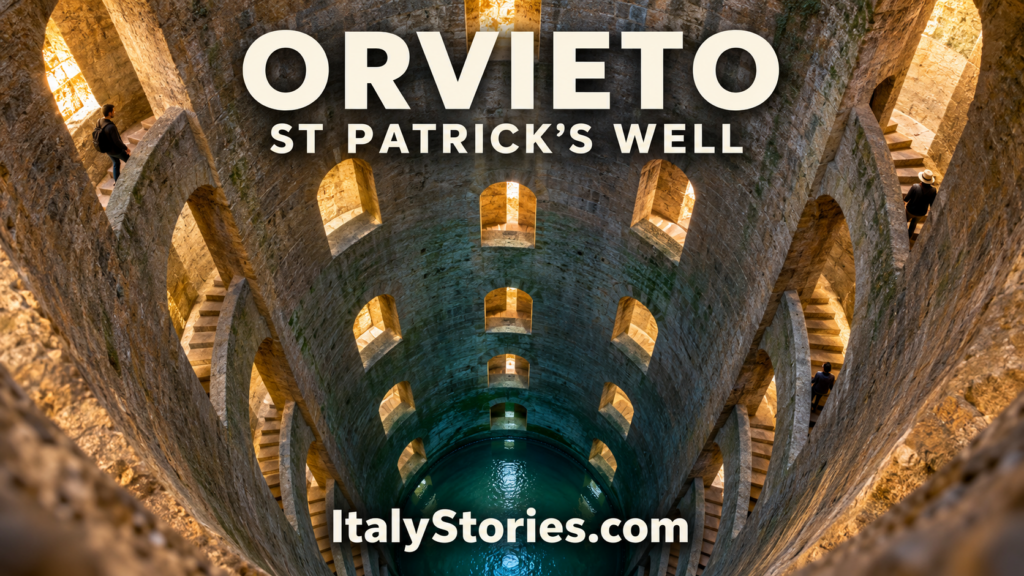
Construction began in 1527 and continued for approximately a decade. Workers carved an enormous cylindrical shaft deep into the volcanic tuff beneath the city. The completed structure descends around 54 metres into the earth and measures approximately 13 metres across. Seventy-two arched openings illuminate the interior, creating a spectacular sequence of light and shadow along its stone walls.
The most remarkable feature is its ingenious double-helix staircase. Two independent spiral routes wind around the central shaft without crossing each other. In the sixteenth century, pack animals could descend one staircase carrying empty containers, collect water at the bottom and return to the surface along the other route. Animals moving in opposite directions never had to meet or turn around in the narrow passage.
It was a remarkably efficient solution, conceived centuries before double-spiral structures became famous in modern architecture. The 248 steps are broad and gently sloping because they were designed not only for people but also for donkeys and mules. At the bottom, a small bridge connects the two routes beside the spring-fed water.
Walking into the well today is an unforgettable experience. The sounds of the city disappear almost immediately. With every step, the air becomes cooler and the light more mysterious. Through the arched windows, visitors catch changing views of the central void: sometimes golden and luminous, sometimes dark and seemingly endless.
Voices and footsteps echo through the stone chamber. People appear briefly in distant openings on the opposite staircase and then vanish again. The geometry creates a strange sensation of moving through time as much as through space. It is easy to imagine the generations of workers, water carriers and animals that once followed the same descending path.
When visitors finally reach the bottom, they find themselves more than fifty metres beneath Orvieto. Looking upward reveals the true scale of the monument. The entrance has become a small circle of daylight, while the rows of windows rise one above another like the openings of a subterranean cathedral.
The return journey follows the second spiral staircase. Although travellers appear to retrace their steps, they are actually climbing along an entirely separate route. The experience is both physical and symbolic: a descent into darkness followed by a gradual return towards daylight.
The monument was originally known as the Pozzo della Rocca, the Well of the Fortress, because it stood near the Albornoz Fortress and was intended to supply water to the fortified area. Its present name developed later and refers to the medieval legend of St Patrick’s Purgatory in Ireland.
According to that tradition, a deep cave on an island in Lough Derg served as a passage into the afterlife. Pilgrims entered it seeking spiritual purification and a vision of the world beyond. The immense depth and mysterious atmosphere of Orvieto’s well naturally recalled this story, and the name of the Irish saint eventually became inseparable from Sangallo’s creation.
This connection gave the monument another layer of meaning. The well was no longer seen only as an ingenious hydraulic structure. Its descent into the earth could also be imagined as an inner journey: a passage through darkness, fear and silence before returning to the light.
At the entrance, a Latin inscription traditionally associated with the monument declares: “Quod natura munimento inviderat industria adiecit.” Its meaning can be translated as: “What nature had denied for defence, human ingenuity supplied.”
Few sentences could describe the Pozzo di San Patrizio more perfectly. Nature gave Orvieto steep cliffs and an almost impregnable position, but it did not guarantee enough water during a siege. Human intelligence completed what the landscape had left unfinished.
The custom of throwing coins into the water and making a wish is much more recent than the monument itself. St Patrick’s Well was never conceived as a magical wishing well. Nevertheless, the tradition feels strangely appropriate. After walking deep into the rock, surrounded by shadows, echoes and centuries of history, even the most practical visitor may feel tempted to leave behind a small hope.
Coins glitter beneath the water like distant stars. Each one represents a private wish, a promise, a memory or perhaps the hope of returning to Orvieto one day. In this way, a Renaissance machine built to defend a city has gradually acquired a more intimate and emotional identity.
The well also reveals something essential about Orvieto. The beauty of the city is not confined to what can be seen on the surface. Its history continues underground, inside a vast network of passages excavated by Etruscans, medieval inhabitants and Renaissance engineers. The cliff is not simply the foundation of Orvieto: it is part of the city’s memory.
Emerging from the Pozzo di San Patrizio, the Umbrian sunlight feels unexpectedly bright. The gardens of the fortress, the medieval rooftops and the countryside stretching towards the horizon seem different after the darkness below. Visitors return to the surface with a deeper understanding of Orvieto and of the extraordinary imagination that shaped it.
The Pozzo di San Patrizio is a monument to water, survival and human ingenuity. It is also a place where history and legend meet, where architecture becomes an experience and where a descent into the earth can feel like a journey into another world.
So, if you visit Orvieto, stop beside the ancient fortress and begin the long walk down. Listen to the echoes, look through the seventy-two windows and admire the perfect spirals disappearing into the stone. When you finally reach the water, you may decide to throw in a coin.
After all, even a masterpiece of Renaissance engineering can become a place for wishes.
Follow ItalyStories.com to discover the landscapes, monuments, traditions and hidden stories that make Italy unforgettable.