

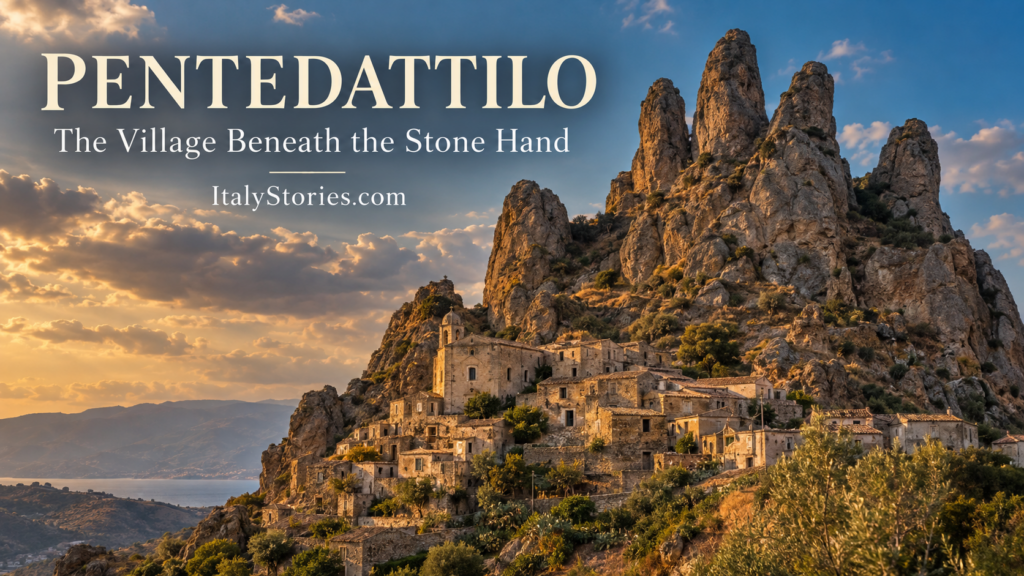
Pentedattilo Calabria does not appear to have been built beside a mountain. It seems to have been caught in its grip. Above the old stone houses rise five enormous rocky peaks, separated like the fingers of a gigantic hand reaching into the sky. Beneath them, narrow lanes pass between abandoned homes, small churches and the remains of a castle connected with one of the bloodiest family feuds in southern Italian history. It is a place where the landscape is already extraordinary before anyone begins telling its stories.
The village stands in the southernmost part of Calabria, within the municipality of Melito di Porto Salvo, in the historic Area Grecanica. The Ionian Sea lies a few kilometres away, while the mountains of the Aspromonte rise behind it. Seen from a distance, Pentedattilo appears almost fused with the rock. Its houses share the same colours as the mountain, shifting from pale grey to ochre and deep amber as the light changes.
Its name comes from Greek. “Pente” means five and “daktylos” means fingers, a clear reference to the unmistakable shape of Monte Calvario. Time and erosion have altered the outline, and some of the original rock formations have partially collapsed, but the image of a colossal stone hand remains powerful enough to dominate every view of the village.
For centuries, the people who lived beneath those peaks looked upward and saw more than geology. The mountain became a guardian, a warning and, eventually, the central figure in stories of violence, guilt and revenge. According to local legend, the five fingers are stained by the memory of a massacre and will one day close over the village to punish the crime committed there.
The mountain has never closed its hand. It has not needed to. The ruins, the silence and the tragic events of 1686 have been enough to give Pentedattilo an atmosphere unlike any other village in Italy.
The Ancient Origins of Pentedattilo Calabria
Human presence in the surrounding territory reaches back to prehistoric times, encouraged by natural shelters, caves and the availability of water. During the Greek period, the area probably belonged to the territory controlled by ancient Rhegion, today’s Reggio Calabria. Its elevated position made it useful for observing the routes that connected the coast with the interior.
The first known written mention of Pentedattilo appears in a medieval account of the life of Saint Elias the Younger, dating from around the ninth century. During the following centuries, the settlement developed into a fortified citadel. Its position beneath the rocky peaks offered protection and allowed those inside to control the countryside and the approaches from the sea.
The history of the village reflected the complicated history of Calabria itself. Byzantines, Normans, Angevins and different feudal families exercised power across the region. Pentedattilo belonged at various times to religious institutions and noble houses, eventually passing through the hands of the Francoperta, Alberti and Clemente-Filangeri families.
The surrounding land supported wheat, legumes and livestock. The settlement also controlled smaller communities closer to the coast, including the area that would develop into modern Melito di Porto Salvo. At its height, Pentedattilo and its dependent villages formed a productive local centre rather than an isolated collection of houses.
Daily life unfolded beneath the castle. Farmers left for the fields, animals moved through the narrow lanes and church bells marked the rhythm of the community. The same streets that appear silent today once contained hundreds of voices.
Then, during Easter 1686, the rivalry between two aristocratic families turned the village into the scene of a massacre.
The Alberti and the Abenavoli
The two families at the centre of the tragedy were the Alberti, marquises of Pentedattilo, and the Abenavoli, barons of nearby Montebello Ionico. Their hostility was not created by a love affair, although love would eventually turn an old rivalry into open violence. The families had argued for years over land, borders and feudal rights.
An attempt to end the conflict appeared possible when Baron Bernardino Abenavoli sought the hand of Antonietta Alberti. A marriage between them could have joined the two houses and settled at least some of their disputes. Antonietta was the daughter of Marquis Domenico Alberti, head of the Pentedattilo family.
When Domenico died, control passed to his son Lorenzo. The new marquis married Caterina Cortez, a woman connected to an influential Spanish family close to the government of Naples. Her brother, Don Petrillo Cortez, soon became part of the Alberti household.
According to the traditional reconstruction, Bernardino Abenavoli continued to expect that he would marry Antonietta. Lorenzo Alberti, however, planned a different union, arranging or favouring a marriage between his sister and Don Petrillo Cortez.
For Bernardino, this was more than a romantic rejection. Marriage among noble families was inseparable from property, alliances and political influence. Antonietta’s union with a Cortez would strengthen the Alberti family and leave the Abenavoli isolated. Old arguments over territory returned with new force, now mixed with wounded pride and the fear of losing power.
Bernardino chose revenge.
Easter 1686: The Alberti Massacre
During the Easter celebrations of 1686, armed men loyal to Bernardino Abenavoli entered the castle of Pentedattilo. The attack was planned with the help of people who knew the building and the habits of those living inside it. Once the attackers gained access, they moved through the rooms searching for members of the Alberti family.
Lorenzo Alberti was killed, along with several relatives and members of the household. The victims included a young child. The violence was not a duel between two noblemen but a deliberate attack intended to destroy the ruling branch of a rival family and remove those who might later seek revenge.
Some members of the household were spared. Caterina Cortez survived, as did Antonietta Alberti and several other relatives. Don Petrillo Cortez was also kept alive, not out of mercy but because his family’s political connections made him a valuable hostage.
After the massacre, Bernardino took Antonietta and Petrillo to the Abenavoli stronghold at Montebello Ionico. Antonietta was forced to marry him only a few days later. The union that might once have reconciled the families had become the final act of a crime.
News of the attack travelled quickly. The massacre could not be treated as an ordinary local feud because Don Petrillo Cortez had connections with the powerful Spanish administration governing the Kingdom of Naples. A military response followed, and several of the men involved were captured and punished.
Bernardino Abenavoli escaped immediate arrest, but his victory was brief. He had not created a lasting alliance or secured peace between the families. He had destroyed the possibility of either.
The precise details of the attack have been retold and altered through the centuries. Documents, literary reconstructions and oral traditions do not always agree on every name, action or motive. The central event, however, is historical: members of the Alberti family were murdered at Pentedattilo in 1686 during a violent confrontation involving Bernardino Abenavoli and his followers.
The legends came later.
The Hand of the Devil
In one local tradition, the mountain above Pentedattilo became known as the Hand of the Devil. The five peaks were no longer viewed as a natural formation but as a warning left over the village after the massacre. Some said the hand would eventually fall and crush the settlement. Others believed it protected the memory of the victims and prevented the crime from being forgotten.
Stories began to circulate about screams carried through the empty streets at night. Travellers claimed to hear voices from the ruined castle, the clash of weapons or the cries of the people killed during the attack. The wind passing between the sharp rocks provided an ideal voice for the legend. In darkness, when the peaks disappeared and only their outline remained visible, imagination could do the rest.
There are no historical grounds for treating these supernatural stories as evidence of ghosts or a curse. Their real importance is cultural. They reveal how the community preserved the emotional memory of the massacre. A violent event involving noble families became a shared story in which the mountain itself appeared to judge the guilty.
The hand-shaped rock was present long before the Alberti and the Abenavoli. After 1686, however, it acquired a new identity. Nature had created the shape; human tragedy gave it meaning.
A Village Slowly Emptied
The Alberti massacre did not cause the immediate abandonment of Pentedattilo. The village continued to be inhabited for generations, passing to other feudal families and maintaining its agricultural life. Its decline was much slower and resulted from several historical and geographical changes.
The growth of settlements closer to the coast gradually reduced the importance of the mountain village. In 1811, Pentedattilo lost its status as an independent municipality and became part of Melito di Porto Salvo. Economic opportunities increasingly moved toward the sea and, later, toward larger cities.
Emigration weakened the community further. Like many villages in Calabria, Pentedattilo lost inhabitants to northern Italy and to countries such as France, Canada and the United States. Families left in search of work, sometimes intending to return but eventually building new lives elsewhere.
The old buildings also became increasingly difficult to maintain. The terrain was fragile, the roads were inconvenient and concerns about structural safety grew. By the end of the 1960s, the historic settlement was considered unfit for ordinary habitation, and the remaining residents were transferred to a newer village nearby.
Pentedattilo became known as a ghost town, but even this description is slightly misleading. It was not erased, nor did it disappear completely. The houses remained, the churches survived and the streets continued to preserve the shape of the community. What vanished was the daily rhythm that had once made them alive.
Lear, Escher and the Attraction of the Impossible Landscape
Pentedattilo fascinated travellers long before abandoned villages became popular tourist destinations. The English writer and artist Edward Lear visited southern Calabria during the nineteenth century and described the extraordinary impression created by the rocky peaks. To him, the pinnacles appeared sharply outlined against the sky like the fingers of a gigantic hand.
Decades later, the Dutch artist Maurits Cornelis Escher reached Pentedattilo during his travels through Italy. In 1930 he produced images of the village, attracted by the strange relationship between human architecture and natural rock. It is easy to understand why the place appealed to an artist whose work would later explore impossible buildings, altered perspectives and the uncertain boundary between reality and illusion.
Pentedattilo already looked like an Escher composition. Houses seemed to emerge from the mountain, stairways disappeared between walls and the enormous peaks distorted any normal sense of scale. The village appeared real and impossible at the same time.
These artistic testimonies have become part of its history. They preserve images of Pentedattilo before complete abandonment and show that its fascination cannot be explained by the massacre alone. Even without the Alberti tragedy, the village would remain one of the most remarkable landscapes in southern Italy.
The Return of Life
Abandonment was not the final chapter. From the late twentieth century onward, associations, volunteers, artisans and cultural projects began bringing activity back to the historic village. Some buildings were restored, small workshops opened and visitors returned to streets that had been silent for years.
Pentedattilo became a setting for artistic events and the Pentedattilo Film Festival, which uses the atmosphere of the old settlement as a meeting place for filmmakers and audiences. Traditional crafts, hospitality and guided visits have helped reconnect the village with the surrounding territory.
This revival is fragile and should not be confused with the return of the original community. Pentedattilo is not once again the agricultural town it was centuries ago. Its new life is based on memory, culture, tourism and the determination to prevent an extraordinary place from disappearing.
Walking through it today, visitors encounter restored spaces beside roofless houses. A church may appear cared for while the building next to it remains open to the sky. This contrast is part of the experience. Pentedattilo is neither a completely dead village nor a reconstructed tourist stage. It exists somewhere between abandonment and rebirth.
Beneath the Five Fingers
The most powerful moment comes when the visitor stops looking at individual buildings and raises their eyes toward Monte Calvario. From inside the village, the rock seems impossibly close. Its peaks rise above the roofs as if the houses had been placed deliberately beneath an enormous hand.
In daylight, the effect is spectacular. At sunset, when the stone becomes orange and the shadows deepen between the pinnacles, it is easy to understand why so many legends were born here. The mountain appears almost alive, though its apparent movement is created only by changing light.
The castle where the Alberti massacre took place is largely ruined, but the absence of intact rooms can make the story more immediate rather than less. Visitors must reconstruct the scene from fragments: a wall, a passage, a view toward Montebello, the narrow routes by which armed men could have approached.
Pentedattilo does not need artificial attractions. The village, the mountain and the silence provide everything. Its history contains Greek origins, feudal power, migration, abandonment and recovery. Its darkest episode adds mystery, but it should never overshadow the generations who lived here before and after 1686.
The stone hand has not crushed the village. If anything, it has protected it. It made Pentedattilo unforgettable when many other abandoned settlements quietly vanished from public memory.
Today, the five fingers still rise above the old houses, holding their stories between rock and sky. Follow ItalyStories.com to discover more hidden places, remarkable events and forgotten chapters from Italy.