

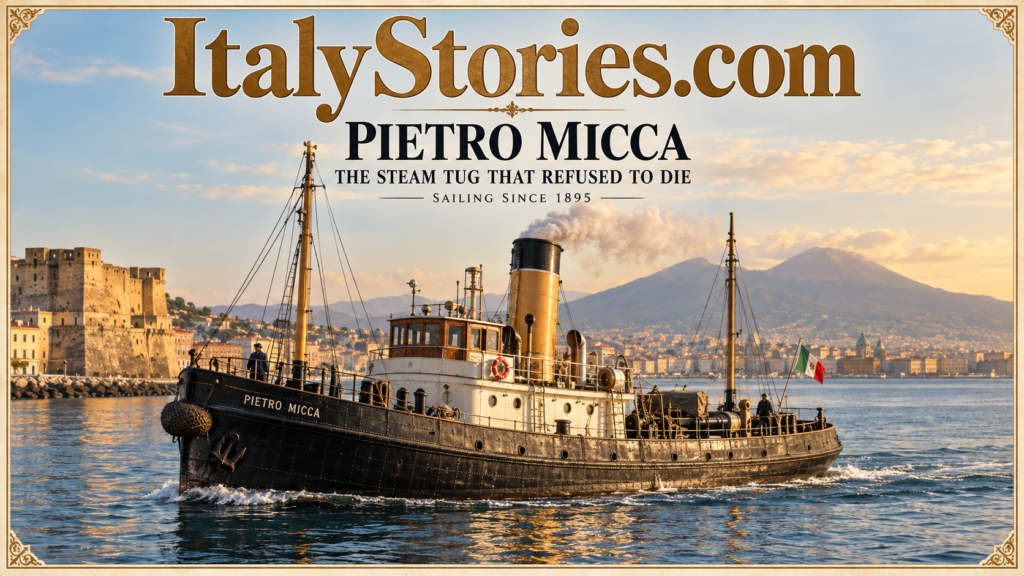
In an age of satellites, diesel engines and computer-controlled ships, there is still a vessel whose heart beats with steam. Its hull is made of riveted steel, its machinery moves slowly enough for the human eye to follow, and its engine was built when Queen Victoria was on the British throne. The vessel is called Pietro Micca, and after more than a century of work, wars, abandonment and restoration, it remains one of the most extraordinary survivors in Italian maritime history.
The story did not begin in Italy. The tug was launched on 4 September 1895 at the James P. Rennoldson & Sons shipyard in South Shields, on the River Tyne in north-eastern England. Its original name was Dilwara, and its yard number was 166. The Tyne was then one of the great centres of British shipbuilding, crowded with shipyards, coal traffic, foundries and vessels sailing toward every part of the world.
Dilwara was constructed as a deep-sea steam tug, a considerably more capable vessel than the small harbour launches used merely to move barges between nearby quays. It needed the strength, endurance and stability to operate beyond sheltered waters, tow heavy loads and survive difficult conditions.
The ship measured approximately 31 metres in length and little more than six metres in width. Its steel hull was assembled with thousands of rivets, long before welded construction became standard. With a displacement of roughly 330 tonnes, it was compact but immensely solid—a floating industrial machine designed for work rather than comfort.
At its centre was a vertical triple-expansion steam engine manufactured by the same company that built the ship. Triple-expansion technology represented the height of nineteenth-century marine engineering. Steam passed through three cylinders of increasing size, expanding and surrendering more of its energy at each stage. This made the engine more economical than earlier steam machinery while providing the steady torque required by a powerful tug.
The engine produced approximately 500 horsepower and turned at only about 85 to 87 revolutions per minute. That number sounds almost impossibly low when compared with a modern engine, but the immense pistons and connecting rods did not need to move quickly. Their strength lay in slow, relentless movement, transferring power directly to the propeller shaft.
In calm conditions, the vessel could reach approximately ten knots. Speed, however, was never its primary purpose. A tugboat’s value was measured by its ability to pull, push and control loads far larger than itself. Dilwara was built to move ships, pontoons and floating equipment that could not manoeuvre independently.
After working in British waters, the tug was acquired by Italian owners and transferred to the Kingdom of Italy. In 1905 it was registered in Naples under a new name: Pietro Micca.
The name honoured one of the most celebrated figures in the history of Turin. During the French siege of the city in 1706, the soldier Pietro Micca detonated an explosive charge inside a military tunnel to prevent enemy troops from entering the citadel. He was killed by the blast, but his sacrifice delayed the attackers and became a symbol of courage and devotion. Giving his name to a powerful working vessel was an appropriate tribute: the tug would also spend its life enduring pressure, danger and exhausting labour.
In Italian waters, the Pietro Micca began the long career for which it would become famous. It towed barges and large pontoons loaded with stone for the construction of harbours, breakwaters and quays throughout the Mediterranean. Its work was connected to places including Naples, Sorrento, Capri, Ischia, Procida, Massa Lubrense and Torre del Greco.
The tug was often associated with the bay of Puolo, where limestone was extracted for maritime construction. Heavy stone had to be loaded onto pontoons and transported to building sites along the coast. The Pietro Micca provided the force necessary to move those enormous floating loads.
It was difficult and sometimes dangerous work. Towing a heavily laden pontoon required an experienced captain, a reliable crew and constant attention to wind, waves and towlines. If a cable snapped under tension, it could cross the deck with lethal force. If weather conditions deteriorated, the tug had to control both itself and a load that might weigh many times more.
The ship’s crew lived close to heat, coal dust, oil and moving machinery. Below deck, stokers maintained the fires that heated the boiler. Engineers watched the pressure gauges, lubricated the machinery and listened for changes in the rhythm of the engine. On deck, sailors handled cables thick enough to challenge several men at once.
The Pietro Micca also passed through both world wars. During periods of military service, its peaceful appearance changed: the hull was painted grey, a weapon was installed near the bow and the vessel was reportedly employed as an auxiliary ship and minesweeper. Tugboats rarely receive the attention given to cruisers, submarines and battleships, yet ports and fleets cannot function without them. They move damaged vessels, assist ships entering harbour, carry equipment and perform countless unglamorous but essential duties.
Surviving one world war was already fortunate. Surviving two, while continuing to work with much of its original machinery, was exceptional.
After the Second World War, the Pietro Micca returned to civilian service. During the early 1950s, its furnaces were modified so that the boiler could use heavy fuel oil as well as coal. This was the most important alteration made to its propulsion system. The original triple-expansion engine remained in place.
Almost everything aboard still depended on steam. Steam powered the main engine, the towing winch, the steering machinery and other auxiliary equipment. Pipes, valves and gauges transformed the engine room into a living museum of industrial technology—but this was not machinery arranged for exhibition. It was machinery that continued to work.
In 1975 the tug was purchased by Sargenavi and received an unusual new assignment in Naples. Instead of merely towing ships, it supplied steam to vessels of the United States Navy stationed in the port. When a warship’s own boilers were shut down for maintenance, an external source was needed to keep kitchens, heating systems, pumps and auxiliary services operating. The elderly Pietro Micca could pull alongside and provide exactly what was required.
A steamship built in Victorian Britain was therefore helping to maintain modern American naval vessels during the Cold War. It was an extraordinary meeting of different technological ages.
This service reportedly continued until 1993. By then, the tug was almost a century old. Most working vessels of its generation had been scrapped decades earlier, their engines melted down and their names forgotten. The Pietro Micca survived partly because the Spinelli family of Monte di Procida supplied captains, engineers, sailors and stokers for three generations. Their knowledge of its machinery became as important as the machinery itself.
Nevertheless, survival eventually became uncertain. By the middle of the 1990s, the ship risked dismantling. Preserving an old steam vessel is enormously expensive. Its hull must be inspected, its boiler maintained and its machinery protected from corrosion. A historic ship cannot simply be tied to a quay and forgotten; neglect can destroy it almost as effectively as a scrapyard.
In 1996 Pier Paolo Giua and a group of enthusiasts decided that the Pietro Micca could not be allowed to disappear. They created the Associazione Amici delle Navi a Vapore G. L. Spinelli and transferred the tug from Naples to the Tecnomar shipyard at Fiumicino, near the mouth of the River Tiber.
The restoration was not intended merely to make the vessel look attractive. The objective was to return it to working condition while preserving as much original equipment as possible. The hull was repaired, the boiler inspected and the engine carefully restored. Old valves, winches, gauges and pipes were retained wherever they could safely continue to operate.
When steam once again entered the cylinders, the engine returned to life with the same slow rhythm it had produced in 1895. The connecting rods moved, the crankshaft turned and the propeller responded. A machine created before the invention of powered flight was working again in the twenty-first century.
The restored tug subsequently took part in cultural, educational and environmental activities. It welcomed school groups and visitors, appeared at maritime events and was used in connection with environmental monitoring initiatives. Rather than becoming a silent exhibit, the Pietro Micca continued to demonstrate how a genuine steamship operated.
Walking through its engine room is unlike visiting a conventional museum. There are no replicas and no machinery placed behind glass simply to be admired. The pistons, gauges and polished metal components belong to the same system that powered the vessel across more than a century of history.
Other nineteenth-century tugboats survive, but many are permanently moored, converted or no longer capable of operating with their original propulsion. The Pietro Micca occupies a particularly rare category: an ocean-going steam tug preserved with its historic triple-expansion engine in working condition.
Its survival is not the result of luck alone. It exists because generations of sailors maintained it when replacement would have been easier, because one family preserved the knowledge required to operate it and because a group of enthusiasts refused to accept that old age automatically meant destruction.
The Pietro Micca was never a luxury liner. It carried no kings, wealthy passengers or glamorous celebrities. It became famous for pulling stone, assisting ships, sweeping dangerous waters and producing steam for other vessels. Its history is made of work—the exhausting, repetitive and indispensable work on which ports and maritime nations were built.
That may be the reason its story is so moving. The ship survived not because it was designed to become a monument, but because it was useful. Then, when its usefulness appeared to have ended, people finally understood that its existence had become valuable in a different way.
The Pietro Micca is no longer merely an old tugboat. It is a moving fragment of the Industrial Revolution, an Italian maritime monument born in Britain and a reminder that machines can acquire something remarkably similar to a soul when human beings care for them long enough.
Its steel plates carry the marks of thousands of journeys. Its engine remembers the hands of stokers and engineers who disappeared generations ago. When the boiler is lit and steam passes through the pipes, the vessel does not imitate history.
It awakens it.